


What is Octoparse AI?
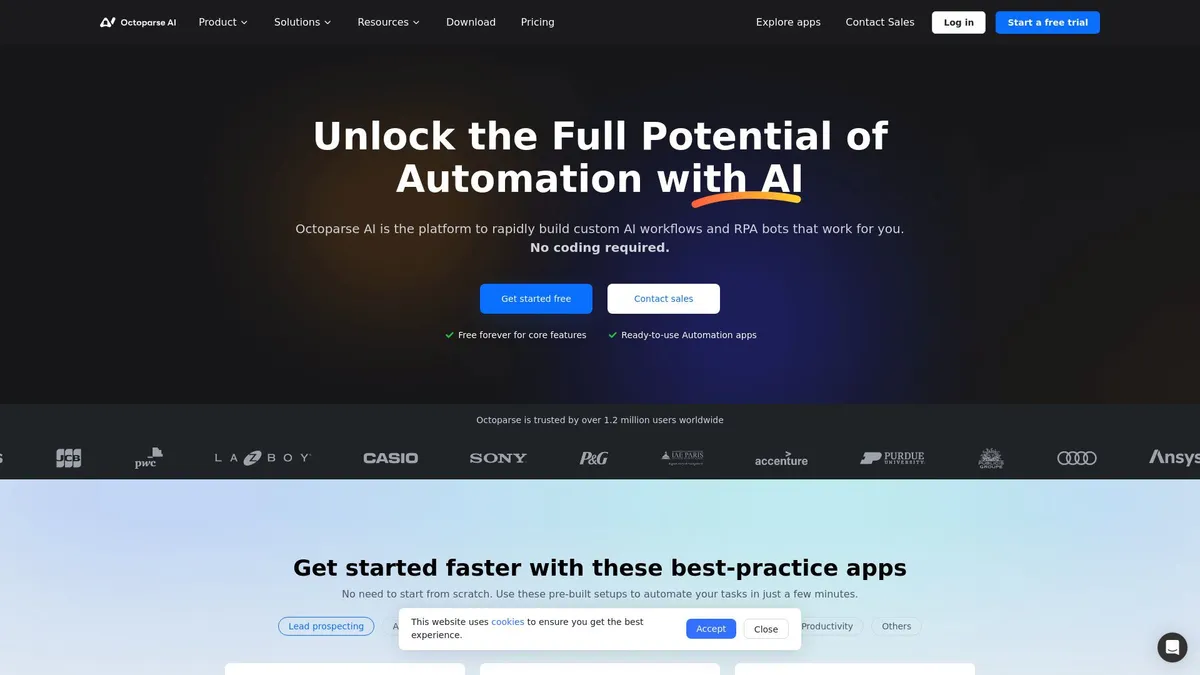
Users expect web scraping to require Python scripts and constant maintenance. Octoparse AI replaces code with natural language prompts. You type what you want, and the bot builds the extraction logic. The platform turns unstructured websites into clean spreadsheets.
Octopus Data Inc. built this platform to solve the layout change problem. Traditional scrapers break when a website updates its design. Octoparse AI targets marketers and researchers who need reliable data without hiring a developer. The AI adapts to minor site changes automatically.
- Primary Use Case: Extracting real-time product pricing and stock availability from e-commerce platforms.
- Ideal For: Non-technical marketers and data analysts.
- Pricing: Starts at $29/mo (Freemium) — The free tier allows unlimited basic usage but restricts concurrent tasks.
Key Features and How Octoparse AI Works
AI-Assisted Scraping
- AI Copilot: Uses natural language prompts to generate scraping tasks. Limit: Complex nested elements sometimes confuse the AI.
- AI Script Wizard: Generates custom JavaScript snippets for data transformations. Limit: Requires basic JavaScript knowledge to debug errors.
Execution and Infrastructure
- Cloud Extraction: Executes tasks on remote servers 24/7. Limit: Available only on paid plans or via limited credits.
- IP Rotation: Uses residential and data center proxies to bypass blocks. Limit: High-volume proxy usage incurs extra costs.
Data Delivery and Integration
- Webhooks: Sends real-time data to external applications like Zapier. Limit: Requires the $29 per month Starter plan.
- Multi-format Export: Delivers data in CSV, Excel, JSON, or SQL. Limit: Free tier restricts the total number of exportable records.
Octoparse AI Pros and Cons
Pros
- No-code interface allows users to build functional scrapers in under 10 minutes.
- AI-driven selector generation adapts to site layout changes automatically.
- Cloud-based execution ensures high reliability for large data collection projects.
- Built-in anti-scraping bypass mechanisms improve success rates on protected sites.
- Direct integration with over 5,000 third-party apps via Zapier and Make.
Cons
- Advanced features like custom regex have a steep learning curve.
- The Free tier severely limits concurrent tasks and data record exports.
- Customer support response times are slow for Free and Starter plan users.
- The desktop client consumes high CPU resources during local debugging.
Who Should Use Octoparse AI?
- E-commerce Managers: Track competitor pricing and stock levels across Amazon and eBay automatically.
- Lead Generation Agencies: Scrape contact details from business directories to build targeted outreach lists.
- Solo Researchers: Aggregate news and sentiment data into spreadsheets without writing Python code.
- Not for Enterprise Developers: Teams needing highly customized code-first scraping infrastructure should look at Apify instead.
Octoparse AI Pricing and Plans
The Free tier costs $0 per month. It includes unlimited basic usage, AI Copilot, and time triggers. This is a real free tier, but it restricts concurrent tasks and export limits.
The Starter plan costs $29 per month. It adds one bot instance, webhooks, a shared workspace, and standard support.
The Team plan costs $69 per month. It includes three bot instances, four organization seats, priority support, and 1-on-1 training.
The Enterprise plan uses custom pricing. It provides dedicated support and custom automation solutions for large departments.
How Octoparse AI Compares to Alternatives
Similar to Browse AI, Octoparse AI focuses on a no-code experience. Browse AI excels at pre-built templates for popular sites. Octoparse AI offers more flexibility for complex multi-page workflows. Browse AI charges strictly by credit usage. Octoparse AI provides unlimited basic runs on its free tier.
Unlike Apify, this tool targets non-technical users. Apify is a developer platform built around Node.js and Python actors. If you want to write custom code and deploy it to a serverless infrastructure, Apify wins. If you want to click elements on a screen and let AI handle the logic, choose Octoparse AI.
Compared to Bardeen, Octoparse AI handles larger datasets better. Bardeen runs entirely in your local browser (which is great for quick personal automations). Octoparse AI uses cloud extraction to run heavy scraping tasks overnight without keeping your computer awake.
The Verdict for Non-Technical Data Analysts
Octoparse AI delivers on its promise of accessible web scraping. Marketers and analysts get the data they need without begging the engineering team for help. The AI Copilot handles basic sites perfectly. You will hit friction on highly dynamic single-page applications (I found the AI struggles with deeply nested tables). The free tier works well for learning the interface. Serious projects require the $29 Starter plan for webhooks and cloud execution. If you are a developer building a massive data pipeline, look at Apify. If you just need competitor prices in a spreadsheet by tomorrow morning, Octoparse AI is the right choice.