



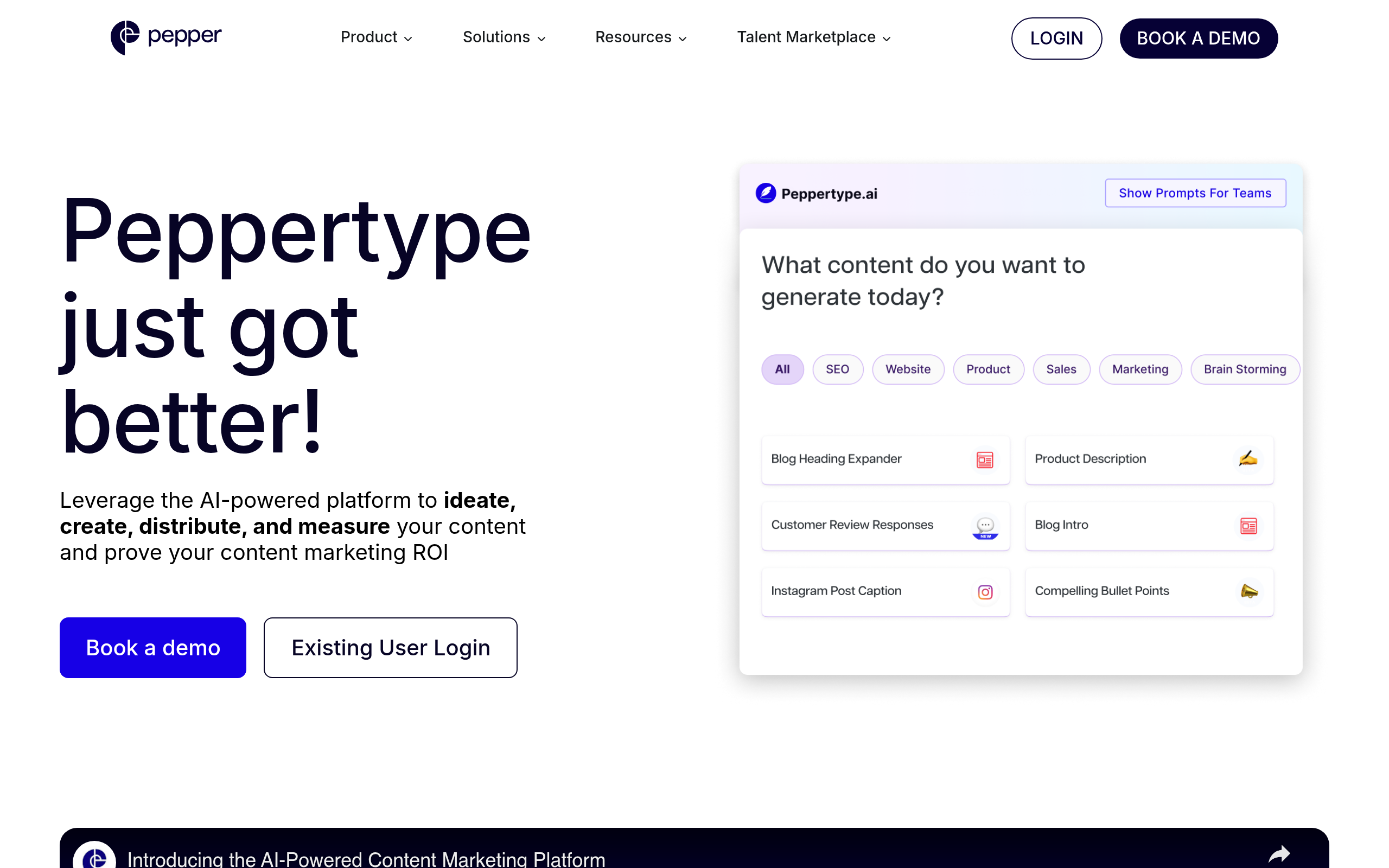
What is Peppertype.ai?
Users expect AI writers to generate ready-to-publish blog posts with a single click, but they usually get repetitive fluff. Peppertype.ai avoids this trap by focusing heavily on short-form templates and structured outlines rather than full article generation.
Developed by Pepper Content Inc., this AI content generation platform helps marketers produce SEO-optimized copy. It excels at generating ad variations and social media captions. (I hit the 50,000-word cap in two weeks while testing blog outlines).
Long-form writers will hit the monthly limit quickly.
- Primary Use Case: Generating multiple variations of Google and Facebook ad copy for A/B testing.
- Ideal For: Solo marketers and small agency teams managing multiple social media accounts.
- Pricing: Starts at $25 (paid) : A mid-tier price point that limits heavy users to 50,000 words.
Key Features and How Peppertype.ai Works
Template-Driven Content Generation
- 40+ Content Templates: Generates blog ideas and Quora answers, limited to the specific prompt structures provided.
- Bulk Content Generation: Generates multiple outputs for a single prompt simultaneously, capped by your monthly word allowance.
- Custom Templates: Enterprise users request bespoke templates tailored to specific brand voices, unavailable on lower plans.
SEO and Editing Tools
- SEO Writing Assistant: Provides real-time keyword suggestions within the editor, though it lacks the depth of Surfer SEO.
- Content Rewriter: Paraphrases existing sentences, restricted to short paragraphs at a time.
- Grammar and Style Check: Flags spelling and punctuation errors, limited to basic corrections rather than deep stylistic edits.
Team and Workflow Management
- Team Collaboration: Offers shared folders and project management tools, restricted to the $199 per month Team plan.
- Plagiarism Checker: Scans text for originality before publishing, using a third-party integration with a monthly credit cap.
- Export Options: Downloads text to PDF or Word, lacking a direct WordPress integration.
Peppertype.ai Pros and Cons
Pros
- Produces high-quality ad copy and social media captions compared to generic LLMs.
- Features a clean interface requiring zero technical training for new marketing hires.
- Generates multiple variations of a prompt in under 10 seconds.
- Displays actionable keyword data directly within the writing interface.
- Provides responsive customer support with documented resolution times under 24 hours for technical issues.
Cons
- Requires significant manual editing to fix repetitive phrasing in long-form content.
- Restricts heavy blog producers with a strict 50,000-word limit on the Personal plan.
- Forces users to manually copy and paste text due to a missing WordPress integration.
- Generates plausible but incorrect statistics during occasional AI hallucinations.
Who Should Use Peppertype.ai?
- Solo marketers: The $25 monthly plan provides enough words for daily social media posts and ad variations.
- Small agencies: The Team plan supports five users and includes shared folders for client campaigns.
- E-commerce managers: The product description rewriter improves readability and keyword density for online stores.
- High-volume bloggers (Not Recommended): The 50,000-word limit and repetitive long-form output make this a poor choice for daily article publishing.
Peppertype.ai Pricing and Plans
Peppertype.ai offers three paid tiers and a free trial. The Personal plan costs $35 per month (or $25 billed annually) for one user and 50,000 words.
The Team plan jumps to $199 per month (or $165 billed annually). This tier supports five users, gives each user 50,000 words, and adds collaboration features.
Enterprise pricing requires a sales call.
This custom tier includes unlimited words, bespoke templates, and bulk processing capabilities.
How Peppertype.ai Compares to Alternatives
Similar to Jasper, Peppertype.ai uses templates to guide the AI output. Jasper costs $39 per month for unlimited words, making it a better deal for heavy writers. Peppertype.ai offers a simpler interface for beginners who find Jasper confusing.
Unlike Copy.ai, Peppertype.ai includes a built-in plagiarism checker and SEO scoring. Copy.ai provides a completely free tier with 2,000 words per month. Peppertype.ai only offers a temporary free trial before requiring payment.
Final Verdict: Best for Social Media and Ad Managers
Peppertype.ai delivers fast results for marketers who need dozens of ad variations or social media captions. The interface requires no training. You can generate five Facebook ad options in 10 seconds.
Long-form writers should look elsewhere.
The 50,000-word limit on the base plan creates unnecessary friction. If you publish daily blog posts, Jasper provides unlimited words for a similar price. Choose Peppertype.ai if your primary focus is short-form marketing copy and team collaboration.