



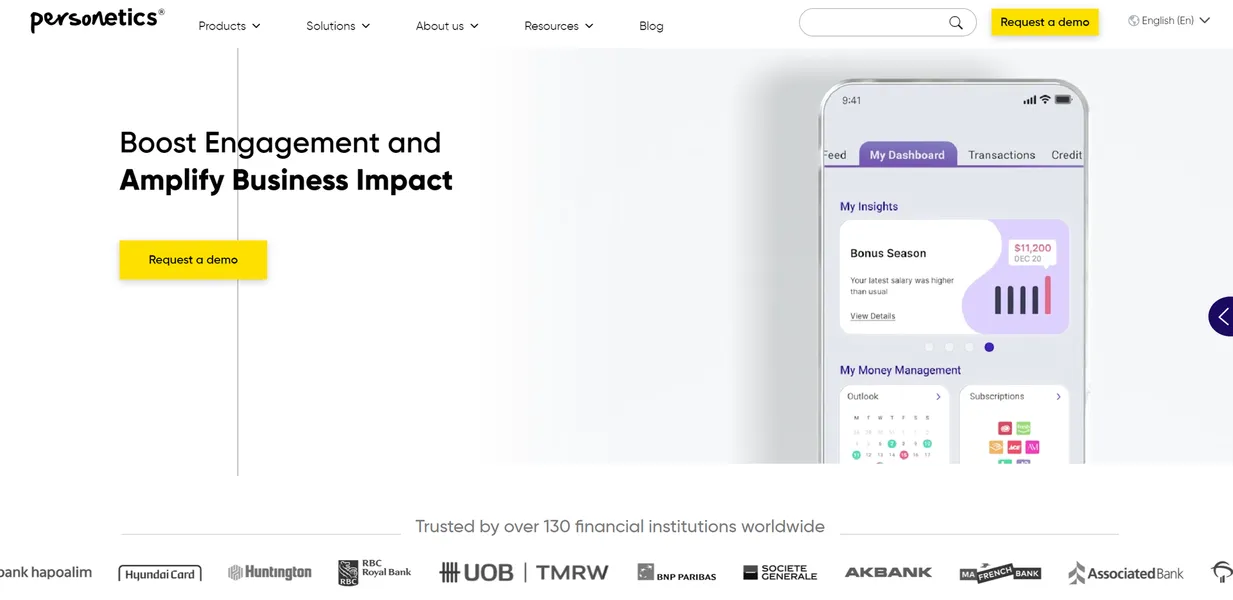
What is Personetics?
Most retail banking customers ignore their transaction history until they spot a fraudulent charge. Personetics changes this behavior by turning raw bank data into proactive financial advice. It transforms static mobile banking apps into interactive financial hubs. Customers receive personalized nudges that encourage better spending habits.
Developed by Personetics Technologies Ltd., this AI financial engagement platform analyzes transaction data for banks. It provides personalized insights and automated savings tools to retail and SME customers. The platform categorizes merchant transactions with high accuracy to improve personal financial management.
- Primary Use Case: Automating customer savings through algorithmic sweep transfers based on real-time cash flow analysis.
- Ideal For: Mid-size to large retail banks and credit unions.
- Pricing: Starts at $0/mo (freemium) – The free tier offers basic personal use.
Key Features and How Personetics Works
Customer Engagement and Insights
- Engage Library: Provides over 400 pre-built financial insights for retail customers. Customization options remain restricted within these templates.
- Proactive Alerts: Sends real-time notifications for unusual spending or duplicate charges. Alert frequency limits depend on the bank’s specific configuration.
Automated Financial Wellness
- Act Programs: Moves money into savings accounts using algorithmic cash flow analysis. Transfer amounts cap at limits set by individual users.
- Wealth Management: Suggests portfolio rebalancing based on cash surplus. This requires active integration with third-party investment platforms.
Data Processing and Delivery
- Data Enrichment: Cleans and categorizes raw ISO 20022 transaction data. Accuracy drops if the bank’s raw data quality is poor.
- API-First Architecture: Uses RESTful APIs for mobile banking integration. Implementation requires massive engineering resources from the client bank.
Personetics Pros and Cons
Pros
- Scales across massive user bases, proven by deployments in over 100 global banks like Santander and RBC.
- Increases mobile app login frequency by 20 to 30 percent according to reported metrics.
- Maintains high data security standards with GDPR and SOC2 Type II certifications.
- Reduces time-to-market for financial institutions through an extensive library of pre-configured insights.
Cons
- Implementation complexity demands deep integration with legacy core banking systems.
- Pricing transparency is non-existent for smaller credit unions or fintech startups.
- Insight accuracy depends on the quality of the bank’s raw transaction data.
- User interface customization feels rigid within the provided insight templates.
Who Should Use Personetics?
- Large Retail Banks: Institutions with massive transaction volumes need automated ways to increase customer engagement and deposit growth.
- SME Banking Divisions: Teams serving small businesses benefit from the cash flow forecasting and tax preparation insights.
- Early-Stage Fintechs: Startups with limited engineering resources will struggle with the complex integration requirements and opaque pricing. This tool is not a good fit for them.
Personetics Pricing and Plans
The pricing structure operates on a freemium model with a massive gap between tiers.
The Free Tier costs $0 per month. This tier provides limited features for personal use. It functions more like a restricted demo than a production-ready tool. Banks cannot use this tier for actual customer deployment.
The Custom Enterprise plan requires contacting sales. Personetics provides no public pricing for its full enterprise suite. (I found the sales process slow when requesting a quote for a mid-sized credit union). Implementation costs often scale based on the number of active digital users.
How Personetics Compares to Alternatives
Similar to Strands, Personetics focuses on personal financial management and transaction categorization. Strands offers more flexible user interface customization for banks wanting a unique look. Personetics wins on the sheer volume of pre-built insights available out of the box. Banks can deploy Personetics faster if they accept the rigid templates.
Unlike Meniga, Personetics places a stronger emphasis on automated savings actions. Meniga provides better tools for banks looking to monetize transaction data through merchant-funded offers. Personetics remains the better choice for institutions prioritizing deposit growth through automated sweeps. Both platforms require significant engineering effort to deploy.
Verdict for Enterprise Retail Banks
Personetics delivers concrete deposit growth for large banks willing to endure a complex integration process. The automated savings tools provide immediate value to retail customers.
Early-stage fintechs must look elsewhere.
Meniga offers a lighter alternative for institutions focused on transaction categorization and rewards.