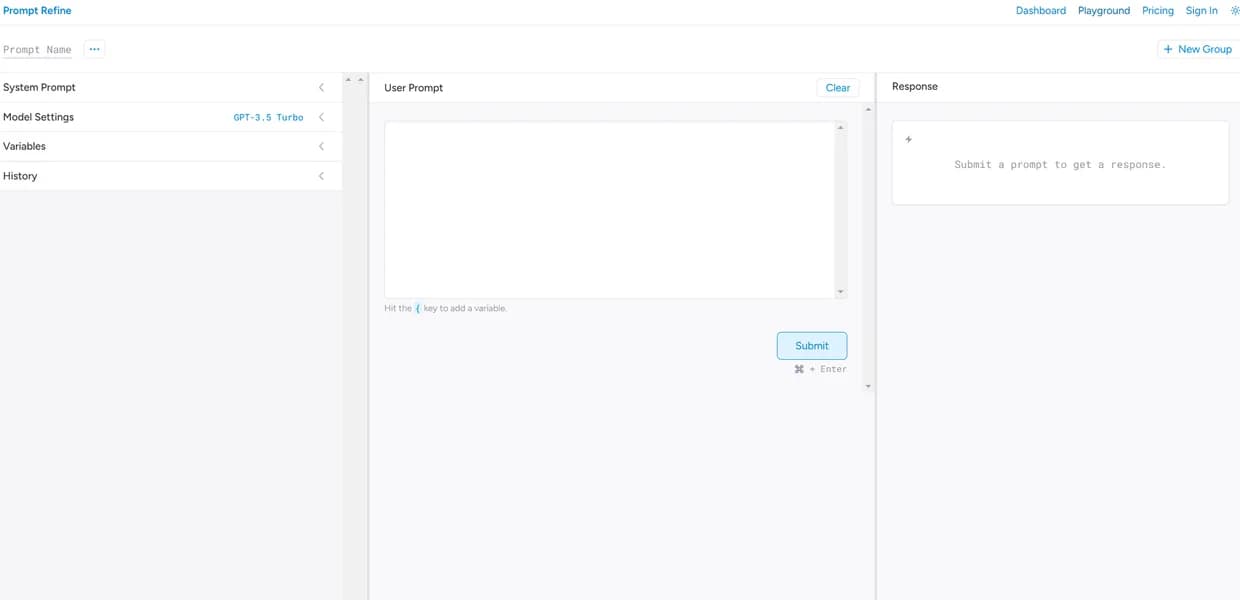

Prompt Refine is a web-based prompt engineering playground for testing outputs across multiple LLMs simultaneously. It helps developers compare models like GPT-4o and Claude 3.5 Sonnet side-by-side. Users can run bulk CSV tests, though the interface struggles with very large datasets.
What is Prompt Refine?
Running the exact same prompt through GPT-4o, Claude 3.5 Sonnet, and Gemini simultaneously reveals just how differently these models interpret basic instructions. You paste a prompt once and see how different providers respond.
Prompt Refine, built by the developer of the same name, is a prompt engineering playground. It targets developers and researchers who need to evaluate model outputs side-by-side. The tool helps you test variables and adjust parameters across providers.
- Primary Use Case: Comparing LLM outputs side-by-side to optimize prompt accuracy.
- Ideal For: Solo developers and prompt engineers testing multiple models.
- Pricing: Starts at $8 per month (freemium) : requires bringing your own API keys.
Key Features and How Prompt Refine Works
Multi-Model Execution
- Side-by-Side Comparison: View outputs from OpenAI, Anthropic, Google, and Perplexity in a responsive grid. The layout gets cramped on screens smaller than 15 inches.
- Parameter Control: Adjust temperature, top-p, and max tokens for each model individually. You must set these manually for every new test run.
Bulk Testing and Variables
- CSV Variable Injection: Use bracket syntax to insert dynamic data from uploaded spreadsheets. The interface slows down when processing files over 500 rows.
- Export Options: Download execution results in CSV or JSON formats. Exports do not include the specific API cost per generation.
Organization and History
- Prompt Folders: Group prompts into custom categories for different client projects. Folders lack sub-folder nesting capabilities.
- History Tracking: The system logs every prompt execution with timestamps. You cannot bulk-delete history entries older than 30 days.
Prompt Refine Pros and Cons
Pros
- Eliminates the need to switch between five different browser tabs to test one prompt.
- Using personal API keys keeps costs lower than paying for multiple $20 monthly AI subscriptions.
- CSV variable injection allows testing 100 inputs in minutes instead of manual typing.
- The clean web interface requires zero coding knowledge to start testing models.
Cons
- Users must secure and manage their own API keys for almost all models.
- The platform lacks advanced chain-of-thought debugging tools found in enterprise software like LangSmith.
- The web interface lags heavily when running large batches of variables.
Who Should Use Prompt Refine?
- Solo Developers: You can test application prompts across providers without writing custom Python scripts.
- Content Teams: Writers can use CSV uploads to generate bulk product descriptions using a single optimized prompt.
- Enterprise Engineering Teams: Large teams need advanced debugging and role-based access control. You should look at LangSmith instead.
Prompt Refine Pricing and Plans
The Free Tier costs $0 per month. It acts as a basic trial to test models and view community prompts.
You still pay your own API costs.
The Paid Plan costs $8 per month when billed annually, or $10 monthly. This unlocks access to top models including ChatGPT, Claude, Gemini, and Perplexity.
The Enterprise tier uses custom pricing. It offers tailored plans for businesses needing specific integrations.
How Prompt Refine Compares to Alternatives
Similar to Nat.dev, Prompt Refine offers a clean playground for testing multiple models. But Nat.dev focuses heavily on raw model access and token counting. Prompt Refine provides better tools for bulk CSV testing and variable injection.
Unlike TypingMind, this tool targets prompt engineers rather than casual chat users. TypingMind gives you a polished chat interface with persona management. Prompt Refine focuses strictly on side-by-side comparison and parameter tuning.
The Best Prompt Playground for Solo Developers
Solo developers get the most value from this tool. You can optimize prompts across providers quickly. Enterprise teams should look elsewhere. LangSmith offers the advanced tracing and debugging that large teams require.
Expect this platform to add native evaluation metrics within the next 12 months.
User Reviews
No reviews yet. Be the first to share your experience!
Sign in to write a review.
Related articles
Guides and articles related to Prompt Refine.

Replit Pricing Explained (2026): Core vs Pro and Effort-Based Agent Billing
DeepSeek V4 Pro vs Claude Opus 4.7: 5-PR Refactor Test (2026)

Claude Code vs Cursor vs Codex vs Devin vs Replit Agent 3: 2026 Scorecard

AI User Testing in 2026: The Tools That Test Your Product While You Sleep
Does API Cost More Than a Subscription for Claude Opus 4.8, GPT-5.5, and Grok?