


What is Scale?
Many teams expect automated data labeling to replace human workers entirely. Scale proves human oversight remains mandatory for training accurate generative AI models. Developers often underestimate the effort required to clean raw data. Scale solves this problem by managing the entire pipeline.
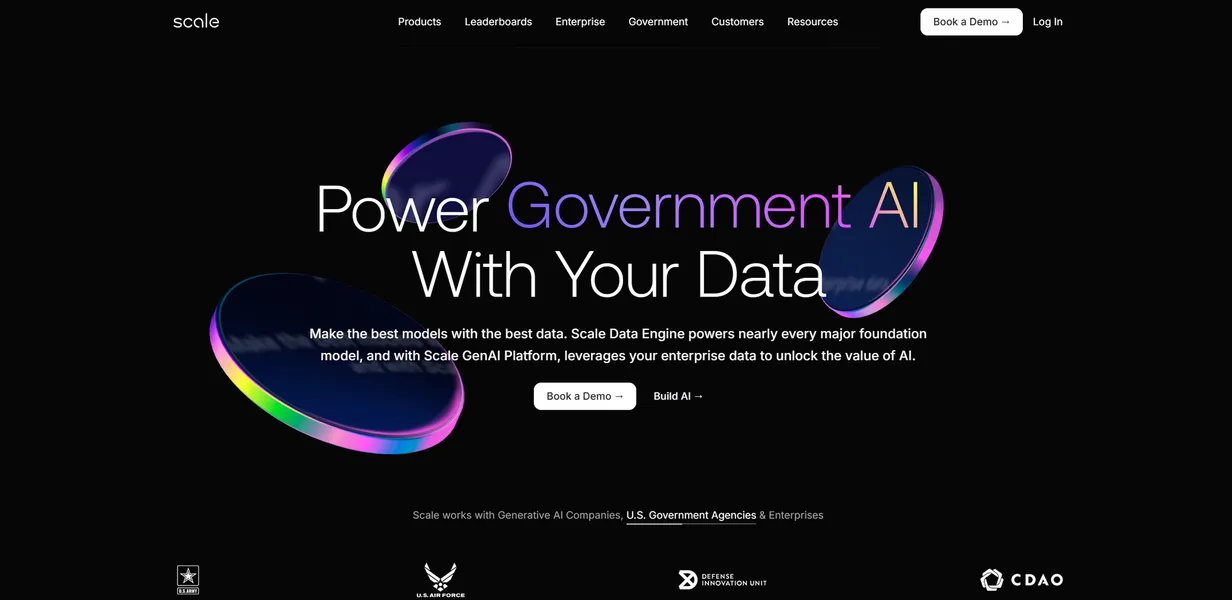
Scale AI, Inc. builds data infrastructure for computer vision and large language models. The platform combines automated labeling with human verification. Enterprise AI teams use it to fine-tune models using Reinforcement Learning from Human Feedback. Government agencies also rely on it for processing complex documents. The system handles millions of data points per month.
- Primary Use Case: Fine-tuning Large Language Models using RLHF.
- Ideal For: Enterprise AI teams building autonomous systems.
- Pricing: Starts at $0 (Pay-as-you-go). Includes first 1,000 labeling units.
Key Features and How Scale Works
Data Labeling and RLHF
- Scale Data Engine: Labels computer vision and NLP data using human experts. Limit: Requires human workforce availability for complex tasks.
- Scale RLHF: Provides human feedback loops for fine-tuning models like GPT-4. Limit: Turnaround times vary based on batch size.
- Scale Rapid: Delivers self-serve labeling with a 24-hour turnaround for small projects. Limit: Only available for small data batches.
Generative AI Development
- Scale GenAI Platform: Offers an environment for building custom AI applications. Limit: Enterprise plan required for full access.
- Scale Spellbook: Acts as a development environment for prompt engineering and testing. Limit: Restricted to supported model APIs.
Data Management and Debugging
- Scale Catalog: Organizes unstructured data across petabytes of cloud storage. Limit: Search speed depends on metadata quality.
- Scale Nucleus: Visualizes dataset debugging and model performance metrics. Limit: Visual interface struggles with datasets exceeding 10 million rows.
- Scale Forge: Automates data curation for large machine learning datasets. Limit: Requires technical expertise to configure.
Scale Pros and Cons
Pros
- Achieves 99 percent accuracy through combined machine learning and human expert verification.
- Handles millions of data points per month for large enterprise projects.
- Maintains SOC 2 Type II, HIPAA, and ISO 27001 compliance for sensitive data.
- Offers specialized workflows for automotive, healthcare, and government sectors.
Cons
- Enterprise pricing costs more than crowdsourced alternatives like Amazon Mechanical Turk.
- Non-technical project managers face a steep learning curve during onboarding.
- Large datasets experience turnaround delays when human workforce availability drops.
- Opaque enterprise pricing makes budget forecasting difficult for mid-sized firms.
Who Should Use Scale?
- Enterprise AI Teams: Large organizations building autonomous vehicle perception systems need high-volume, accurate image labeling. Scale provides the necessary workforce and infrastructure.
- Government Agencies: Defense contractors use Scale Donovan for secure AI decision support. The platform meets strict federal compliance standards.
- Machine Learning Engineers: Technical users building custom large language models need RLHF capabilities. Scale provides the human feedback loops required for alignment.
- Solo Developers: Independent creators building small projects will find the platform too complex and expensive. This tool is not a good fit for individuals.
Scale Pricing and Plans
Scale offers two primary pricing tiers based on usage volume. The company hides exact enterprise costs behind a sales call.
The Self-Serve Data Engine operates on a pay-as-you-go model. Users get the first 1,000 labeling units and 10,000 images free. This tier works well for testing the platform.
You must provide a credit card to access this tier.
The free tier acts more like a trial than a permanent solution. Once you exhaust the initial credits, costs accumulate per task.
The Enterprise plan uses custom pricing based on volume (which gets expensive fast). This tier includes the GenAI Platform, custom SLAs, and dedicated support. Mid-sized companies struggle to forecast costs due to this opaque structure.
How Scale Compares to Alternatives
Similar to Labelbox, Scale provides a platform for managing training data. Labelbox focuses on providing software for your internal labeling teams. Scale differentiates itself by supplying the human workforce. Teams without internal labelers prefer Scale.
Unlike Snorkel AI, Scale relies on manual human verification. Snorkel AI uses programmatic labeling to generate training data using code. Teams with massive datasets prefer Snorkel AI to reduce manual labeling costs. Scale wins on pure accuracy for edge cases.
Superb AI offers another alternative for computer vision teams. Superb AI focuses on automated labeling with minimal human intervention. Scale provides better results for complex edge cases requiring human context.
Final Verdict: Enterprise AI Teams Seeking High Accuracy
Scale delivers high-quality training data for teams with large budgets.
If you need 99 percent accuracy for autonomous vehicles, choose Scale. The platform handles massive volumes of complex data. If you have a limited budget, look elsewhere. Small teams should consider Labelbox for managing internal labeling efforts.