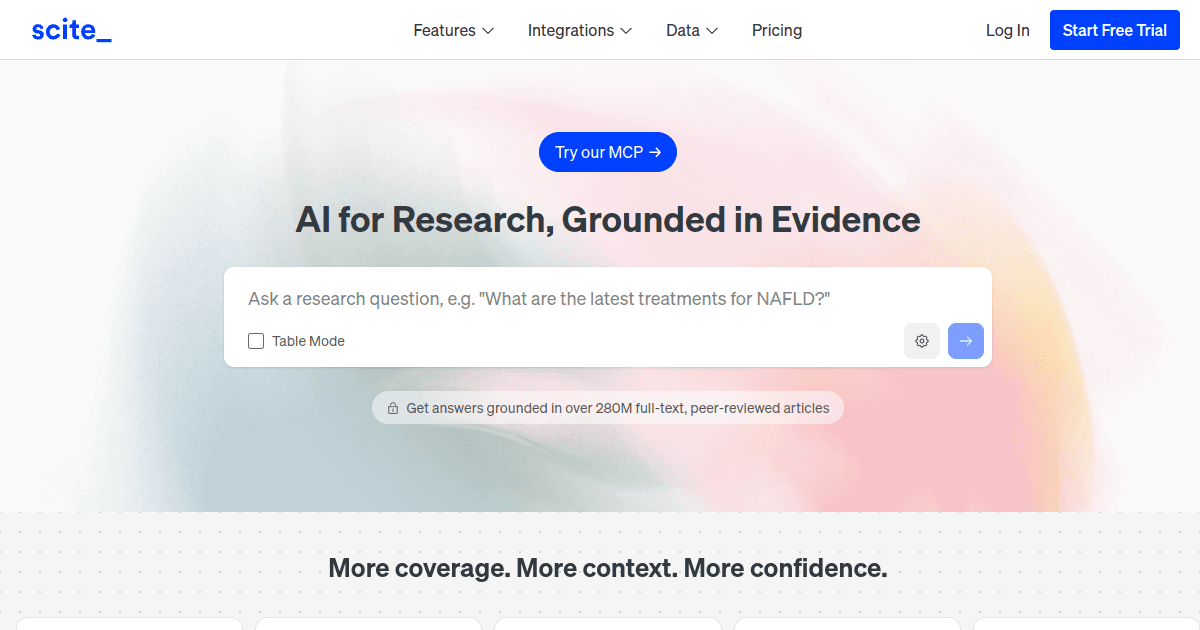
Scite is a citation analysis platform that classifies over 1.4 billion citation statements as supporting, contrasting, or mentioning a given paper. Owned by Research Solutions since 2023, it helps researchers verify claim credibility and catch retracted sources before they reach published work.
Scite is an AI-powered research platform built around a single idea that existing citation tools ignore: not all citations are equal. When a later paper cites an earlier study, it might be supporting its findings, contradicting them, or simply mentioning them in passing. Scite's Smart Citations technology classifies every citation statement in its index into one of those three categories, giving researchers a credibility signal that raw citation counts from Google Scholar or Web of Science cannot provide. Founded in 2018 and acquired by Research Solutions, Inc. (NASDAQ: RSSS) for $14.8 million in November 2023, Scite serves over 2 million users across academic institutions, government agencies, and corporate research teams worldwide.
The platform indexes 281 million articles and 1.4 billion citation statements from major publishers and preprint servers. Core tools include the Scite Assistant (an AI chat grounded in 35+ million full-text articles), Reference Check (PDF upload that scans manuscripts for retracted or disputed sources), a browser extension that overlays Smart Citation data directly on PubMed and Google Scholar, and Scite Rankings, a global research ranking system launched in October 2025 that evaluates institutions by citation quality rather than volume. In February 2026, Research Solutions launched the Scite MCP, connecting ChatGPT, Claude, Microsoft Copilot, and other MCP-enabled AI tools directly to Scite's 250 million article index.
What Scite actually is in April 2026
Scite's core product is a citation intelligence layer sitting on top of the scientific literature. When you search for a paper, Scite shows you not just how many times it was cited but how: how many subsequent papers supported its findings, how many contradicted them, and how many merely referenced it in passing. Each classification links back to the exact text passage where the citation appears, so you can read the sentence, not just the number.
Three major additions have expanded the platform since the Research Solutions acquisition. First, the Scite Assistant uses retrieval-augmented generation over 35 million full-text articles to answer research questions with sourced citations, reducing the hallucination risk that plagues general-purpose AI chatbots when asked about scientific literature. Second, Scite Rankings (October 8, 2025) applies the same citation context methodology to institutional rankings, comparing universities not by total publication volume but by the ratio of supporting to contrasting citations their researchers earn. Third, the Scite MCP (February 26, 2026) lets AI assistants like Claude and ChatGPT query Scite's index directly, so researchers can ask citation-grounded questions without leaving the tools they already use.
The browser extension is free to install and adds a persistent layer to Google Scholar and PubMed, showing Smart Citation tallies next to search results even without a paid subscription. Deeper features including the AI Assistant, Reference Check, and custom dashboards require the personal plan.
Where Scite sits versus Elicit and Consensus
These three tools are often compared because all three try to help researchers evaluate scientific evidence, but they operate on fundamentally different mechanisms.
Scite vs. Elicit: Elicit's core mechanism is structured data extraction. It searches 138 million papers via semantic search (pulling from Semantic Scholar) and lets researchers define custom columns, sample size, p-values, outcome measures, population characteristics, then populates a comparative table across dozens of papers automatically. Elicit does not classify citation sentiment at all. It does not tell you whether a paper has been supported or contradicted by later research. Scite, by contrast, does not extract structured data from individual papers. It tells you how the research community has received a given finding over time. If you want to run a systematic review and pull effect sizes across 40 RCTs, use Elicit. If you want to know whether those RCTs have themselves held up in subsequent literature, use Scite.
Scite vs. Consensus: Consensus is built for binary evidence synthesis. Its Consensus Meter aggregates literature to return a visual "Yes," "No," or "Possibly" verdict on a research question, pulling from roughly 200 million peer-reviewed papers via semantic search. That makes Consensus faster for exploratory questions where you want a directional answer fast. Scite does not produce a binary verdict. Instead, it surfaces the sentiment of individual citation statements at paper level, which is more granular but requires more interpretive work from the researcher. Consensus wins for speed on high-level questions. Scite wins when you need to evaluate a specific paper's track record in subsequent literature rather than a topic-level verdict.
How AI actually works inside Scite
The Scite Assistant uses retrieval-augmented generation: it queries Scite's full-text index of 35 million articles and constructs answers grounded in that literature rather than generating responses from parametric memory alone. Every claim the assistant makes links to a specific paper and the relevant passage. This architecture is specifically designed to reduce hallucination risk on scientific content, where fabricating citations is a common failure mode in general-purpose AI models.
The Smart Citations classification itself runs a deep learning model trained to read citation context in full-text papers and assign supporting, contrasting, or mentioning labels. The model analyzes sentence structure and vocabulary around each citation. It is not perfect: complex academic hedging and ironic citations occasionally receive incorrect labels, and coverage depends heavily on publisher agreements. Papers behind strict paywalls may have their citation statements missing from the index entirely.
Reference Check applies the same technology to uploaded manuscripts. A researcher submits a PDF before submission, and the tool scans every reference against Scite's retraction database and highlights any cited papers that have since been contradicted at scale or formally retracted. This single feature catches a class of error that manual bibliography review frequently misses.
"Scite is an incredibly clever tool. The feature that classifies papers on whether they find supporting or contrasting evidence for a particular publication saves so much time. It has become indispensable to me when writing papers and finding related work to cite and read." - Researcher testimonial, scite.ai/partners/researchers, 2024-2025
"As a PhD student, I'm so glad that this exists for my literature searches and papers. Being able to assess what is disputed or affirmed in the literature is how the scientific process is supposed to work, and scite helps me do this more efficiently." - PhD student testimonial, scite.ai, 2024-2025
The friction Scite users keep raising
The most serious recurring complaint involves the Scite Assistant hallucinating citations. Trustpilot reviewer Alex Sokolovsky described the problem in stark terms: "The amount of hallucinations that manifested as fabricated quotes was OVERWHELMING." Reports describe receiving answers with fabricated DOI links and invented passages presented with the same formatting as verified citations. This is the category-level failure you would expect from RAG systems with noisy or incomplete retrieval, and it is an especially damaging bug for a tool whose core promise is verifiability.
A second persistent frustration is the paywall coverage gap. Scite's coverage of citing papers depends on publisher agreements. If a citing paper sits behind a strict paywall that Scite has not licensed, the citation statement is missing from the index. This means your Smart Citations count for any given paper is always a lower bound. For fields with high open-access rates (biology, medicine, physics), coverage is strong. For social sciences, humanities, and interdisciplinary work, the gaps are noticeable.
The mandatory credit card requirement for the free trial deters students and casual evaluators who want to explore the interface before committing. There is no genuinely free tier, unlike Consensus or Elicit, which offer meaningful free access. The trial auto-converts to a paid subscription, and users have reported difficulty canceling or obtaining refunds.
Finally, results in niche and interdisciplinary fields are thinner. Contrasting citations are already rare in well-established fields; in smaller research communities they are nearly absent, making the core feature less useful for researchers outside mainstream quantitative disciplines.
Who Scite is for
Scite earns its place most clearly for four user segments. Funded academic researchers and medical writers who need to verify whether a paper's findings have been replicated or contradicted will get immediate value from Smart Citations. Graduate students writing literature reviews get the Reference Check feature for retraction screening, which alone can justify the subscription cost for a thesis or dissertation. Systematic review teams working in medicine, psychology, or biology benefit from the citation context depth that Elicit does not provide. Librarians and research support staff at institutions with organization licenses can surface citation quality data without per-user costs.
Scite is not the right tool for undergraduate students writing standard course essays. The $20 monthly price is high for occasional use, the interface requires meaningful time to learn, and the free alternatives (Consensus free tier, Google Scholar, Semantic Scholar) cover most undergraduate research needs. Researchers in niche interdisciplinary fields will find the coverage gaps frustrating. Teams looking for a general-purpose AI research assistant will find the Scite Assistant too narrow compared to Claude, ChatGPT, or Perplexity.
Reviewer Osamu Ekhator (techpoint.africa, 2025) summarized the tradeoff accurately: "Some UX quirks, a bit of a learning curve, and a few places where the AI assistant gets too confident, but as a companion for serious research, it punches above its weight, especially for $12 a month."
User Reviews
No reviews yet. Be the first to share your experience!
Sign in to write a review.
Related articles
Guides and articles related to Scite.
Gemini Deep Research for a Thesis Literature Review in One Day (2026)

Perplexity AI Tutorial: Maximize Your Research Workflows
Undetectable AI Review (2026): What It Does, What It Costs, and 7 Alternatives
Turn Any AI Agent Into a Superagent: The 12-Integration Stack (2026)

AI Content Quality Control: How to Avoid Publishing AI Slop