


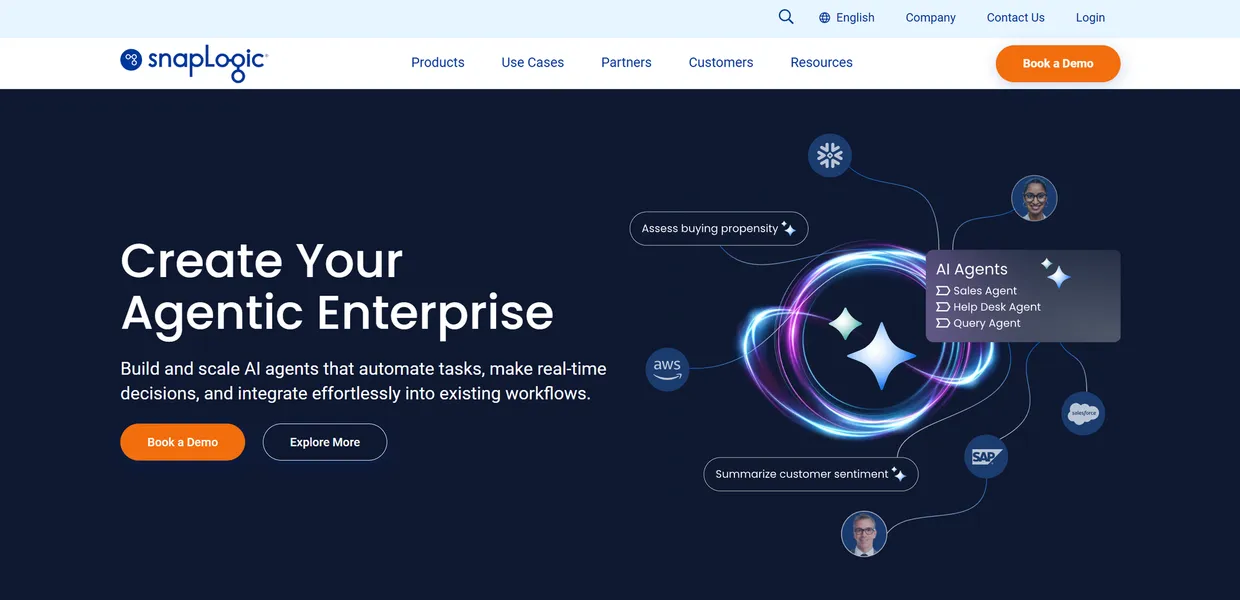
What is SnapLogic?
SnapLogic connects over 600 enterprise applications through its pre-built integration modules. The platform processes billions of data rows monthly across hybrid cloud environments.
SnapLogic Inc. built this integration platform as a service (iPaaS) to link disparate data systems. It targets enterprise IT teams and data engineers who move large volumes of data between legacy on-premises servers and modern cloud data warehouses. Users build data pipelines using a visual interface and generative AI prompts.
- Primary Use Case: Automating data movement between on-premises databases and cloud data warehouses.
- Ideal For: Enterprise IT teams managing complex hybrid environments.
- Pricing: Starts at Custom Pricing (Enterprise). Premium connectors add $15,000 to $45,000 annually.
Key Features and How SnapLogic Works
AI-Assisted Pipeline Building
- SnapGPT: Generates integration pipelines from natural language prompts. Complex logic still requires manual adjustment.
- Auto-Link: Suggests field mapping between different data schemas. Accuracy drops with highly customized legacy databases.
Connectivity and Execution
- 600+ Pre-built Snaps: Connects major applications like Salesforce and ServiceNow. Niche applications require custom REST API configuration.
- Ultra Pipelines: Processes real-time data with low latency. Requires dedicated infrastructure resources to maintain high-frequency calls.
Deployment and Management
- Groundplex and Cloudplex: Runs integration nodes on-premise or in the cloud. Groundplex requires internal server maintenance.
- API Management: Manages API lifecycles including versioning and security. Lacks the deep monetization features found in dedicated API gateways.
SnapLogic Pros and Cons
Pros
- SnapGPT reduces development time by generating SQL queries and pipeline structures via chat.
- The visual interface lets business analysts build basic integrations without writing Java or Python code.
- Groundplex execution keeps sensitive data behind corporate firewalls to maintain privacy.
- The platform handles petabyte-scale data movements across enterprise environments.
Cons
- Premium Snap Packs add $15,000 to $45,000 per year to the base cost.
- Debugging nested pipelines is difficult due to generic error messages.
- The learning curve for advanced transformations frustrates users without a data background.
- Documentation for edge-case Snaps lacks detail compared to core platform guides.
Who Should Use SnapLogic?
- Enterprise Data Teams: Engineers moving massive datasets from SQL Server to AWS S3.
- Business Operations: Analysts automating HR onboarding between Workday and Okta.
- Small Businesses: Look elsewhere. The custom enterprise pricing makes it cost-prohibitive for simple automation tasks.
SnapLogic Pricing and Plans
SnapLogic does not offer a free trial or transparent public pricing.
The Business Package requires a custom quote. It includes unlimited data movement and core integrations. The Enterprise Package also requires custom pricing. It adds three organizations (one production, two sandboxes) and advanced orchestration features.
Premium Snap Packs create a significant hidden cost. You must pay an extra $15,000 to $45,000 per year to connect specific enterprise applications like Workday or NetSuite.
How SnapLogic Compares to Alternatives
Similar to MuleSoft but focuses more on a visual interface. MuleSoft requires more technical expertise and Java knowledge. SnapLogic uses its SnapGPT AI to speed up pipeline creation for less technical users. MuleSoft offers better native API monetization tools.
Unlike Workato, SnapLogic handles massive bulk data transfers better. Workato excels at event-driven business workflow automation. SnapLogic is the better choice for migrating petabytes of data into Snowflake (a major advantage if you use on-premises servers).
The Best iPaaS for Hybrid Enterprise Environments
SnapLogic provides immense value for large organizations managing hybrid cloud and on-premises data. Enterprise IT teams save hundreds of hours using the visual designer and AI prompts.
Small teams and startups should look elsewhere. The hidden costs of Premium Snap Packs inflate the total cost of ownership.
If you need simple app-to-app automation on a budget, choose Make or Zapier instead.