



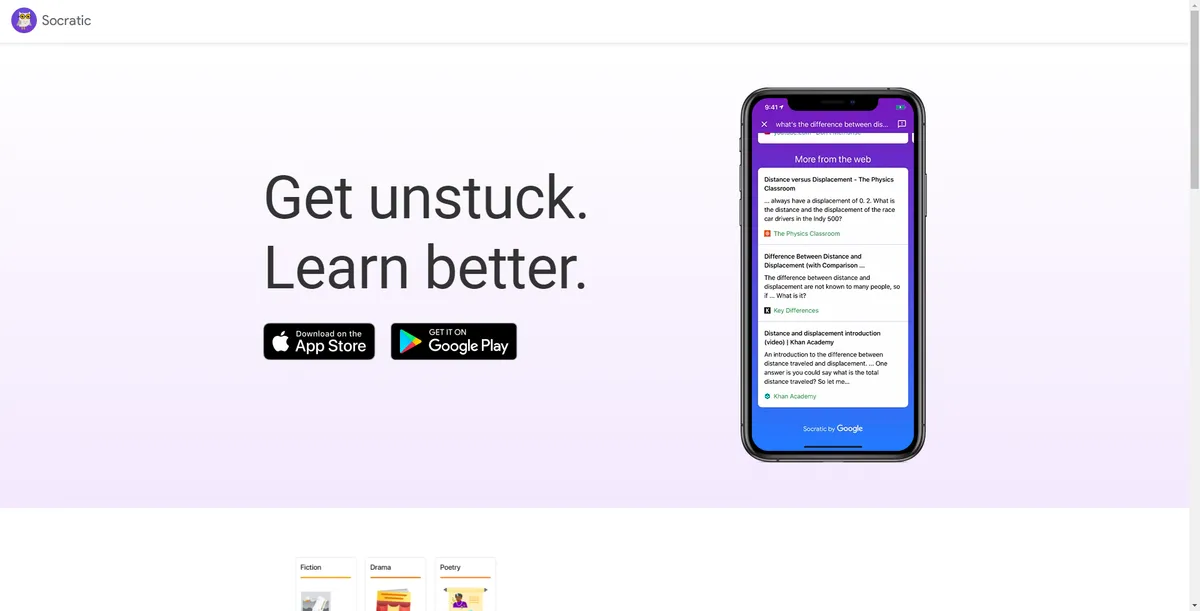
What is Socratic by Google?
Over 10 million students download mobile study aids every year. Socratic by Google processes academic questions in under three seconds. Users take a photo of a textbook problem. The app returns step-by-step explanations and curated video content. Google LLC developed this AI-powered learning app to help high school and university students understand complex school work. Socratic functions as a mobile tutor for subjects ranging from algebra to physics. It replaces generic web searches with targeted educational resources. Students often waste time sifting through irrelevant search results. This tool filters out unhelpful websites.
The application relies heavily on visual learning. It provides high-resolution infographics for biological processes and geometry formulas.
- Primary Use Case: Solving complex algebra equations and science problems via photo analysis.
- Ideal For: High school and early college students needing instant homework help.
- Pricing: Starts at $0 (Free) – Provides full access without hidden subscription costs.
Key Features and How Socratic by Google Works
Camera Analysis and OCR
- Photo Analysis: Uses optical character recognition to read handwritten text from a mobile camera feed. It struggles with highly stylized cursive writing.
- Step-by-Step Explanations: Breaks down math problems into individual logical steps. It occasionally skips intermediate steps on advanced calculus problems.
Voice Search and AI Summaries
- Voice Search: Allows students to ask academic questions verbally using Google speech recognition. Background noise easily disrupts the transcription accuracy.
- AI-Powered Summaries: Generates concise explanations of complex academic concepts using Google language models. Summaries lack citations for historical claims.
Content Curation and Integration
- Visual Guides: Provides high-resolution diagrams for complex science topics like biological processes. The library covers standard curricula but misses niche university topics.
- YouTube Integration: Embeds relevant educational videos directly within the app interface. Users cannot save videos for offline viewing.
- Subject Coverage: Supports multiple disciplines including geometry, chemistry, and literature. The literature section lacks deep analysis of contemporary novels.
Socratic by Google Pros and Cons
Pros
- Completely free access to all features without any hidden subscription costs.
- High accuracy in OCR technology correctly identifies messy handwriting in dim lighting.
- Curated content ensures students see high-quality educational resources from sites like Khan Academy.
- Fast processing speeds deliver answers and visual explanations in under three seconds.
Cons
- Limited desktop functionality restricts usage strictly to mobile devices.
- The AI struggles with complex multi-step word problems requiring deep logical reasoning.
- Students cannot access a live human tutor for questions beyond the AI capabilities.
- Dependency on a stable internet connection prevents offline studying.
Who Should Use Socratic by Google?
- High School Students: Teenagers studying standard algebra, biology, and history get instant visual explanations for homework.
- Visual Learners: Students who need diagrams and embedded YouTube videos grasp concepts faster than reading text alone.
- Budget-Conscious Users: Anyone needing free academic help benefits from the complete lack of paywalls.
- Not for Graduate Students: Advanced researchers will find the curated content too basic for complex university-level physics or literature.
Socratic by Google Pricing and Plans
Socratic operates on a completely free model. Google offers one tier at $0 per month. Users gain full access to all subjects, visual explanations, and step-by-step math solvers. The app contains no advertisements. You do not need to enter a credit card. (I noticed the app requires a Google account, which is a minor friction point). Users must sign in with a Google account to use the app. This requirement prevents anonymous usage. Still, the lack of a paywall makes it highly accessible.
There are no premium upgrades or hidden usage limits.
How Socratic by Google Compares to Alternatives
Similar to Photomath, Socratic uses a mobile camera to scan and solve equations. Photomath focuses exclusively on mathematics and provides highly detailed calculator functions. Socratic covers multiple subjects including history and biology. Photomath offers a paid premium tier for advanced explanations. Socratic keeps all features completely free. Photomath recognizes complex printed graphs better than Socratic.
Unlike Brainly, this tool does not rely on a community of users to answer questions. Brainly allows students to ask highly specific questions and receive peer-reviewed answers. Socratic uses Google algorithms to pull existing web content and generate AI summaries. Brainly includes gamification and social features. Socratic provides a solitary study experience. Brainly requires a paid subscription to remove advertisements. Socratic offers an ad-free environment by default.
Final Verdict for Mobile Study Aids
High school students studying standard curriculum subjects get the most value from Socratic. The free price tag makes it accessible to everyone. The fast photo analysis saves time during evening homework sessions. Visual learners benefit heavily from the embedded YouTube videos.
But students taking advanced college courses should look elsewhere. The AI cannot handle complex logical word problems. It fails to provide deep analysis for graduate-level research.
The lack of a desktop version forces users to study on small screens.
If you need help exclusively with advanced mathematics, Photomath remains a better specific alternative. Socratic works best as a general knowledge companion. The honest limit remains its dependency on existing web content. It cannot generate novel solutions for highly specific university assignments.