

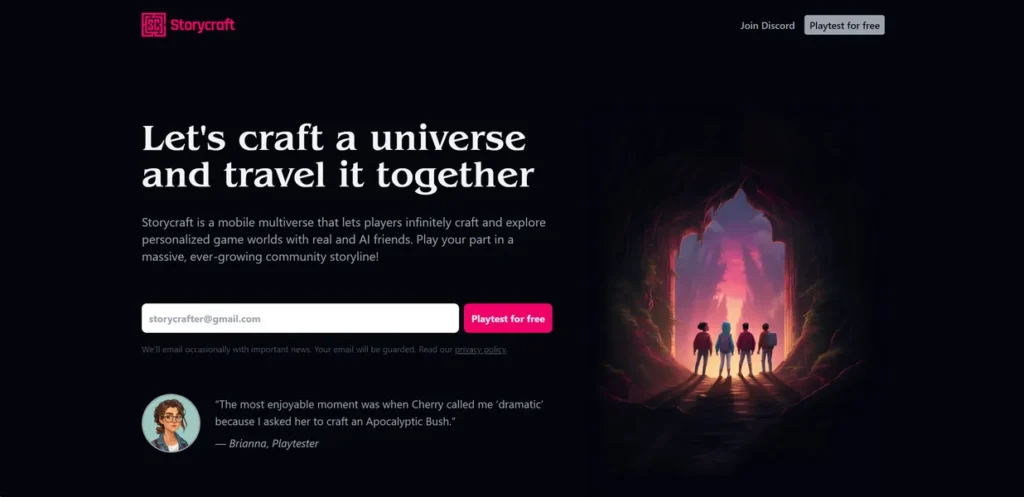
What is Storycraft?
From a technical standpoint, Storycraft is more than a mobile game; it’s an ambitious platform engineered to support a persistent, user-generated multiverse. It provides a framework where players can procedurally generate and customize entire game worlds, complete with unique narratives and challenges. The architecture facilitates a massive, shared storyline that evolves based on collective user input, suggesting a robust backend capable of managing complex, branching data structures in real-time. The core value proposition is the fusion of a sandbox creation engine with a social network, all powered by AI-driven characters that add a layer of dynamic, non-scripted interaction. For developers and creators, it’s a fascinating look at the future of scalable, interactive entertainment on mobile architecture.
Key Features and How It Works
Storycraft’s functionality is built upon several key pillars that enable its creative ecosystem. From an engineering perspective, each feature addresses a significant challenge in game design and user engagement.
- Infinite Crafting Possibilities: Think of Storycraft’s world-building engine as a powerful, open-source API for your imagination. It provides the core functions, libraries, and assets, but you, the creator, execute the calls to build the final application—your unique game world. This modular approach allows for immense flexibility and scalability within individual player creations.
- AI-Powered Companions: The platform integrates AI companions that are more than simple NPCs. These entities appear to operate on complex behavior trees, reacting dynamically to player actions and environmental changes. This suggests a sophisticated AI model that moves beyond pre-scripted dialogue, offering stateful interactions that can fundamentally alter a player’s narrative path and enhance replayability.
- Community Storyline: This feature implies a version-control system for narrative, akin to a ‘Git for stories.’ Individual player actions and creations can be ‘committed’ to a main branch, influencing the global narrative. This requires a complex system for merging disparate storylines without creating conflicts, fostering a truly collaborative and emergent world.
- Mobile Multiverse: Deploying a persistent, multi-user environment on mobile devices is a significant technical feat. Storycraft is optimized for mobile performance, focusing on efficient data synchronization and asset streaming to ensure a smooth experience without draining device resources.
Pros and Cons
Evaluating Storycraft from a developer’s perspective reveals a platform with immense potential and some inherent trade-offs.
Pros:
- High Technical Ceiling: The toolset is robust, offering creators a high degree of freedom. This allows for complex and deeply engaging worlds that go beyond typical mobile game limitations.
- Dynamic AI Interaction: The use of AI-driven companions is a significant leap forward, creating unpredictable and emergent gameplay scenarios that are computationally impressive for a mobile platform.
- Scalable Community Model: The shared storyline architecture fosters strong network effects, increasing user retention and creating a self-sustaining content ecosystem.
- Optimized Mobile Performance: The platform runs smoothly on mobile devices, indicating a well-engineered client-server architecture designed for accessibility.
Cons:
- Steep Learning Curve: A powerful toolset can be intimidating. Without comprehensive documentation and tutorials, new users may struggle to unlock the platform’s full potential.
- Mobile-First Limitations: While accessible, a mobile-first design may lack the precision and power that developers and hardcore creators expect from a desktop client or dedicated API access.
- Data and AI Privacy: The reliance on AI raises questions about data usage. It is unclear how player interaction data is used to train the companion models and what privacy controls are in place.
Who Should Consider Storycraft?
Storycraft’s architecture caters to a diverse set of users, each leveraging the platform for different ends:
- Indie Developers & Prototypers: A powerful sandbox for rapidly prototyping game mechanics and interactive narrative structures without the overhead of building an engine from scratch.
- Narrative Designers & Writers: An interactive medium to bring stories to life, test branching narratives, and engage an audience in a dynamic, playable format.
- Community Architects: Individuals focused on building and managing online communities will find the shared universe a compelling environment for fostering social interaction and collaborative projects.
- Educators: The platform serves as a gamified engine for creating educational content, allowing students to learn through interactive storytelling and problem-solving.
- Casual Gamers: Users seeking a creative outlet that combines the satisfaction of building with the adventure of exploration and social connection.
Pricing and Plans
During our review, detailed pricing information for Storycraft’s subscription tiers was not publicly available. The platform offers a free-to-start tier, allowing new users to explore the core functionalities and begin creating. For the most accurate and up-to-date pricing, please visit the official Storycraft website.
What makes Storycraft great?
Storycraft’s most powerful feature is its seamless integration of dynamic AI companions into a user-generated content framework. This is what sets it apart from a sea of sandbox creation tools. By injecting unpredictable, intelligent agents into player-built worlds, Storycraft creates a system of emergent narrative and gameplay that is unique to each user’s experience. This technical achievement solves a major problem in user-generated content platforms: the static nature of player creations. The AI breathes life into these worlds, ensuring they are not just digital dioramas but living, evolving ecosystems. This focus on dynamic interaction provides near-infinite replayability and makes Storycraft a truly innovative force in the mobile gaming landscape.
Frequently Asked Questions
- How sophisticated is the AI for the companions?
- Based on the observed behavior, the AI appears to go beyond simple scripted responses. It likely utilizes a combination of procedural generation for personality traits and a stateful behavior model that tracks player interactions over time. While it’s probably not a full-fledged large language model (LLM) due to mobile constraints, it represents an advanced form of dynamic NPC logic designed to create believable and evolving relationships.
- Can I export my creations or integrate Storycraft with other tools via an API?
- Currently, Storycraft operates as a closed ecosystem. There is no public information regarding an API for exporting creations or integrating with third-party development tools like Unity or Unreal Engine. Its value is centered on the experiences created and shared within its own platform.
- What are the technical limitations on world size and complexity?
- While described as ‘infinite,’ all systems have practical limits. The constraints are likely tied to mobile device processing power and memory. Users may encounter performance degradation in worlds with an extremely high density of objects, complex logic, or a large number of concurrent AI agents. The platform likely uses clever optimization techniques, such as level streaming and dynamic asset loading, to mitigate these limitations and ensure a stable user experience.