


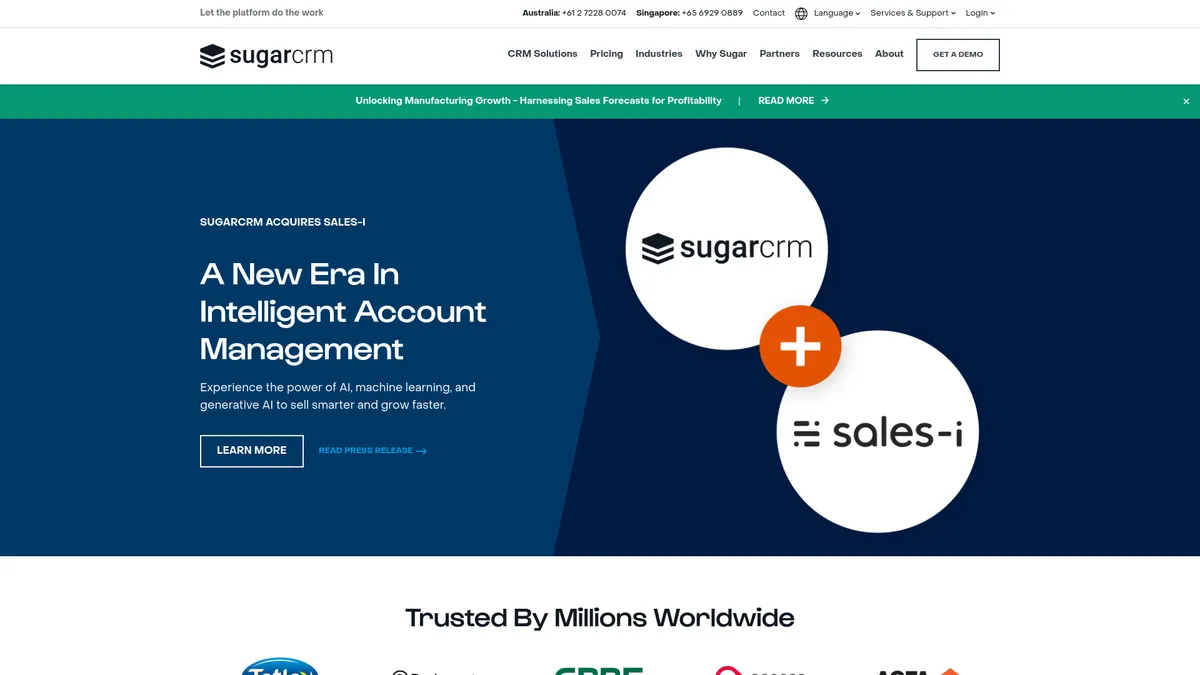
What is SugarCRM?
Imagine a mid-sized manufacturing firm tracking 5,000 active leads across three continents. Sales reps lose hours manually updating spreadsheets. Marketing sends generic emails to cold prospects. Customer support struggles to route urgent tickets to the right technicians. SugarCRM fixes this disconnect by unifying these departments under one data model.
Developed by SugarCRM Inc., this customer relationship management platform handles sales, marketing, and service automation. It targets mid-market and enterprise businesses. The system uses AI-driven insights to manage the entire customer lifecycle. Managers get clear visibility into pipeline health, while reps spend less time on manual data entry.
- Primary Use Case: Automating complex sales pipelines and marketing journeys for mid-market teams.
- Ideal For: Mid-sized to enterprise businesses needing high customization and on-premises deployment options.
- Pricing: Starts at $59 (paid) – Requires a strict 15-user minimum, making the real entry cost $885 per month.
Key Features and How SugarCRM Works
AI-Driven Sales Intelligence
- SugarPredict: Scores leads and opportunities using AI to predict win rates. It requires historical data to function accurately.
- Sugar Hint: Auto-populates contact records using 70 external data sources. It limits manual data entry but relies heavily on public data availability.
Marketing and Service Automation
- Sugar Market: Builds visual marketing journeys and email campaigns. It supports up to 10,000 contacts with unlimited user seats.
- Sugar Serve: Routes customer support tickets automatically based on agent availability. It tracks multi-channel support SLAs within a dedicated console.
Workflow and Integration Tools
- Sugar BPM: Designs automated business processes visually. Non-technical users can build sequences, though complex logic requires specialized training.
- Sugar Connect: Syncs emails and calendars bi-directionally. It works specifically with Microsoft Outlook and Google Workspace to keep records updated.
Are these features worth the steep learning curve?
SugarCRM Pros and Cons
Pros
- High customization flexibility lets businesses modify modules to match specific industry workflows.
- Deployment choices include cloud and on-premises hosting for strict data sovereignty compliance.
- SugarPredict AI comes natively integrated into Sell and Serve tiers without extra add-on fees.
- Native mobile apps provide full offline data access for field agents working in remote locations.
Cons
- The 15-user minimum on the Sell Standard plan creates a high entry barrier for small teams.
- System administrators face a steep learning curve compared to lighter CRM platforms.
- The user interface feels cluttered next to modern SaaS competitors.
- Implementation usually requires hiring a certified partner (which easily doubles your first-year software spend), adding upfront professional service costs.
Who Should Use SugarCRM?
- Mid-market manufacturing and finance firms: Companies needing strict data control benefit from the on-premises deployment option.
- Large sales teams: Organizations with complex, multi-stage sales cycles can utilize the Sugar BPM visual workflow designer.
- Small businesses and solo founders: This tool is not a good fit. The 15-user minimum and heavy implementation process will drain small budgets quickly.
SugarCRM Pricing and Plans
SugarCRM does not offer a free tier or a free trial.
Sugar Sell Standard costs $59 per user per month. It requires a minimum of 15 users, pushing the actual starting price to $885 monthly. This tier handles entry-level sales automation.
Sugar Sell Advanced runs $85 per user per month. It adds smarter workflows and direct email integration for growing sales teams.
Sugar Sell Premier costs $135 per user per month. This tier includes full-featured sales automation and guided selling tools for enterprise groups.
Sugar Serve is priced at $80 per user per month. It provides a complete customer support solution with SLA tracking.
Sugar Market costs $1,000 per month (a standard rate for enterprise marketing tools). This covers 10,000 contacts and allows unlimited users.
On-Premises Enterprise costs $85 per user per month. It allows companies to host the software on their own private servers.
On-Premises Enterprise+ costs $120 per user per month. This premium self-hosted tier includes advanced customization options.
How SugarCRM Compares to Alternatives
Similar to Salesforce, SugarCRM offers deep customization and enterprise-grade reporting. Unlike Salesforce, SugarCRM includes its AI predictive scoring natively in mid-tier plans rather than charging extra for an AI add-on. Salesforce still offers a more extensive third-party app ecosystem. Companies must weigh native AI against a larger integration library.
HubSpot CRM targets a different audience. HubSpot provides a generous free tier and an intuitive interface for small to mid-sized teams. SugarCRM requires a 15-user minimum and professional implementation. HubSpot wins on ease of use, while SugarCRM wins on complex, self-hosted data requirements.
The Verdict for Enterprise Data Control
SugarCRM delivers massive value for mid-market companies operating in highly regulated industries. Teams that need on-premises hosting and complex workflow automation will find it highly capable. The platform handles massive datasets without slowing down.
Small teams and startups should look elsewhere. The steep learning curve and high minimum user count make it impractical for agile groups. If you need a fast setup with zero implementation costs, HubSpot CRM remains a better choice.
Over the next 12 months, expect SugarCRM to push its generative AI features deeper into the Sugar Market suite to compete with automated content creation tools.