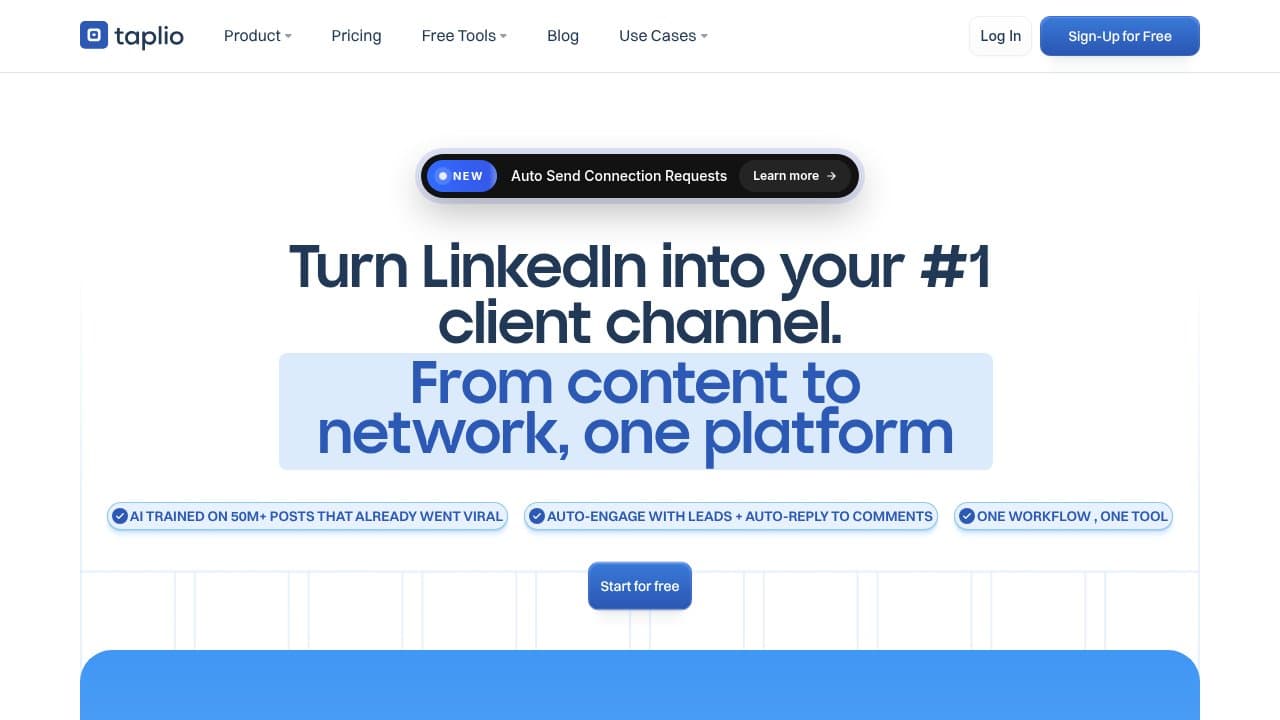

Taplio is an AI-powered LinkedIn growth platform for scheduling posts, generating content with AI trained on millions of viral examples, and automating outreach. Built by the founders of TweetHunter and now part of Lempire, it covers the full LinkedIn content-to-pipeline workflow.
Taplio is a LinkedIn-only personal branding and lead generation platform built around AI content tools, post scheduling, engagement automation, and analytics. It was created in 2022 by Thibault Louis-Lucas and Thomas Jacquesson, the same duo behind TweetHunter, and sold to Lempire (the company behind lemlist cold outreach) in a deal worth up to $12 million. As of May 2026, Taplio sits inside the Lempire product family alongside lemlist email sequences, which means its design philosophy has always pointed toward one outcome: turning LinkedIn visibility into pipeline. The content tools are the front door; the outreach automation is the back end.
Core features include an AI post generator drawing on a library of over five million high-performing LinkedIn posts, a carousel creator that converts blog URLs and YouTube links into formatted slides, a visual editorial calendar with queue and re-queue support, a Chrome extension that overlays real-time engagement analytics while browsing LinkedIn, an engage-list system for monitoring target accounts, and a Pro-tier lead database of 450 million contacts with auto-DM sequences. The platform also exposes an API for teams building custom integrations, which pairs with the Browser Extension for users who want both a workflow tool and a programmatic access layer.
What Taplio actually is in May 2026
Taplio launched on Product Hunt on November 29, 2022, finishing first that day. At the time, it had roughly 1,000 customers and had been live in soft launch since April of that year. The founders signed a handshake acquisition deal with Lempire in May 2022 and completed the sale in 2023, by which point Taplio had grown to around 3,000 paying users. The product has since scaled substantially under Lempire's ownership, with the viral post library expanding from under a million examples at launch to over five million indexed posts by 2026.
The current product stack breaks into three layers. The first is content creation: the AI post generator, hook writer, and carousel tool handle ideation and drafting. The second is publishing: the editorial calendar, queue manager, and scheduling engine handle distribution. The third is outreach: the Pro plan adds a lead database, auto-connection requests, and automated DM sequences. Most users who arrive for the first layer discover the third layer only after upgrading.
One important operational detail: Taplio relies on a Chrome extension and browser cookie-based authentication to interact with LinkedIn. It does not use LinkedIn's official API for all of its features. This matters for the account safety discussion below.
Where Taplio sits versus AuthoredUp and Buffer
Taplio occupies a specific position: it is LinkedIn-only, AI-heavy, and automation-forward. Two tools define the edges of that positioning in different directions.
AuthoredUp is a LinkedIn-only Chrome extension built entirely around content quality rather than automation volume. The two tools diverge mechanically in several ways. AuthoredUp's analytics collect post data locally through a LinkedIn archive import, giving you full historical performance metrics from account creation. Taplio's analytics start only from your signup date and cannot backfill older posts. AuthoredUp's editor includes Flesch-Kincaid readability scoring, a precise "See More" preview that shows exactly where LinkedIn truncates your post, and local draft autosave. Taplio's editor is a standard CMS with AI sentence completion but no readability controls. Critically, AuthoredUp does not automate posting, engagement, or connection requests. Its extension modifies only the LinkedIn interface and operates entirely within LinkedIn's terms. AuthoredUp starts at around $20/month. Effective AI access in Taplio starts at the Growth plan: $49/month on annual billing.
Buffer sits at the other edge: multi-platform breadth where Taplio offers LinkedIn depth. Buffer supports LinkedIn, X, Instagram, Facebook, Pinterest, TikTok, and YouTube from a single dashboard. Taplio publishes to LinkedIn only. Buffer's bulk scheduler handles up to 2,000 posts per channel on Enterprise plans and integrates directly with Canva, Dropbox, and OpenAI for cross-platform content workflows. Taplio has no equivalent bulk import. Buffer uses LinkedIn's official scheduling API, which means posting is within LinkedIn's terms. Buffer has no lead database, CRM, or outreach automation. Buffer's free plan covers three channels; paid plans start at $6/month per channel. If you manage multiple social platforms and need basic LinkedIn scheduling alongside them, Buffer costs a fraction of Taplio's entry price for the scheduling use case alone. If LinkedIn is your only channel and you want AI-assisted content plus outreach, Taplio covers the full workflow in ways Buffer does not.
For users focused on LinkedIn scheduling alongside content planning, tools like Later and Publer also offer LinkedIn scheduling as part of broader multi-platform stacks, though without Taplio's LinkedIn-specific AI content depth. For LinkedIn lead enrichment and cold outreach beyond LinkedIn, Drippi handles Twitter/X DM sequences as a parallel channel. And if your broader social media management stack includes YouTube or Instagram alongside LinkedIn, Hootsuite covers enterprise multi-platform workflows that Taplio doesn't touch.
How AI actually works inside Taplio
Taplio's AI runs on GPT-4 and operates in two modes. The first is reactive: you paste a topic, URL, or YouTube link, and the AI drafts a LinkedIn post in one of several formats (list, story, hot take, thread). The second is proactive: the platform surfaces ten personalized post suggestions daily based on your engagement history and chosen topics.
The viral post library is the more defensible differentiator. Over five million LinkedIn posts, indexed by topic, format, and engagement metrics, are searchable and filterable. You can find the top-performing posts in your niche from the past 30 days and use them as structural templates. This part of the product gets consistently strong feedback on G2 and Product Hunt.
The AI voice and style settings allow you to paste samples of your own writing so the generator attempts to mirror your tone. In practice, reviewers across G2 and Reddit describe mixed results. The style training reduces but does not eliminate the generic GPT phrasing that makes posts sound like they were written by a language model rather than a person. A common pattern in reviews is spending 15 to 30 minutes editing each AI draft before publishing.
"I used Taplio but the post was robotic and expensive." - Reddit user, r/SaaS, 2024
The carousel generator is a more reliable feature. Paste a blog URL or YouTube link, and Taplio produces a formatted carousel PDF in roughly 60 seconds. The output requires less editing than the prose generator and handles structure reasonably well for educational content.
One mechanical friction point: the GPT-4 credit system applies credits to auto-commenting and basic engagement actions, not just post generation. Users on the Growth plan (250 credits/month) report their allocation depleting faster than expected when engagement automation is active.
The friction and account-safety concerns users keep raising
Taplio's Trustpilot rating is 2.1 out of 5 as of 2026, with approximately 70% one-star reviews. Its G2 rating is 3.9 and Product Hunt is 4.0. The gap between pre-purchase enthusiasm and post-purchase experience is wide and documented.
The recurring frustrations break into three categories.
The Starter plan deception. The entry plan is marketed at $32/month (annual) but contains zero AI credits. The AI post generator, hook writer, carousel AI, and AI copilot are all locked. A user who signs up at the lowest price expecting to generate posts with AI will encounter a paywall on day one. The effective price for AI features is $49/month (annual Growth plan), a 53% jump from the advertised entry price. This is the most consistently raised complaint across all review platforms.
"Pricing not competitive, learning curve." - G2 reviewer, May 2025
Account safety on the Pro plan. The Pro plan's auto-DM, auto-connection-request, and engagement automation features operate through browser cookie injection and extension-based automation rather than LinkedIn's official API. LinkedIn's User Agreement explicitly prohibits scraping, automation, and third-party access outside the official API. In April 2025, LinkedIn ran an enforcement wave targeting automation tools using these methods. Multiple Taplio Pro users reported account warnings within 24 hours of each other. Some received second warnings even after manually disabling the Chrome extension. Taplio's own LinkedIn company page was restricted during this wave, temporarily locking out the Taplio team's own accounts. One Trustpilot user described the cycle: "They don't share with you clear instructions on how to avoid getting flagged.. I had to beg them to get it back."
Customer support and billing. Taplio offers no weekend customer support. Multiple Trustpilot reviews describe being charged after cancellation attempts, with support declining to refund. The free trial cancellation flow has had reported UX bugs requiring direct contact with support to complete. These complaints escalated in 2025-2026.
The scheduling and calendar features, by contrast, get consistently positive feedback. The calendar UX is well-designed, the re-queue function for evergreen content is described as a genuine time-saver, and the smart-reply feature for responding to comments draws favorable mentions specifically because few competitors offer it.
Who Taplio is for
Taplio earns its place for a specific type of user: the solo founder, consultant, B2B sales rep, or executive who has decided that LinkedIn is a primary channel and wants a single tool covering scheduling, content research, AI drafting, and analytics without manually managing separate tools for each.
The viral post library alone provides real value for anyone who struggles with what to post. The scheduling calendar eliminates daily friction for professionals who post five or more times per week. The carousel generator handles educational content formats faster than any manual alternative.
The Pro plan's outreach automation, lead database, and DM sequences are the closest thing to a LinkedIn CRM-plus-sequencer in one product. For B2B sales teams building pipeline through LinkedIn, this is a functional workflow. The April 2025 enforcement incident is a real risk; teams that accept it because the pipeline value outweighs the account risk are a legitimate Taplio audience.
Skip Taplio when: you manage social media across multiple platforms (Buffer, Hootsuite, or Later will serve the LinkedIn scheduling component at lower cost); when your LinkedIn account is a professional or career asset you cannot afford to risk on ToS-violating automation; when you need AI that deeply mirrors your writing voice rather than producing editable drafts in a generic style; or when your budget is genuinely $32/month and you cannot justify the Growth plan upgrade to access the AI features you signed up for.
AuthoredUp is the better choice for content quality and editorial control on a tighter budget. Buffer is the better choice for multi-platform scheduling. Taplio is the better choice when LinkedIn depth, outreach automation, and content research all need to live in one product and you can work around its limitations.
User Reviews
No reviews yet. Be the first to share your experience!
Sign in to write a review.
Related articles
Guides and articles related to Taplio.

How to Repurpose One Blog Post Into 30 Pieces With AI (The Step-by-Step System)

AI Instagram Reels Factory: 30 Reels/Day on Autopilot (2026)

AI Agents for Business: What They Actually Are and 12 Things You Can Automate Today

Build and Sell AI Automations as a Service: The Operator Playbook (2026)

The Signal-Based Outbound Playbook: Use Intent Data to Raise Reply Rates