

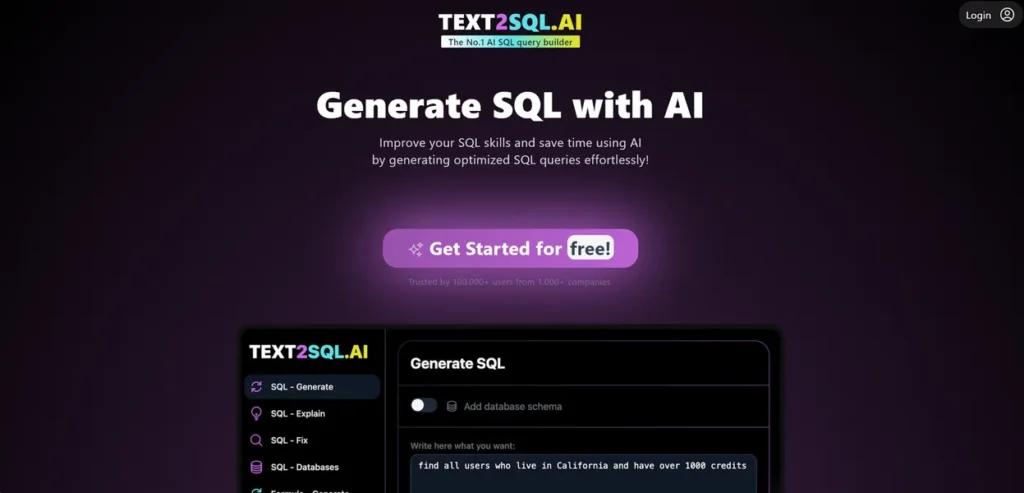
What is Text2SQL?
Text2SQL is an AI-driven platform that serves as a high-level abstraction layer for database interaction. It translates natural language prompts into executable SQL code, effectively bridging the gap between human intent and database query languages. From a development standpoint, this isn’t just a convenience tool; it’s a potential accelerator for both prototyping and production workflows. By automating the generation of routine queries, it frees up engineering resources to focus on more complex architectural challenges, such as performance tuning and data modeling. It empowers team members across an organization—from product managers to marketing analysts—to self-serve their data needs without creating a bottleneck for the development team.
Key Features and How It Works
Text2SQL operates by parsing user input through a sophisticated Natural Language Processing (NLP) engine, which then constructs a syntactically correct and optimized SQL query. Its architecture is designed for flexibility and integration.
- Natural Language Processing: The core of the tool is its advanced AI model, which interprets conversational language and maps it to specific database operations, tables, and columns.
- Multi-Dialect SQL Support: A critical feature for any team working in a heterogeneous environment. Its compatibility with major databases like MySQL, PostgreSQL, and MS SQL means it can be deployed across different projects and stacks without modification, ensuring consistent behavior.
- Custom Database Schema Integration: This is arguably its most powerful technical feature. Allowing the AI to ingest your custom schema is like giving a human translator a specialized technical dictionary for a specific engineering project. Instead of just translating words, it understands the relationships, constraints, and context of your data, resulting in far more precise and efficient queries.
- Robust API Access: For developers, the API is the main entry point. It allows Text2SQL to be integrated directly into custom applications, internal tools, or automated data pipelines. This moves it from a simple utility to a foundational component of a modern data stack.
- Multilingual Capabilities: Support for major global languages broadens its applicability for international teams and global-scale applications, ensuring that data access is not limited by language barriers.
Pros and Cons
From a senior developer’s perspective, the trade-offs are clear.
Pros:
- Increased Development Velocity: Automating query generation for standard requests significantly reduces time spent on repetitive tasks, allowing developers to focus on higher-value work.
- Empowers Non-Technical Teams: Provides a secure and controlled way for business users to query data directly, reducing dependency on engineering and fostering a data-driven culture.
- Scalable Integration: The API-first design means its capabilities can be embedded into virtually any application, scaling with your operational needs.
- Reduced Cognitive Load: Simplifies the process of data retrieval, especially for developers who may not be SQL experts or are unfamiliar with a specific database schema.
Cons:
- Abstraction Limitations: For highly complex, performance-critical queries, the AI-generated code may not be as optimized as a hand-tuned query written by an experienced database administrator.
- Input Sensitivity: The quality of the output is directly proportional to the clarity of the natural language input. Ambiguous prompts can lead to incorrect or inefficient queries.
- Dependency on a Third-Party Service: Integrating Text2SQL introduces an external dependency, which has implications for application uptime, latency, and data governance that must be carefully managed.
Who Should Consider Text2SQL?
Text2SQL is a strategic asset for a wide range of technical and business roles.
- Software Development Teams: Ideal for building internal tools, admin panels, and features that require dynamic data reporting. It can dramatically speed up the development of data-centric applications.
- Data Analysts and Scientists: Allows for faster exploratory data analysis and hypothesis testing by removing the friction of writing SQL for every query variation.
- Product Managers and Business Stakeholders: Enables direct, autonomous access to product usage data and business metrics, facilitating quicker, more informed decision-making.
- Startups and Lean Teams: A force multiplier for small teams where engineers must cover a broad range of responsibilities. It automates data tasks, conserving valuable development time.
Pricing and Plans
At the time of this review, detailed pricing information for Text2SQL was not available. The service may offer various tiers, including free trials, subscription plans for individuals, and enterprise-level packages tailored to specific organizational needs. These plans often differ based on factors like the number of API requests, the level of support, and access to advanced features. For the most accurate and up-to-date pricing, please visit the official Text2SQL website.
What makes Text2SQL great?
How often do your data requests get bottlenecked by the limited availability of SQL-savvy developers? Text2SQL directly addresses this common operational pain point by functioning as a powerful abstraction layer. Its true strength lies not just in translating text to SQL, but in its thoughtful design for integration. The support for custom schemas and multiple SQL dialects shows an understanding of real-world development environments. More importantly, its robust API transforms it from a simple end-user tool into a component that can be programmatically embedded deep within an organization’s software ecosystem, enabling a new class of data-aware applications and workflows.
Frequently Asked Questions
- How does Text2SQL handle complex joins and subqueries?
- Text2SQL’s AI is trained to understand relationships within a provided database schema. By analyzing table relationships (foreign keys), it can infer the need for joins. Users can typically specify complex logic, and the model will attempt to construct the necessary nested queries or common table expressions (CTEs).
- What are the security implications of integrating our database schema?
- Security is a primary concern. Reputable services like Text2SQL typically process schema information in a secure environment and do not store sensitive data. They use the schema contextually to generate queries. It is crucial to review their data privacy and security protocols to ensure compliance with your organization’s policies. The tool generates SQL; it does not execute it, giving you full control over permissions.
- Can the Text2SQL API handle high-volume, concurrent requests for an enterprise application?
- Scalability is a key consideration. The API is generally designed for high availability and low latency. However, performance will depend on the chosen subscription plan. Enterprise tiers typically offer higher rate limits, dedicated resources, and priority support to ensure performance under heavy load.
- How does the tool’s performance scale with very large and complex database schemas?
- The complexity of the schema can impact the AI’s inference time. However, the models are optimized to handle large schemas efficiently. The initial ingestion and analysis of the schema is a one-time process, after which query generation should remain swift. Performance for extremely intricate schemas is a good question for their technical support during a proof-of-concept phase.