

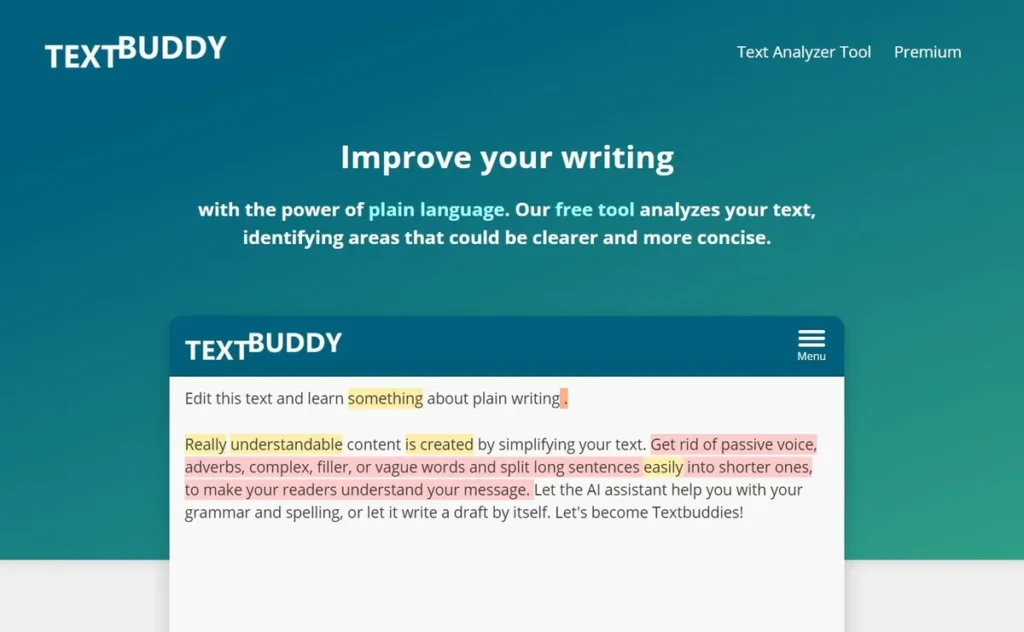
What is TextBuddy?
TextBuddy is a browser-based writing editor engineered to enhance textual clarity and conciseness. From a technical standpoint, it operates as a Software-as-a-Service (SaaS) application that processes user-submitted text through a sophisticated backend. This system integrates a deterministic, rules-based engine for plain language analysis with the probabilistic power of OpenAI’s GPT-4 large language model. The primary function is to serve as a real-time text optimization tool for a diverse user base, from individual professionals to enterprise teams, by ensuring written communication is both accessible and effective without requiring local software installation.
Key Features and How It Works
TextBuddy’s architecture is built around a core set of features designed for comprehensive text refinement. Its functionality can be broken down into several key components:
- Plain Language Analysis: The system evaluates text against a pre-defined set of plain language heuristics. It identifies complex sentence structures, jargon, and convoluted phrasing, providing actionable recommendations for simplification. This core logic ensures a baseline of clarity.
- AI Writing Assistant: Leveraging a fine-tuned implementation of GPT-4, this feature offers advanced text manipulation capabilities. It executes grammar and spelling corrections with high accuracy and provides contextual rephrasing suggestions, going beyond simple syntactical fixes to improve flow and tone.
- Multilingual Support: The platform is architected to support over 50 languages, demonstrating a robust internationalization framework. This allows the analysis and AI assistance engines to be applied across a global user base.
- Readability and Text Metrics: TextBuddy computes standard readability scores (e.g., Flesch-Kincaid) and provides detailed statistics such as word count, sentence length, and keyword density. These metrics offer quantitative feedback for content optimization.
- API Access: For developers, TextBuddy provides API endpoints that allow for programmatic integration of its text analysis capabilities into custom applications, content management systems, or CI/CD pipelines for documentation. This enables automated content quality gates and workflow enhancements.
Pros and Cons
From a software development and implementation perspective, TextBuddy presents a clear set of advantages and limitations.
Pros
- Enhanced Clarity and Consistency: The tool programmatically enforces a clear writing style, which is invaluable for technical documentation and corporate communications where consistency is key.
- Efficient Workflow: As a cloud-based service, it provides immediate feedback, reducing the cycles required for manual editing and peer review. This improves development and content velocity.
- Lightweight and Accessible: Being browser-based, it has no client-side overhead and is accessible from any machine with an internet connection, ensuring low friction for user adoption.
- Powerful Backend: The use of GPT-4 as its AI engine ensures state-of-the-art performance for grammar correction and text generation tasks.
Cons
- Network Dependency: All functionality is contingent on a stable internet connection to communicate with its backend servers. There is no offline mode.
- Potential for Latency: API calls and real-time analysis of large documents may introduce latency depending on server load and network conditions.
- Subscription-Gated Features: Critical features, particularly API access and unlimited AI assistance, are likely gated behind the premium tier, a standard SaaS business model that may be a constraint for some users.
Who Should Consider TextBuddy?
TextBuddy is a highly functional tool for any individual or team where clear communication is a critical operational requirement. Specific user profiles include:
- Technical Writers and Developers: For creating and maintaining user manuals, API documentation, and internal wikis that are easily understood by all stakeholders.
- Business Professionals: For drafting unambiguous reports, proposals, and emails that drive decisive action.
- Legal and Compliance Teams: To simplify complex legal terminology in contracts and terms-of-service documents for a general audience.
- Content Strategists and Marketers: To refine web copy, articles, and marketing collateral for maximum readability and engagement, thereby improving SEO performance.
- Non-Profit Organizations: For crafting grant proposals and donor communications that are persuasive and easy to comprehend.
Pricing and Plans
TextBuddy operates on a freemium model, providing tiered access to its features. This approach allows users to evaluate the core functionality before committing to a paid subscription.
- Free Plan: This entry-level tier offers basic text analysis and limited access to the AI writing assistant. It is suitable for individuals with light usage needs who want to test the platform’s capabilities.
- Pro Plan: Priced from $9 per month, this plan unlocks the full suite of features. Subscribers gain unlimited access to the advanced GPT-4 powered assistant, comprehensive text analysis, and potentially higher usage limits or API access.
For the most current and detailed pricing information, including specific feature breakdowns and enterprise options, users should consult the official TextBuddy website.
What makes TextBuddy great?
Ever find your carefully crafted technical documentation or business proposal falling flat because it’s too dense for the intended audience? TextBuddy’s greatest strength lies in its focused, dual-engine approach to solving this exact problem. It doesn’t just check for grammatical errors; it fundamentally re-engineers text for clarity. The platform’s integration of a deterministic, rules-based plain language checker with a powerful, probabilistic model like GPT-4 is a significant technical advantage. This hybrid system provides the best of both worlds: the consistency and predictability of rule-based analysis, and the contextual nuance and advanced rephrasing capabilities of a leading-edge AI. For developers and technical professionals, this translates to a tool that is not only effective but also reliable and predictable in its output.
Frequently Asked Questions
- What is the underlying technology for the AI assistant?
- The AI Writing Assistant is powered by OpenAI’s GPT-4 model, providing state-of-the-art natural language processing for tasks like grammar correction, rephrasing, and summarization.
- How does the API function and what are its limitations?
- The API is expected to be a RESTful service that accepts text payloads and returns structured JSON data containing analysis and suggestions. Access is typically secured via API keys and is likely subject to rate limits and usage quotas defined by the subscription plan.
- What is TextBuddy’s data privacy and security policy?
- As a cloud-based service, TextBuddy processes user data on its servers. Users, especially those in enterprise environments, should review the official privacy policy to understand how their data is handled, stored, and whether it is used for AI model training.
- Can TextBuddy be integrated into an IDE or other development tools?
- Direct IDE plugins may not be available, but the tool’s API allows for custom integrations. A developer could build a script or extension to send text from their IDE or CMS to the TextBuddy API for analysis within their existing workflow.
- How does the tool handle highly technical content or code snippets?
- The tool is optimized for natural language prose. While it may ignore or correctly handle code snippets within text, its primary analysis is not designed for source code. Its effectiveness will be highest on the explanatory text surrounding the code.