



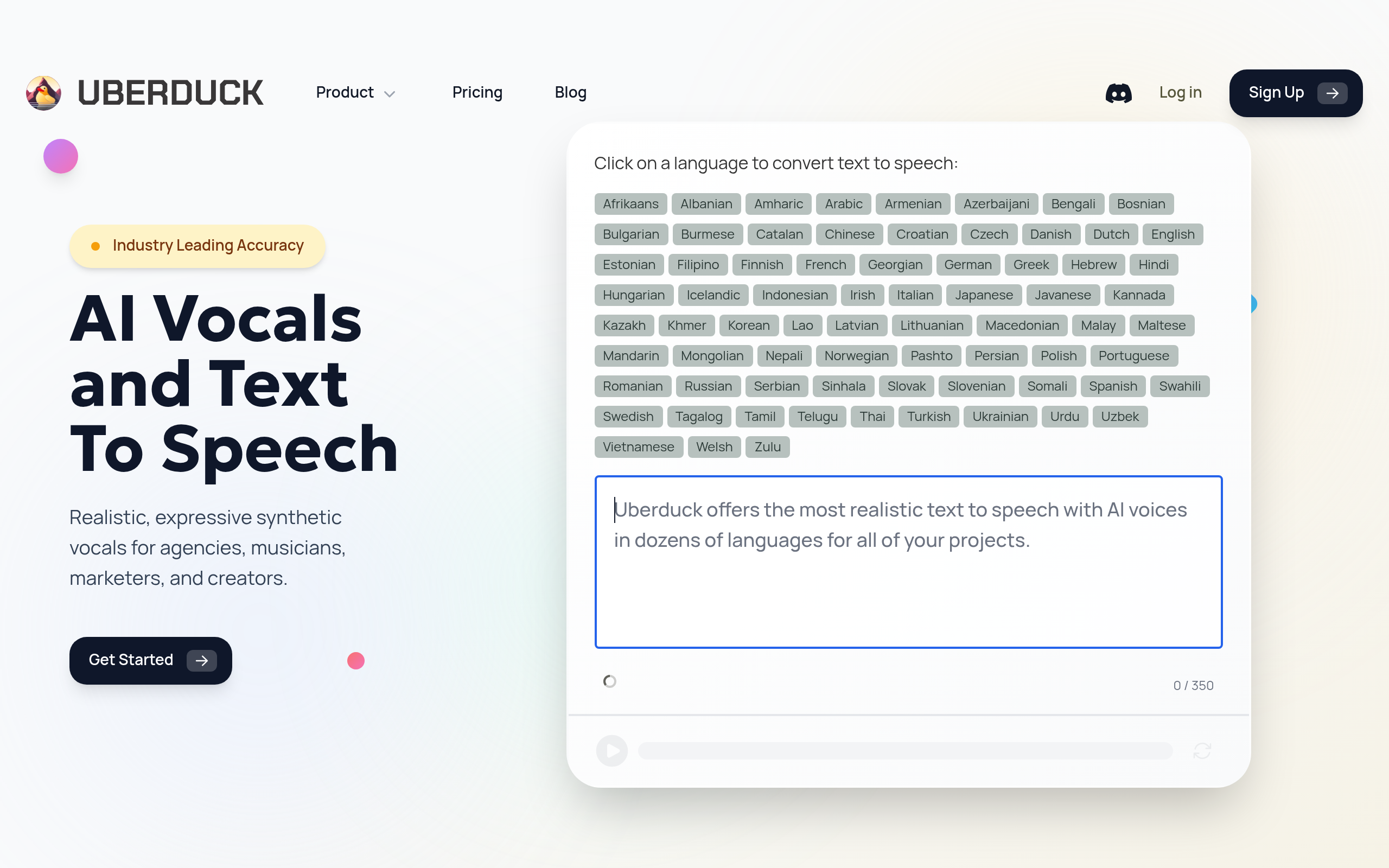
What is Uberduck?
Testing Uberduck reveals a stark contrast between its capable AI rap generator and its inconsistent community voice library. The platform excels at matching synthetic vocals to rhythmic beats. Standard text-to-speech outputs often sound robotic compared to premium competitors. (Finding a usable voice often requires testing dozens of bad ones.)
Uberduck, Inc. built this AI audio platform to solve vocal synthesis for musicians, developers, and content creators. The software generates custom rap songs, clones personal voices, and integrates audio into mobile apps via a REST API.
- Primary Use Case: Generating custom rap songs with AI-synced lyrics and rhythmic beats.
- Ideal For: Budget-conscious creators and developers needing API access.
- Pricing: Starts at $2/mo (Starter). This is an extremely low entry price for basic AI audio tasks.
Key Features and How Uberduck Works
AI Rap and Vocal Synthesis
- AI Rap Generator: Creates automated lyrics with rhythmic vocal synthesis and beat matching, limited to available backing tracks.
- Text-to-Speech: Provides access to 4,000 community and official voice models, restricted by a 300-credit monthly limit on the free tier.
Voice and Face Cloning
- Voice Cloning: Replicates digital voices with high fidelity, requiring at least 20 minutes of clean audio data.
- Face Cloning: Synchronizes facial movements to generated audio for video avatars, available only on the $25 Pro plan.
Developer Tools and Integrations
- API Access: Supports programmatic audio generation via REST API, requiring a $5 Creator plan for commercial use.
- Twilio Integration: Connects synthetic voices directly to telecommunication systems, restricted to the $300 Enterprise tier.
Uberduck Pros and Cons
Pros
- The $2 monthly entry price makes professional-grade AI audio accessible to hobbyists.
- The specialized AI rap engine handles rhythm and flow better than standard text-to-speech tools.
- A massive library of 4,000 options provides extensive variety for non-commercial projects.
- Detailed API documentation allows developers to integrate audio features with minimal technical friction.
Cons
- Community-uploaded voices suffer from inconsistent quality, with many models sounding distorted.
- Strict copyright enforcement caused the removal of many popular celebrity and character voices.
- High-quality voice cloning demands significant manual effort and professional-grade recording equipment.
- The user interface feels cluttered and difficult to navigate for new users.
Who Should Use Uberduck?
- Musicians and producers: The AI rap generator creates unique vocal tracks synced to specific beats.
- App developers: The REST API allows easy integration of text-to-speech functionality into mobile applications.
- Budget-conscious creators: The $2 Starter plan offers basic tools for quick audio tasks without high costs.
- Not for premium audiobook narrators: Users needing highly emotive, long-form narration should look elsewhere due to robotic cadences in standard voices.
Uberduck Pricing and Plans
Uberduck uses a freemium model. The Free tier provides 300 render credits per month for non-commercial use across 4,000 voices. This tier functions as a genuine free plan rather than a disguised trial.
The Starter plan costs $2 per month when billed annually. It includes basic tools for quick tasks. The Creator plan costs $5 per month annually. It increases limits to 3,600 render credits and adds commercial use rights, API access, and the AI rap generator.
Advanced users can choose the Clone/Pro plan for $25 to $30 per month. This tier adds voice cloning, face cloning, and video generation. The Enterprise plan costs $300 per month. It provides bulk voice clones, lowest latency processing, Twilio integration, and dedicated support.
How Uberduck Compares to Alternatives
Similar to ElevenLabs but focused on musical applications. ElevenLabs dominates in emotive, realistic speech for audiobooks and podcasts. Uberduck wins for users who need rhythmic vocal synthesis and beat matching. ElevenLabs charges $5 per month for its lowest paid tier, making Uberduck cheaper for basic tasks.
Unlike Kits.ai, this tool targets a broader mix of developers and casual creators. Kits.ai focuses on professional music producers needing studio-quality AI vocalists. Kits.ai offers superior voice-to-voice conversion tools. Uberduck provides better text-to-rap capabilities and a more accessible REST API for software integration.
The Best AI Audio Tool for Budget Developers
Uberduck delivers the most value to developers and hobbyist musicians. The $5 Creator plan offers cheap API access and commercial rights. (The interface takes time to learn, but the low cost justifies the effort.) Users needing flawless, human-sounding narration for long videos should choose ElevenLabs instead.
The platform will likely shift toward musical generation and developer APIs within 12 months. Standard text-to-speech competition is too fierce, but Uberduck owns the automated rap niche.