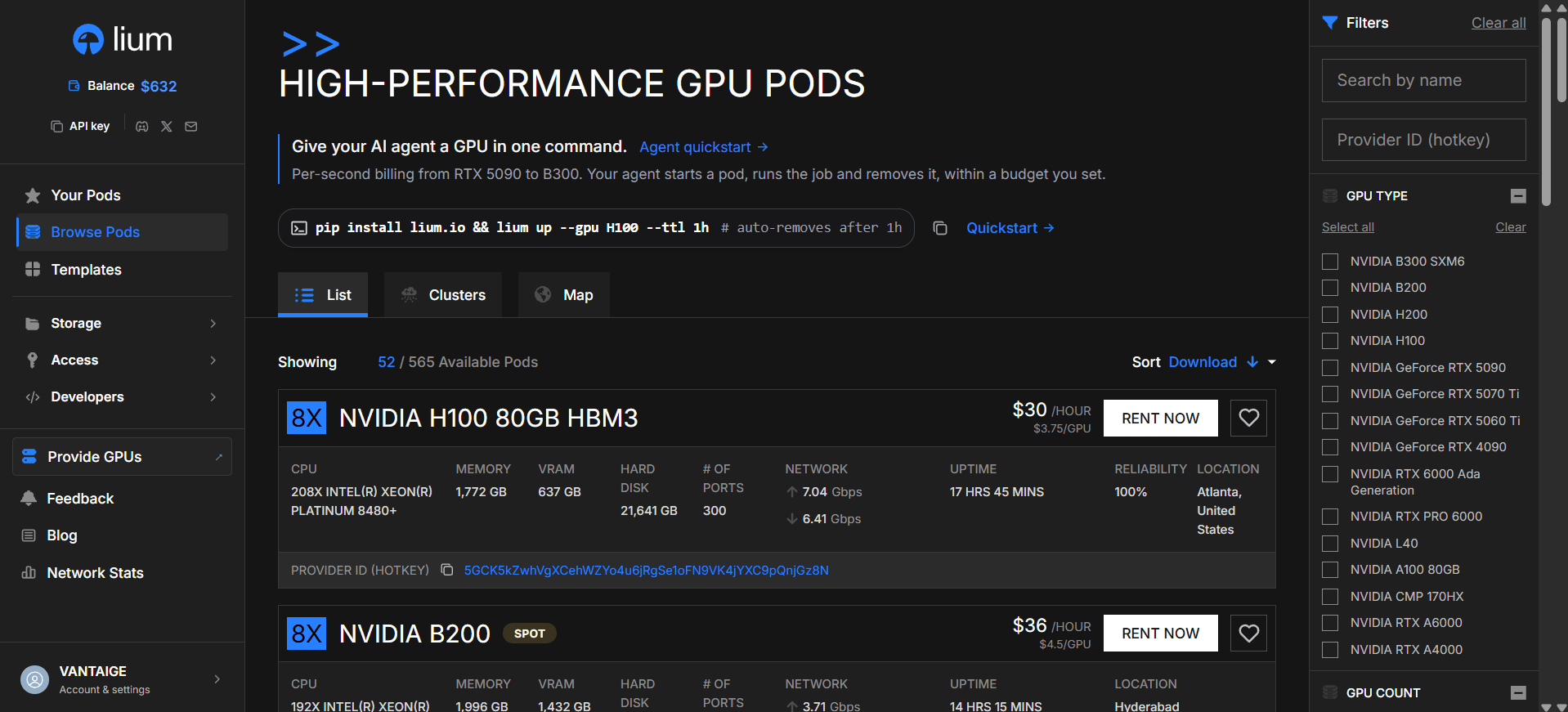

Lium is a GPU marketplace where you rent verified NVIDIA GPUs, from RTX 4090 to H100, H200, B200 and B300, billed per second with no minimum. Use the web, CLI, SDK or an AI agent.
Lium is a GPU rental marketplace operated by Datura AI Corp. Independent providers connect their machines, renters deploy containerized GPU pods on them, and every pod is billed per second at the node's own hourly price with no minimum and no reservation. It launched in late 2024 as Celium and became Lium in mid-2025, and its provider network runs on Bittensor Subnet 51. The marketplace catalogues 92 GPU models in data center, professional and consumer classes, from Blackwell B300 and B200 and Hopper H200 and H100 down to RTX 5090, RTX 4090 and older cards for cheap experiments.
Lium serves two audiences. Renters get on-demand compute with a pod running within minutes, hardware that independent verifiers check over SSH before it is listed and keep checking afterwards, and tooling designed so that an AI agent with only a shell can rent, run and release a GPU. Providers get a global marketplace for their hardware, set their own prices and keep 95% of what renters pay. In August 2026 Lium served 7,549 rentals across 900 paying accounts (Lium production data). Its public pricing feed showed 1,670 GPUs listed on 15 October 2026, with 1,571 of them rented at that moment (Lium blog, 15 October 2026).
How renting on Lium works
Sign up, top up a prepaid balance by card or crypto, paste an SSH key, pick a node and a Docker template, and deploy. A pod is a Docker container on a provider's machine with root SSH access and direct GPU passthrough. The default template is PyTorch with CUDA, and you can bring any public or private Docker image, build from a Dockerfile, or attach Jupyter. To start a pod your balance must cover 15 minutes of its price, plus 15 minutes for each pod you already have running or starting. Billing stops when you delete the pod or its scheduled end time arrives.
The Browse Pods marketplace shows every rentable node with its GPU count, VRAM, CPU, memory, disk, measured upload and download speed, uptime, reliability percentage and location, in a list, map or quickstart view. Filters cover GPU type and count, price per hour or per GPU, Secure or Spot tier, country or coordinates, CUDA version, open ports, confidential computing and GPU profiling support. If the GPU you want is sold out, you can file a machine request.
Which open-source AI models each GPU can run
Model memory is mostly weights plus working space. Lium's own sizing rule counts the weights plus about 20% for activations and cache, and the table applies it to popular open-weight models as of October 2026, alongside runs Lium has measured itself. Longer context windows and bigger batches need more headroom, so use the table as a starting point and check any model with Vantaige's free LLM VRAM Calculator. Prices are live asks per GPU-hour on 19 October 2026.
| GPU (VRAM) | Live price per GPU-hour | LLMs and text | Image and video | Speech and audio |
|---|---|---|---|---|
| RTX 4090 (24 GB) | $0.48 to $0.90 | Llama 3.1 8B and Qwen2.5-7B in BF16, gpt-oss-20b, Qwen3.6-27B and Qwen3.6-35B-A3B at 4-bit with modest context | SDXL (Lium measured 6.1 s per 1024px image), FLUX.2 [klein] 4B, quantized Qwen-Image | Whisper large-v3 and turbo, Parakeet TDT, Qwen3-ASR, Kokoro and Chatterbox TTS |
| RTX 5090 (32 GB) | $0.50 to $1.60 | The same models with longer context, Qwen3.6-27B at 4-bit with a large KV cache | FLUX.2 [dev] at 4-bit, Qwen-Image, Wan 2.2 5B with offloading | Batch transcription with Whisper, Qwen3-TTS |
| L40S, RTX A6000, RTX 6000 Ada (48 GB) | L40S $0.38, A6000 $0.42 to $0.55, 6000 Ada $0.70 to $1.04 | Qwen3.6-27B and Qwen3.6-35B-A3B in FP8, Llama 3.3 70B at 4-bit | FLUX.2 [dev] in FP8, Qwen-Image in BF16, SDXL batches | Whisper large-v3 at scale, TTS next to an LLM |
| RTX PRO 6000 Blackwell Server (96 GB) | $1.19 to $1.70 | gpt-oss-120b, Llama 3.3 70B in FP8, Qwen3.6-35B-A3B in BF16 | FLUX.2 [dev] in BF16, Wan 2.2 A14B video | Several speech models resident at once |
| A100 SXM4 (80 GB) | $1.68 (8-GPU nodes) | Qwen3.6-27B in BF16, Llama 3.3 70B at 4-bit, four GPUs for 70B in BF16 (Lium sizing) | FLUX.2 [dev] quantized, diffusion fine-tuning | Whisper and Parakeet pipelines |
| H100 (80 GB) | $1.95 to $3.75 (PCIe $2.15) | gpt-oss-120b on one GPU, Llama 3.3 70B at 4-bit, Qwen3.6-35B-A3B in FP8, Qwen3.6-27B in BF16 | FLUX.2 [dev], Wan 2.2 A14B video, LoRA training | Whisper at scale |
| 8x H100 (640 GB) | $1.95 to $3.75 per GPU | DeepSeek-V4.1-Flash (510 GB of weights; Lium measured it ready about 10 minutes after the pod was created, 138 tokens per second for one stream) and Llama 3.1 405B in FP8 | ||
| H200 (141 GB) | $3.65 to $5.76 | Llama 3.3 70B in FP8 on one GPU and in BF16 on two (Lium sizing), GLM-5.3-Flash at 4-bit on two GPUs, gpt-oss-120b with a large KV cache | High-throughput batch transcription | |
| 8x H200 (1,128 GB) | $3.65 to $5.76 per GPU | GLM-5.3 (744B, about 756 GB in FP8) and DeepSeek-V4-Pro (1.6T, about 893 GB) | ||
| B200 (180 GB) | $5.50 to $8.89 | Qwen3.6-35B-A3B in FP8: Lium measured 14,499 output tokens per second in aggregate at 256 concurrent streams on a single GPU. Also Llama 3.3 70B in FP8 with long context | ||
| B300 (288 GB) | $8.00 to $9.25 | GLM-5.3-Flash (320B, MIT) at 4-bit on one GPU, 70B-class models in BF16 with generous headroom | ||
| 8x B300 (2,304 GB) | $8.00 to $9.25 per GPU | Kimi K3 (2.78T parameters, roughly 1.6 TB at 4-bit; our sizing estimate) | ||
Notes: Blackwell GPUs (B200, B300, RTX 5090, RTX PRO 6000) need a CUDA 12.8 or newer image or template. Licenses differ by model: Llama is gated behind Meta's license, FLUX.2 [dev] is non-commercial, Kimi K3 has its own license, while gpt-oss and Qwen3.6-27B are Apache 2.0 and DeepSeek-V4.1-Flash and GLM-5.3-Flash are MIT. Parameter counts and weight sizes come from model cards and Lium's guides in October 2026, and the open-model landscape changes monthly.
Current prices of the most in-demand GPUs
Live asks per GPU-hour on 19 October 2026, read from lium.io/pricing. Each provider sets its own price and the ranges move through the day, so treat these as a dated snapshot. A whole node bills the per-GPU price times its GPU count.
B300 SXM6 (288 GB): $8.00 to $9.25, 4 GPUs free
B200 (180 GB): $5.50 to $8.89, 33 GPUs free
H200 (141 GB): $3.65 to $5.76, 20 GPUs free
H100 80GB HBM3: $1.95 to $3.75, 72 GPUs free (H100 PCIe $2.15, 1 GPU)
A100 SXM4 80GB: $1.68, 16 GPUs free on 8-GPU nodes
RTX PRO 6000 Blackwell Server (96 GB): $1.19 to $1.70, 29 GPUs free
RTX 5090 (32 GB): $0.50 to $1.60, 32 GPUs free
RTX 4090 (24 GB): $0.48 to $0.90, 32 GPUs free
RTX 6000 Ada (48 GB): $0.70 to $1.04, 17 GPUs free
RTX A6000 (48 GB): $0.42 to $0.55, 17 GPUs free
L40S (48 GB): $0.38, 10 GPUs free
On the same day 15 of the 92 catalogued models had a pod free, 292 GPUs in total, and live asks across the marketplace started around $0.18 per GPU-hour. Spot nodes are cheaper but can be reclaimed. Live prices need no account at lium.io/pricing, in a JSON feed at lium.io/pricing.json and through a public nodes API. In August 2026, 21 different GPU models were rented, from RTX 4090s up to H100, H200, B200 and B300 (Lium production data).
Hands-on examples from Lium's own guides
These are Lium's own tested walkthroughs and benchmark, not independent reviews. Each one lists the pod time and cost it measured.
Serve an open LLM: Qwen2.5-7B-Instruct with vLLM on one RTX 4090, called through an OpenAI-compatible endpoint from a laptop. 18 minutes of pod time, about 14 cents.
Image generation: ComfyUI with the SDXL base checkpoint on a 4090 at $0.48 per hour. The pod was ready 21 seconds after the request, each 1024px image took 6.1 seconds, and the whole 19-minute session cost about $0.15, most of it the checkpoint download.
Fine-tuning and training: a LoRA fine-tune of Qwen2.5-0.5B-Instruct took five minutes of pod time for about three cents, and training ResNet-18 on CIFAR-10 on an RTX A6000 cost about ten cents.
A 510 GB model: DeepSeek-V4.1-Flash (MIT) on an 8x H100 node with vLLM. The server was ready about 10 minutes after the pod was created (4.7 minutes of download, 30 seconds of weight loading, 2.8 minutes of warmup) and answered a single request at about 138 tokens per second.
Agents renting GPUs: guides for Claude Code and OpenAI Codex use a scoped API key, a server-enforced daily budget and automatic removal. The Claude Code test on an RTX 5070 Ti cost under one cent.
Throughput benchmark: Lium reported 14,499 output tokens per second for Qwen3.6-35B-A3B in FP8 on a single B200, running vLLM at 256 concurrent streams, at a GPU cost of about $0.107 per million output tokens. The benchmark setup is public (36 runs across B200, H200, H100, RTX PRO 6000 Blackwell and RTX 5090). Figures are GPU cost only, at high concurrency, and were reported by Lium on 6 September 2026.
Benefits for renters
Pay only for the seconds a pod runs, with no minimum, no reservation and no subscription.
Choose a specific node by GPU, price, location, reliability, uptime and network speed, with live prices that need no account to read.
Hardware is checked over SSH before it is listed and again on a regular cycle, and a pod that fails to start because of its node is moved to another node of the same GPU at the same or a lower price at no charge for the failed start.
Run any Docker image, including current vLLM or SGLang builds, so you are not waiting for a managed catalog to add a model.
Control spend with TTLs, scheduled termination, per-key budgets, low-balance warnings and per-pod statements.
Pay by card, crypto, TAO or Bittensor alpha, and get a 2.5% bonus on crypto, TAO and alpha top-ups.
Built for AI agents and developers
Lium's homepage pitch is giving your AI agent a GPU in one command. The lium CLI installs as a standalone binary or with pip install lium.io, and a rental looks like lium up --gpu H100 --ttl 1h, which auto-removes the pod after an hour. The same package ships a Python SDK, including a decorator that rents the cheapest matching node, runs one Python function on it, returns the result and removes the pod. The REST API is described in OpenAPI 3.1, the documentation site runs a Model Context Protocol server so agents can search and read the docs, and an agent skill for coding agents is published on GitHub.
An agent can even create its own account. A single API call returns a fingerprint login and an API key with no email, password or confirmation link, and the CLI also supports a two-step headless login for existing accounts.
"pip install lium.io && lium up --gpu H100 --ttl 1h" (Lium homepage, lium.io, 2026)
Verification, privacy and confidential computing
Every node is checked automatically when it is added and again on a regular cycle while it is listed, covering the GPU model and count, network speed, the container runtime and storage. A node that fails a check is not listed.
Privacy depends on the node you pick. Lium's documentation states that on standard nodes the GPU provider has full access to rental containers, so keep secrets such as cloud credentials and private keys off them. Some nodes offer a confidential virtual machine option built on Intel TDX, where the machine owner cannot read the renter's workload. It requires GPUs with NVIDIA Confidential Computing support, which consumer RTX and workstation A-series cards lack. Lium also offers encrypted local volumes.
Clusters, storage and cost controls
For jobs that span machines, Lium rents multi-node clusters on one InfiniBand or RoCE fabric. Clusters are homogeneous (one GPU model and count per node), made of whole machines only, reserved together as one order, and come with a private WireGuard overlay network, RDMA devices exposed in the pod and a shared SSH login for tools such as torchrun. For RoCE, Lium pushes RDMA traffic across a pair and measures the link before offering it, and a pair that fails the measurement is not listed.
Persistent volumes survive the pod and mount at /mnt, billed per GB-hour. Scheduled backups run on an interval you choose with a retention window, and a backup can be restored into a new or existing pod. Pods have no stopped state and bill until removed, so anything you need to keep belongs on a volume, in a backup or pushed off the pod. Every card top-up gets a Stripe invoice that can carry a company name, address and tax ID.
Benefits for GPU providers
Providers list their GPUs on Lium's marketplace, set their own hourly price per GPU and receive 95% of what renters pay. The share is the same for every provider and Lium keeps 5%. Payouts are processed daily, and in the 30 days before 9 September 2026 every rental payout arrived within two days (payout ledger, 9 September 2026). Lium said on X on 7 October 2026 that utilization was at an all-time high and most GPU types were fully rented out.
Providers registered on Bittensor Subnet 51 can also earn subnet emission, including for idle hours when the GPU model is eligible, subject to conditions such as a connected Discord account, a price at or under the model's soft limit, current node software and, for 8-GPU H200, B200, B300 and GB300 hosts, GPU splitting, GPU profiling or a confidential VM. Both income streams are paid in alpha tokens to the provider's coldkey with a two-day delay. A node that has a misbehavior incident that day does not receive that day's payout, and a provider who drops a live rental is penalized while the renter is refunded.
Onboarding is fast. A new node is validated automatically and typically listed about 20 minutes after it is added: across 175 nodes added in the 30 days to 6 September 2026 the median was 21 minutes and the 90th percentile 64 minutes (docs.lium.io). Hosts need Ubuntu 24.04 (or 22.04 with the HWE kernel), a working NVIDIA driver, Docker, the Sysbox runtime, at least 100 Mbit/s download, a public IP, 8 GB of RAM and 150 GB of disk. Lium says renters most often ask for whole 8-GPU hosts: 8x H100, 8x H200, 8x B200 and 8x B300. Providers manage nodes, prices and earnings in the Provider Portal at provider.lium.io, with Grafana dashboards and a rewards calculator.
Provider sign-up currently requires a Bittensor wallet and TAO to cover the Subnet 51 registration fee. An email or Google account path with no wallet is documented as coming but is not open yet, and on that path unrented time would not be paid.
Compared to similar tools
Against hyperscalers such as AWS, Google Cloud and Azure, Lium is a marketplace rather than a single vendor's fleet. Prices are set by independent providers, Lium says renting is self-service with no sales call or waitlist, and you choose a specific node by location, reliability and network speed. The trade-off is that hardware, uptime and bandwidth vary from node to node, and standard nodes are not confidential.
Managed GPU clouds such as Lambda and CoreWeave operate their own GPU capacity. Lium aggregates capacity from many operators, which can widen the choice of models and price points, with Spot and Secure tiers to trade price against dedication. Vast.ai is the closest like-for-like marketplace, since it also lists machines from independent hosts, and RunPod splits its supply into a Community Cloud of vetted hosts and a Secure Cloud in partner data centers. Lium's angle is continuous automated verification, an agent-first CLI, SDK, API and MCP surface, measured cluster pairs and an optional confidential-VM tier. Compare live prices and availability for your GPU on each before committing, because marketplace pricing changes hourly.
Who Lium is built for
ML engineers and researchers who need cheap on-demand GPUs for training, fine-tuning, inference and experiments. Startups serving open-weight models who want H100 to B300 capacity without a long contract. Developers building autonomous agents that need to provision compute programmatically. GPU owners, data centers and hosting companies with idle hardware to monetize. Lium is a weaker fit for teams that need guaranteed SLAs, a stopped-instance state that keeps the disk, a specific GPU guaranteed at a fixed time, or strict compliance guarantees on every node, since reliability and privacy depend on the provider and on whether the node is a confidential VM.
Pricing and getting started
There is no subscription. Lium is prepaid and pay as you go: top up from $10 by card (processed by Stripe) or by cryptocurrency, TAO or Bittensor alpha, with a 2.5% bonus on crypto, TAO and alpha top-ups. Pods are charged every five minutes for the seconds since the last charge, and a pod that reaches RUNNING also pays for its provisioning window. The hourly pod price includes the pod's local disk, and the provider receives 95% of what you pay. Persistent volumes and backups are billed separately per GB-hour at cost. New accounts may receive a small signup credit, but it depends on platform settings and is not guaranteed. A provider can raise a node's price while your pod runs, but by at most 25%, once per calendar month and with advance notice (7 days on Secure nodes, 24 hours on Spot), while a price drop reaches your pod within about 15 minutes.
Company, compliance and support
Lium is operated by Datura AI Corp, incorporated in Saint Kitts and Nevis. The source code of the CLI, SDK, agent skill and provider software is public under the Datura-ai GitHub organization. Lium bans access to its compute from US-embargoed countries and by sanctioned parties. Support runs through [email protected], the official Lium Discord (tickets are opened in the #tickets channel) and a private Discord channel with the provider for a rented pod. Documentation lives at docs.lium.io.
Reseñas de usuarios
Aún no hay reseñas. ¡Sé el primero en compartir tu experiencia!
Inicia sesión para escribir una reseña.
Artículos relacionados
Guías y artículos relacionados con Lium.io.
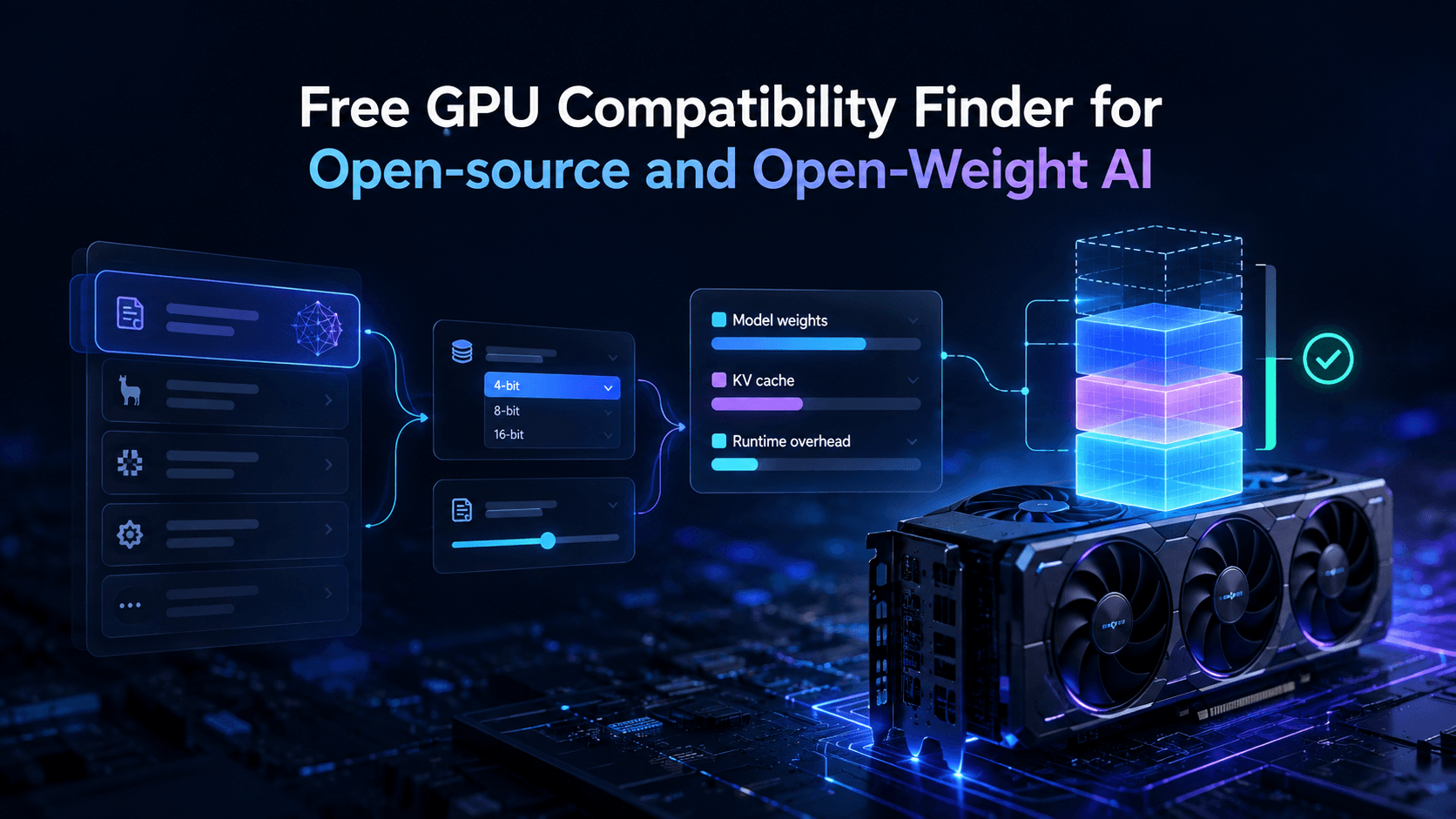
Vantaige Launches the LLM VRAM Calculator: A Free GPU Compatibility Finder for Open-source and Open-Weight AI

Xiaomi MiMo-V2.6 Deep Dive: The 1-Trillion-Parameter Open-Source Titan Disrupting the Frontier