
GPTinf is an AI humanizer and detector toolkit that rewrites ChatGPT, Claude and Gemini drafts to read as human-written. Freeze keywords, 8 modes, built-in detector, 240 free words, from $9.99/mo.
GPTinf is an AI humanizer and detector toolkit at gptinf.com that rewrites AI-generated drafts from ChatGPT, Claude, Gemini, DeepSeek, Grok and Mistral so they read as human-written and score low on AI detectors. The positioning is direct: six core tools on one platform, plus an essay writer, with a Check, Fix, Submit loop, built for students, freelancers, SEO teams and marketers who start from an AI draft and must submit or publish with confidence. The company claims 15B plus words humanized, 500K plus monthly visitors and 374K plus rewrites per month, founded in 2023 in Lviv, Ukraine by Artur Zhdan.
The core differentiation claim is architectural. GPTinf says it does not use one AI to fix another AI. Its Steel engine rebuilds sentence architecture, including subjects, verb constructions, clause order, sentence splits and merges, and rhythm, instead of surface synonym swapping, which it brands LLM Feather. The engine is described as trained side-by-side on human versus AI text and updated as detector patterns evolve. Vendor marketing cites under 5 percent average AI score after humanization and 37 percent better detection results than competitors, which should be read as vendor claims, since independent competitor run tests report mixed results, especially against Turnitin, Originality and GPTZero, detailed below.
How GPTinf works
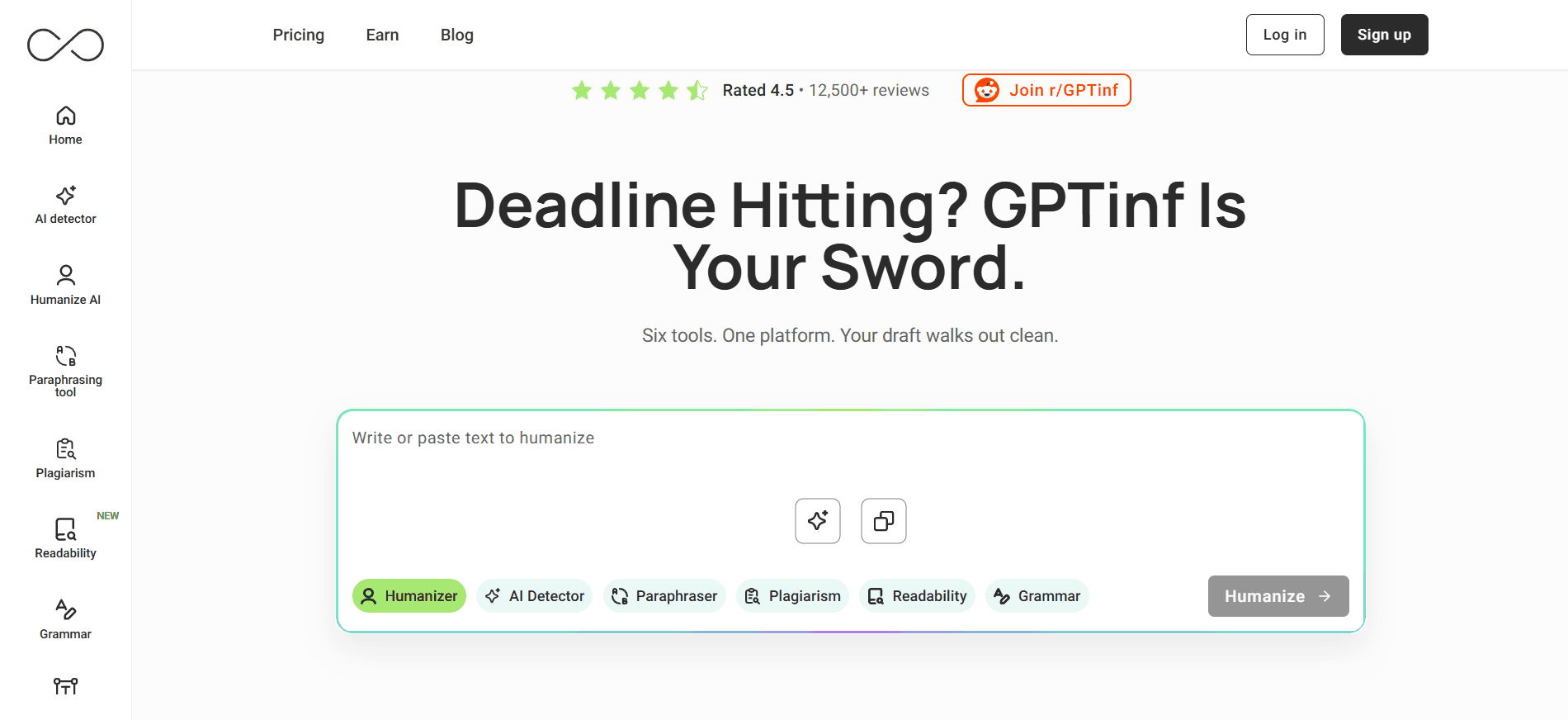
Paste a draft into the input box, try the built-in sample, or upload a PDF, Word or plain text file. Choose a rewrite mode such as Standard or Academic, lock protected terms with Freeze Keywords so names, citations, brand terms and SEO keywords survive the rewrite, then press Humanize. The engine scans for uniform sentence length, flat rhythm, abstract subjects and predictable transitions, then rebuilds the sentences while preserving meaning, tone and register. An AI score appears automatically under every output, so verification is part of the same screen rather than a separate purchase.
Review the output, then re-run the whole text, re-humanize a single paragraph, or use selective rephrase on one part, with a compare mode that shows original versus rewritten side-by-side. When satisfied, run the same workspace through the AI Detector, Plagiarism Checker and Readability Checker before submitting. The detector flow mirrors this: paste or upload, press Check for AI, read the percentage with per-sentence AI, Mixed and Human highlighting plus a per-model breakdown, then one-click export to the Humanizer.
The toolkit: humanizer, detector, paraphraser and more
AI Humanizer. The flagship at gptinf.com/humanize-text. Eight writing and rewrite modes with Academic Mode singled out for academic submissions, Freeze Keywords and Freeze List, re-humanize and selective rephrase, compare mode, automatic AI score under the output, file-to-file humanizing for PDF, Word and text with per file caps by plan, and an encrypted private History dashboard organized by date and time.
AI Detector. Free and unlimited with no account required. Multi-signal detection over structural patterns, probability signals and AI watermarks, trained on large human plus AI corpora, with per-sentence color labels and trigger explanations. Eight-system cross-check with results per system, plus per-model percentage match across ChatGPT, Gemini, DeepSeek, Claude and xAI Grok. Cross-checked systems listed on the student pages include Turnitin, Copyleaks, OriginalityAI, GPTZero, Crossplag, Sapling, Winston and ZeroGPT.
Paraphrasing Tool. Paste or upload, lock important words, and choose a rewriting mode across Standard, Academic, Fluency, Creative and Formal. Built for restating sources without losing the argument.
Plagiarism Checker. Returns a plagiarism percentage with flagged sentences, each match traced to its source URL against the public web index.
Grammar Checker. Contextual error detection with click-to-fix and Fix All Errors plus Apply All on paid plans.
Readability Checker. Instant score with Flesch-Kincaid level reference, hard-to-read spot highlighting, and audience adjustment guidance.
Essay Writer. Configurable topic, essay type including Argumentative, Descriptive, Expository, Narrative, Compare and Contrast, and Research, plus tone, language, 500 to 2,000 word length, academic level from High School to PhD, citation format across APA, MLA and Harvard, and outline generation.
Bypass coverage and an honest test record
Official marketing names Turnitin, GPTZero, Originality.ai, Copyleaks, ZeroGPT, Winston AI, Sapling and Crossplag, with dedicated landing pages for Turnitin detection, bypassing Originality, and undetectable AI. The pricing page carries the strongest line, stating Ultra Humanization guarantees bypassing all AI detectors without exception with an always-on 0 percent AI score. That guarantee language overstates what the company's own ethics FAQ concedes, namely that no service is 100 percent undetectable and that GPTinf scores well more often than not. Treat the guarantee as marketing, not methodology.
Independent evidence is thin and mostly comes from competitors, so disclose the conflict. A May to June 2026 UndetectedGPT test across five detectors reported an overall bypass rate of about 45 percent with 6.8 out of 10 readability, with per-detector AI scores falling from 98 to 42 percent on Turnitin, 96 to 38 on GPTZero, 99 to 55 on Originality, 97 to 35 on Copyleaks and 94 to 28 on ZeroGPT. A GPTHumanizer side-by-side reported GPTinf output scoring 100 percent AI on GPTZero and ZeroGPT in their sample. Originality's own review noted changed phrasing that strong detectors still flagged. No neutral 2026 benchmark found includes GPTinf in a repeatable harness, and the July 2026 HumanizerBench round did not include it. Directionally, GPTinf handles lighter detectors more reliably and struggles most against Turnitin, Originality and GPTZero on adversarial samples, with occasional grammar or awkwardness complaints. Always re-check important submissions with the built-in detector and the actual system your school or client uses.
Who uses GPTinf
Official segments include students and graduates working on essays and assignments, researchers and academics, content writers and freelancers polishing client drafts, SEO and content specialists publishing at volume with keyword freeze, bloggers and newsletter writers, business and marketing teams drafting cold email and landing copy, non-native and ESL writers who need natural formal English, educators pre-checking submissions, plus personas shown on the homepage spanning a high school student, a company CEO, a freelancer and an educator. Named use cases run from academic essays, student assignments, submission review, ESL writing, blog posts, marketing copy, research summaries and business reports to SEO articles, emails and long-form content.
There are no enterprise logos presented as institutional clients. The About page shows Harvard, Stanford, Oxford, Cambridge, UC, Toronto, UBC, McGill, LSE and Columbia wordmarks under Top students choose GPTinf, which signals student users at those universities, not institutional endorsements or contracts, and it is presented that way here. All on-site testimonials below are anonymous persona-based with no named endorsements published. Public testimonials are persona-based rather than enterprise case studies: a US freelancer calling it much simpler, a student praising Academic Mode, a seven month Pro user reporting Turnitin detection brought to zero most of the time with large time savings, a UK marketer of over a year calling it a lifesaver for copy, an Argentinian student noting strong English humanizing with a wish for equally strong Spanish, a US student praising the detector, a high school student reporting human written results, a CEO reporting consistent human reads after six weeks of multi-detector checks, and an educator calling the output solid and readable with light editing sometimes needed. Third party volume is thin: Trustpilot shows 4.0 out of 5 across 17 reviews as fetched in October 2026, with 100 percent of negatives answered, while the official site badge of 4.5 across 12,500 plus reviews aggregates on-site and private feedback and should not be equated with the public Trustpilot count. No dedicated G2 or Capterra profile was found.
I have been using GPTinf for 6 weeks now. The accuracy is genuinely impressive, even after checking the output with multiple detection tools, it consistently reads as human-written. (Anonymous CEO testimonial, no personal name published, gptinf.com homepage)
Saves huge amount of time, brings Turnitin detection to 0 most of the time. (Anonymous Pro user testimonial, 7 months, no personal name published, gptinf.com/reviews)
Compared to similar tools
StealthWriter offers Ninja and Ghost models with about 1,000 words per free run and paid plans from about 20 USD per month, with a low 2.8 out of 5 Trustpilot base and its Ghost model paywalled. GPTinf undercuts on entry price and answers with Freeze List plus Academic Mode, while StealthWriter allows larger single runs. Undetectable AI spans roughly 19 to 209 USD per month with 50 plus languages, tone and purpose controls, an API and a Chrome extension, against which GPTinf counters with its non-AI engine story, cheaper entry and a free unlimited detector, but without a public API or extension. HIX Bypass and BypassGPT advertise 50 plus languages each, and competing humanizers typically offer around three rewrite modes versus eight in GPTinf, with Humanize AI Pro offering about 1,500 free words against GPTinf 240 to 300. WriteHuman sits near 18 USD per month and UndetectedGPT near 19.99 with its own high bypass claims. Common GPTinf gaps versus rivals are fewer languages at about 11 plus versus 50 plus, no public API, no Chrome extension or iOS app, no team or enterprise plan, English-centric humanizer quality, and low monthly word caps on Lite with no rollover.
Who GPTinf is built for
Students self-checking their own drafts, ESL writers, freelancers and SEO content teams that need keyword safe rewrites plus instant detector verification, bloggers and marketers polishing AI-assisted drafts, and educators pre-checking work. It fits single-seat web-based revision with a detector in the loop.
It is not the right fit for teams needing API automation, bulk or enterprise workflows with audit trails and LMS integration, multilingual at scale production, users needing a guaranteed Turnitin or Originality pass on a high-stakes submission, institutions requiring procurement controls, or writers wanting long-form generation from scratch, since the essay writer is template based rather than a full agent. The official Responsible Use Policy and ethics page state the tool is for flow, style and clarity, not for cheating, academic dishonesty, misleading clients, faking expertise, or evading institutional rules, and require citing sources, following school and company policy, keeping your own ideas and research, and using AI as a partner rather than the final author. Detectors evolve, false positives and negatives exist, and some schools and employers treat humanizer use as misconduct, so check the applicable policy first.
Getting started and pricing
Start free with no account: humanize about 120 words without signup plus another 120 after a free account, 240 words total, enough to watch the score drop before committing, with the free AI detector unlimited for everyone and no card required. Some site pages currently show 300 words per run, which looks like page level variation or testing, so 240 is stated as primary with that footnote. Monthly billing runs Lite at 9.99 USD for 5,000 humanizer words plus 2,500 paraphraser words, Pro at 24.99 USD for 25,000 plus 12,500 as the most popular tier, and Unlimited at 59.99 USD for unlimited humanizer plus paraphraser. Annual billing halves the effective monthly cost to 4.99, 12.49 and 29.99 respectively, with the word budget refreshing monthly and no rollover, upgrades prorated and downgrades applying at period end. File-to-file caps scale from 5,000 words per file on Lite to 25,000 on Pro to full files with no cap on Unlimited. All paid tiers include unlimited plagiarism, grammar with Fix All, detector checks, the built-in detector, all rewrite modes, and unlimited re-humanizing with selective rephrase, with priority email support on Pro and top-tier support plus early feature access on Unlimited. Plans are month-to-month with two-click cancel or tier switch and the remaining balance kept to period end. Payments process through Paddle.
Security, privacy and company
Text is processed to generate output and the company states it keeps an encrypted copy only in your personal History dashboard so you can revisit past work by date and time, with no access for professors, detectors or third-party services, no sharing, and no use for model training. The homepage FAQ phrases this more strictly as not stored after the session ends, which conflicts slightly with the History dashboard description, so the History version is treated as current. GPTinf was founded in 2023, publicly released that April, with a rebrand and stronger humanizer in May 2025 and the AI Detector launch in August 2025. Founder and CEO is Artur Zhdan, with Nazar D. as CMO, Maryna M. as COO and Sasha R. as board member. Headquarters is Lviv, Ukraine, while some registries also show a Tallinn, Estonia address. The team is about 10 plus specialists per the About page (LinkedIn snapshots range from 2-10 to about 18), unfunded, operating a web-only app with PDF, Word and text upload, help center support plus [email protected], a Reddit community at r/GPTinf, and a creator program at gptinf.com/earn paying 15 USD per TikTok plus 30 percent referrals rather than a classic SaaS affiliate.
Reseñas de usuarios
Aún no hay reseñas. ¡Sé el primero en compartir tu experiencia!
Inicia sesión para escribir una reseña.
Artículos relacionados
Guías y artículos relacionados con GPTinf.

Vantaige Launches the LLM VRAM Calculator: A Free GPU Compatibility Finder for Open-source and Open-Weight AI

Xiaomi MiMo-V2.6 Deep Dive: The 1-Trillion-Parameter Open-Source Titan Disrupting the Frontier