Sell AI Agents on Marketplaces or Run an Agency: The Real Math (2026)
Sell AI Agents on Marketplaces or Run an Agency: The Real Math (2026)
Marketplaces look passive. Agencies look like a job. The math says one of them is a lie. The AI-agent market is projected to grow from $7.6B in 2025 to over $100B by 2034, and that growth is being captured by two business models with very different unit economics. This article breaks the two paths apart on the variables that actually decide whether you make money: gross margin per sale, time from launch to first paying customer, churn, scaling ceiling, ops burden, capital required, and the operator profile each rewards. Every price figure here is a market-observed range, attributed inline. What any one operator earns depends on niche, execution, and sales volume, not on the model alone.
TL;DR
Marketplaces: $20-$200 per sale, low ops, high churn.
Agencies: $500-$15,000 per build, high ops, low churn.
Time to first dollar: marketplace 30-90 days, agency 7-30.
Scaling ceiling: marketplace unbounded, agency capped by hours.
Hybrid sequences them; most successful operators run both.
What is the difference between selling AI agents on a marketplace and running an agency?
Selling AI agents on a marketplace means publishing a pre-built, configurable agent as a product that buyers find, buy, and run themselves for a flat or recurring fee. Running an agency means scoping, building, and maintaining a custom agent for one named client and billing for that engagement. The first sells a product to many strangers. The second sells a service to a few named buyers.
The deliverable splits at the root. A marketplace listing on Gumroad, SellerShorts, or an agent store is a finished artifact: a chatbot template, an n8n workflow, a GPT, or an agent that works on day one with light configuration. An agency engagement is a process: discovery, scoped build against one company's stack, deployment, and a maintenance retainer. One is software you stop touching after launch; the other is a relationship you maintain for months.
Both serve the same demand. The global AI-agent market is projected at $7.6B in 2025 and over $100B by 2034, a roughly 14x expansion in nine years. That demand splits unevenly: marketplaces capture the long tail of self-serve buyers, agencies capture the head of high-value bespoke work, and the same operator can sell into both if the offers are designed for it. The agency end of this market sits inside the operator playbook for building and selling AI automations.
What is the real unit economics of selling AI agents on a marketplace?
Marketplace AI agents are reported at $20-$200 for a one-time download or $10-$50 per month for a subscription, with near-zero marginal cost per additional sale once the artifact is built. Gross margin per sale is high in percentage terms, but absolute dollars per sale are small, so revenue depends on volume, not on per-unit price. Platform fees typically take 5-20% off the top.
The cost structure is software-shaped. Build cost is front-loaded: time spent designing the agent, writing the configuration UX, and documenting the install. Marginal cost per sale is the platform fee plus any usage-pass-through to the buyer. A $49 sale at a 10% platform fee leaves $44 in your pocket before tax, with no incremental labor on sale 100 versus sale 1. The constraint hiding inside that math is discoverability and churn. Recurly's SaaS benchmarks report low-ticket consumer subscriptions churning at roughly 4-7% monthly, which means a $29/month agent loses roughly half its base inside a year unless the value compounds. The tools landscape for what you would compete with is in the AI agents and automation directory.
What is the real unit economics of running an AI-agent agency?
Agency AI-agent work is reported at $500-$2,000 for a simple single-workflow automation and $5,000-$15,000 for a custom integrated agent wired into a client's real stack, with a monthly retainer of $500-$5,000 attached to ongoing systems. Gross margin per engagement is high in absolute dollars but cost scales with your hours: discovery, build, deployment, and support all consume calendar.
The cost structure is service-shaped. Each engagement carries real labor: discovery call, scoped proposal, the build itself, integration debugging against the client's specific OAuth and webhooks, deployment, and a handover. Digital Agency Network's 2026 AI-agency pricing guide reports starter packages in the $1,000-$3,500 band, mid-tier integrated systems at $5,000-$15,000, and multi-workflow department projects climbing to $35,000 and up. Each dollar of revenue carries hours of your time underneath it. The constraint is capacity: even at $10,000 per build, a solo operator can realistically scope, ship, and support 2-4 builds per month before quality drops, so monthly revenue is bounded by calendar long before it is bounded by demand. The model that breaks that ceiling is either a retainer base that funds capacity without new sales, or productization that turns one custom build into a repeatable offer. The first-clients motion is in the AI automation agency first 5 clients playbook, and rate-card anchors are in the 2026 AI-automation rate card of what operators charge.
Marketplace vs agency: the side-by-side on the variables that decide
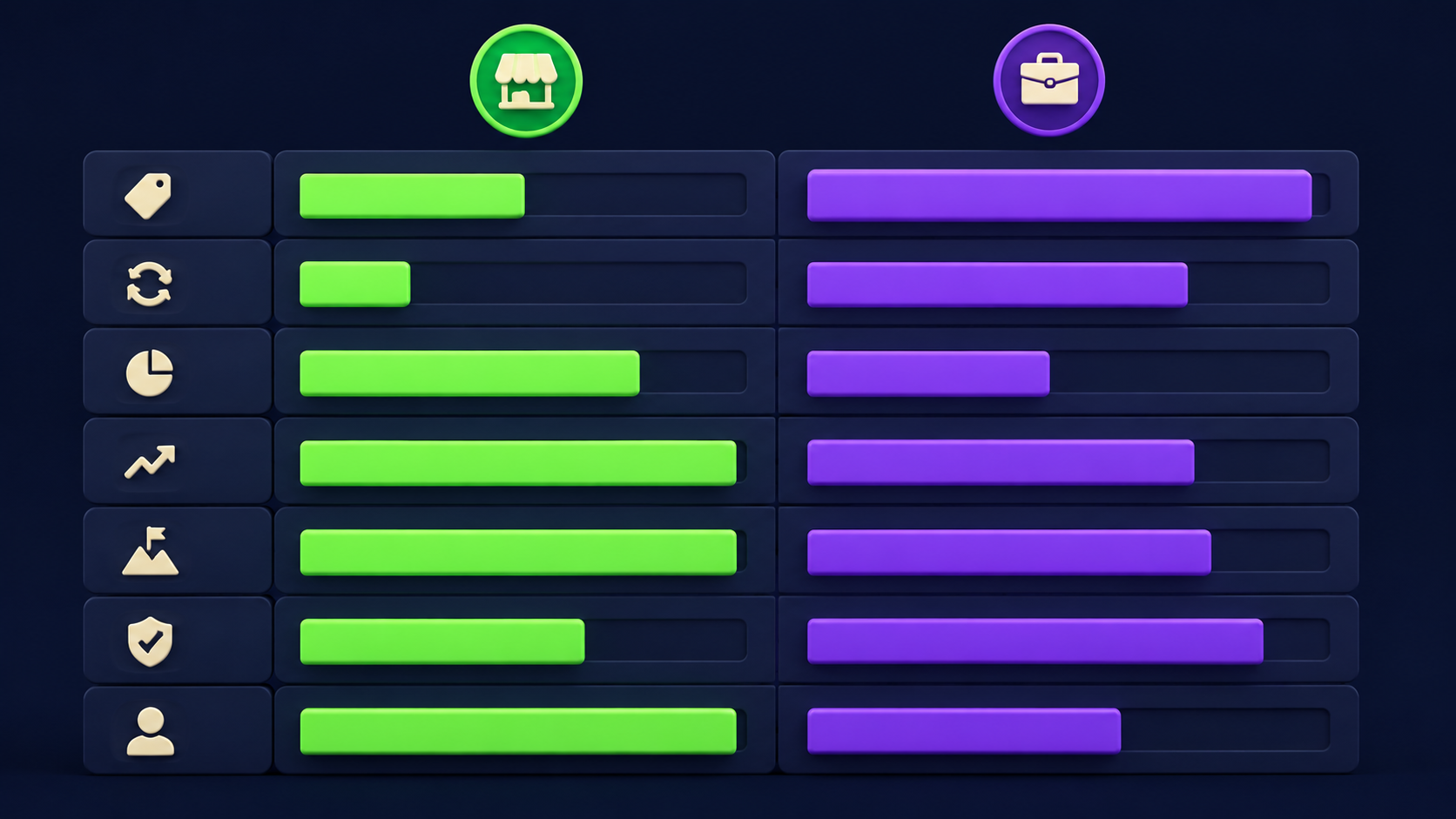
The honest comparison is on seven variables. Marketplaces and agencies trade the same dollars in opposite directions: one optimizes for volume and low touch, the other for price and trust. The table pins each variable to a market-observed range.
Dimension | Marketplace (productized) | Agency (custom) |
|---|---|---|
Price range per sale | $20-$200 one-time, $10-$50 / month subscription | $500-$2,000 simple build, $5,000-$15,000 integrated, $500-$5,000 / month retainer |
Time to first dollar | 30-90 days (build, list, wait for discovery) | 7-30 days (one warm intro, one scoped proposal) |
Churn dynamic | High on subscriptions: 4-7% monthly reported on low-ticket SaaS | Low on retainers: agency retainers typically run quarters to years; B2B churn benchmarks report roughly 5% annual on mid-market |
Scaling ceiling | Unbounded by your time; capped by listing visibility, niche size, and price | Capped by your calendar until you productize, delegate, or hire |
Ops burden per dollar | Low after launch: support tickets, doc updates, platform changes | High per engagement: discovery, build, deployment, retainer, account management |
Capital required to start | Tooling subscriptions and time only; under $500 cash is typical | Tooling plus a pilot to prove the offer; reported sub-$1,000 cash to start |
Fit-for-profile | Strong builders with weak sales muscle, async-first operators, audience already in place | Operators with discovery-call comfort, B2B network, and patience for relationships |
The table is a tradeoff matrix, not a scoreboard. Every row that favors marketplace on effort favors agency on price; every row that favors agency on certainty favors marketplace on scaling ceiling. There is no row that wins both columns, which is the entire reason both models exist at scale.
What is the time-to-first-dollar for each model, honestly?
Time-to-first-dollar is roughly 7-30 days for an agency engagement and 30-90 days for a marketplace listing, with both ranges sensitive to existing audience and existing network. Agencies start earning faster because one warm conversation can close a $1,000 build before any product exists. Marketplaces start earning slower because revenue depends on a listing being found by strangers, not on a relationship being closed.
The agency clock starts the moment a real prospect agrees to a discovery call. Closed correctly, that call produces a scoped proposal inside a week, a deposit inside the second week, and a deliverable inside the third or fourth. HubSpot's 2026 State of Marketing report describes mid-market B2B services with comparable sales cycles when the operator has a warm referral channel. Without warm intros, the same pipeline takes 60-90 days, and the difference is the cost of cold outreach. The marketplace clock starts on launch day but the curve is flat for weeks: a new Gumroad or SellerShorts listing typically earns nothing for the first two-to-four weeks until it accumulates ranking signals, reviews, or external traffic. Operators with an existing audience compress the curve dramatically. One X thread or one newsletter feature can move the first-dollar timeline from 60 days to 60 minutes, while a no-audience launch can take six months to compound. Niche selection sits underneath both curves; the patterns that win small markets are in the boring B2B AI-agent niches that pay guide.
What does churn actually look like for marketplace agents versus agency retainers?
Marketplace subscription agents churn at roughly 4-7% monthly on low-ticket consumer SaaS benchmarks, which compounds to about 40-60% annual loss of the recurring base. Agency retainers churn far slower: B2B service retainers report roughly 5% annual churn at the mid-market level, because the system is embedded in the client's operations and a switch carries real migration cost. One-time marketplace sales do not churn in the strict sense, but they do not recur, which is the same problem in a different shape.
The mechanism behind the gap is switching cost. A $29/month marketplace agent can be canceled in two clicks, by anyone, on any day, for any reason. A $2,000/month agency retainer is wired into the client's CRM, email, billing, and staff workflows; pulling it out is a project, not a decision. The practical implication for operators is opposite per model. A marketplace business survives by replacing churn faster than it loses, which means content, audience growth, and pricing experimentation are the daily job. An agency business survives by deepening the retainer scope per client, which means quarterly reviews, new automations added to the same engagement, and account-management discipline. Both are real work; they are not the same work. The retainer-stacking pattern shows up cleanly in the replace SaaS subscriptions with four n8n AI agents case studies.
What is the actual scaling ceiling for marketplace versus agency?
The marketplace ceiling is bounded by niche size, listing visibility, and price; the agency ceiling is bounded by your calendar until you productize, delegate, or hire. A single marketplace listing can theoretically sell to every buyer in a niche, but in practice runs into a ceiling of $5,000-$50,000 monthly per listing before discoverability, churn, and price competition flatten the curve. A single solo agency caps at roughly $15,000-$40,000 monthly before quality drops or burnout hits, then breaks the ceiling only by hiring or productizing.
The marketplace ceiling lifts by adding listings, not by raising prices. Buyer expectations lock the pricing band: a buyer who scrolls past a $49 agent will not consider the same agent at $499 even if the value justifies it, because the comparison set on the platform is the wrong set. Reported operator playbooks describe a catalog model with 5-15 listings under one creator account, each in an adjacent niche, summing to a meaningful monthly base. The agency ceiling lifts by either hiring or productizing. A solo agency at $10,000 builds twice a month plus three $2,000 retainers grosses $26,000 monthly, which is the realistic top of solo capacity. Above that, you either bring in a delivery contractor or you turn one repeated build pattern into a fixed-scope productized offer. The productized-offer pattern is exactly what the marketplace model encodes, which is why the hybrid below exists. The mechanics of stacking many small agents are in the 15 AI-agent n8n workflows to build this weekend piece.
Why does the hybrid model outperform either pure path?
The hybrid model uses a marketplace listing as a low-cost validation engine and a qualified-lead funnel, then routes the highest-value buyers into a custom agency engagement. A cheap, self-serve agent proves the problem is real and that people pay to solve it; the buyers who outgrow the off-the-shelf version become warm, pre-qualified prospects for a high-margin custom build. This compounds the strengths of both models and reduces the dominant risk of each.
The economics stack cleanly. A $49 marketplace listing buys you the equivalent of paid market research: which problem is real, which buyer type converts, which feature drives upgrade. When a buyer's needs exceed the productized scope, you have a warm lead you did not pay to acquire, and a closing conversation that starts at "I already paid you" instead of "who are you." This is the cheapest customer-acquisition channel an agency has access to. The honest catch is operational: you are maintaining a product and running a sales pipeline at once, and doing either one poorly undermines the other. The pattern that succeeds is sequential: ship the agency motion first for faster first-dollar, then productize the most-repeated build into a marketplace listing, then use that listing to feed the next agency wave. The orchestrator pattern for running the resulting agent fleet is in the orchestrator-worker n8n template.
Which operator profile fits each path?
Marketplace work fits operators with strong building muscle, a pre-existing audience, comfort with async work, and patience for the slow-start curve. Agency work fits operators with comfort on discovery calls, an existing B2B network, tolerance for relationship work, and the ability to scope and quote under uncertainty. The hybrid fits operators who have shipped one full path already and want to compound it with the other; it is rarely the right starting point.
The marketplace profile rewards audience over agent quality. The single biggest predictor of marketplace revenue is not the build itself but the audience the operator brings on launch day, because the platform algorithm rewards early traction. An operator with 5,000 X followers in a tight niche will out-earn a better-built agent from a no-audience operator for the first 90 days. If you do not have an audience, plan to build one before, alongside, or you will pay for visibility in other ways. The agency profile rewards relational stamina. The single biggest predictor of agency revenue is referral-loop velocity: how fast one happy client produces the next two. Operators who treat the relationship as the product (and the build as the deliverable) compound faster, because retainers and referrals do the work that cold outreach cannot. The first-five-clients motion that codifies this is in the AI automation agency first 5 clients playbook.
What capital and tooling do you actually need to start each path?
Both paths are reported to start on under $1,000 cash. The marketplace path needs a platform listing fee or revenue share (Gumroad, SellerShorts, an agent store), a build tool subscription, and an LLM API budget for the agent's own usage in testing. The agency path needs the same automation platform and LLM subscriptions plus a domain, a simple landing page, and a CRM. Neither path requires venture capital, an office, or a team to start.
The marketplace cash floor is roughly $50-$200 monthly: an n8n self-hosted instance on a small VPS, an LLM API key with a small testing budget, and any subscription fees for the platform you list on. Gumroad takes a percentage rather than a monthly fee, which keeps fixed costs near zero. The bottleneck is time spent building, packaging, documenting, and supporting, not cash. The agency cash floor is roughly $100-$400 monthly: the same automation and LLM stack, plus a domain, a basic site or notion-doc proposal, and a CRM at the free tier. The first pilot can and often should be free or low-cost to generate a provable case study. After that, every engagement is funded by the deposit it carries. The migration math between automation platforms is in the n8n vs Zapier vs Make migration math piece.
FAQ
Can a marketplace listing alone support a full-time income in 2026?
Reported earnings on marketplace AI-agent listings span an enormous range, with the distribution skewed toward the low end. A small percentage of listings capture most of the revenue, which is the standard creator-economy power law observed on Gumroad and template stores. The realistic market pattern for a full-time marketplace income is a catalog of 5-15 listings in adjacent niches plus an audience to drive launch traction, not a single listing as a one-shot bet.
Is an agency really lower-risk than a marketplace for a first-time operator?
Agency work usually has lower revenue uncertainty and higher time commitment for a first-time operator, while marketplace work has higher revenue uncertainty and lower time commitment. An agency engagement with a deposit at signing produces a known dollar figure on a known timeline, but consumes a heavy share of the operator's calendar per engagement. A marketplace listing consumes a fixed front-loaded build then almost no calendar, but carries no contractual revenue and no timeline. Which feels "lower risk" depends on whether your scarce resource is dollars or hours.
What is the typical churn rate on marketplace AI agents versus agency retainers?
Marketplace subscription agents track close to consumer-SaaS churn benchmarks of roughly 4-7% monthly per Recurly 2026 data, which compounds to losing 40-60% of the recurring base inside a year. Agency retainers report annual churn closer to 5% at the mid-market service tier, because switching cost is high and the system is embedded in client operations. One-time marketplace purchases do not churn but do not recur, which is the same drag in a different mathematical shape.
How long until a marketplace AI-agent listing breaks even on the build cost?
Reported break-even on a marketplace AI-agent listing spans 1-6 months at typical prices and sales volumes, with a long right tail of listings that never break even. Variance is dominated by audience and discoverability, not by agent quality. A $49 agent launched into an existing 5,000-person email list can break even in a week, while the same agent launched cold can take a year. Plan break-even on the assumption you have no audience until proven otherwise.
Can one solo operator realistically run both a marketplace and an agency at once?
One solo operator can run both, but typically not at full intensity in the same month. The sequence that works is: ship the agency motion first to compress time-to-first-dollar, then productize the most-repeated build into a marketplace listing, then use the listing as a qualified-lead funnel for the next agency wave. Operators who launch both at once usually under-execute both.
Which model has higher gross margin per dollar in 2026?
Marketplace gross margin per sale is higher in percentage terms (often 80-95% after platform fees) but smaller in absolute dollars, while agency gross margin is lower in percentage (typically 40-70% after time-cost and pass-through usage) but larger in absolute dollars per engagement. A $49 marketplace sale at 90% margin returns roughly $44; a $10,000 agency build at 50% margin returns roughly $5,000. Whichever path returns more total margin depends on how many of each you ship, not on the per-unit number.
Common mistakes operators make picking between marketplace and agency

Three patterns recur in reports from operators who tried one path, failed, and switched. All three are about misreading the unit economics before committing to the model.
Launching a marketplace listing with no audience and no traffic plan. The build is fine, the agent works, the listing is live, and nothing happens for 90 days because the operator assumed the platform algorithm would do the discovery work. The fix is to build the audience alongside the listing, or launch into someone else's audience via a sponsorship.
Treating the agency model as a salary instead of a business. Operators who quote per hour, accept open-ended scope, and skip deposits find themselves in a job they own. The fix is fixed-price proposals, deposits at signing, written scope, and the pivot to retainer revenue inside the first 90 days, codified in the 2026 AI-automation rate card of what operators charge.
Running the hybrid as two half-built businesses instead of one sequenced one. Operators who launch a product and a service in the same week typically under-execute both. The fix is to ship one path to a clear milestone (first three paying customers, first three closed engagements) before the second motion gets attention.
Related from Vantaige
References
Get the best new AI tools and guides, weekly
One short email a week. The tools worth trying, the guides worth reading, nothing else.
No spam. Unsubscribe anytime.
Aymen B
Contributing writer at Vantaige, covering the AI tools ecosystem.