GPT-5.5 Instant vs Claude Opus 4.7: 2026 Routing Matrix

GPT-5.5 Instant vs Claude Opus 4.7: 2026 Routing Matrix
OpenAI swapped ChatGPT's default brain on May 5, 2026, replacing GPT-5.3 Instant with the new GPT-5.5 Instant for every Free, Plus, and Pro user, per the official OpenAI launch post. At the same time, Anthropic's Claude Opus 4.7 (released April 16, 2026) is sitting at the top of SWE-bench Verified and the AA-Omniscience calibration leaderboard. The honest question for anyone shipping product is no longer "which model is best," it's "which model for which job, and how do I route?" The TL;DR sits below.
TL;DR
GPT-5.5 Instant ships May 5, 2026, $5/$30 per million tokens, 1M context
Claude Opus 4.7 holds at $5/$25 per million tokens, 1M context, 36% AA-Omniscience hallucination rate
GPT-5.5 hallucinates at 86% on AA-Omniscience, 50pp worse than Opus 4.7
Use Opus 4.7 for agentic coding, citations, function calling, anything you cannot babysit
Use GPT-5.5 Instant for chat UX, summarization, throughput, ChatGPT-native workflows
Aymen Loukil, Founder, Vantaige. Published 2026-05-11. 11 min read. Last reviewed 2026-05-11.
What is GPT-5.5 Instant and when did OpenAI launch it?
GPT-5.5 Instant is OpenAI's new default ChatGPT model, launched on May 5, 2026, replacing GPT-5.3 Instant for all tiers and exposed in the API as chat-latest. Per OpenAI's GPT-5.5 Instant announcement, it produces 52.5% fewer hallucinated claims than GPT-5.3 Instant on high-stakes prompts and uses 30.2% fewer words per response.
The Instant variant is the chat-tuned, low-latency sibling of the full GPT-5.5 reasoning model. It targets short, conversational replies with fewer emoji and a more workplace-safe tone, and it can now reach into past conversations, files, and Gmail for personalized answers (Plus and Pro on web first), per TechCrunch's coverage. For developers, the practical change is that any prompt sent to ChatGPT after May 5 hits a meaningfully different model than the one you tested against last month.
What is the hallucination rate of GPT-5.5 Instant vs Claude Opus 4.7?
Claude Opus 4.7 hallucinates on roughly 36% of attempted answers on the AA-Omniscience benchmark, while GPT-5.5 (xhigh) hallucinates on roughly 86%, a 50-percentage-point gap on the same 6,000-question evaluation set. GPT-5.5 has higher peak accuracy when it does know the answer (57%), but it is far more willing to confabulate when it does not.
The full per-model snapshot, sourced from the public AA-Omniscience leaderboard and the CometAPI breakdown:
Model | AA-Omniscience accuracy | Hallucination rate | Omniscience index | Source |
|---|---|---|---|---|
Claude Opus 4.7 (max) | ~46% | 36% | 26 | artificialanalysis.ai |
Gemini 3.1 Pro Preview | ~52% | 50% | 33 | artificialanalysis.ai |
GPT-5.5 (xhigh) | 57% | 86% | n/a (high recall, low calibration) | artificialanalysis.ai |
The takeaway for routing: AA-Omniscience does not measure how smart the model is, it measures how often a confident assertion turns out to be wrong. For chat UX, an 86% rate is annoying. For an agentic loop that grades its own outputs and acts on them, an 86% rate is dangerous, because a confidently wrong tool call costs more than no tool call at all.
What does each model cost per million tokens?
GPT-5.5 lists at $5 per million input tokens and $30 per million output tokens, while Claude Opus 4.7 lists at $5 per million input and $25 per million output. Headline input prices match. The output gap (20% in Opus's favor) compounds across reasoning loops and long generations.
Spec | GPT-5.5 Instant | Claude Opus 4.7 |
|---|---|---|
Released | 2026-05-05 | 2026-04-16 |
Context window | 1,050,000 tokens | 1,000,000 tokens |
Max output | 128K tokens | 128K tokens |
Input price (per 1M) | $5.00 | $5.00 |
Output price (per 1M) | $30.00 | $25.00 |
Long-context (over 272K input) | 2x input, 1.5x output | No premium |
Batch / Flex discount | 50% off ($2.50/$15) | 50% off batch |
Cache read | ~10% of input | ~10% of input (90% cache savings) |
AA-Omniscience hallucination | 86% | 36% |
SWE-bench Verified | ~74% (full GPT-5.5) | 87.6% |
MCP-Atlas tool use | 68.1% (GPT-5.4 baseline) | 77.3% |
Two pricing footnotes worth knowing. First, GPT-5.5 charges 2x input and 1.5x output above 272K context tokens, per OpenAI's API model docs, which means a 600K-token request actually costs about $10/$45 per million. Second, Opus 4.7 ships a new tokenizer that produces up to 35% more tokens for the same input text (covered in Finout's pricing analysis), so the rate-card parity is misleading on real bills unless you measure post-tokenization.
Which model is better for X? A routing matrix
Pick by job type, not by brand. The matrix below maps the seven workloads we route through Vantaige's own stack. "Winner" means the model we'd pick if you could only run one for that job, given May 2026 prices and benchmarks.
Use case | Winner | Why | Cost note |
|---|---|---|---|
Long-form writing (1500+ words) | Claude Opus 4.7 | Lower hallucination on cited claims, holds voice across sections | 20% cheaper output, matters at length |
Coding / refactor / agentic dev | Claude Opus 4.7 | 87.6% SWE-bench Verified, 77.3% MCP-Atlas tool use | Cache reads 10% of input |
Research with citations | Claude Opus 4.7 | 36% hallucination vs 86% means fewer fake URLs and fake quotes | Use 1M context for source corpus |
Data analysis / numbers from docs | Claude Opus 4.7 | Calibration profile, willingness to say "not in the data" | Long context, no premium under 1M |
Customer support chat | GPT-5.5 Instant | 30.2% fewer words, workplace tone, latency tuned for chat | Batch/Flex cuts to $2.50/$15 |
Function calling / structured tools | Claude Opus 4.7 | MCP-Atlas leader, fewer out-of-scope tool calls per turn | Tool errors cost more than tokens |
Cheap throughput / batch jobs | GPT-5.5 Instant (Batch) | $2.50/$15 in Batch mode beats Opus on output-heavy throughput | Only if hallucination is acceptable |
The single biggest router rule: if a wrong answer is shipped to a user or to a downstream tool without a human in the middle, default to Opus 4.7. If a wrong answer is just a re-roll, GPT-5.5 Instant (especially in Batch) wins on cost.
How do I route between models programmatically?
The cheapest way to route is a thin classifier that looks at the request and picks the model before you spend reasoning tokens. Below is a minimal pattern in Node and Python that classifies on three signals: requires citations, is agentic, is bulk throughput. Keep the router rules in one file so you can re-tune without redeploying every consumer.
Node (TypeScript):
import Anthropic from "@anthropic-ai/sdk";
import OpenAI from "openai";

type Job = {
  prompt: string;
  needsCitations?: boolean;
  isAgentic?: boolean;
  isBulkBatch?: boolean;
};

const anthropic = new Anthropic();
const openai = new OpenAI();

function pickModel(job: Job): "opus" | "gpt55" {
  if (job.needsCitations) return "opus";       // 36% vs 86% hallucination
  if (job.isAgentic) return "opus";            // 77.3% MCP-Atlas
  if (job.isBulkBatch) return "gpt55";         // Batch $2.50/$15
  return "gpt55";                              // chat default
}

export async function run(job: Job) {
  if (pickModel(job) === "opus") {
    return anthropic.messages.create({
      model: "claude-opus-4-7",
      max_tokens: 4096,
      messages: [{ role: "user", content: job.prompt }],
    });
  }
  return openai.chat.completions.create({
    model: "chat-latest",                       // GPT-5.5 Instant alias
    messages: [{ role: "user", content: job.prompt }],
  });
}
Python:
from anthropic import Anthropic
from openai import OpenAI

anthropic = Anthropic()
openai = OpenAI()

def pick_model(job: dict) -> str:
    if job.get("needs_citations"): return "opus"
    if job.get("is_agentic"):      return "opus"
    if job.get("is_bulk_batch"):   return "gpt55"
    return "gpt55"

def run(job: dict):
    if pick_model(job) == "opus":
        return anthropic.messages.create(
            model="claude-opus-4-7",
            max_tokens=4096,
            messages=[{"role": "user", "content": job["prompt"]}],
        )
    return openai.chat.completions.create(
        model="chat-latest",
        messages=[{"role": "user", "content": job["prompt"]}],
    )
Two production tips. First, log the route decision (needs_citations, is_agentic, is_bulk_batch, chosen model, token counts) so you can audit cost and quality monthly. Second, for any agentic loop, turn on Anthropic prompt caching on the system prompt and tool schemas; cache reads at roughly 10% of input price are what makes Opus competitive on long sessions.
When does GPT-5.5 Instant beat Claude Opus 4.7?
GPT-5.5 Instant beats Opus 4.7 on three concrete jobs: short conversational chat at scale, anything routed through ChatGPT's product surface, and Batch/Flex throughput where an 86% hallucination rate is acceptable because a human or a deterministic check sits between the model and the user.
The ChatGPT product surface matters more than the API benchmark gap suggests. Hundreds of millions of weekly users now hit GPT-5.5 Instant by default through ChatGPT, per Axios coverage of the swap. If your funnel involves a user pasting from ChatGPT into your product, GPT-5.5 is the model that produced their input, and matching the same model in your follow-up call cuts tone-mismatch friction.
For raw cost on output-heavy throughput (think summarizing 100K customer reviews where a downstream classifier verifies the result), GPT-5.5 Batch at $2.50/$15 per million tokens is the most efficient frontier model on the market.
When does Claude Opus 4.7 still win?
Opus 4.7 wins on every workload where a confidently wrong answer costs more than a token. That's most of agentic infrastructure, every workflow that produces citations or numbers, function calling, multi-step research, and long-form writing where reputation is on the line.
The benchmarks are concrete. Per the TheNextWeb agentic benchmark roundup, Opus 4.7 leads SWE-bench Verified at 87.6%, SWE-bench Pro at 64.3%, and MCP-Atlas at 77.3%. The MCP-Atlas score is the one to watch for tool use: Opus made roughly a third the tool errors of the previous generation, which is what determines whether your agent loop converges or thrashes.
The hallucination gap (36% vs 86% on AA-Omniscience) is the bigger deal in 2026. Per the FindSkill analysis of GPT-5.5 hallucinations, the practical fix for GPT-5.5 in research workflows is to wrap every claim in retrieval-augmented grounding. Opus does not need that scaffolding for the same reliability.
What about cost? A worked example for 1M tasks/month
For 1M monthly tasks averaging 2K input tokens and 800 output tokens each (a realistic chat-or-summarize workload), GPT-5.5 Instant on standard pricing costs $34,000 per month and Claude Opus 4.7 costs $30,000 per month. Switch GPT-5.5 to Batch and it drops to $17,000 per month, the lowest cost in the comparison.
Scenario | Input cost | Output cost | Total / month |
|---|---|---|---|
GPT-5.5 Instant (standard) | $10,000 (2B in @ $5/M) | $24,000 (800M out @ $30/M) | $34,000 |
GPT-5.5 Instant (Batch / Flex) | $5,000 | $12,000 | $17,000 |
Claude Opus 4.7 (standard) | $10,000 | $20,000 (800M out @ $25/M) | $30,000 |
Claude Opus 4.7 (90% prompt cache, system + tool reuse) | $1,000 (cached) + setup | $20,000 | ~$21,000 |
The cheapest absolute price (GPT-5.5 Batch at $17K) is only a real win if a 86% hallucination rate is acceptable for that workload. If it isn't, Opus 4.7 with prompt caching at ~$21K is the floor. The naive comparison ($34K vs $30K) hides where the actual money is, which is in caching strategy and batch-mode eligibility, not the rate card.
Self-hosted alternative: when cost is the deciding factor
If your blocker is the rate card itself and not the quality gap, self-hosted open-weights models are the path. Hermes 4 (405B), Mistral Large 3, and DeepSeek V4 Pro are all MIT or Apache-licensed and can be run on rented GPU infrastructure for roughly $0.30 to $0.80 per million tokens depending on utilization, an order of magnitude below GPT-5.5 or Opus 4.7.
The two cheapest hosting paths we've validated:
Hostinger VPS with GPU for smaller open-weight models (Hermes 4 quantized, Mistral 8x22B). Best for 24/7 inference where utilization is high enough to amortize a fixed monthly bill.
RunPod on-demand or Spot GPUs for batch and intermittent workloads. Spot H100s at roughly $2/hr beat any frontier API on cost-per-token if you can tolerate occasional eviction.
For a self-host vs frontier-API breakdown with measured tokens-per-second, see our Hermes 4 self-hosted setup vs closed agents writeup.
FAQ
Is GPT-5.5 Instant better than Claude Opus 4.7?
Not for most production workloads. GPT-5.5 Instant has higher peak accuracy on AA-Omniscience (57% vs ~46%) and a snappier chat tone, but it hallucinates on 86% of attempted answers compared to 36% for Opus 4.7. For chat UX inside ChatGPT, GPT-5.5 wins. For coding, function calling, citations, and any agentic loop that grades its own work, Opus 4.7 wins by a wide margin on the benchmarks that matter for those workloads.
Which AI model has the lowest hallucination rate in 2026?
Claude Opus 4.7 has the lowest hallucination rate among frontier models on AA-Omniscience as of May 2026, at roughly 36%, per Artificial Analysis's omniscience leaderboard. Gemini 3.1 Pro Preview comes in at 50%, and GPT-5.5 (xhigh) at 86%. The benchmark covers 6,000 questions across 42 economically relevant topics in six domains, and it specifically rewards models that decline to answer when uncertain rather than confabulating.
What is GPT-5.5 Instant's pricing per million tokens?
GPT-5.5 Instant lists at $5 per million input tokens and $30 per million output tokens for prompts under 272K input tokens. Above that threshold, OpenAI charges 2x input and 1.5x output, so a long-context request runs $10/$45 per million. Batch and Flex modes cut standard pricing in half to $2.50/$15. Priority mode raises it to $12.50/$75. The full schedule is in OpenAI's API pricing page.
Does GPT-5.5 Instant have a 1M token context window?
Yes, GPT-5.5 has a 1,050,000 token context window in the Responses and Chat Completions APIs with a maximum output of 128K tokens. Note that some products surface a smaller effective window: Codex Desktop currently caps at 400K, and several open-source coding agents default to 272K to avoid the long-context price tier. Always check the product surface, not just the model docs.
How do I route between GPT-5.5 Instant and Claude Opus 4.7 in production?
Build a thin classifier that picks the model before you spend reasoning tokens. The minimal three-signal rule: if the task needs citations or factual accuracy, route to Opus 4.7; if the task is agentic or uses tools, route to Opus 4.7; if the task is bulk throughput where hallucinations are tolerable, route to GPT-5.5 Instant in Batch mode. Log the route decision and token counts so you can audit cost and quality monthly.
Will GPT-5.5 Instant replace GPT-5.3 in the API?
Yes, gradually. OpenAI exposes GPT-5.5 Instant in the API as chat-latest and is keeping GPT-5.3 available to paid users for three months from the May 5, 2026 launch. After that window, the default chat-latest alias remains GPT-5.5 Instant. If your code depends on GPT-5.3-specific behavior, pin to the explicit version string before August 2026, or migrate prompts and re-test against chat-latest.
Related from Vantaige
DeepSeek V4 Pro vs Claude Opus 4.7: 5-PR Refactor Test. Same five PRs, both models, real cost per task.
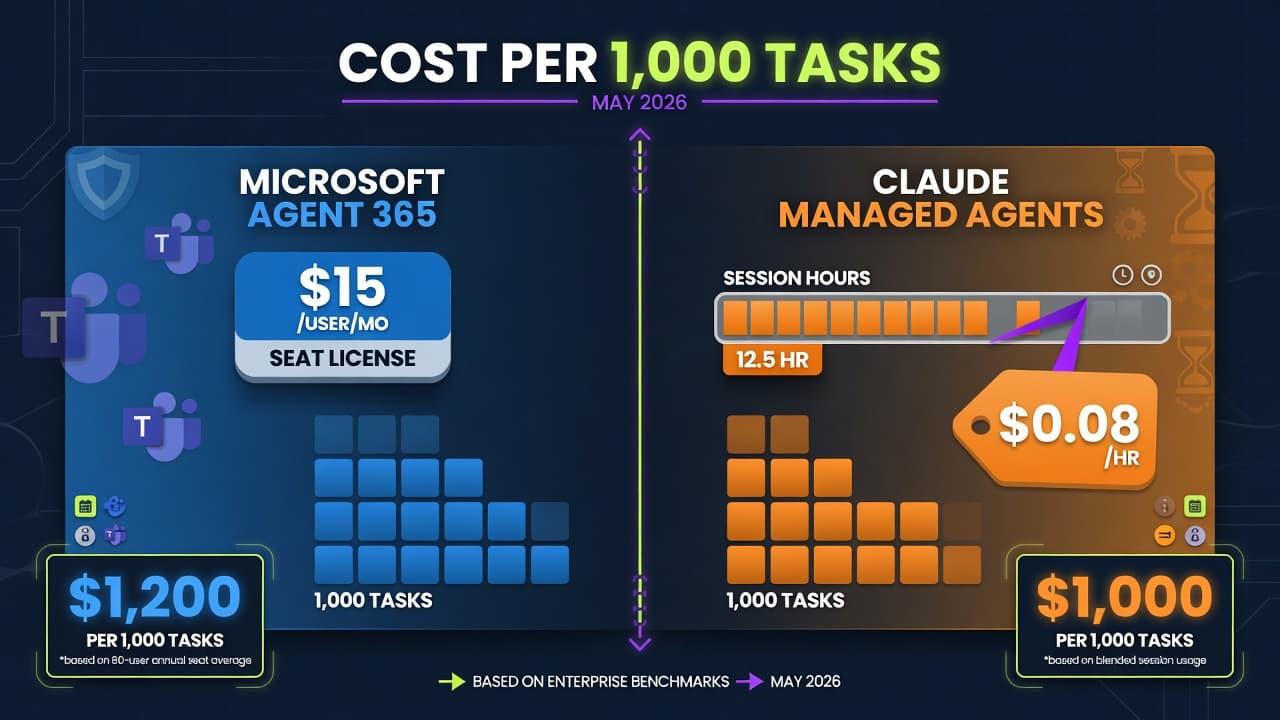
Agent 365 vs Claude Managed Agents: Cost Per 1,000 Tasks. Side-by-side cost math across 4 representative workloads.
Claude Code New Limits (May 2026): Per-Plan Changes & SpaceX Deal. What doubled and why, plus how to verify your new ceiling.
Hermes 4 Self-Hosted Setup vs Closed Agents (2026). Real tokens/sec, real GPU bill, when self-hosting beats the API.
References
OpenAI, "GPT-5.5 Instant: smarter, clearer, and more personalized" (2026-05-05). openai.com
TechCrunch, "OpenAI releases GPT-5.5 Instant, a new default model for ChatGPT" (2026-05-05). techcrunch.com
Artificial Analysis, "AA-Omniscience: Knowledge and Hallucination Benchmark". artificialanalysis.ai
CometAPI, "GPT-5.5 vs Claude Opus 4.7: Which AI to Use When Hallucination Matters". cometapi.com
OpenAI, "GPT-5.5 Model" API docs. developers.openai.com
OpenAI, "API pricing". developers.openai.com/api/docs/pricing
Anthropic, "Pricing" Claude API docs. platform.claude.com
Anthropic, "What's new in Claude Opus 4.7". platform.claude.com
Finout, "Claude Opus 4.7 Pricing 2026". finout.io
TheNextWeb, "Claude Opus 4.7 leads on SWE-bench and agentic reasoning". thenextweb.com
FindSkill, "GPT-5.5 Hallucinates 86% of the Time. Here's How to Use It Anyway". findskill.ai
Axios, "OpenAI updates ChatGPT Instant with GPT 5.5". axios.com
Get the best new AI tools and guides, weekly
One short email a week. The tools worth trying, the guides worth reading, nothing else.
No spam. Unsubscribe anytime.
Aymen B
Contributing writer at Vantaige, covering the AI tools ecosystem.