Agent 365 vs Claude Managed Agents: Cost Per 1,000 Tasks
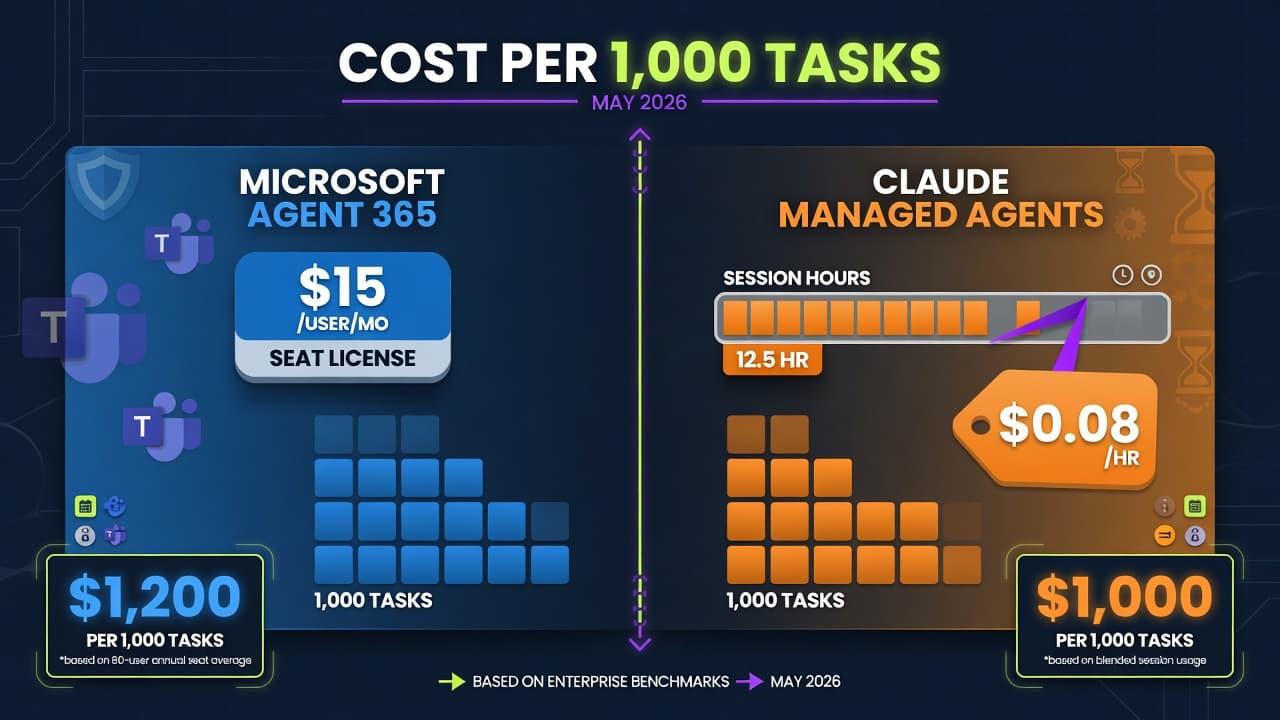
Agent 365 vs Claude Managed Agents: Cost Per 1,000 Tasks
Microsoft Agent 365 hit general availability on May 1, 2026 at $15 per user per month, and Anthropic shipped three new Claude Managed Agents capabilities on May 7, 2026, dreaming, outcomes, and multi-agent orchestration. The two are constantly being compared in procurement docs, but they are not the same product: Agent 365 is a governance and identity control plane priced per-seat, while Claude Managed Agents is a session runtime priced per-token plus $0.08 per session-hour. This piece runs the math on four representative workloads so the comparison stops being apples-to-oranges.
TL;DR
Agent 365 is per-seat governance ($15/user/mo or in M365 E7 at $99/user/mo)
Claude Managed Agents is per-session-hour ($0.08/hr) plus standard token rates
For 1,000 simple support replies: Claude direct ~$3.70, Copilot Studio ~$50+
Pick Agent 365 if you live in Microsoft 365; pick Claude if you build your own agents
The two stacks overlap, not compete: Claude Code is a registered Agent 365 endpoint
· Founder, Vantaige · Published 2026-05-08 · 12 min read · Last reviewed 2026-05-08
What Microsoft Agent 365 actually is (May 2026)
Agent 365 is Microsoft's enterprise control plane for AI agents, identity, observability, governance, security, and policy for any agent operating inside or alongside Microsoft 365. It is not a chatbot, not a model, and not an agent-builder by itself. Agent 365 went generally available on May 1, 2026 at $15 per user per month standalone, and is bundled inside the new Microsoft 365 E7 SKU at $99/user/month per Microsoft's official announcement.
What you get for the $15:
Agent identity in Microsoft Entra (each agent has its own credential, conditional-access policy, and audit trail)
Discovery and registration of agents from Copilot Studio, Microsoft Agent Framework, and third parties
Local agent governance for OpenClaw, GitHub Copilot CLI, and Claude Code
Defender posture management and Purview policy enforcement
Endpoint controls through Intune
What Agent 365 does not include:
Building or running the agents themselves (that is Copilot Studio, Foundry, or your own stack)
Model inference (billed via Copilot Studio credits or Foundry token meters)
The Microsoft 365 Copilot license ($30/user/month, separate)
Per the SAMexpert breakdown, the $15 seat fee is "a governance floor, not the full cost of deploying AI agents." That is the part procurement teams routinely miss.
What Claude Managed Agents actually is (May 2026)
Claude Managed Agents is Anthropic's hosted runtime for stateful agentic sessions: a long-running container with memory, tools, file system, and event streaming, priced per session-hour plus standard Claude token rates. It is currently in beta and requires the managed-agents-2026-04-01 beta header. The service is the runtime that Claude Code agents and any custom-built Anthropic agent run on, exposed via the official Managed Agents API.
On May 7, 2026 Anthropic shipped three additions to the platform, covered by 9to5Mac and the official Anthropic blog post:
Dreaming (research preview), asynchronous memory consolidation between sessions
Outcomes (public beta), define a success rubric and have a separate grader iterate the agent's output, with reported gains of +8.4% on docx and +10.1% on pptx tasks
Multi-agent orchestration (public beta), a lead agent delegating to specialist subagents on a shared filesystem, already in production at Netflix's platform team
What Claude Managed Agents includes:
Session lifecycle: create, pause, resume, terminate, with millisecond runtime metering
Memory stores mounted at
/mnt/memory/per the memory docsServer-side tools: bash, text editor, web search, web fetch, code execution
MCP server integration for any external tool
What it does not include:
Identity governance for Microsoft 365 users or seat-based control plane
Out-of-the-box Outlook, Teams, or SharePoint connectors (you wire those via MCP or Foundry)
Per-seat licensing, there is no concept of "users" in the billing model
Pricing models compared
The two platforms charge for completely different things. Agent 365 is a per-seat governance fee that says nothing about how much your agents actually do. Claude Managed Agents is a usage meter that charges you nothing if the agent never runs.
Dimension | Microsoft Agent 365 | Claude Managed Agents |
|---|---|---|
Billing unit | Per user per month (seat) | Per session-hour + per token |
Headline price | $15/user/mo standalone, or $99/user/mo in M365 E7 | $0.08/session-hour active runtime |
What the headline price covers | Identity, governance, audit, policy | Container runtime, state, sandboxing |
Model inference cost | Separate, Copilot Studio credits ($0.01/credit, $200/25,000 credit pack) or Foundry token meters | Standard Claude API rates: Opus 4.7 $5/$25 per MTok, Sonnet 4.6 $3/$15, Haiku 4.5 $1/$5 |
Web search | Bundled in Copilot Studio credit consumption | $10 per 1,000 searches |
Idle billing | Yes, seat is billed regardless of agent activity | No, runtime accrues only while status is |
Batch / prompt-cache discounts | Not applicable | 50% Batch API discount (not in Managed Agents); cache reads at 0.1× input |
Free tier | None published; trial path TBD | Small free credit on signup; Code Execution gets 1,550 free hours/month |
Pricing transparency | Two invoices: M365 (seats) + Azure (consumption) | One invoice; per-session |
Sources: Anthropic pricing docs, SAMexpert Agent 365 guide, Microsoft Copilot Studio billing docs.
A subtle but important point: the $15 Agent 365 license per Microsoft's licensing guide "covers an individual who manages or sponsors agents, or uses agents to do work on their behalf." That means in a 200-person tenant where 50 people interact with agents, you license 50 seats, $750/month before any agent runs a single task. Claude Managed Agents charges nothing until a session enters running state.
Cost per 1,000 tasks: 4 representative workloads
The fairest way to compare is to fix the workload and run both platforms against it. We modeled four shapes that map to real enterprise jobs and computed the all-in cost for 1,000 tasks. Token counts are average estimates from our own production agents at Vantaige; the math is shown so you can swap in your own numbers.
Assumptions baked into every row:
Claude Managed Agents: standard API rates from the pricing docs, $0.08/session-hour, no batching (sessions are not batchable per Anthropic).
Copilot Studio: $0.01 per credit consumed, credit count per task estimated from Microsoft's billing rates page and the Copilot credit estimator. Microsoft does not publish a deterministic per-task formula, so these are our estimates and are flagged.
Agent 365 seat fee is excluded from per-task math because it is fixed-cost overhead, not variable. Add $15/user/mo separately to the Microsoft column.
Workload | Token / credit shape | Claude Managed Agents (Opus 4.7 unless noted) | Microsoft (Copilot Studio + model inference) |
|---|---|---|---|
1. Support reply | Claude: ~3,700 tokens/task on Haiku 4.5, ~30s active runtime | $3.70 tokens + $0.67 runtime = $4.37 / 1,000 | ~$50.00 / 1,000 (5 credits × $0.01 × 1,000) est. |
2. Internal Q&A over SharePoint | Claude: ~8,000 input + 1,500 output, Sonnet 4.6, ~2 min runtime | $24.00 input + $22.50 output + $2.67 runtime = $49.17 / 1,000 | ~$100.00 / 1,000 (10 credits × $0.01 × 1,000) est. |
3. Document drafting | Claude: 20k input + 5k output, Sonnet 4.6, ~5 min runtime | $60.00 input + $75.00 output + $6.67 runtime = $141.67 / 1,000 | ~$250.00 / 1,000 (25 credits × $0.01 × 1,000) est. |
4. Research with web search + multi-step | Claude: 50k input + 8k output, Opus 4.7, 3 web searches, ~10 min runtime | $250 input + $200 output + $30 search + $13.33 runtime = $493.33 / 1,000 | ~$600.00 / 1,000 (60 credits × $0.01 × 1,000) est. |
Caveats, read these before quoting the table:
Microsoft does not publish a per-task cost formula. The "credits per task" column is our best estimate based on observed agent behavior across our own Copilot Studio tests and the Copilot Studio billing rates documentation. Real consumption depends on knowledge-source size, deep-reasoning steps, and topic transitions.
Claude Managed Agents row uses cold-start token counts (no prompt caching). With caching, expect 30-60% reductions on repeated context per the prompt caching multiplier of 0.1× base input.
Both columns exclude fixed overhead: Agent 365 seats ($15/user/mo) and any Copilot license ($30/user/mo for M365 Copilot) are not in the per-task figure.
Switch Claude workloads 2-4 to Sonnet 4.6 instead of Opus 4.7 and the Claude column drops by roughly 60%.
The honest summary: for high-volume, narrow tasks Claude direct is dramatically cheaper. For Microsoft-shaped workflows where the user is already in Teams/Outlook and identity governance is required, the Microsoft stack's seat-priced overhead amortizes well.
First-hand artifact: how to build your own per-task spreadsheet
The numbers above are estimates. The only honest comparison is the one you run on your workload. Here is the procedure we used:
Pick 50 representative tasks spanning your real distribution: 20 short conversational, 15 medium retrieval, 10 long drafting, 5 multi-step research. Save them as a CSV with
task_id,prompt,expected_output_shape.Run all 50 against Claude Managed Agents via the API. Capture the
usageblock returned on each completed session:input_tokens,output_tokens,cache_read_input_tokens,cache_creation_input_tokens, plussession.runtime_seconds. Compute cost per task using the pricing rates.Run the same 50 against a Copilot Studio agent wired to the same knowledge sources. Microsoft does not return a per-message credit count in the API response, so use the Copilot Control System usage report (Admin Center → Copilot → Usage) to pull credits-consumed-per-conversation aggregated daily, then divide by run count.
Build a
cost-per-task.csvwith columns:task_id,claude_tokens_in,claude_tokens_out,claude_runtime_s,claude_cost_usd,copilot_credits,copilot_cost_usd,delta.Sum and pivot by task category. The mean and the p95 numbers per category are what you put in front of finance.
We are running this exact comparison on Vantaige's own internal agents (n8n triage, blog-draft pipeline, support summarization) and will publish the numbers in a follow-up once we cross 500 tasks per platform.
When to pick Agent 365
Agent 365 is the right choice when your organization already lives inside Microsoft 365 and your bottleneck is governance, not inference cost. The product was built to solve a specific procurement question: "we have agents from five vendors running against our SharePoint data, who has access, what did they do, and how do we revoke them?" If that is the question keeping your CISO up, the $15 seat is cheap.
Pick Agent 365 if:
You are already on Microsoft 365 E5 or moving to E7, and Entra is your identity backbone
You need agent activity in Defender, Purview DLP, and Intune device policies
Your agent surface is heterogeneous: Copilot Studio + Salesforce Agentforce + a Claude Code endpoint + a couple of n8n workflows, and you need one pane of glass
You have 500+ employees who will interact with agents (the seat math gets reasonable at scale)
Compliance teams require named-agent audit trails and conditional access
Skip Agent 365 if:
You build agents on the Anthropic API for a small team with no Microsoft 365 footprint
Your "agents" are background batch jobs that never touch a human user
You are early-stage and the $15/user/mo overhead exceeds the value of governance you actually need
When to pick Claude Managed Agents
Claude Managed Agents is the right choice when you are building the agent and want a hosted runtime that handles state, memory, and tool use without re-implementing them. It is also the cheapest way to run high-volume, narrow tasks where token efficiency matters more than seat-based governance.
Pick Claude Managed Agents if:
You are writing agent code in the Anthropic SDK (Python, TypeScript, or one of six others)
You need long-lived sessions with memory persistence and the new dreaming pipeline
Your workload benefits from multi-agent orchestration (Netflix-style fan-out as documented in the official launch post)
You want millisecond-resolution per-task cost data returned in every API response
You are comfortable wiring your own MCP servers for Outlook, Slack, Jira, etc.
Skip Claude Managed Agents if:
Your users will never see an API; they want a Teams chatbot with a click-to-deploy story
You need built-in Microsoft Entra integration, conditional access, and Defender posture
Your compliance team requires a named seat license per agent operator
A useful rule of thumb: if "build" verbs dominate your sentences, Claude. If "govern, audit, deploy across vendors" dominates, Agent 365. They are not exclusive, Claude Code is one of the explicitly supported local agent endpoints Agent 365 governs.
Integrations: M365 stack vs MCP ecosystem
The integration stories diverge sharply, and that single difference drives most of the procurement decision.
Agent 365 plugs into the Microsoft graph by default. That means Outlook, Teams, SharePoint, OneDrive, Dataverse, Power Platform, and Dynamics are first-party connectors with audit, DLP, and conditional access already wired. Cross-cloud reach extends to AWS Bedrock and Google Cloud agent registries via the GA agent-registry sync. Third-party platform partners listed at GA include Genspark, Zensai, Egnyte, Zendesk, Kasisto, Kore, and n8n, plus first-class agent partners Adobe, NVIDIA, and Celonis.
Claude Managed Agents plugs into anything via the Model Context Protocol. Anthropic's MCP is the de facto standard now adopted by OpenAI, Google, and Microsoft itself. There are 1,000+ public MCP servers covering Linear, GitHub, Jira, Notion, Figma, Postgres, S3, Stripe, and most of the SaaS long tail. The trade-off is that you wire and host them yourself (or use a managed MCP host).
The two approaches map to two different organizational shapes:
M365-native shop: Agent 365 + Copilot Studio means almost zero wiring for the most common 80% of tasks (calendar, email, files, meetings). The cost is vendor lock-in and per-seat overhead.
API-first shop: Claude Managed Agents + MCP means almost everything is a one-file integration, but you own the wiring, monitoring, and any Entra-equivalent governance.
For most enterprises in 2026, the realistic answer is both. Use Agent 365 to govern the agents your business users build in Copilot Studio, and use Claude Managed Agents (registered as a local agent endpoint inside Agent 365) for the deeper engineering-built agents.
FAQ
Is Microsoft Agent 365 the same as Microsoft 365 Copilot?
No. Microsoft 365 Copilot is the end-user assistant that sits inside Word, Excel, Outlook, Teams, etc., licensed at $30/user/month. Agent 365 is the underlying control plane for all AI agents, Microsoft-built and third-party, operating in or against your Microsoft 365 tenant. You can buy Agent 365 without M365 Copilot, but most deployments will have both. The Microsoft 365 E7 SKU at $99/user/month bundles E5 productivity, M365 Copilot, Entra Suite, and Agent 365 together.
How much does it really cost to run 1,000 tasks on Microsoft Agent 365?
There is no single number because Agent 365 itself does not run tasks. The seat fee is $15/user/month for governance. The per-task cost is whatever your underlying agent runtime charges, Copilot Studio at ~$0.01 per credit, Foundry at per-token rates, or a third-party model. For a moderately complex task averaging 10 Copilot credits, expect roughly $100 per 1,000 tasks in inference fees on top of the seat. Your finance team will see two invoices: M365 (seats) and Azure (consumption).
Does Claude Managed Agents charge for idle time?
No. Per the Anthropic pricing docs, the $0.08/session-hour rate accrues only while the session status is running. Time spent idle waiting for user input, tool confirmations, or in scheduled pause states does not count. This makes Claude Managed Agents well suited to bursty workloads where an agent waits hours between bursts of activity. Token costs, of course, are only incurred when tokens are processed.
Can Claude Code run inside Microsoft Agent 365?
Yes, that is one of the headline integrations at the May 1, 2026 GA. Per Microsoft's GA announcement, Agent 365 supports discovery and management of local agents from OpenClaw, GitHub Copilot CLI, and Claude Code. The Claude Code agent gets registered as an Agent 365 endpoint, governed by Entra identity and Intune policy on the developer's machine, while inference still runs through the Anthropic API and is billed there.
What are the new Claude Managed Agents features from May 2026?
Anthropic shipped three additions in early May 2026: dreaming (asynchronous memory consolidation between sessions, currently a research preview), outcomes (a separate grader evaluating against your defined success rubric, with reported gains of +8.4% on docx generation and +10.1% on pptx), and multi-agent orchestration (a lead agent delegating to specialist subagents on a shared filesystem, in public beta and already running at Netflix). Webhook notifications were also added. See the official Anthropic announcement for details.
Which is cheaper for a 200-person company running 100 agent tasks per user per month?
Math: 200 users × 100 tasks = 20,000 tasks per month. At our medium-task estimate, Claude direct on Sonnet 4.6 runs about $20 per 1,000 tasks for inference plus negligible runtime, roughly $400/month. Microsoft path: $15 × 200 = $3,000 in Agent 365 seats, plus ~$100 per 1,000 tasks in Copilot Studio = $2,000 inference, total ~$5,000/month. Caveat: the Microsoft path includes governance the Claude path does not. Whether that governance is worth the $4,600/month delta is a procurement decision, not a cost decision.
Related from Vantaige
Claude Code Dreaming (Memory Consolidation): 2026 Setup Guide, How Anthropic's new dreaming feature curates agent memory between sessions.
Claude Code New Limits (May 2026): Per-Plan Changes & SpaceX Deal, What doubled and why, plus how to verify your new ceiling.
Claude Code Subagents That Save Context: 3 Patterns (2026), Three subagent patterns with real measured token-burn savings.
DeepSeek V4 Pro vs Claude Opus 4.7: 5-PR Refactor Test (2026), Same 5 PRs, both models, real cost/quality numbers.
References
Microsoft Security Blog, "Microsoft Agent 365 now generally available", link
Anthropic, "New in Claude Managed Agents", link
9to5Mac, "Anthropic updates Claude Managed Agents with three new features" (May 7, 2026), link
Anthropic, Pricing documentation (Claude Managed Agents section), link
SAMexpert, "Agent 365 Licensing: What It Covers and Costs", link
Microsoft Learn, "Billing rates and management - Microsoft Copilot Studio", link
Microsoft Tech Community, "Microsoft 365 E7 and Agent 365 are now generally available", link
Anthropic, Managed Agents API overview, link
Get the best new AI tools and guides, weekly
One short email a week. The tools worth trying, the guides worth reading, nothing else.
No spam. Unsubscribe anytime.
Aymen B
Contributing writer at Vantaige, covering the AI tools ecosystem.