AI Automation Agency From Zero: The First-Five-Clients Playbook (2026)

AI Automation Agency From Zero: The First-Five-Clients Playbook (2026)
Most small and mid-sized businesses know AI automation can remove hours of manual work, yet almost none have an internal person who can wire a model to their CRM, inbox, and spreadsheets. So they pay an outside operator. This is the method for taking an AI automation agency from zero to five paying clients in 2026: positioning, the free pilot, outreach, pricing, contract and scope, handoff, and the referral loop. A method, not an income pitch. What any operator earns depends on niche, execution, and sales volume.
TL;DR
Pick one painful workflow inside one industry.
Ship one free pilot to a real, named business.
Outreach: warm intros, Loom plus one-line audit, communities.
Price fixed-scope build plus monthly retainer, never hourly.
Every delivery produces one case study and one intro.
Disclaimer: every dollar figure here is a market-observed range reported by agencies, operators, and 2026 pricing roundups. None of it is income promised, projected, or guaranteed. Outcomes depend on your niche, execution, and sales volume.
What does "AI automation agency from zero" actually mean in 2026?
An AI automation agency from zero is a one-person services business with no portfolio or brand, selling other businesses the design, build, and maintenance of workflows where an AI model handles a reasoning step. The unit you sell is a working pipeline, not technology. The first five clients are won on positioning and proof, not a website.
The buyer purchases a recurring manual task disappearing plus the number that task improves. "Every inbound lead enriched and routed in under sixty seconds instead of a coordinator spending two hours a day on it" is the deliverable. "An n8n workflow with an LLM node" is not. The deeper service architecture is in the operator playbook for building and selling AI automations as a service.
Why are the first five clients a distinct phase with their own playbook?
The first five clients are a distinct phase because each one converts an unknown operator into a referenceable one. Client one produces your first measured before-and-after number. Clients two through five turn that result into a pattern. After five delivered builds in one niche, acquisition cost drops because proof and warm intros replace cold effort.
Before client one you are selling a claim. After client five you are selling evidence. That shift is why the first five get their own moves: a free or low-fee pilot, a tight outreach motion built around one demo, a deliberate referral ask, and pricing that increases on confidence rather than guesswork.
How do you pick the one niche and the one painful workflow?
Pick one repeatable workflow inside one industry, tied to revenue or a large recurring cost, in a vertical where you can name the tools and pains. "Patient intake follow-up for dental clinics" is a niche. "AI automation for businesses" is not. Specificity is the close-rate lever: "I built this exact workflow for three comparable businesses" beats any generalist pitch.
Use three filters in order:
A nameable, repetitive workflow. Point at one task a human does many times a week, by name. "Recruiters manually copying applicant data from six job boards into an ATS." Vague pain does not convert a cold prospect.
The workflow touches money. Automations near revenue (lead response, quoting, follow-up) or a large cost center (support volume, headcount, chargebacks) get budget approved. "Nice to have" never does.
You have an unfair edge in the vertical. A past job, an existing network, or a community you already belong to. The niche where you can speak the buyer's language beats a colder one with bigger theoretical budgets.
Commit through all five clients before reconsidering the niche. Switching after client one erases the proof from client one, because the case study no longer matches the next prospect's vertical. The decision logic for which boring verticals reliably have budget is in the guide to boring B2B AI agent niches that pay in 2026.
How does the free-pilot-to-paid mechanism actually work?
The free-pilot-to-paid mechanism is a written agreement where you deliver one scoped automation to one real business at zero or near-zero cost, in exchange for their real data to test on and permission to use the measured result as a case study. The pilot produces proof, not revenue. The proof converts the next four clients at full price.
A documented result for a named business converts because buyers trust measured outcomes, not screenshots. Treat client one as a proof investment and the math works.
Pitch the pilot in writing. Approach one business in your niche, ideally a warm contact. The pitch names one workflow, what you will measure, what they keep, and what you keep (case-study rights and a testimonial). One workflow, one page, one signature.
Measure the baseline before you build a single node. Record the current state in their numbers: hours per week on the task, response time, error rate, leads lost. This baseline is the single most valuable artifact in the playbook.
Build the smallest workflow that produces the result. One trigger, one model step, one or two integrations, error handling from version one. Anything outside the named workflow is a paid change order.
Document the after, then ask for the testimonial and the intro on the same call. After two to three weeks live, pull the post numbers, write a one-page case study, and on the result-review call ask for a short quote plus one introduction. Asking at any other moment converts worse.
Success state: one live automation for a real business, a one-page case study with a before-and-after number and a client quote, and one warm intro in hand. This produces proof, not guaranteed revenue.
What is the outreach motion that returns replies in 2026?
The outreach motion that returns replies in 2026 is a short message that names the workflow, names a number, attaches a two-minute Loom of the client-one build, and adds a one-line audit of something visible on the prospect's site. Generic "I do AI automation" messages get ignored. Specific messages with a visible artifact convert because they prove you already looked.
The motion runs in three channels, weighted by cost. Warm and referral close best at lowest cost but only exist after client one delivers, so outbound and communities carry early volume. Run all three in parallel, not sequentially.
Warm network and referrals. List every person you know who runs, works at, or sells into a business in your niche. Send a short message naming the workflow and the client-one number ("the dental clinic I built for cut follow-up time from 110 minutes a day to 18"). Ask client one and every later client at day sixty for one introduction. This is the channel that compounds.
Targeted outbound with Loom plus one-line audit. Build a list of businesses in your niche that visibly have the problem (slow contact form, public hiring for the role you would automate, stale support inbox). Send a message under one hundred words that names the workflow, names a number from client one, attaches a two-minute Loom of the build, and adds one specific line about their site ("your contact form has no autoresponder"). The audit is the hook; the Loom is the proof.
Communities and marketplaces. Be where buyer intent already exists. Answer real questions in niche subreddits, Skool groups, and Upwork filtered to your workflow. Subcontract jobs in operator communities are an honest source of paid early reps. The same buyer-intent logic, applied to local businesses, is in the local-business AI chatbot retainer playbook.
Volume calibration: a typical first-week target is twenty to forty targeted outbound messages per business day, every warm contact emailed once, and one substantive community answer per day. The build is rarely the bottleneck; pipeline is.
What does the Client 1 to Client 5 map look like week by week?
The Client 1 to Client 5 map is a planning shape, not a deadline. Proof from client one must exist before paid acquisition scales: skip the pilot and the rest of the table collapses. Outreach starts in parallel with the pilot.
Client | Week window | Outreach action | Offer | Conversion mechanism | Typical price range |
|---|---|---|---|---|---|
1 | Weeks 1 to 4 | Direct ask to one warm contact in your niche | Free or near-free scoped pilot for data and case-study rights | Measured before-and-after; written quote at delivery | $0 to $500 pilot (proof, not revenue) |
2 | Weeks 4 to 7 | Referral from client one, shared with the case-study one-pager | Fixed-scope paid build using the same workflow template | One-pager plus short discovery call; fixed proposal | $500 to $2,000 simple build |
3 | Weeks 6 to 10 | Targeted outbound with Loom plus one-line audit, 20 to 40 / day | Fixed build fee plus small monthly maintenance retainer | Loom of client-one build plus prospect-specific audit line | $1,500 to $5,000 build, $300 to $750 / month retainer |
4 | Weeks 8 to 13 | Community inbound (Skool, subreddit, Upwork) plus second-degree referral | Productized package: build plus retainer plus usage pass-through | Public answers tied to your workflow; one named case study | $3,000 to $8,000 build, $500 to $1,000 / month retainer |
5 | Weeks 12 to 16 | Compounding referrals from clients two and three; one outbound batch | Same productized package, integrated-stack pricing when scope expands | Three referenceable case studies; higher pricing confidence | $5,000 to $15,000 integrated stack, $500 to $1,500 / month retainer |
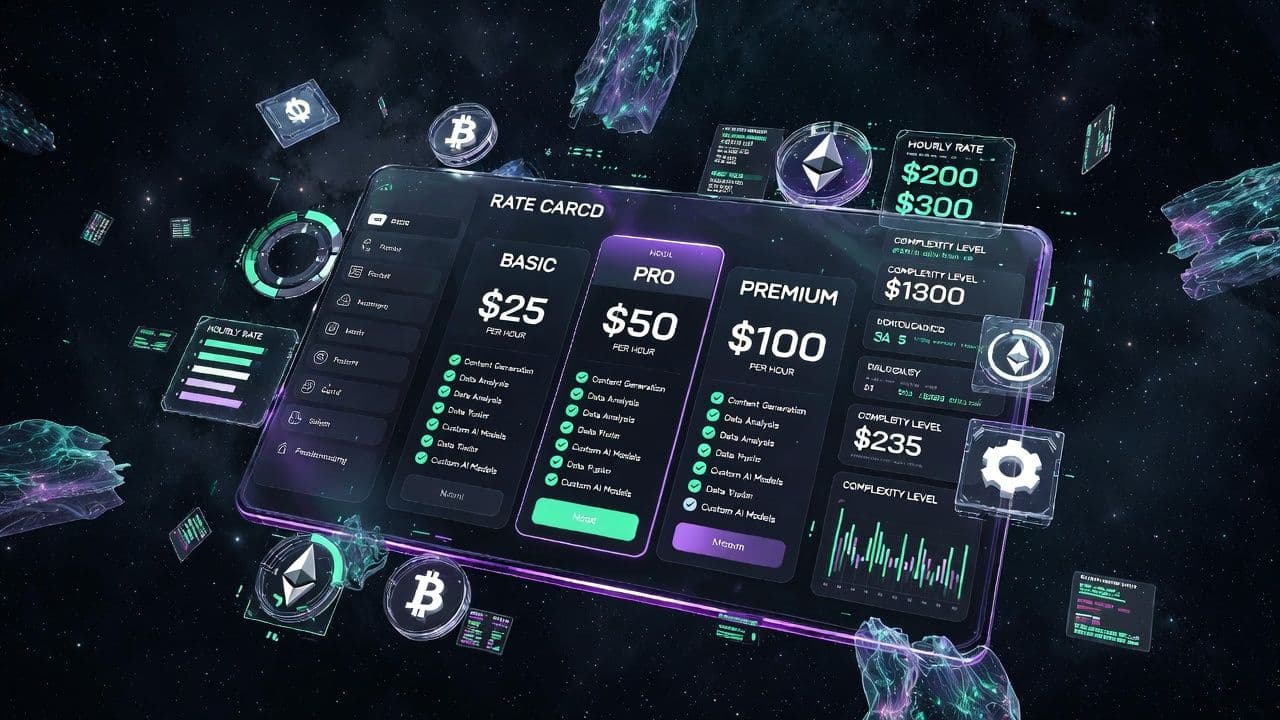
The price columns are market-observed ranges, not guarantees: simple builds cluster at $500 to $2,000, integrated multi-tool stacks at $5,000 to $15,000, monthly retainers at $300 to $1,500. Week windows overlap on purpose: clients two and three are usually being scoped while client one is still in delivery. The full rate logic by deal type is in the 2026 AI automation rate card of what operators charge.
How do you have the pricing conversation without flinching?
You have the pricing conversation by anchoring on outcome value, naming a market-observed range out loud, and proposing a fixed-scope number tied to a written deliverable. The fatal pattern is hourly: it rewards the slow operator, invites micromanagement, and caps revenue at calendar hours. Fixed price plus retainer is the only structure that scales past client two.
Run the discovery call in four moves. Mirror the outcome in the buyer's words ("you want every inbound lead enriched in under sixty seconds, you currently spend roughly two hours a day on it"). Attach a number to the status quo ("two hours a day at coordinator cost is roughly $X per month, never mind lost-lead drag"). Name the range out loud ("builds of this shape are commonly $1,500 to $5,000 one-time plus a $300 to $750 monthly retainer"). Propose a specific fixed-scope number inside the range, in writing, the same day. Anchored, ranged, specific.
Three rules hold across every early pricing conversation. Never split scope from price; one workflow with named inputs and outputs is one fixed price. Separate the one-time build from the recurring retainer, because the build pays for now and the retainer compounds. Pass usage costs (LLM tokens, scraping, messaging) through at cost plus 10% to 30%. Reference bands are in the 2026 AI automation rate card.
What goes in the contract and the scope document?
The contract and the scope document are two artifacts, both short. The contract covers commercial terms, ownership, liability, and termination. The scope document covers the one workflow being built, in named inputs, named outputs, and named "done." Both are signed before any build work starts. Skipping either costs money on scope creep, unpaid maintenance, or both.
The scope document is the more important of the two for the first five clients. A clear scope kills 80% of scope-creep arguments, because "can you also..." becomes a polite "yes, that is a change order at $X."
Pick the right commercial structure. Fixed-price build is a one-time scoped engagement with a defined deliverable. Monthly retainer is a recurring fee for monitoring, fixes, prompt tuning, small changes, and a monthly report, signed at handover. Almost every deal is "fixed build plus retainer," not one or the other.
Write the scope in eight named fields. Workflow name, trigger, inputs, model step(s), integrations, outputs, success metric (with baseline), and what is explicitly out of scope. Eight bullets, one page. If a field is empty, the scope is not done.
Set commercial terms that protect cashflow. 50% deposit at signing, 50% at handover for fixed-price builds. Retainers billed monthly in advance. Usage costs pass through line-itemized. Net 7 on the first invoice, net 14 thereafter.
Own the IP boundary clearly. The client owns their data, account, and workflow outputs. You own the templated workflow logic and the right to reuse it in unrelated verticals. This is what protects template reuse, the reason a niche compounds.
Write a single-page change-order template before client one. Two fields: the requested change in one sentence, the fixed price. Sign before building. Without this, scope creep destroys margin past the first deal.
How do you do the handoff and the handover so the automation does not break?
The handoff is the moment the client takes operational ownership of the workflow. The handover is the document and access set that makes that ownership real: written, dated, signed. Operators who skip it stay on the hook for free support. Common post-launch failures (OAuth expiry, API changes, prompt drift, schema changes, rate limits) are predictable and budgeted into the retainer.
Write a one-page runbook before handover. What the workflow does, what triggers it, where it runs, which credentials power it, where the logs are, who to contact on failure, and what "failing" looks like. One page, linked from the scope, reviewed on the handover call.
Decide hosting and credential ownership before signature. Default for the first five clients: you host on your own n8n or Make account, credentials live in their accounts, billed under their LLM key. This keeps you in control of the code and out of the firing line for their billing.
Build observability into the workflow on day one. A scheduled health check that runs the workflow against a test input every hour and alerts you (not the client) on failure. A monthly success-and-volume report you send proactively, even when nothing broke. The client should never be the first to discover a broken automation among your first five references.
Run the handover call as a defined event, not an email. Walk the client through the workflow live, show them where they will see results, show them what failure looks like, hand them the runbook link, and sign the retainer on the same call. Asking for the signature later converts worse.
The retainer is not optional. A one-time build with no retainer leaves recurring revenue on the table and forces you to absorb free maintenance, the single most common margin leak in the first five relationships.
How do you build the referral loop that lowers acquisition cost?
The referral loop is the routine where every delivered automation produces two assets before you move on: a one-page measured case study and one warm introduction. Each completed loop lowers the cost of the next client because proof accumulates and warm intros replace cold sends. Skipping the loop is what stalls operators after client two.
The loop is cheap to run and expensive to skip. Ask at the right moment and the intro comes for free. Ask three months late and it never comes.
Measure before, always. No build starts without the baseline in the client's own numbers. An unmeasured delivery is worthless as proof.
Write the one-pager within five business days of go-live. Problem in one paragraph, build in two sentences, before-and-after number, client quote, workflow named. One page, branded, dated. The document you sell with for the rest of the year.
Ask for the introduction on the result-review call. Ask for one specific intro to one comparable business they know. "Can you introduce me to Sarah at the dental group across town" works; "do you know anyone" does not.
Reuse the template, not the build. Client two onward gets a cloned workflow with swapped credentials and inputs. Reuse is the reason a niche compounds. The math behind template reuse vs custom is in the marketplace vs agency real math comparison.
Schedule the day-sixty intro ask on every account. Check the live metrics, send a one-paragraph update, ask once more for one introduction. By day sixty the workflow has produced more proof than at handover, so the second ask converts almost as well as the first.
What are the most common mistakes operators make in the first-five-clients phase?
The mistakes that most often stall the first five clients: staying a generalist, selling technology instead of the outcome, building before selling, skipping the baseline, treating client one as paid work, under-doing outreach, quoting hourly, and shipping without a retainer or runbook. All eight are preventable.
Generalist positioning. "AI automation for any business" makes a stranger imagine the use case for you, which they will not. Name one workflow for one industry.
Selling the tool, not the result. No client wants "an n8n workflow." They want the manual task gone and the number it improves. Every line of every pitch references the client's metric, not your stack.
Building before selling. A generic demo no specific buyer requested converts almost nobody. A scoped pilot for one named business is the sales asset.
Skipping the baseline. If the before number was never recorded, the after is unprovable. Measure first, build second.
Treating client one as income. Client one is a proof investment, priced free or low. Expecting it to pay well breaks the loop.
Under-doing outreach. The build is rarely the bottleneck; pipeline is.
Quoting hourly. Hourly punishes speed, invites micromanagement, and caps revenue at calendar hours.
Shipping without a retainer or runbook. No retainer means free maintenance forever. No runbook makes you the client's full-time support desk.
FAQ
Do I need to know how to code to start an AI automation agency in 2026?
No, but you need to be comfortable with webhooks, JSON, API keys, OAuth, and a visual automation platform. n8n, Make, and Zapier are largely visual, and the official n8n Level One course takes about two hours. The genuinely hard skills are scoping, prompt design, error handling, and sales, none of which is traditional programming. Sales ability matters more than engineering depth for the first five.
How long does it usually take operators to land their first client?
There is no guaranteed timeline. Operators commonly report a first discovery call within one to two weeks of consistent targeted outreach paired with one Loom demo, and a first pilot client within several weeks after that. That is the reported pattern, not a promise. Paid acquisition only scales after client one delivers a measured result, so the calendar is driven by how quickly you land and ship the pilot.
Should the first client really be free, or is that bad advice?
Free or a low pilot fee is the common reported approach because client one's job is to produce proof, not revenue. You trade the build for the client's real data and written permission to use the result as a case study. That documented before-and-after number is what converts clients two through five at full price. A measured pilot for a named business outperforms a paid generic demo as a sales asset.
What do AI automation agencies actually charge in 2026?
Market-observed ranges in 2026: simple single-workflow builds roughly $500 to $2,000, integrated multi-tool stacks roughly $5,000 to $15,000, and monthly maintenance retainers roughly $300 to $1,500. Some operators report bigger deals outside that band, especially for department-wide rollouts. These are market references, not a promise of what any individual will earn. Your price depends on niche, scope, workflow value, and proof.
Fixed price or hourly: which is correct for the first five clients?
Fixed price for the build, monthly retainer for the maintenance, never hourly. Hourly punishes speed, invites micromanagement, and caps revenue at calendar hours. Fixed scope ties price to a written deliverable, which lets scope creep be priced as a change order. Retainers convert ongoing care into recurring revenue. Operators who quote hourly rarely make it past client three.
Marketplace listings or direct outreach for finding early clients?
A reported progression: validate the simplest builds on a marketplace (Upwork, niche Skool, agent stores) where intent already exists, then move to direct outreach and referrals as proof accumulates. Marketplaces shorten the search for early validation; direct and referral channels close better at lower cost once you have a case study. The honest split: marketplace for early proof and volume, direct plus referral for higher-value deals after client one.
How do I stop the first automations from breaking after handover?
Build error handling and monitoring from version one, sign a maintenance retainer at handover, and ship a one-page runbook with the build. Common failure modes are OAuth token expiry, third-party API changes, schema drift, prompt degradation, and quiet rate-limit changes. Add retry logic in every workflow, run a scheduled health check that alerts you on failure, and send a proactive monthly report. The client should never be the first to discover a broken automation among your first five references.
What is the difference between an AI automation and an AI agent in client work?
An AI automation is a defined workflow where a model handles one or more reasoning steps along a fixed path. An AI agent has more autonomy, choosing which tools to call and in what order. For paid client work in 2026, most early deliverables are deterministic automations with a model step, because they are predictable, debuggable, and easier to maintain on a retainer. Agents fit bounded problems once you have proof, process, and tighter SLAs.
References
How to Start an AI Automation Agency from Zero (2026 walkthrough, first-clients pattern). abhyashsuchi.in/how-to-start-ai-automation-agency-2026
Digital Agency Network: AI Agency Pricing Guide (2026). digitalagencynetwork.com/ai-agency-pricing
MonetizeBot: AI Automation Agency Pricing (2026 packages and retainers). monetizebot.ai/blogs/ai-automation-agency-pricing-2026
n8n Level One official course (learning-curve reference). docs.n8n.io/courses/level-one
Anthropic Claude API pricing (2026 usage pass-through reference). platform.claude.com/docs/en/about-claude/pricing
Precedence Research: AI Agents Market projection. precedenceresearch.com/ai-agents-market
Related from Vantaige
Get the best new AI tools and guides, weekly
One short email a week. The tools worth trying, the guides worth reading, nothing else.
No spam. Unsubscribe anytime.
Aymen B
Contributing writer at Vantaige, covering the AI tools ecosystem.