Does API Cost More Than a Subscription for Claude Opus 4.8, GPT-5.5, and Grok?
Does API Cost More Than a Subscription for Claude Opus 4.8, GPT-5.5, and Grok? (2026)
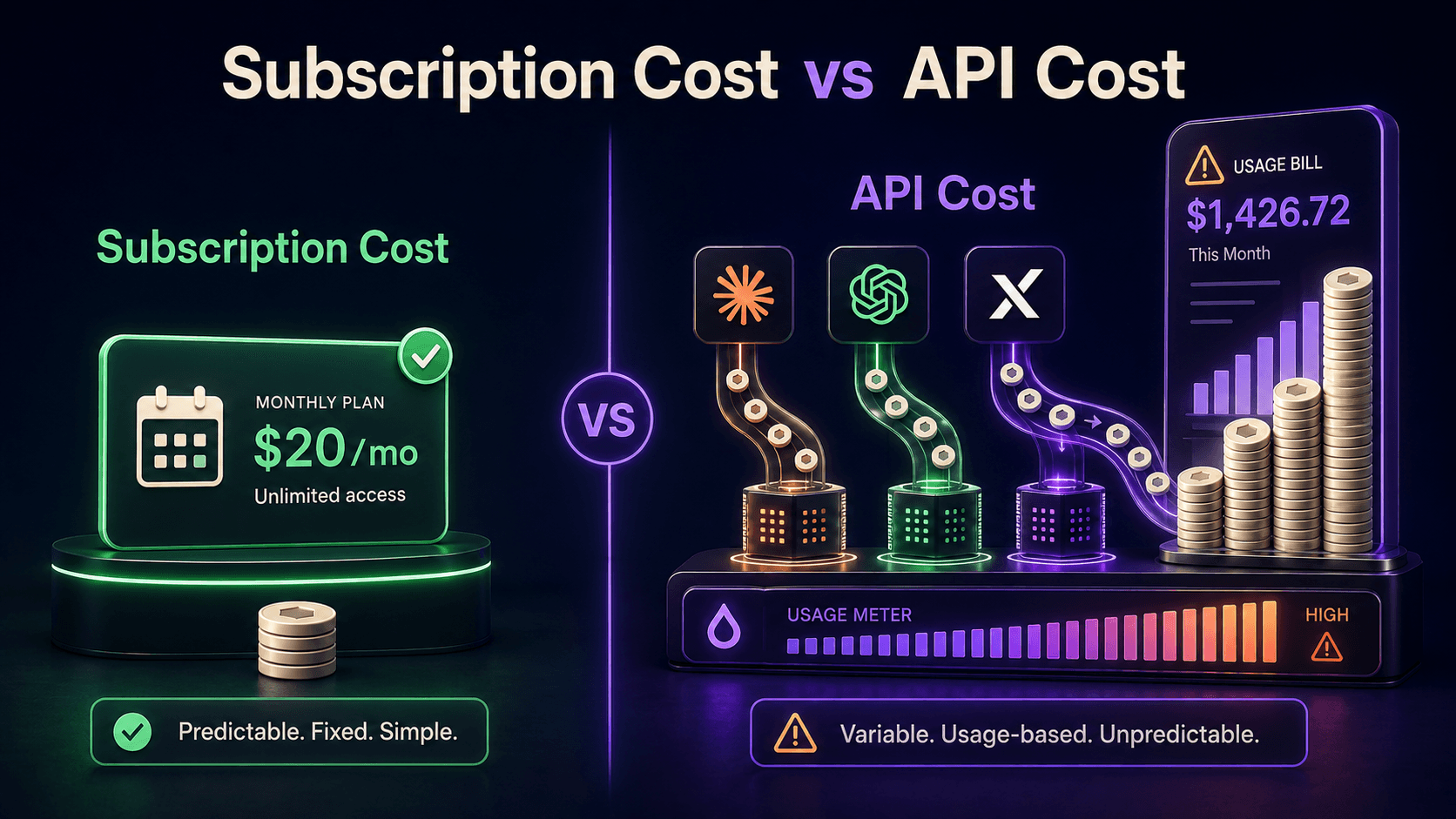
You opened your API console this month and saw a bill that would have bought five Claude Max subscriptions, three ChatGPT Pro plans, and a SuperGrok seat with change left over. The metered pricing is not a mistake. Anthropic, OpenAI, and xAI charge API customers the marginal cost of compute plus margin, while subscriptions are pre-sold capacity priced for the average user who never fully consumes what they paid for. This article walks through the real numbers across all three flagship models, explains the structural reasons the gap exists, and lays out the cost-control levers operators can apply this week to cut API spend by 50 to 80 percent without losing output quality.
TL;DR
Claude Opus 4.8 API runs $5 input and $25 output per million tokens
GPT-5.5 charges $5 input and $30 output, with a 272K context price cliff
Grok 4.3 undercuts both at $1.25 input and $2.50 output per million
Subscriptions hide cost by routing easy queries to smaller models
Prompt caching, batch mode, and routing cut API bills 50 to 80 percent
Why does paying per token cost more than paying a flat fee?
API billing meters actual compute consumed, while a subscription is a pre-sold bundle priced for the average subscriber, who uses far less than they paid for. The roughly 80 percent of subscribers who barely touch the product subsidize the 20 percent who hammer it. API customers opt out of that cross-subsidy and pay marginal compute cost plus margin, which is structurally higher than a blended-average subscription price.
The second mechanism: subscriptions are revenue providers can predict and pre-collect. APIs bill in arrears against spiky, unpredictable demand. Predictable cash flow commands a discount in every industry. Airlines sell cheaper advance tickets, cloud providers sell reserved instances at half the on-demand rate, and AI providers sell flat-fee consumer plans at a fraction of the metered API rate. The flat fee is the loyalty discount; the API is the on-demand premium.
Operators who treat the API as a "more powerful subscription" miss the framing. Subscriptions are marketed to consumers calibrated against Netflix at around $17 and Spotify at around $11. APIs are sold to businesses that can defend a $500 monthly line item against a $5,000 ROI calculation. Same compute, two different price ceilings.
What is the real price gap right now for Opus 4.8, GPT-5.5, and Grok 4.3?
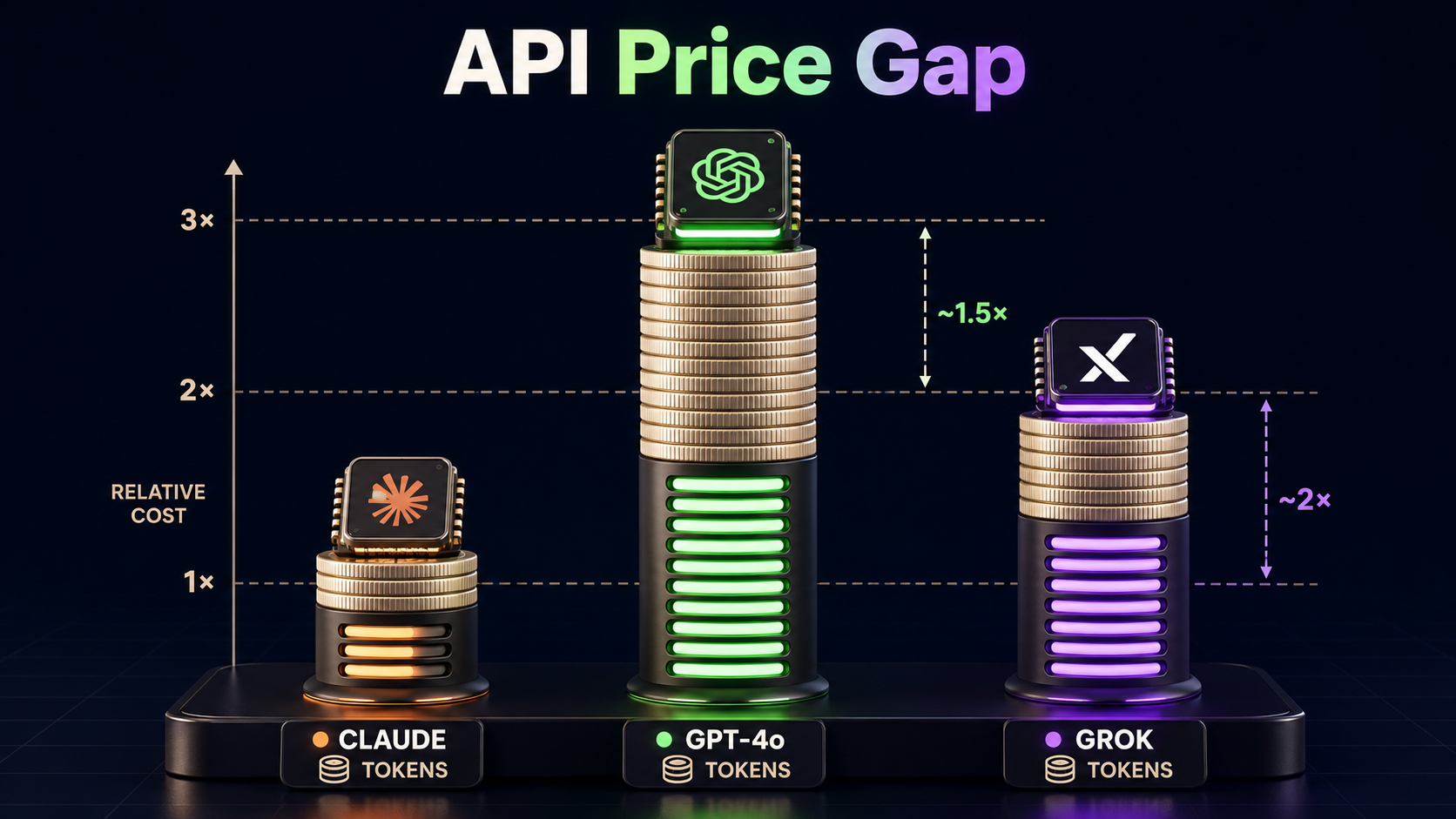
As of June 2026, the headline rate gap across the three flagships is roughly 4x between the cheapest (Grok 4.3) and the most expensive on output (GPT-5.5). On input tokens, Claude and OpenAI sit at $5 per million, while xAI prices Grok 4.3 at $1.25 per million. On output, the spread widens further: $25 for Opus 4.8, $30 for GPT-5.5, and $2.50 for Grok 4.3.
Here is the head-to-head:
Provider / Model | Sub entry price | Sub for top model | API input / 1M | API output / 1M | Cached input / 1M |
|---|---|---|---|---|---|
Anthropic / Claude Opus 4.8 | $20/mo (Pro) | $100/mo (Max 5x) | $5.00 | $25.00 | $0.50 |
OpenAI / GPT-5.5 | $20/mo (Plus, limited) | $100/mo (Pro) | $5.00 | $30.00 | $0.50 |
xAI / Grok 4.3 | $30/mo (SuperGrok) | $300/mo (Heavy) | $1.25 | $2.50 | $0.20 |
Two details matter beyond the rack rate. First, GPT-5.5 has a long-context cliff at 272K input tokens. Cross it and the entire session reprices to 2x input and 1.5x output. Not just the overflow. The whole session. Operators building long-document apps need to watch this hard. Second, Claude Opus 4.8 offers a "Fast Mode" at $10 input and $50 output, a 2x premium for latency-sensitive workloads. GPT-5.5 Pro, restricted to the $100+ subscription tier, lists at $30 input and $180 output, which is six times the base output rate.
Grok 4.3 sits structurally below the other two because xAI is leaning on its Colossus cluster scale and aggressive market-share pricing. The 75 to 92 percent gap is not a quality concession on every benchmark, but operators should A/B test their specific task before swapping providers blindly.
How many tokens of API use equal one month of the subscription?
For Claude Pro at $20 per month, the breakeven is roughly 1 million combined tokens at a 50/50 input-output split, which works out to about $15 of API value. Claude Max at $100 buys you somewhere between $37 and $75 of API value depending on usage. The subscription is a markup, not a discount, for most users.
Here is the worked math for a 50/50 input-output blend at standard list prices:
Plan | Monthly price | Tokens to break even (50/50 split) | Implied API value at the cap |
|---|---|---|---|
Claude Pro | $20 | ~1.33M tokens | $15 at 1M tokens, $30 at 2M tokens |
Claude Max 5x | $100 | ~6.6M tokens | $37.50 at 2.5M tokens, $75 at 5M tokens |
ChatGPT Plus | $20 | ~1.1M tokens | $8.75 at 500K tokens, $17.50 at 1M tokens |
ChatGPT Pro $200 | $200 | ~11.4M tokens | Hard to reach without programmatic use |
SuperGrok | $30 | ~16M tokens (50/50 Grok 4.3 rates) | $22.50 at 12M tokens (full throttle) |
Two patterns jump out of this table. Light subscribers pay a 2x to 5x premium versus the API value they consume. That is the gym-membership effect priced in. Heavy users who actually hit the rate limit can extract more value than they pay, but the rate limit usually stops them before they get there. Subscriptions are designed so the heaviest users do not bankrupt the unit economics. The throttle is the safety valve.
For a coding session at roughly 30K input and 10K output tokens, Claude Opus 4.8 costs about $0.40 per session on the API. Twenty sessions a month is $8, well under Claude Pro at $20. The math flips when sessions get longer or chats get more numerous. A 50-turn document-analysis chat at 100K input and 40K output tokens runs $1.50 on Claude API. Run 90 of those in a month and you are at $135, far above any subscription. But you will hit the rate limit at session 30, so the subscription never lets you arrive at the API-loses crossover anyway.
What is the unit-economics reason, GPU cost, KV cache, batched inference?
Raw GPU rental costs $2.50 to $12.29 per hour for H100 SXM5 instances depending on tier, with B200 sitting between $2.12 and $3.44 per hour for higher throughput. At roughly 2 million tokens per hour on a frontier 70B+ model, raw compute alone is about $1.25 per million tokens before networking, storage, cooling, model licensing, or salaries.
That $1.25 per million floor explains why xAI can list Grok 4.3 at $1.25 input. They are pricing at or near marginal compute, betting on developer lock-in to recoup margin over time. Claude Opus 4.8 at $5 input is layering a 4x stack on top of compute to cover the same costs plus model training amortization plus the cost of running a safety research org. GPT-5.5 at $5 input does the same. None of these prices are arbitrary. They reflect different financial structures behind the same hardware.
Three architectural details push the API cost above raw compute:
KV cache reuse. Consumer chat apps share common prompt prefixes across millions of sessions. The provider caches system prompts, safety preambles, and UI boilerplate once and reuses them. An API customer sending a fresh
claude-opus-4-8call pays full input price on every token, including their system prompt, on every single call. The consumer app amortizes that overhead across the whole user base. This inverts the intuition that API should be cheaper because there is no UI; the UI is what funds the shared cache.Batched inference. Frontier inference servers batch requests across users to keep the GPU saturated. Higher batch sizes mean lower per-token compute cost. Consumer apps achieve high batch sizes naturally because millions of users are sending requests every second. API customers send sparse traffic per account, and the provider has to maintain headroom for bursts. The Batch API tier (50 percent off on Anthropic and OpenAI, 20 to 50 percent off on xAI) is exactly the provider passing through the savings from delayed, batchable workloads.
Reasoning tokens. Extended thinking modes generate hidden reasoning tokens billed at full output rates. A 10K output response with extended thinking might consume 30K to 50K reasoning tokens. Subscription users get "Deep Think" as a feature at no extra meter. API users pay every reasoning token in full.
Why does the subscription quietly route you to smaller models when it can?
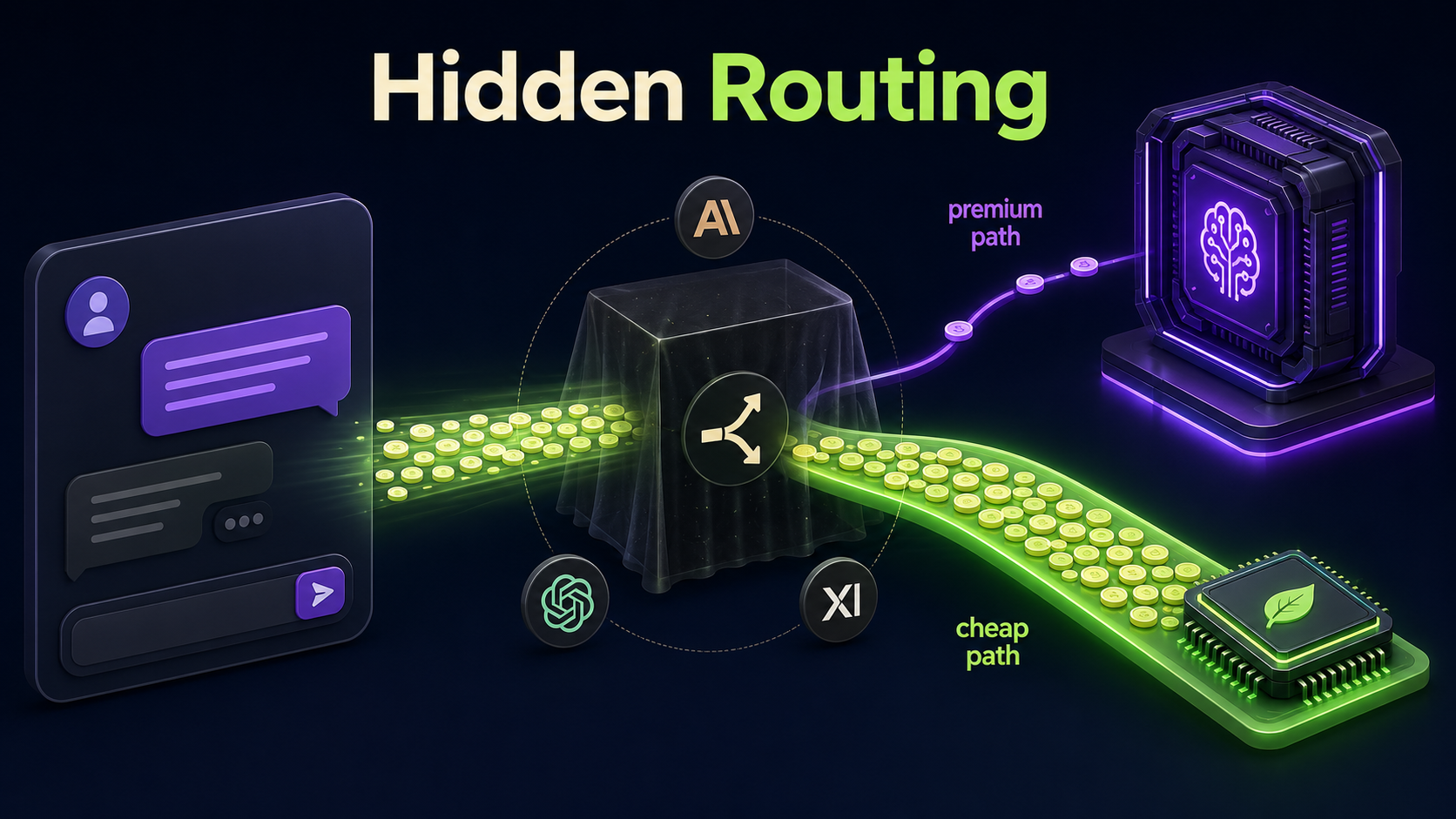
Subscription apps run a router behind the chat box. Easy queries hit Haiku or GPT-5.3 Instant; hard ones invoke Opus or GPT-5.5. The subscriber sees one product called "Claude" or "ChatGPT," but a typical session pulls compute from two or three different model tiers. API callers who specify claude-opus-4-8 always get Opus and always pay Opus rates.
Operators report this routing is invisible by design. The chat UI does not display which model just answered. Anthropic and OpenAI both refuse to publish the percentage of requests served by smaller models on each subscription tier. The closest analogy is a cellular carrier's "unlimited" plan that throttles speeds after a hidden cap. The product is unlimited in name. The compute is rationed in fact.
For an API customer, this means the subscription comparison is structurally unfair. A subscriber paying $20 for "Opus 4.8 access" might receive Opus on only 30 to 40 percent of their queries. The other 60 to 70 percent are answered by a model that costs the provider 5x less to run. The subscription captures the price arbitrage; the API does not. If you build your cost model assuming API equals subscription quality, you are overpaying because you are buying frontier compute for every request, including the trivial ones a router would have downgraded.
What does the gym-membership effect have to do with your AI bill?
Subscriptions price for the median user, who barely shows up. The 30 to 40 percent of subscribers who lapse or use minimally fund the heavier tail. Providers collect $20 from a subscriber who logs in twice in March and use the credits to discount the subscriber who runs 8 hours of conversations a day. The API has no lapse subsidy, so every dollar billed has to cover its own compute plus margin.
This pattern is identical to gym memberships and "unlimited" cell plans. The provider builds a margin curve assuming most buyers will not extract full value. Throttles, rate limits, or quality routing exist to enforce that ceiling. If you are a heavy user, the subscription is a discount. If you are a light user, the subscription is a markup. The API removes both.
Why is the API priced for margin and the subscription priced for growth?
Subscription entry plans are land-and-expand surfaces. They acquire users, build mindshare, generate training data, and establish platform lock-in. OpenAI's $20 ChatGPT Plus has held the same price since 2023, three years of inflation and major model capability gains with no increase. That is a strategic choice funded by API revenue.
API customers are revenue-bearing accounts with measurable spend visibility. Providers can adjust API pricing per model release without breaking subscriber promises. Grok 4.3 ships at $1.25 input partly because xAI is aggressively buying market share with cluster economics that may not last. Enterprise API customers also extract volume discounts that are never published, sometimes 30 to 60 percent off list. The rack rate partially subsidizes those enterprise discounts.
How does each provider differ, Anthropic, OpenAI, and xAI?
The three flagships price differently because they have different cost structures, different go-to-market strategies, and different definitions of "frontier." Anthropic and OpenAI are within 20 percent of each other on input rates and have nearly identical cache and batch discount structures. xAI sits in a separate league on price, targeting developer adoption over near-term margin.
Anthropic
Anthropic deliberately leaves subscription token budgets vague. "5x more than Pro" prevents comparison shopping and lets them throttle dynamically. The prompt caching architecture is a genuine differentiator: a 50K-token system prompt with 1-hour TTL costs $0.50 to write plus $0.025 per read. At 100 calls per hour, that is roughly $3 instead of $250, an 83x effective discount. Batch API at 50 percent off plus prompt caching stacked together can drop production costs to 5 to 10 percent of list. Consumer subscribers have no equivalent fast lane or batch tier.
OpenAI
GPT-5.5 at $5 input and $30 output is aligned with Anthropic on input but 20 percent more on output. The GPT-5.5 Pro variant at $30 and $180 targets research-grade users on enterprise budgets, gated behind the $100 and $200 consumer plans. The 272K-token context cliff is the trap operators get caught by most often. Send a 280K-token context once and the entire session reprices, not just the overflow. The ChatGPT Pro $200 plan signals OpenAI is testing $100 to $500 monthly pricing for consumer power users, eroding the old "API is for businesses, subscriptions are for consumers" framing.
xAI
Grok 4.3 at $1.25 input and $2.50 output is roughly 75 percent cheaper on input and 92 percent cheaper on output than Claude Opus 4.8 for tasks where the quality matches. xAI is leaning on its Colossus cluster scale (operators report roughly 300K H100 equivalent) and Musk's broader capital structure to subsidize aggressive pricing for developer market share. Automatic prompt caching with no configuration required is a developer UX win. SuperGrok Heavy at $300 per month is a category error: priced like enterprise, sold like consumer.
Which workloads cross the line where API actually wins?
The API wins when you need any of four conditions: multi-user serving, programmatic automation, reproducibility, or volumes that exceed subscription rate limits. Below those thresholds, subscriptions are the cheaper unit economic for a single human at a chat interface.
Concretely, the API beats the subscription when you check at least one of these boxes:
You are building a product that serves more than one user from one account
You need version pinning so today's results match next month's results
You hit the subscription rate limit consistently (>10 messages per 5-hour window throttle)
You need prompt caching, batch processing, or tool use at automation scale
You are integrating an LLM into an n8n workflow, Python script, or Zapier chain
You need a documented SLA with rate-limit tier guarantees
The subscription beats the API when:
The use case is one human in an interactive chat window
Monthly metered cost would equal or exceed the subscription
You do not need reproducibility across model versions
The rate limit on the plan is not your binding constraint
You actually want the dynamic routing to smaller models because most queries are easy
For most operators serving a single seat, Claude Pro at $20 or ChatGPT Plus at $20 is the right answer for chat-shaped work. The crossover to API happens not because tokens get cheap, but because the workflow shifts from "I am chatting" to "code is chatting" or "many people are chatting through one account."
How do you cut API spend by 50 to 80 percent without losing quality?
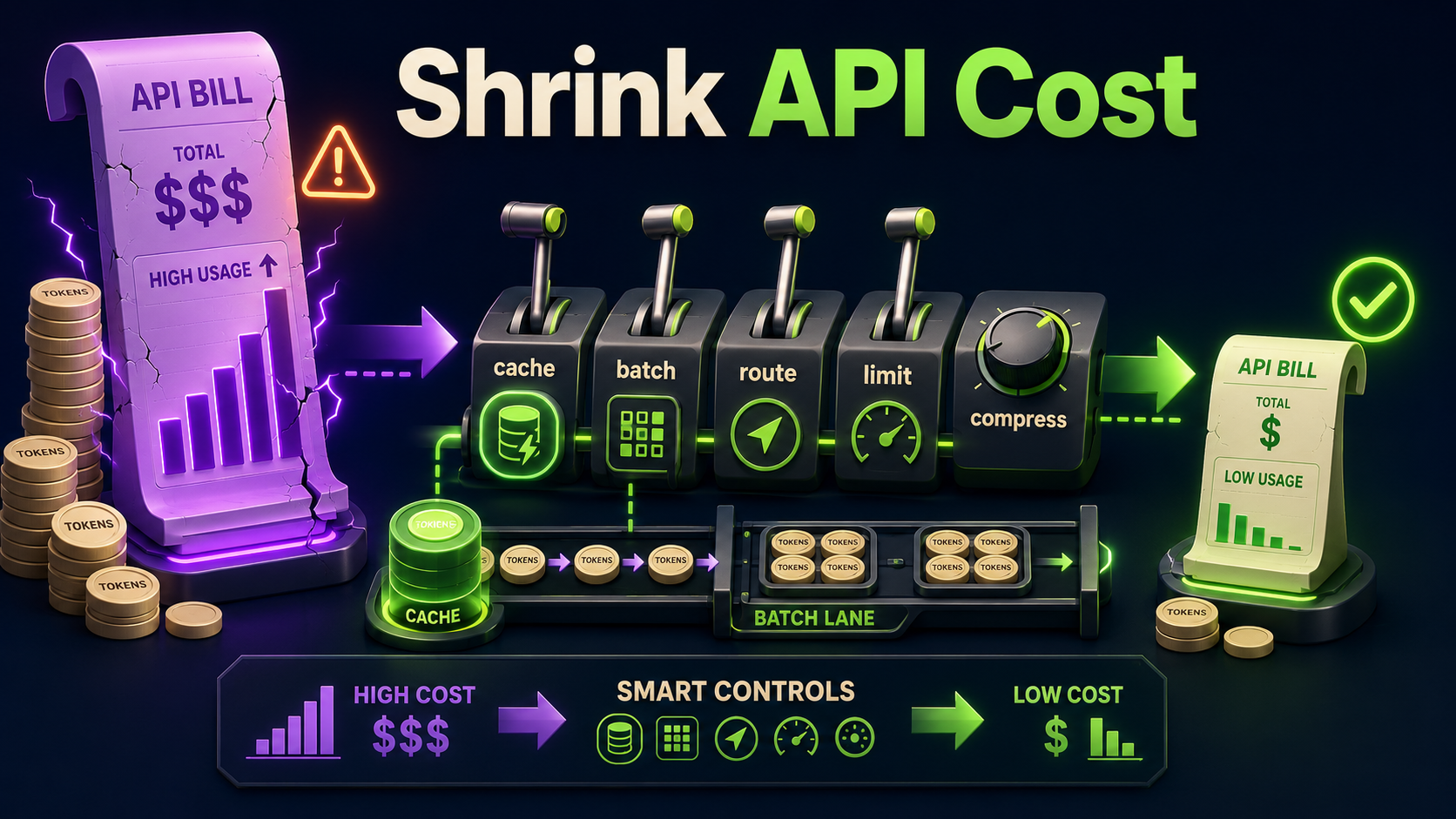
Eleven levers stack to deliver compound savings. The top three (prompt caching, batch mode, and model routing) together typically take a production bill from $1,000 per month to $200 to $400 per month at zero quality loss. The remaining eight pick up the long tail.
Here is the impact ranking, biggest savings first:
Lever | Typical savings | Implementation effort | Works on |
|---|---|---|---|
Prompt caching | 50 to 90% on repeated context | Medium (Claude, GPT-5.5); zero (Grok) | Any fixed system prompt >1,024 tokens |
Batch API | 50% on async workloads | Low (one API flag) | Any non-real-time job |
Model routing (Haiku/Instant for easy) | 30 to 60% on mixed traffic | Medium (router code + classifier) | Any app with mixed complexity |
RAG instead of long context | 80 to 95% on doc-heavy apps | Medium-high (embeddings + vector store) | Long-document Q&A, knowledge bases |
System prompt compression | 20 to 50% on per-call input | Low (just rewrite) | Every API caller |
Output token cap (max_tokens) | 30 to 70% on output bills | Very low (one param) | Any task with bounded output |
Response caching (Redis) | Eliminates repeat queries | Medium | FAQ bots, classifiers, support deflection |
Multi-provider arbitrage | 50 to 92% on Grok-acceptable tasks | Medium (router + quality eval) | Tasks where quality bar is met by Grok |
Workload smoothing (off-peak) | Variable (Bedrock/Vertex only) | Low | Cloud-hosted inference environments |
Enterprise volume contract | 30 to 60% off list | Requires >$10K/mo spend | Larger accounts only |
Switch to subscription | Up to 80% on single-user chat | Zero | One human, chat-shaped work only |
Prompt caching, applied in detail
On a 50K-token system prompt at 100 calls per hour, the uncached bill is 50K x 100 x $5/M = $25. With caching: one write at $0.3125 plus 99 reads at $0.025 each = $2.79. That is a 9x reduction on the system prompt alone. Grok handles this automatically. OpenAI's $0.50 per million cached input is structurally identical to Anthropic's discount.
Model routing, applied in detail
Classify the query with Haiku or GPT-5.3 Instant ($1 input, $5 output for Haiku) and only call Opus or GPT-5.5 when the classifier flags hard reasoning. A 70/30 hard/easy split saves 30 to 40 percent at zero accuracy loss on the easy bucket. Easy: intent classification, data extraction, yes/no grading, sentiment scoring, FAQ matching. Hard: agent planning, long-document synthesis, code generation, multi-step tool use.
Output cap and RAG
Default max_tokens is the model's full ceiling, 128K for Opus 4.8. Most production tasks need 500 to 2,000 tokens out. An uncapped request returning 5,000 tokens when 500 would do costs 10x on the output bill. Output is the single most expensive line item, so cap it per task type.
For long-document apps, embed the source once with text-embedding-3-small and retrieve only the 3 to 5 most relevant chunks per query. Input drops from 100K+ tokens to 5,000 to 10,000 per call, a 20x input cost reduction, with a latency win on top.
The switch trigger
If you are a single human spending more than $20 on Claude API for chat-shaped work and not hitting subscription rate limits, switch to Pro. If you serve multiple users or need reproducibility, stay on API and optimize. If you cross $1,000 per month at one provider, call sales: operators report 30 to 60 percent off list is achievable above $10,000 monthly run-rate.
FAQ
Is the API more powerful than the ChatGPT or Claude subscription?
The API gives you direct, deterministic access to the model you specify. The subscription may route your query to a smaller model and never tell you. So the API is more consistent and reproducible, but the consumer app often gets to the same answer faster and cheaper because the router downgrades trivial queries. "More powerful" depends on whether you value consistency (API wins) or blended cost efficiency for chat work (subscription wins for a single user).
Why is GPT-5.5 output 20 percent more expensive than Claude Opus 4.8?
OpenAI prices output at $30 per million versus Claude's $25. The difference reflects OpenAI's pricing strategy for output-heavy reasoning workloads and their internal cost structure. Practically, on a workload that is 70 percent output by volume (typical for code generation), GPT-5.5 will cost about 14 percent more total than Claude Opus 4.8. For input-heavy workloads (document Q&A), the two are nearly identical at $5 per million input.
How accurate are the token estimates for subscription plans?
No provider publishes a hard token budget for consumer subscriptions. The numbers in this article (1 to 2 million tokens per month for Pro, 2.5 to 5 million for Max 5x) are operator-reported aggregates from forums and Reddit, validated against rate-limit observations. Treat them as order-of-magnitude estimates. Anthropic and OpenAI both reserve the right to throttle dynamically, and they do.
Does prompt caching work across providers?
Each provider has its own prompt caching implementation and pricing. Claude requires explicit cache_control blocks in your API calls. OpenAI's cached input at $0.50 per million applies automatically when you reuse a prefix within a time window. Grok caches automatically with no configuration. The discount is structurally similar (about 90 percent off input) across all three, but the engineering work to enable it differs. If you switch providers, you re-implement caching for the new one.
When should I stop using the consumer chat app and move to the API?
When any of these become true: you need to share the same access with a teammate, you want to script repeated tasks, you need the answer to come back in a structured JSON format, you keep hitting the rate limit on the subscription tier, or your monthly metered cost would still be lower than upgrading to the next subscription tier. For a solo founder building an automation that runs unsupervised, API on day one.
Will API prices keep dropping?
Input prices have dropped roughly 80 percent over the past two years across all three providers, driven by GPU cost amortization, model architecture efficiency gains, and competitive pressure. Output prices have moved less because output is GPU-bound at decode time. Operators should expect input rates to continue declining at 30 to 50 percent annually for the next few model generations, with output rates declining more slowly. Grok's $2.50 output is a meaningful signal of where Anthropic and OpenAI are likely headed within 12 to 18 months.
Where this leaves you
API access is honestly priced for what you consume. Subscriptions are blended-margin products priced for the average user who barely shows up. Both are correctly priced for their target buyer. The mistake is treating them as interchangeable.
For most operators, the right answer is a stack: a personal subscription for chat-shaped work, an API account for everything programmatic, prompt caching and batch mode on every production workload that allows them, and a routing layer that sends easy queries to cheap models. Done right, this drops a $1,000 monthly API bill to $200 to $400 with no quality regression. Done wrong, the bill compounds and the founder learns the hard way that "Opus on every call" is the most expensive default setting in modern software.
Need help auditing your AI spend?
If your API bill has outgrown your understanding of where the money is going, a focused process audit usually finds 40 to 70 percent of the savings in the first two weeks. Talk to us at vantaige.io/contact for a Vantaige consulting engagement that maps your current workload to the cheapest provider and tier per use case, implements caching and routing where they pay back inside a month, and leaves you with a cost model your CFO can actually read.
Related from Vantaige
References
Anthropic API pricing (fetched June 22, 2026)
xAI Grok API models (fetched June 22, 2026)
Get the best new AI tools and guides, weekly
One short email a week. The tools worth trying, the guides worth reading, nothing else.
No spam. Unsubscribe anytime.
Aymen B
Contributing writer at Vantaige, covering the AI tools ecosystem.