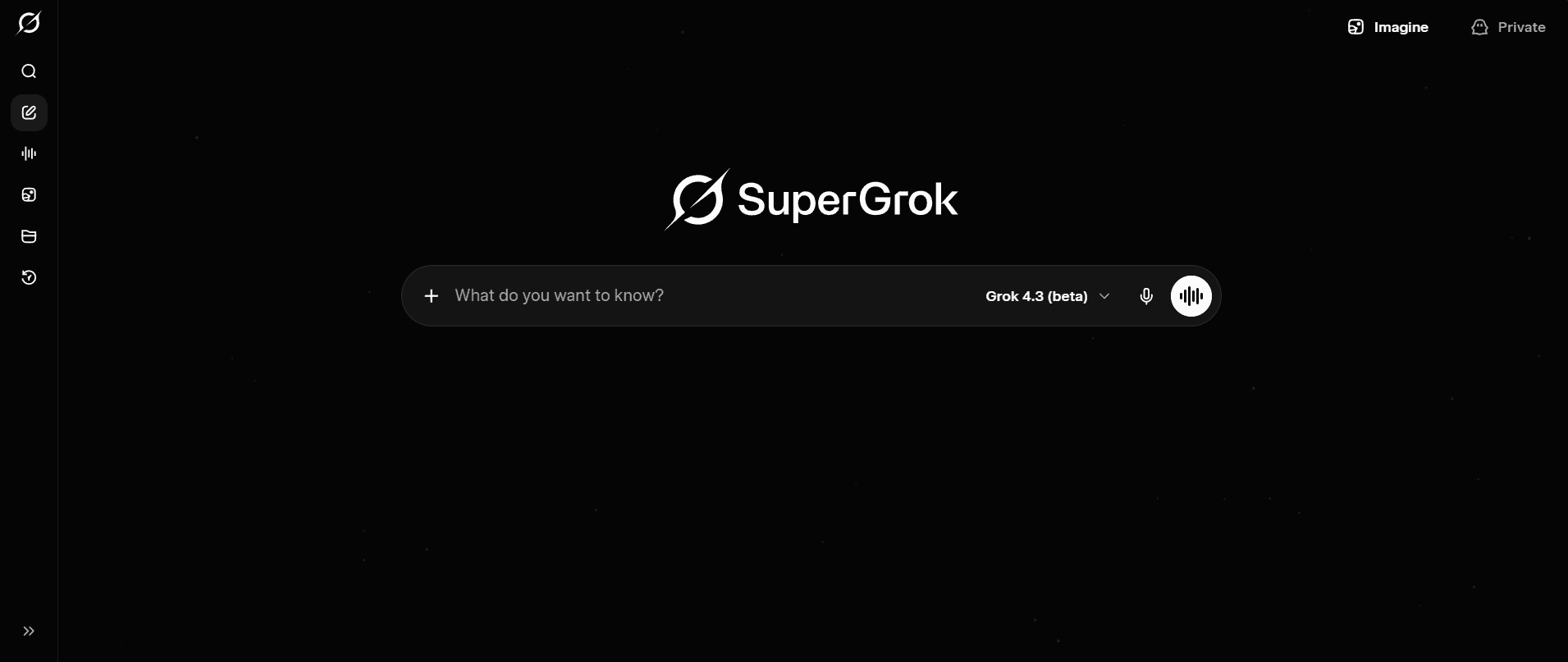

Grok is xAI's frontier chatbot and model family with native real-time web and X search, Grok Imagine image/video, Voice mode, and an OpenAI-compatible API. As of September 2026 the API flagship is grok-4.6 ($2 input / $6 output per 1M tokens under 200k prompts). Consumer access starts free, with SuperGrok at $30/mo and SuperGrok Plus at $100/mo on x.ai/pricing.
Grok is the AI chatbot and language model family built by xAI, Elon Musk's artificial intelligence company founded in 2023. It runs on the Colossus supercluster in Memphis, Tennessee, one of the largest GPU clusters in the world, and it is the only frontier-class LLM with native, real-time access to X (formerly Twitter), which processes roughly 500 million posts per day. That real-time social data feed is not a bolt-on integration but a first-class design choice: Grok was built around it. As of 2 September 2026 the published API flagship is grok-4.6 (500k context, knowledge cutoff 1 Feb 2026) with sibling grok-4.5 and grok-4.3 (1M context, cheaper). Consumer apps at grok.com bundle chat, research, Grok Imagine (image/video), Voice, Grok Build, and Grok Bot on paid SuperGrok tiers.
The core feature set includes DeepSearch, a research mode that crawls both the open web and X simultaneously and produces cited reports significantly faster than comparable modes in competing products; Grok Imagine (image and video): API SKUs from $0.02–$0.05/image and $0.05–$0.08/sec video per docs.x.ai; consumer marketing cites up to 2K stills and ~15s clips. Aurora is the prior brand.; Companions, a set of voice-enabled AI personas with distinct personalities; and API access with some of the most competitive per-token pricing among frontier models, starting at $0.20 per million input tokens for the fast tier. The 2-million-token context window is roughly 16 times larger than GPT-5's standard window, making Grok a practical choice for whole-codebase or long-document analysis without chunking.
What Grok ships as of September 2026
xAI currently ships three active tiers of Grok:
Grok 4.20 Beta 2 (public flagship, March 2026): multi-agent architecture, 2M token context, multimodal input (text, image), real-time X access, DeepSearch and DeeperSearch modes.
Grok 4.3 beta (April 2026, limited early access): improved reasoning, reduced hallucinations, expanded voice and video capabilities. Knowledge cutoff December 2025.
Grok 4 Heavy (SuperGrok Heavy subscribers): the highest-capability variant, using a full multi-agent collaborative stack for frontier-level performance. Priced at $300/month.
Grok 5 is confirmed in training on the Colossus 2 supercluster, which xAI expanded to 1.5 gigawatts of compute capacity in April 2026. The company set a Q2 2026 target in its Series E announcement (January 28, 2026). Reported specs remain unverified but cite a Mixture-of-Experts architecture with roughly double the parameters of Grok 4 and a 1.5-million-token context window.
Grok 4 launched on July 9, 2025, via a livestream that drew approximately 1.5 million concurrent viewers. On the Humanity's Last Exam benchmark, Grok 4 scored 25.4% without tools, outperforming Google Gemini 2.5 Pro (21.6%) and OpenAI o3 (21%). In multi-agent configuration, Grok 4 Heavy hit 44.4% with external tools. The ARC Prize Foundation independently verified Grok 4's 15.9% on ARC-AGI-2, nearly double the next-best commercial model at the time.
What Grok is actually good at
The single most practical differentiator is real-time social intelligence. No other frontier model can query live X posts as part of an answer. For journalists, researchers, marketers, or anyone asking "what is the internet saying about this right now," Grok's native access is not replicable by switching to DeepSearch in ChatGPT or enabling web browsing in Claude. It is architectural.
"Finally, an AI that's in touch with the present. Researching with Grok feels like the internet at my fingertips." - Product Hunt discussion participant, 2025
DeepSearch and DeeperSearch extend that advantage into structured research. xAI positions DeeperSearch as crawling roughly three times more pages than ChatGPT's equivalent, at around ten times the speed. For competitive analysis, market research, or event-driven topics where freshness matters more than long-form polish, these modes consistently outperform Perplexity Pro Search on recency.
The API value proposition is real, too. Romain Cochard, CEO of Hack'celeration, tested Grok in production and noted that "Grok came in 40% cheaper than GPT-4 and 25% below Claude Opus," adding that "the 2-million-token context window at these prices is exceptional value." For developers building RAG pipelines, document analysis tools, or long-context summarization products, the per-token economics are favorable at the Grok 4.1 Fast tier.
Where Grok breaks: the failure modes users keep hitting
The "high demand" wall is the most persistent complaint in 2026. Grok's infrastructure has struggled to keep pace with user growth, and paying SuperGrok subscribers repeatedly encounter capacity errors, particularly during new feature launches and high-traffic windows. A documented outage on April 22-23, 2026 locked users out of the Companions/Ani feature. The gap between paying $30 per month for "priority access" and seeing a try-again-later error is a top pattern in Trustpilot and Reddit complaints.
Instruction following degrades on multi-step tasks. The community consensus is that Grok can excel on single-turn benchmark-style prompts but becomes less reliable in complex agentic workflows where each step depends on the previous one. One Wired reviewer put it plainly: "Grok can be both brilliant and bizarre. In one session it outperforms on a tough benchmark, and in another its built-in persona calls the user an idiot."
Aurora's image quality has regressed since late 2025. When Aurora launched in December 2024, it stood out for photorealistic output with relatively permissive generation. A series of moderation updates through 2025 and early 2026 drew a sharp community backlash, summarized by Reddit user jogetgemoy69 (r/grok): "More moderation less realism." Another r/grok thread documenting the change received 16+ upvotes with the top comment from Important-Use5136: "Who cares. Now that it's censored, it's just another clanker."
The Elon Musk ownership factor is a genuine adoption friction for a significant segment of enterprise buyers. Procurement teams at companies with visible political stances have flagged X/xAI as a non-starter regardless of technical merit.
Grok vs. ChatGPT vs. Claude
ChatGPT (GPT-5, OpenAI): GPT-5 uses a unified three-component system: a standard model, a deeper reasoning variant (GPT-5 Thinking), and a real-time router that selects which to deploy based on query complexity. Mechanically, GPT-5 is the current leader in computer-use tasks, scoring 75% on OSWorld versus a 72.4% human baseline, making it the best choice for autonomous agent workflows that interact with desktop software. GPT-5's standard context window is 128K tokens, roughly 16 times smaller than Grok 4.20's 2M window. API pricing for GPT-5's flagship tier is $1.75 per 1M input / $14.00 per 1M output, significantly more expensive than Grok 4.1 Fast at $0.20/$0.50. ChatGPT is more polished, more consistent, and has a deeper third-party tool ecosystem. Grok wins on context length, cost at equivalent capability tiers, and real-time X data.
Claude (Anthropic): Claude Opus 4.6 uses a transformer-based architecture trained with Constitutional AI, a method that embeds ethical reasoning into the training loop rather than applying filters on top. On expert-task Elo ratings, Claude 4.6 scores 1606, the highest of any tracked model on certain benchmarks. Responses reach up to 128K output tokens per turn, double the typical competitor ceiling. Claude is the category leader for long-form writing quality, nuanced analytical prose, and document-heavy workflows. The Constitutional AI training also means Claude's refusals are more principled and predictable, whereas Grok's content filtering has been inconsistent. Grok wins on price, context length, and recency of information. Claude wins on writing quality, depth, and alignment reliability.
Is the paid tier worth it?
For most users, the question is which tier makes sense. The free tier (10 prompts per 2-hour window) is enough for casual use but inadequate for daily work. SuperGrok at $30/month provides full access to Grok 4.20, the 2M context window, DeepSearch, Aurora, and Companions. That is a reasonable price for a capable frontier model, particularly for users who use Grok for research or long-document tasks where the context window advantage is meaningful.
Published x.ai/pricing cards: SuperGrok $30/mo and SuperGrok Plus $100/mo (1080p video, higher weekly shared usage pool, priority). X Premium starts from $8/mo and Premium+ from $40/mo on help.x.com. SuperGrok is included with Premium Business and Org seats per help.x.com; whether individual Premium+ grants a standalone SuperGrok discount should be verified at checkout before subscribing. For X users already paying for Premium, it is close to a no-brainer add-on.
The API is where Grok makes the most compelling case for developers. The flagship API tier for grok-4.6 is $2/$6 per 1M tokens for requests under 200k tokens (input/output), rising to $4/$12 per 1M for requests at or above 200k. The prior Grok 4.1 Fast narrative at $0.20/$0.50 is superseded by the published grok-4.6 pricing. Budget separately for Imagine and Voice API line items.
SuperGrok Heavy is a niche tier on the x.ai pricing matrix without published card pricing as of September 2026; treat third-party figures such as $300/mo as unconfirmed. Most individuals should choose SuperGrok ($30) or SuperGrok Plus ($100) on published cards. At that price, it competes directly with top-tier ChatGPT plans and is harder to justify without a specific workflow that requires Grok Heavy's multi-agent depth.
Best use cases (and when to skip it)
Grok earns its place for users who need real-time information about X specifically, whether that is tracking brand sentiment, monitoring breaking news, or following cultural moments as they happen. No other LLM can do this natively. It also earns its place for developers building cost-sensitive applications on long documents, because the 2M token window at sub-$1 per million input tokens is a combination no competitor currently matches.
"Chatting with Grok is like chatting with a super-informed internet friend who isn't afraid to roast you a bit, and I love that." - X forum user, X/Twitter, 2025
Skip Grok when your work requires consistent, polished long-form writing. Claude is the better tool for essays, reports, and structured documents where tone and coherence across thousands of words matter. Skip it when your workflow depends on reliable multi-step agent behavior at high volume. And skip it if Musk-associated controversy is a deal-breaker for your team, because the connection to X is not incidental; it is the product's core infrastructure advantage.
Getting started with Grok
Free users can access Grok at grok.com or via the X app on iOS and Android with any X account. The free tier gives 10 prompts per 2-hour window on the base model. Upgrading to SuperGrok ($30) or SuperGrok Plus ($100) on x.ai/pricing unlocks Grok 4.6 priority, Imagine image/video, higher weekly usage across Chat/Imagine/Voice/Build, and Grok Bot. Companions remain iOS-only per xAI FAQ.
For developers, xAI's API is documented at docs.x.ai and is OpenAI-compatible, meaning any application built against the OpenAI SDK can switch to Grok by changing the base URL and model name. The first API call can realistically be made in under 10 minutes using curl or the Python SDK. Rate limits on the free API tier are modest; production workloads require a paid API key available through the developer console.
User Reviews
No reviews yet. Be the first to share your experience!
Sign in to write a review.
Related articles
Guides and articles related to Grok.
Grok 4.3 API for Agents (May 2026): Pricing, Benchmarks, Migration
Does API Cost More Than a Subscription for Claude Opus 4.8, GPT-5.5, and Grok?

Perplexity AI Tutorial: Maximize Your Research Workflows
Claude Code New Limits (May 2026): Per-Plan Changes & SpaceX Deal
OpenAI GPT-Realtime-2 (May 2026): Pricing, Latency & 30-Min Voice Agent