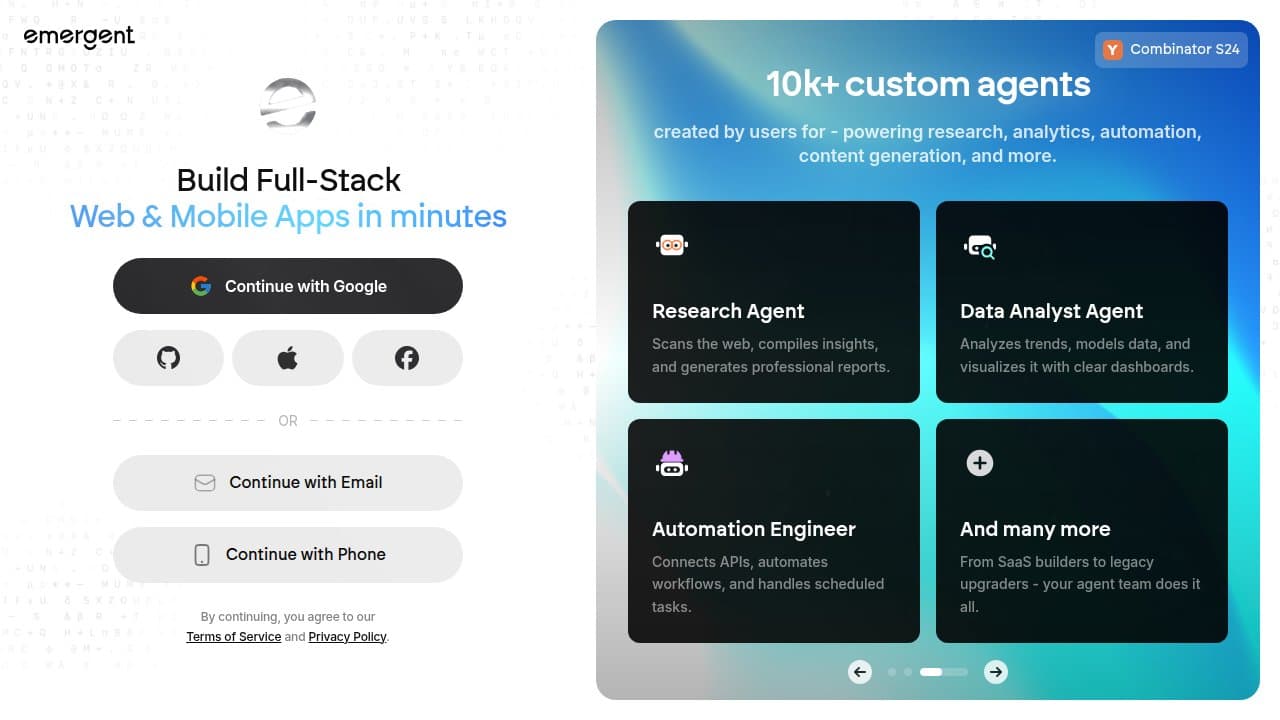

Emergent is a vibe coding platform that builds and deploys full-stack web and mobile apps from plain-English prompts. Founded by twin brothers Mukund and Madhav Jha (YC S24), it reached 6 million users and $100M raised within a year of its June 2025 launch.
Emergent is a vibe coding platform that converts plain-English prompts into deployed, production-ready full-stack applications. Built by twin brothers Mukund Jha (former CTO of Google-backed Dunzo) and Madhav Jha (formerly at Dropbox), the company launched commercially in June 2025 out of Y Combinator's S24 batch and grew to six million users across 190 countries within a year. The core pitch is direct: describe your app in a paragraph, and Emergent handles architecture, code, database, authentication, hosting, and deployment without the user writing a single line of code.
The platform runs a multi-agent system that assigns specialized roles to different AI agents: a Manager Agent plans the architecture, a Backend Agent writes Python/FastAPI endpoints and MongoDB schemas, and a Frontend Agent builds a React interface with Tailwind CSS. Apps deploy to Emergent's own cloud infrastructure with one click. Mobile app support uses React Native with Expo, enabling cross-platform iOS and Android builds and app store submission via EAS. Standard plan users get GitHub export and private project hosting. The Pro plan ($200/mo or $167/mo annual) unlocks a one-million-token context window, custom agent configuration, and priority support. In June 2026, Emergent launched E3 in beta for Pro subscribers, an orchestrator agent capable of autonomous multi-hour build sessions without constant human prompting.
What Emergent actually does in June 2026
Emergent generates the full application stack, not just UI scaffolding. A prompt like "build me a client portal where customers log in, view their invoices, and pay with a card" produces working user authentication, a MongoDB database pre-seeded with the right schema, FastAPI backend routes, Stripe payment integration, a React frontend, and a live URL. The stack is predictable: React on the frontend, Python/FastAPI on the backend, MongoDB for data, with optional integrations for Google Sheets, Airtable, Notion, Slack, and Stripe.
The Mobile Agent builds cross-platform iOS and Android applications using Expo and React Native. Developers or founders without a Mac can still submit to both app stores using EAS (Expo Application Services), and the Expo Go app lets anyone test the build on a real phone in seconds via QR code. This is a genuine differentiator: most competing platforms either skip mobile entirely or produce web-wrapped apps rather than true React Native.
E3, launched June 8, 2026 exclusively for Pro plan subscribers, extends the standard 10-15 minute E1 build session into multi-hour autonomous workflows. It uses agentic verification, deploying testing agents that interact with the finished app the way a human QA tester would, automatically routing discovered issues back to the builder for resolution without user input. It also supports monorepo builds that generate web and mobile apps simultaneously from a single session. E3 consumes roughly 30% more credits than a standard build due to the extended autonomy and verification pass.
Integrations on production tier include GitHub sync for code export, custom domain attachment, and the ability to edit generated code directly. Emergent does not lock users into a proprietary runtime: the generated code is standards-based React and Python, and Pro and Standard plan users can download and self-host the output.
"Just amazing, I just built a complex financial tool just prompting and it's live on the internet." - Trustpilot reviewer, Trustpilot, early 2026
Where Emergent sits versus Lovable and Bolt.new
The three dominant AI app builders in 2026 share the same goal but differ substantially in how they achieve it. Comparing Emergent against Lovable and Bolt.new reveals meaningful architectural choices, not marketing distinctions.
Emergent vs. Lovable: Lovable uses Supabase as its backend layer, which means users get PostgreSQL (not MongoDB), row-level security, Supabase Storage for file uploads, and a PostgREST-generated API. Lovable also supports two-way GitHub sync: edit code in your own IDE and push changes back into Lovable without losing the visual editor. Emergent offers only one-way export (Standard plan and above) and builds on MongoDB, which is more flexible schema-wise but lacks the structure that makes Supabase well-suited for multi-user apps with complex permissions. Lovable skews toward technically comfortable founders who want control; Emergent skews toward non-technical users who want zero decisions.
Emergent vs. Bolt.new: Bolt.new, from StackBlitz, runs the development environment entirely inside the browser using WebContainers, a technology that executes Node.js via WebAssembly without a backend server. This means zero cloud spin-up time, full runtime visibility inside the browser tab, and no credit consumption for idle time. The tradeoff is that Bolt.new is fundamentally JavaScript-first: it excels at frontend React prototypes and Node.js backends, but cannot match Emergent's Python/FastAPI backend generation or its Expo mobile output. Bolt.new is token-priced through StackBlitz; Emergent uses a credit system where every agent action consumes credits, including failed debugging attempts. Users who need a polished JavaScript frontend fast tend to prefer Bolt.new; users who need a full Python/database/mobile stack tend to lean toward Emergent.
Replit occupies a different category: it is a cloud IDE with AI assistance (Ghostwriter) layered on top, not a prompt-to-app generator. Replit requires users to read and edit code, supports 100-plus languages, and suits developers who want a persistent cloud environment. Emergent requires no code literacy at all, which is both its greatest strength and its most significant limitation when an app needs customization beyond what prompting can achieve.
For teams considering these tools alongside a code editor, Cursor represents the other end of the spectrum: a developer IDE with AI deeply embedded, aimed at engineers who write code themselves but want AI completion and context. Cursor and Emergent serve almost entirely different audiences, and comparing them illuminates how wide the vibe coding category has become.
What the agent loop reality looks like
A typical Emergent session starts with a prompt. The Manager Agent breaks the request into subtasks, assigns them to Backend and Frontend agents, and begins building in parallel. Users see a live activity feed as agents write files and run tests. For simple apps (task tracker, landing page with a contact form, client login portal), this process takes 5-20 minutes and the result is genuinely deployable.
The problems start at the edges. When an agent encounters an error, it attempts to fix it autonomously. Each fix attempt consumes credits. If the agent's fix introduces a new error, it tries again, and again, and again. Users report losing entire monthly credit allocations in a single debugging spiral on a moderately complex app. This is the most documented complaint across Trustpilot, review aggregators, and community discussions. The phenomenon is not unique to Emergent but the credit model makes it financially painful in a way that flat-subscription tools (like Lovable's subscription tier) are not.
"Constant dead ends with the agent and ultimately no product. When I asked for a refund they say I only have one chance to request a refund and its final." - Trustpilot reviewer, Trustpilot, 2026
There is also a deployed-app credit tax. Keeping a live app running on Emergent's infrastructure costs 50 credits per month per app. For Standard plan users (100 credits/month), that means 50% of the monthly budget is consumed by hosting alone before any new building begins. Users building multiple apps quickly find themselves in a credit deficit that forces either an upgrade or a choice about which apps to keep live.
Context degradation is a third friction point. On longer or more complex projects, the agent can lose track of earlier decisions and re-architect parts of the app inconsistently. Users then spend credits re-prompting context that was already established earlier in the session. Pro plan users benefit from the one-million-token context window that largely resolves this, but Standard plan users hit it regularly.
Who Emergent is built for
Emergent's own user data reflects the platform's positioning clearly: approximately 70% of users have no prior coding experience, and 40% are small businesses. The tool is genuinely well-matched for:
Non-technical founders who need a working MVP to test market demand before committing to a developer hire
Small businesses needing custom internal tooling (client portals, inventory trackers, admin panels) that would otherwise require a contractor
Product managers prototyping features to communicate requirements to engineering teams
Creators who want a monetizable web app (membership site, booking tool, digital product store) and have no development background
Anyone who needs a cross-platform mobile app (iOS + Android) without access to a macOS machine or Xcode
The platform is less suited to users who need predictable monthly costs, since the credit model punishes failed builds. If your project is likely to require dozens of debugging iterations, a flat-rate subscription tool will be more economical. Emergent is also not the right choice for production enterprise applications where uptime guarantees and security audits are required: the $200/mo Pro tier does not include SLAs, and the Enterprise tier with production-grade commitments requires a custom contract.
What Emergent is not
Emergent is not a code editor, and it is not designed to be used alongside one. There is no VS Code integration, no IDE plugin, and no in-browser terminal for lower-tier users. Users who expect to review, understand, and modify every line of generated code will find the experience frustrating: the generated codebase is real, standards-based React and Python, but accessing it for meaningful editing requires downloading on Standard plan or using GitHub export, and Emergent does not natively provide a visual code diff when the agent makes changes.
It is not a no-cost solution for serious projects. The Free plan's 10 credits per month is enough to generate one small prototype app per month, not to maintain and iterate on a live product. Users who describe Emergent as a "free AI app builder" in YouTube thumbnails are using the Free tier to generate a demo, not to run a business on it.
It is not a Webflow or Bubble competitor in the visual design sense. Emergent does not provide a drag-and-drop interface for adjusting layouts, typography, or component placement. Design changes go through prompts, and the agent's interpretation of aesthetic requests is inconsistent. Users who need pixel-precise control over their interface should look at tools that provide a visual editor layer on top of the code output.
It is not a guaranteed path from prompt to production. The platform's own positioning, "idea to URL in minutes," is achievable for simple apps. For anything with third-party API integrations, complex user roles, or real-time data requirements, the agent loop can cycle for hours, and the result may still require manual code intervention to reach a stable state.
User Reviews
No reviews yet. Be the first to share your experience!
Sign in to write a review.
Related articles
Guides and articles related to Emergent.

Replit Pricing Explained (2026): Core vs Pro and Effort-Based Agent Billing

Auto-Build Weekly Client Status Reports From Slack, Asana, GitHub & Stripe (2026)

Turn Any AI Agent Into a Superagent: The 12-Integration Stack (2026)

AI Agent Use Cases: 5 Industries Transformed in 2026

AI User Testing in 2026: The Tools That Test Your Product While You Sleep