LangGraph is an open-source Python framework by LangChain for building production-grade AI agents as stateful directed graphs. It provides durable execution, built-in checkpointing, and human-in-the-loop controls used in production by Klarna, LinkedIn, and Uber.
LangGraph is an open-source Python and JavaScript framework developed by LangChain, Inc. for building stateful, multi-step AI agent workflows. Released as a stable 1.0 on October 22, 2025, it models agent logic as a directed graph where nodes represent computation steps and edges represent conditional transitions. Unlike simple chain-based frameworks, LangGraph treats durable execution, state persistence, and human review as first-class runtime concerns rather than afterthoughts bolted on by the developer.
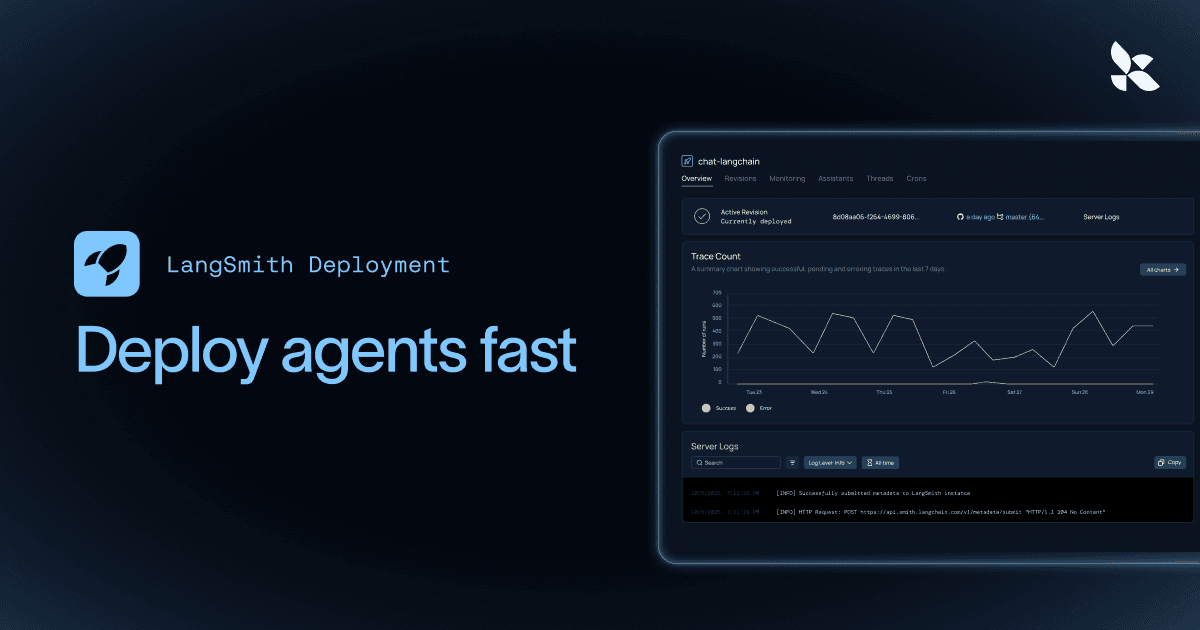
At its core, LangGraph provides four production primitives: stateful checkpointing that survives server restarts and network failures, built-in human-in-the-loop interrupt patterns for pausing agent execution pending approval, graph-based workflow control that supports cycles and conditional branching, and a memory layer covering both short-term working state and long-term cross-session persistence. LangGraph is model-agnostic: it works with OpenAI, Anthropic, Google, Mistral, and any LLM reachable via API. The LangGraph Platform (previously called LangSmith Deployment) adds managed cloud hosting, fleet orchestration, and LangSmith observability on top of the open-source runtime.
What LangGraph actually does in April 2026
LangGraph 1.0 GA ships a runtime that handles the infrastructure concerns most agent frameworks leave to the developer. State defined via Python TypedDict flows through graph nodes; each transition is checkpointed to a configurable backend (SQLite for local dev, Postgres or Redis for production). If a worker crashes mid-graph, the next execution resumes from the last saved checkpoint rather than starting over. This behavior is native to the framework, not an optional plugin.
Human-in-the-loop control works through interrupt primitives. A node can pause execution and surface pending state to an external system (a Slack approval bot, a web UI, a human review queue). The agent thread blocks without holding server resources, and resumes when the human sends a response command. This pattern is particularly valuable for high-stakes workflows: financial approvals, medical record updates, content moderation escalations.
LangGraph also ships a time-travel debugging interface via LangSmith. Because every state transition is checkpointed, developers can replay any historical graph execution from any node, inspect the agent's reasoning, modify state mid-run, and fork alternate execution branches. Austin Vance of Focused Labs, who has deployed LangGraph across more than a dozen production industries, summarized the observability value directly:
"When a customer reports a weird agent behavior, I can pull up the trace and see that at step 7, the agent received ambiguous search results." - Austin Vance, Focused Labs, dev.to, 2025
The framework supports multi-agent topologies: supervisor agents that orchestrate specialized subagents, parallel branches that fan out across independent tasks, and hierarchical graphs where a parent graph invokes child subgraphs. Klarna's customer support AI, which handles 85 million active users across multiple countries, uses LangGraph and LangSmith to manage these workflows, reducing customer resolution time by 80 percent.
Where LangGraph sits versus CrewAI and Temporal
The comparison with CrewAI and Temporal exposes two fundamentally different design philosophies.
LangGraph vs. CrewAI: CrewAI organizes agents around role definitions: each agent gets a Role, Goal, and Backstory string, and the framework anthropomorphizes the coordination. Task outputs feed forward as implicit context to the next agent in sequence or hierarchy. There is no explicit state object and no native checkpoint layer. CrewAI prioritizes low-configuration startup over runtime guarantees. LangGraph, by contrast, exposes a StateGraph with typed schemas and explicit reducer functions for merging concurrent branch outputs. Developers must think in terms of graph topology and state transformations. This is more demanding to learn but yields deterministic, inspectable execution rather than emergent role-play. The common production pattern is to prototype in CrewAI for speed, then migrate to LangGraph when reliability and auditability requirements arrive. As one framework comparison put it: "While LangGraph requires you to think in graphs and state machines, CrewAI lets you think in human terms."
LangGraph vs. Temporal: Temporal is a general-purpose durable workflow engine that predates the LLM era. It serializes execution history at the workflow-engine level, re-executing recorded steps deterministically on worker restart. This guarantees exactly-once execution semantics for any code, not just LLM calls. LangGraph's checkpointing is scoped differently: it saves agent state between graph nodes, but state inside a node is not persisted. Temporal has no native LLM concepts (no prompt templates, no tool-calling wrappers, no human-in-the-loop primitives). For teams building agents that also involve real business side effects (payments, database writes, external API calls), the recommended architecture as of 2026 is a two-layer stack: Temporal for the outer durable execution wrapper, LangGraph for the inner LLM reasoning loop. LangGraph is LLM-native. Temporal is infrastructure-native. They are increasingly used together rather than as alternatives.
What the agent loop reality looks like day to day
Building with LangGraph means defining your state schema upfront as a Python dataclass or TypedDict, then writing nodes as plain Python functions that read from and write to that state. Edges can be static (always go from node A to node B) or conditional (inspect state and route to B, C, or terminate). Cycles are supported, which is essential for retry logic and iterative refinement loops.
The development loop requires LangSmith for anything beyond toy examples. Without trace inspection, debugging why an agent took a wrong branch or entered an infinite loop is extremely time-consuming. LangSmith is a separate product with its own pricing, but the integration is tight and the team treats it as the production observability story for LangGraph.
Deployment options range from running the LangGraph server locally, to self-hosting on Kubernetes, to using LangGraph Platform's managed cloud. The managed cloud reduces DevOps overhead significantly but adds per-minute compute costs on top of LLM API fees.
"After shipping agents into production across a dozen different industries, it's the only framework that treats the hardest problems as first-class concerns." - Austin Vance, Focused Labs, dev.to, 2025
A recurring frustration is boilerplate density. Defining state schemas, writing reducer functions, mapping out edge conditions, and configuring checkpointer backends is a significant investment before any LLM logic runs. Community discussions consistently surface the same pattern: developers write simple direct-API scripts that work faster for prototypes but hit walls when they need recovery, human review, or multi-agent coordination. The overhead pays off at production scale. It does not pay off for scripts that run once.
Who LangGraph is built for
LangGraph is built for engineering teams deploying AI agents in regulated, high-stakes, or long-running production environments where correctness matters more than time-to-first-demo. Finance teams at companies like Klarna that need deterministic approval chains. Developer platform teams at companies like Uber running large-scale code migration pipelines where a restart halfway through would corrupt state. Recruiting systems at LinkedIn that need to coordinate between natural-language search, candidate matching, and outbound messaging without losing context between sessions.
It is also appropriate for any team that has already hit the wall with simpler frameworks: agents that fail silently on network errors, workflows that restart from the beginning on deployment restarts, multi-step processes that need a human to review an intermediate decision before the agent proceeds.
What LangGraph is not
LangGraph is not a low-code tool. There is no visual workflow builder in the open-source framework. Building and debugging a LangGraph application requires Python proficiency, comfort with graph theory and state machines, and ideally familiarity with LangSmith's trace interface. The graph-based mental model is conceptually different from sequential scripting and has a documented steep learning curve.
It is not a good fit for simple linear workflows. If your agent calls one tool, formats a response, and returns, the overhead of typed state, checkpoint configuration, and graph topology is unjustified. Direct API calls with minimal orchestration are faster to build and maintain for single-step use cases.
It is also not an isolated security guarantee. In March 2026, CVE-2025-67644 disclosed an SQL injection vulnerability in LangGraph's SQLite checkpoint implementation (CVSS 7.3), allowing metadata filter manipulation to run arbitrary SQL against the checkpoint database. The patch landed in langgraph-checkpoint-sqlite 3.0.1. Teams self-hosting on SQLite checkpointers should verify they are on the patched version.
Finally, LangGraph is not Temporal. For workflows that must guarantee exactly-once execution of side effects (charging a payment, writing to a regulatory ledger), Temporal's execution model provides stronger guarantees. The production consensus by 2026 is to layer LangGraph inside Temporal when both LLM reasoning and transactional durability are required.
User Reviews
No reviews yet. Be the first to share your experience!
Sign in to write a review.
Featured in collections
Curated lists that include LangGraph.
Related articles
Guides and articles related to LangGraph.
15 AI Agent n8n Workflows You Can Build This Weekend (2026)
Run a Company With AI Agents: The Open-Source Orchestration Setup (2026)
How AI Agents Work: Architecture & Implementation Guide (2025)
Orchestrator-Workers: The Multi-Agent Pattern That Actually Scales (2026)
Turn Any AI Agent Into a Superagent: The 12-Integration Stack (2026)