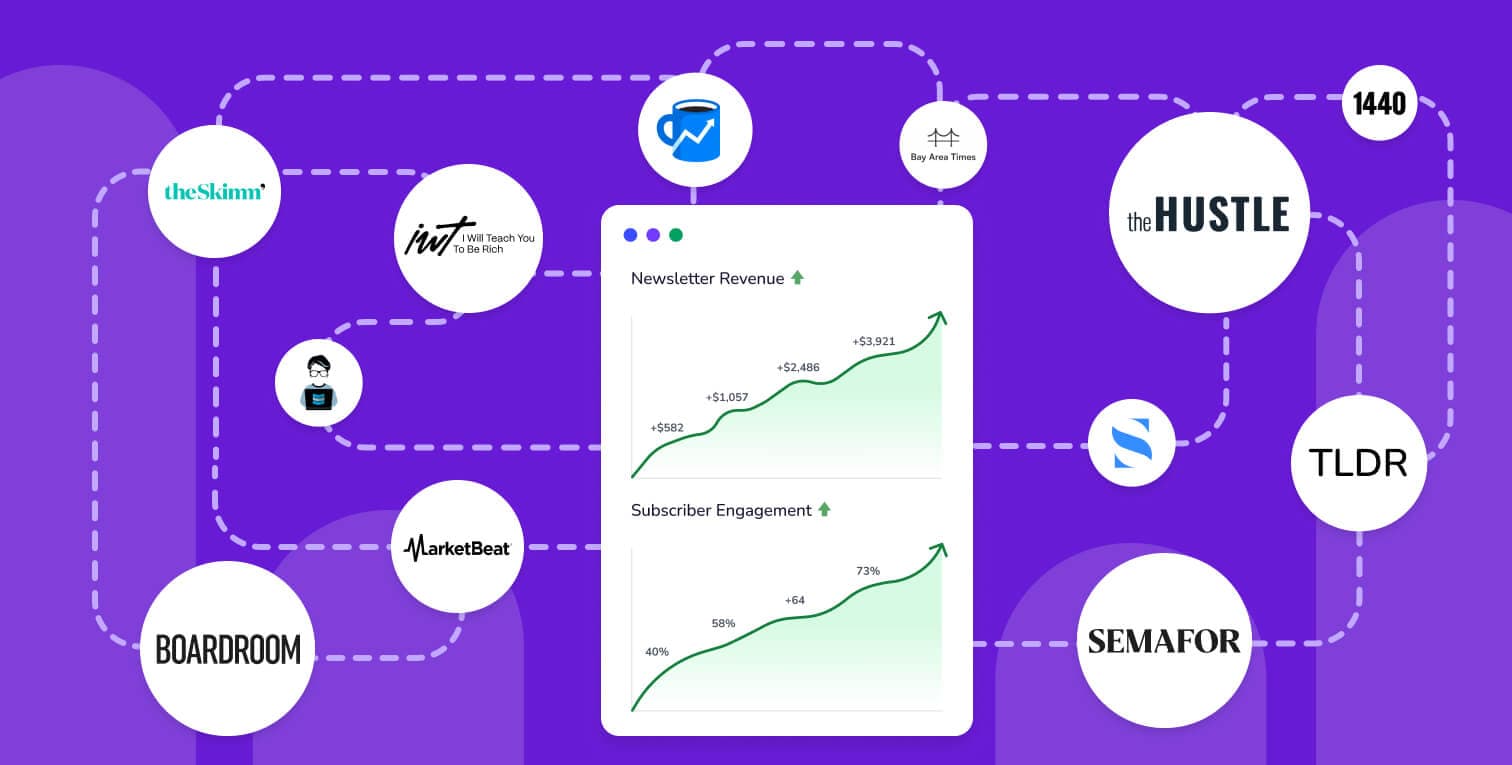

SparkLoop is the leading cross-platform newsletter referral and paid subscriber acquisition network. Founded by Louis Nicholls and Manuel Frigerio, it powers referral programs for some of the world's largest newsletters and connects publishers willing to pay for engaged subscribers with those willing to recommend them.
SparkLoop is a newsletter growth platform built around two distinct products: a Referral Program that rewards existing subscribers for referring friends, and a Partner Network that lets newsletter operators buy and sell engaged subscribers through vetted cross-promotions. Founded in 2020 by Louis Nicholls and Manuel Frigerio (who had previously built and sold ReferralHero), SparkLoop was acquired by ConvertKit in June 2023 and continues to operate independently. It integrates with over 25 email service providers including beehiiv, Mailchimp, ActiveCampaign, Klaviyo, HubSpot, and Kit, making it the only scaled paid recommendations marketplace that works across platforms rather than within a single newsletter ecosystem.
The core mechanism is a two-sided marketplace: publishers with engaged audiences earn $2-$7 per subscriber they recommend to partner newsletters, while growth-focused operators pay $2-$20 per confirmed subscriber to be featured in those recommendations. Referral programs use in-email widgets, post-signup Upscribe popups, and Magic Links to drive viral sharing. SparkLoop handles fraud detection, automated reward fulfillment (digital downloads, coupons, physical goods via Printful), referral tracking across web forms and popups, a subscriber-facing Referral Hub portal, and full analytics with A/B testing and CPA measurement. An API and webhook layer supports custom integrations and enterprise-grade reward workflows.
What SparkLoop actually is in May 2026
SparkLoop operates as two somewhat separate products bundled under one platform. The first is the Referral Program: a classic referral marketing engine that adds a trackable sharing layer to any newsletter. Subscribers get a unique link, share it, and unlock rewards when enough friends confirm their subscriptions. The rewards engine handles digital files, custom emails, coupon codes, and physical merchandise (via Printful). The in-email referral section drops into newsletters via a visual builder with no developer required.
The second and more strategically significant product is the Partner Network, launched in beta in September 2022. This is where SparkLoop's market position really sits: a manually vetted, cross-platform marketplace where publishers recommend other publishers. At signup, a new partner gains access to roughly 30 programs; the broader pool includes hundreds of vetted newsletters and media brands paying $1-$20 per verified new subscriber. Recommendations surface through the Upscribe post-signup widget (reporting average 40-60% opt-in rates) and Magic Links embedded in newsletter body copy.
The Kit acquisition in June 2023 added a distribution layer: SparkLoop's paid recommendations infrastructure now powers the Kit Creator Network, letting Kit's 100,000+ newsletter creators participate without a separate subscription. For everyone else, SparkLoop remains independent, and the team has maintained integrations across all major ESPs to avoid being perceived as a Kit-only tool.
Where SparkLoop sits versus beehiiv Boosts and the Kit Creator Network
beehiiv Boosts is SparkLoop's most direct rival. Beehiiv launched Boosts natively into its platform, meaning beehiiv users get paid recommendations without an additional subscription or integration step. The fee structures are close but not identical: beehiiv charges 20% flat (payment processing included), while SparkLoop charges 20% plus a separate 3.5% processing fee, making SparkLoop marginally more expensive on earnings. The critical mechanical difference is network scope: beehiiv Boosts only connects beehiiv-to-beehiiv. SparkLoop's Partner Network works across any ESP combination, so a Mailchimp publisher can receive subscribers recommended by a beehiiv newsletter and vice versa. For operators already on beehiiv who don't need cross-platform reach, the native simplicity of Boosts is genuinely hard to argue against. For operators on other platforms, or those who want access to SparkLoop's larger established network, the case for SparkLoop remains intact.
Kit Creator Network is now SparkLoop's parent company's competing product, which creates an unusual dynamic. The Creator Network is free for Kit Creator Pro subscribers and pays $1-$4 per subscriber, a narrower range than SparkLoop's $2-$20. It operates only within Kit's ecosystem. SparkLoop, as a separate product, gives access to a broader publisher pool and higher per-subscriber rates for premium niches. For Kit users specifically, the question of whether to use SparkLoop vs the Creator Network comes down to network breadth: Creator Network is simpler and cheaper, SparkLoop offers more programs and higher ceilings. Both are technically possible to use simultaneously.
"My 200-subscriber newsletter grew to an engaged, valuable audience of ~10,000 almost overnight." - Sam Klemens, The Rollup Newsletter, sparkloop.app/grow-on-beehiiv
How the referral and recommendation engine actually works
When a new subscriber joins a newsletter using SparkLoop's Referral Program, they see their unique referral link embedded in a post-confirm email or inside the newsletter's referral section widget. The visual builder lets operators add this section to their emails in two clicks, without touching HTML. Subscribers who hit referral milestones (3 referrals, 10 referrals, etc.) get rewards fulfilled automatically: SparkLoop sends a digital file, triggers a Printful physical shipment, or fires a webhook to a custom fulfillment system.
The Upscribe widget surfaces on the post-subscription confirmation page. After a new subscriber confirms their email, they see a list of recommended newsletters from SparkLoop's Partner Network. Each recommendation that converts triggers a commission payout to the recommending publisher. Average opt-in rates of 40-60% are reported, though this varies significantly by niche and audience quality. Magic Links work in newsletter body copy: a publisher writes a recommendation in their editorial content and embeds a tracked link; if the reader subscribes and confirms, the recommending publisher earns the commission.
Fraud detection runs automatically. SparkLoop monitors for self-referrals, bot signups, and engagement patterns inconsistent with legitimate subscribers. The system allows customization for operators with specific quality requirements, and advanced analytics track referral sources, subscriber engagement over time, and CPA across acquisition channels.
"The subscribers that come in through SparkLoop referrals are the best subscribers I can get. They are engaged, open every edition, love it, and respond to me. They post about the newsletter in places I don't have access to." - Andrew Kamphey, Influence Weekly, sparkloop.app/stories/influence-weekly
The friction and limitations users keep raising
The most consistent complaint in reviews and user discussions is geographic restrictions. The overwhelming majority of Partner Network programs only accept US, UK, and Canadian subscribers. Publishers with substantial audiences in Europe, Latin America, Southeast Asia, or Australia report that a significant portion of their audience simply does not qualify for commission payouts. This disproportionately affects niche newsletters that have grown internationally or B2B newsletters whose readership skews global.
The $2,000/month minimum for paid acquisition through Partner Programs is a meaningful barrier. Solo creators and early-stage newsletters cannot access SparkLoop's growth network as buyers without committing $24,000/year minimum. The Partner Network (earning side) is free, but the paid growth side requires scale to even enter.
Several reviewers flag that subscriber quality monitoring is required. Not every subscriber acquired through paid recommendations engages at the rates implied by SparkLoop's marketing. Publishers who run paid campaigns without active monitoring of engagement metrics downstream report disappointing results. SparkLoop's fraud detection catches obvious abuse but does not guarantee editorial relevance between recommending newsletter and recommended newsletter.
For Kit users specifically, the overlap with the native Creator Network creates mild redundancy. Since the June 2023 acquisition, some Kit publishers find they're paying for SparkLoop features they already access through Kit's dashboard, though the network sizes and rate ceilings differ.
Finally, the inbox clutter concern is real for some subscribers. When a new reader subscribes to a newsletter and sees the Upscribe post-signup recommendations, they may subscribe to two or three additional newsletters. Some of those new inboxes fill up faster than anticipated, leading to unsubscribes that dilute list engagement for the operator who purchased those subscribers in the first place.
Who SparkLoop is for (and when to skip it)
SparkLoop earns its cost for established newsletter operators with 10,000+ subscribers who are serious about subscriber acquisition as a growth channel. Publishers earning revenue through sponsorships or paid subscriptions can justify the Partner Network's free tier immediately, since recommendations earned offset other acquisition costs. The referral program at $2,000/year ($167/month) makes sense for any newsletter where subscriber lifetime value exceeds $1 in revenue, which is most monetized publications. For larger operators setting $5,000-$20,000/month paid acquisition budgets, SparkLoop's cross-platform network and fraud detection infrastructure offer lower CPAs than Google or Meta for newsletter-specific audiences. Pair it with a strong editorial product on platforms like Ghost or Substack and the math becomes compelling quickly.
Skip SparkLoop if your newsletter is under 2,000 subscribers and you don't yet have a monetization model. The referral program costs more to run than the subscriber value recovered at small scale. Skip it if the majority of your audience is outside US/UK/Canada - the earning side of the Partner Network will return very little. Skip it if you're already on beehiiv and find Boosts sufficient for your growth goals, since beehiiv's native integration is simpler and the fee difference is marginal. Skip it if you're a Kit Creator Pro subscriber who hasn't exhausted what the Creator Network offers first.
For operators running multi-publication portfolios, agencies managing newsletters for clients, or media brands that want the flexibility to run referral programs across multiple ESPs without being locked into a single platform, SparkLoop remains the most established and battle-tested option in the category. Tools like Sender handle email delivery but not cross-publisher referral networks. SparkLoop's moat is its network size - years of publisher relationships and manually vetted quality standards that newer competitors haven't had time to build.
The economics of newsletter acquisition through SparkLoop often surprise operators coming from paid social. On Meta or Google, CPAs for newsletter subscribers routinely run $3-$8 per subscriber in competitive niches, with no engagement guarantee. SparkLoop's Partner Programs charge $2-$20 per subscriber, but those subscribers are newsletter-native readers who have already confirmed an email subscription to a vetted, related publication. Engagement rates downstream of Partner Network acquisition consistently outperform social-ad-driven subscribers in SparkLoop's published case studies. Andrew Kamphey of Influence Weekly reported that 80% of new subscribers in peak weeks came from SparkLoop referrals, and he described the resulting audience as qualitatively different from cold traffic: "I have an army of me running around out there and sharing the newsletter." That flywheel effect, where your best readers actively recruit similar readers, is what SparkLoop was designed to create and sustain.
The platform's API layer deserves separate mention for operators with engineering resources. Full API access means SparkLoop can plug into custom CRM systems, fire rewards based on proprietary engagement signals, or power white-label referral experiences that carry a publisher's own branding. Media companies running five or ten newsletter titles can use the API to manage programs across the portfolio without logging into each separately. This infrastructure layer is what separates SparkLoop from simpler referral plugins, and it is what justified Kit's acquisition as a strategic infrastructure investment rather than just a distribution play.
User Reviews
No reviews yet. Be the first to share your experience!
Sign in to write a review.
Related articles
Guides and articles related to SparkLoop.

How to Build an AI Newsletter to 10k Subscribers in 90 Days (2026)

Build and Sell AI Automations as a Service: The Operator Playbook (2026)
The 2026 AI Automation Rate Card: What Operators Actually Charge
How to Make Money Selling AI UGC Content for Brands (2026)

AI Instagram Reels Factory: 30 Reels/Day on Autopilot (2026)