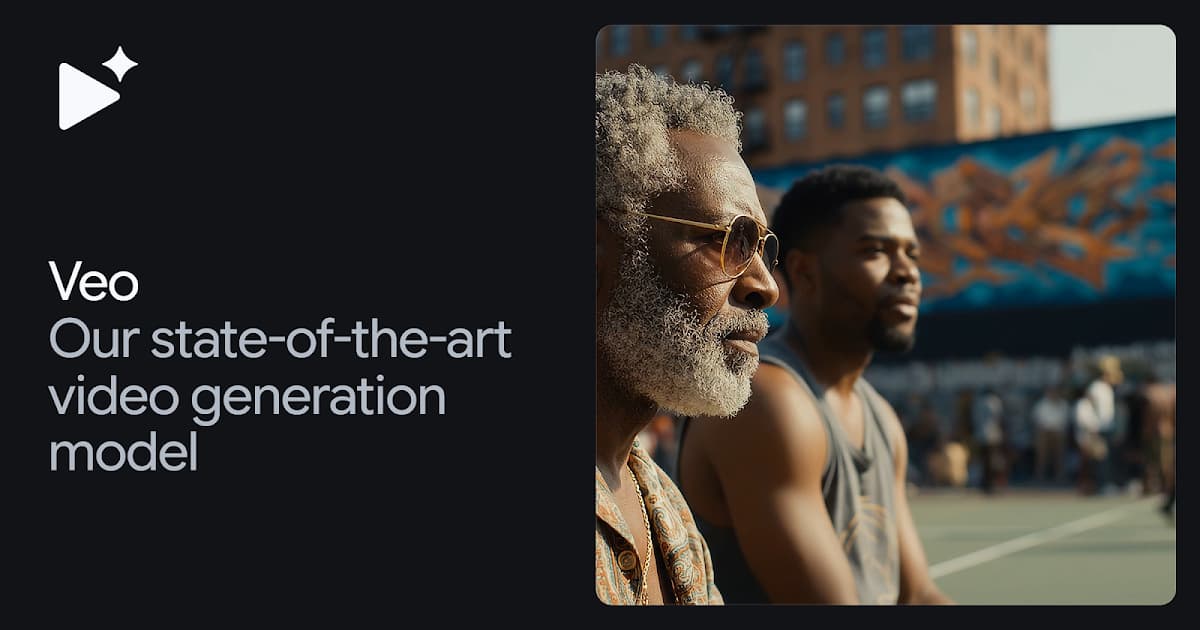

Veo 3 is Google DeepMind's video generation model and the first major commercial AI to produce synchronized audio alongside video in a single pass. Available via Gemini app on iOS and Android, Google Flow, and Vertex AI for enterprise API access.
Veo 3 is Google DeepMind's video generation model, launched at Google I/O on May 20, 2025. It is the first major commercial AI video generator to produce synchronized audio, including dialogue, ambient sound effects, and music, natively alongside video in a single generation pass. Before Veo 3, every major AI video tool including Sora, Runway, Pika, and Kling produced silent clips by default, requiring audio to be sourced and layered separately in post-production. Veo 3 ended that workflow. It runs through the Gemini app on iOS and Android, Google Flow (the dedicated filmmaking tool), Google AI Studio, and Vertex AI for enterprise API access.
The model generates 1080p video up to 8 seconds per clip with physics-aware motion and camera controls including zoom, pan, and tracking shots. Its audio system creates contextually matched output: ocean waves, ambient street noise, character dialogue with lip-synced mouth movement, background music chosen by the model from scene context. Veo 3.1 (October 2025) extended the architecture with 4K upscaling, 9:16 vertical video for Shorts and TikTok, and Scene Extension technology that chains clips into continuous narratives exceeding 60 seconds. Vertex AI access provides per-second billing for developer integrations, with SynthID invisible watermarking applied to all outputs for content provenance tracking.
What Veo 3.1 outputs as of September 2026
As of September 2026, the official shipping line is Veo 3.1 (API IDs such as veo-3.1-generate-preview / veo-3.1-fast-generate-preview / veo-3.1-lite-generate-preview; Agent Platform GA IDs veo-3.1-generate-001 and veo-3.1-fast-generate-001, with Lite preview from April 2026). Documented clip lengths are 4, 6, or 8 seconds at 24 FPS; aspect ratios 16:9 and 9:16; output up to 720p/1080p/4K on Standard Generate (Fast/Lite max 1080p; Lite lacks Extension and reference images). Veo 3.1 adds Ingredients-to-Video, Scene Extension, first-and-last-frame transitions, richer native audio, and vertical Ingredients support (Jan 2026). There is no official Veo 4 model page, API ID, or Vertex listing as of 2 Sep 2026: I/O 2026’s major video launch was Gemini Omni, not a Veo major bump.
The audio system is the defining technical feature. Veo 3 uses a joint video-audio diffusion architecture rather than a separate audio model layered on top. When you prompt for a beach scene, the model generates matching wave sounds. When you prompt for a character speaking dialogue, it generates the voice with natural inflection and attempts lip-sync. The model makes contextual audio decisions: in tests, when a scene could have ambient noise or background music, it selected whichever better matched the content. Generation time runs 2-10 minutes depending on complexity and server load, with a faster variant ("Fast") available for prototyping at reduced resolution and audio fidelity.
Consumer access is freemium via Google Flow credits (documented free daily credits for non-subscribers on Veo 3.1 Lite/Fast/Quality) plus Google AI Plus / Pro / Ultra plans. Developer access: paid Gemini API and Cloud Agent Platform / Vertex. Official Gemini API video-with-audio rates (per second, paid tier only: no free Veo API tier): Standard $0.40 (720p/1080p) / $0.60 (4K); Fast $0.10 / $0.12 / $0.30; Lite $0.05 / $0.08 (no 4K). Cloud table also lists cheaper video-only SKUs (e.g. Standard $0.20/$0.40). Charge only on successful video generation.
Where Veo 3 sits versus Sora 2 and Runway Gen-4
The three dominant commercial video generation platforms differ in architecture in ways that directly affect creative workflows.
Veo 3 versus Sora 2 (OpenAI): Sora uses a spatiotemporal autoencoder combined with a Diffusion Transformer (DiT) that represents video as spacetime patches with 3D positional encoding. Its Multimodal Diffusion Transformer (MM-DiT) processes text, image, and audio inputs through separate streams. The critical mechanical difference: Sora's architecture separates audio entirely from video generation. Sora does not produce native audio. Clips output silent; sound must be added via post-production tools. Sora's temporal coherence and prompt semantics for cinematic camera movement are widely recognized as stronger, making it preferable for longer narrative sequences. But for content creators needing a complete audio-visual output without a post-production step, Sora's silence is a workflow blocker.
"Veo 3.1 audio alone is worth it. Sora videos are beautiful but silent - useless for most content." - Reddit commenter, r/AIVideoGeneration, late 2025
Veo 3 versus Runway Gen-4 / Gen-4.5: Runway Gen-4 (March 2025) launched with no native audio, consistent with every prior Runway model. The architecture is a diffusion transformer with temporal attention across frames, purpose-built for professional cinematic output: strong character consistency, sophisticated camera controls, and deep integration into post-production workflows. Runway Gen-4.5 (December 2025) added native audio generation, 7 months after Veo 3. The Autoregressive-to-Diffusion (A2D) hybrid in Gen-4.5 blends diffusion visual quality with autoregressive scene comprehension. Runway's pricing model (subscription tiers from $12-$144/month by credit volume) suits high-iteration creative professionals. Its cinematic output quality and character consistency remain the industry standard for production use. Veo 3's advantage is audio-first delivery and broader consumer accessibility through Google's existing subscription stack.
The real cost of generating video with Veo 3
Cost depends on the access path. Consumer path: Google AI Plus/Pro/Ultra gate Flow credit pools (commonly 200 / 1,000 / 10,000–25,000 monthly on official Flow help; unused monthly credits do not roll over). Pro users still report tight shared compute quotas for video. Ultra is now split (I/O 2026) at roughly $100/mo (5x) and $200/mo (20x), not the prior $249.99 single top tier.
API path (Gemini API + Cloud Agent Platform): official Standard video+audio is $0.40/s at 720p/1080p ($0.60/s at 4K): an 8-second 1080p Standard clip is about $3.20, not $6. Fast with audio is $0.10/s (720p), $0.12/s (1080p), $0.30/s (4K): not ~$0.15. Lite with audio is $0.05/s (720p) / $0.08/s (1080p). Cloud also publishes video-only rates (Standard $0.20/$0.40). Google states you are charged only if video is successfully generated; treat AI Studio “per video” UI labels as misleading versus the per-second docs.
"I actually thought a random ad had popped up on my screen. It looked that realistic." - Manus.im reviewer, testing Veo 3, 2025
Klarna, Kraft Heinz, and Japan Airlines (via agency partner Jellyfish/Pencil) were cited in Google's Vertex AI launch announcement as early enterprise users. Kraft Heinz reported reducing creative timelines from 8 weeks to 8 hours using Veo via Vertex AI.
Where Veo 3 consistently breaks
Six recurring failure modes appear in reviews and forum discussions consistently enough to expect rather than be surprised by:
Garbled subtitle hallucination: From launch through at least July 2025, Veo 3 added nonsensical caption overlays to dialogue scenes even when explicitly prompted not to. Google announced a fix on June 9, 2025. MIT Technology Review reported the problem persisting on July 15, 2025. Creative director Mona Weiss stated: "If you're creating a scene with dialogue, up to 40% of its output has gibberish subtitles that make it unusable." The root cause is training on YouTube and TikTok content with embedded captions; negative prompts are less effective than positive instructions for suppressing learned patterns.
8-second hard limit per clip: The most common frustration. Social content and ads frequently require 15-20 second segments. Scene Extension in Veo 3.1 helps but requires individual clips to be chained, with seams and consistency management.
Audio-prompt misalignment: The model sometimes generates unsolicited audio elements, adds dialogue that was not requested, or produces unintelligible speech. Audio intelligence can overshoot.
Complex scene prompt drift: Multi-element scenes with 3+ distinct objects or behaviors frequently misrepresent parts of the prompt. Action sequences produce static crowds and generic rather than specified behaviors.
Content policy false positives: Users report legitimate creative prompts flagged for policy violations, requiring resubmission and credit loss.
Rendering slowness and generation limits: Generation can run 10+ minutes under load. Daily generation caps vary by subscription tier and are not always clearly published, leading to unexpected lockouts mid-project.
The July 2025 content moderation incident is worth noting separately for enterprise users. Media Matters for America reported on July 1, 2025 that racist and antisemitic videos generated using Veo 3 were being uploaded and going viral on TikTok, with some clips reaching over 1 million views. The model's failure to understand racist tropes made content moderation difficult. TikTok banned the flagged accounts. The incident highlighted the gap between per-video safety filters and systemic misuse at scale, and prompted Google to tighten generation constraints.
Best use cases versus skip-this scenarios
Best suited for:
Short-form social content where audio-complete delivery matters. YouTube Shorts, TikTok, and Instagram Reels creators get a full video-plus-audio asset in one generation, eliminating the audio sourcing and sync step entirely.
Marketing B-roll and social animations. The enterprise case is well documented: fast iteration from brief to deliverable for brand content, social animations, and product bumpers.
Documentary and interview-style content. Talking-head dialogue generation is a specific strength, with natural speech inflection and facial expression capture performing well in controlled-subject tests.
Developers embedding video generation via API. Per-second Vertex AI billing is predictable; Gemini API integration is straightforward for teams already in the Google Cloud ecosystem.
Skip Veo 3 when:
You need long-form narrative coherence across 30+ seconds of a single continuous scene. Sora remains the usual comparison for longer temporal coherence; Veo 3.1 Scene Extension chains 4–8s clips but is not a single continuous 30s generator. There is no official Veo 4. For multi-turn omnimodal editing, prefer /ai-tool/gemini-omni.
You need deterministic character consistency across multiple takes or across scenes. Runway Gen-4 is specifically designed for this production use case.
Your workflow requires high iteration volume at low cost. At official Standard rates (~$3.20 per 8s 1080p+audio): or Flow Quality credit burns: heavy iteration gets expensive fast; use Fast/Lite tiers or other APIs for draft volume.
You are outside the Google ecosystem and need multi-provider workflow flexibility. Runway and Sora have broader third-party integrations.
User Reviews
No reviews yet. Be the first to share your experience!
Sign in to write a review.
Featured in collections
Curated lists that include Veo 3.
Related articles
Guides and articles related to Veo 3.
AI Video Generator Prompting: The Filmmaker's Real Workflow
Sell AI-Generated Short Films on TikTok Shop, Instagram & YouTube (2026)
AI Fashion Prompts That Stay Consistent: The Working Formula (2026)
Grok 4.3 API for Agents (May 2026): Pricing, Benchmarks, Migration

OpenAI GPT-Realtime-2 (May 2026): Pricing, Latency & 30-Min Voice Agent