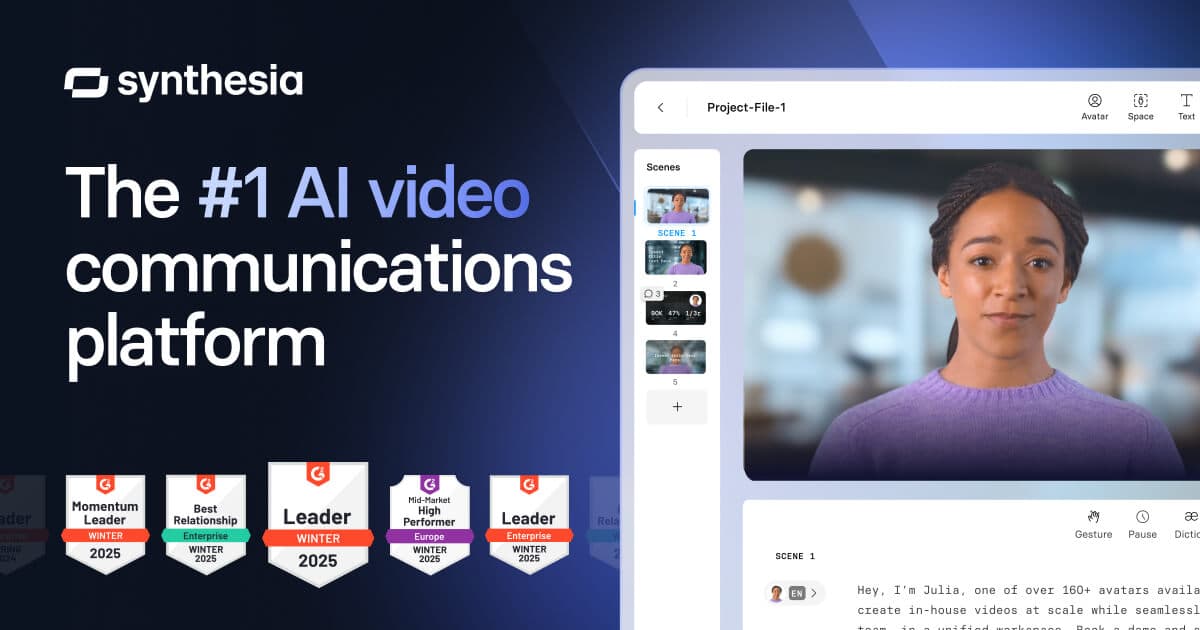

Synthesia is the enterprise standard for AI avatar video, used by Electrolux, major pharmaceutical firms, and 70%+ of Fortune 100 companies to produce multilingual training content at scale. Express-2 avatars are genuinely impressive, with real trade-offs.
What Synthesia's output actually looks like in April 2026
We built a 90-second new-hire onboarding module using a German-language personal avatar on the Creator plan, running Synthesia's Express-2 engine. The avatar, recorded via webcam, delivered the script in measured, professional German at medium-shot framing. Lip sync tracked standard phonemes accurately throughout most of the video, and the Express-2 full-body system showed noticeably more natural gesture variety than what the chest-up Express-1 baseline produced. For the first 80 seconds, the output cleared the "professional enough" bar without hesitation.
Then the cracks showed. Two company-specific product names caused the avatar's lip movement to lag roughly one syllable behind the audio, a drift that would require phonetic spelling in the script editor to fix. In the final 10 seconds, a tighter close-up framing exposed the avatar's hyper-smooth complexion, triggering the mild uncanny valley effect that remains Synthesia's most discussed quality ceiling. For standard corporate training, this output is genuinely usable. For anything requiring emotional intimacy with the viewer, a CEO message, a testimonial-style module, the artificiality will be visible to attentive eyes.
That tension, impressive for its category, not quite convincing as human, defines Synthesia's 2026 position. Express-2, which launched September 2025 with an ~800M parameter voice engine and a diffusion transformer motion model, is a real generational step over what this platform offered 18 months ago. Synthesia 3.0 added interactive video, branching scenarios, and Video Agents (AI avatars that respond to viewer questions in real time). The platform now serves 70%+ of Fortune 100 companies and passed $100M ARR. But the features that close enterprise deals. SCORM export and 1-click multilingual translation, sit behind a custom Enterprise contract, and the minute caps on lower plans run out faster than most teams expect.
Best use cases, and the disasters to avoid
Synthesia's strongest ground is L&D content that needs to exist in multiple languages, gets updated regularly, and must integrate with a corporate LMS. The core operational insight is that training videos become infrastructure, not artifacts. When a compliance policy changes, teams with a Synthesia workflow update the script and regenerate, no studio booking, no re-recording, no scheduling talent. Electrolux uses this model to train 15,000 employees across Europe in 30+ languages. Multiple enterprise teams report production speed improvements that sound impossible until you factor in that most corporate training video spend goes into logistics, not creation.
"What would have been 100 hours of work, we can do in 10 minutes.". Enterprise HR director, Synthesia case study, 2025
The disasters are predictable once you know the platform's limits. Emotionally-driven content, sales testimonials, personal CEO communications, vulnerability-forward culture videos, consistently exposes the uncanny valley. One YouTube creator who tested avatar-based channel content reported that audience engagement dropped 40% compared to human-presented material, and that viewers immediately identified the artificial delivery. If your audience's trust in the speaker is load-bearing, Synthesia's avatars will undercut it.
Healthcare and biotech teams hit a specific trap: Synthesia's Acceptable Use Policy prohibits using stock avatars for medical content, requiring the $1,000/year Studio Avatar add-on instead. This restriction is embedded in the AUP rather than surfaced on the pricing page, and it generates consistent buyer's remorse from life-sciences buyers who discover it after committing to a plan.
The non-obvious power-user deployment: connect Synthesia's API to an LMS so that policy-document updates automatically trigger new video renders and retire old versions. Teams running this pattern report near-zero ongoing video production overhead for mandatory annual compliance training, and most discover it through enterprise customer references, not Synthesia's own marketing.
Avatars and lip sync, how well they hold up
Express-2's core advances are real and visible in practice. The shift from blending pre-recorded motion clips to generating new performances from a diffusion transformer model means avatars now produce anatomically plausible co-speech gestures, arms, hands, and body movement that correspond to vocal rhythm and stress rather than looping in patterns. At 1080p/30fps with no length cap per video, the technical baseline is now competitive with human-produced corporate content in controlled conditions.
The flagship Express-2 avatars. Ada, Ryan, Zola, Michael, and Ellie, each carry built-in delivery styles (neutral, concerned, excited, assertive). In medium-shot framing for standard business vocabulary, lip sync quality for English, French, German, Spanish, and Japanese rates at roughly 80–90% accuracy. The remaining 10–20% surfaces in three specific failure conditions: proper nouns and brand names (phoneme lag of up to one syllable), technical jargon with multi-syllable clusters (visible mouth-shape approximation rather than accurate phoneme rendering), and regional accent variants where voice performance differs from lip calibration (Mexican Spanish vs. Castilian Spanish is the most commonly noted example).
"A colleague had to ask if my demo video was AI-generated or actually me. That's a first.". Reviewer testing Express-2, aitoolanalysis.com, 2025
Gesture variety holds across the first two to three minutes before repetition becomes noticeable. The reviewer who spent a week testing Synthesia's 2025 platform found that stacking gestures on every sentence produced an "conducting an invisible orchestra" effect, and recommended restraint: sparse gesture use across a 10-minute module maintains perceived naturalness better than maximally animated delivery. Granular keyframe-level gesture control is absent, the system handles gesture timing algorithmically, and art-directing specific emphasis moments is not currently possible.
Personal avatars, created from webcam footage or uploaded video, perform comparably to stock avatars at medium framing. Synthesia allows 3 personal avatars on Starter, 5 on Creator, and unlimited on Enterprise. Selfie Avatars, generated from a small set of still photos rather than video, remain experimental as of April 2026 and show more visible artificiality than webcam-generated equivalents.
The close-up problem is structural. Express-2's diffusion-based complexion rendering produces skin that reads as hyper-smooth and uniformly lit in tight framing, a tell that improves in medium and wide shots but cannot be corrected in close-up without post-processing the output. For training content shot at standard presentation framing, this is manageable. For content designed around personal connection with the viewer, it is not.
Export limits: resolution, length, watermarks
Free plan output carries a watermark and cannot be downloaded, videos can only be shared via Synthesia's hosted player. Paid plans remove the watermark and enable direct download. All paid tiers output at up to 1080p/30fps via Express-2, with no per-video length cap on generation (though minute allocations constrain total monthly output).
The critical export constraint is SCORM: SCORM 1.2 and SCORM 2004 package export is Enterprise-only. This covers compatibility with Workday Learning, Cornerstone, SAP SuccessFactors, and any SCORM-compliant LMS. Creator-plan users can embed videos via iframe or share hosted links into LMS platforms that support external video, but cannot produce a native SCORM package without an Enterprise contract. This is the most frequently cited structural limitation in B2B reviews, teams who evaluate Synthesia for L&D discover the SCORM wall after committing to Creator and face an upgrade conversation to a custom-priced plan.
1-Click Translation into 80+ languages with lip-sync resynchronization is also Enterprise-only. Creator and Starter plans include AI Dubbing (30-minute monthly cap on Creator), which handles translation but requires manual trigger per language per video rather than bulk deployment. The practical consequence: a Creator-plan team producing a 10-video compliance course in six languages must run AI Dubbing 60 times individually.
A real workflow: building a multilingual onboarding library with Synthesia
An instructional designer scripts a 5-minute onboarding module in English, assigns a stock avatar with a delivery style (neutral + assertive for policy content), and publishes the English master. AI Dubbing generates translated versions per language. On Creator plan, each language requires a separate Dubbing session; on Enterprise, 1-Click Translation generates all 80+ language variants at once.
When a policy updates, the designer revises the script and regenerates, the video URL or SCORM package remains the same, the content updates automatically. Teams with Creator-tier API access can automate this entirely: a policy-document change triggers a Synthesia API call, renders the new video, and pushes it to the LMS with no human involvement.
The caveat L&D teams consistently miss: minute caps count all renders, including re-renders and localized copies. A 5-minute module re-rendered twice and published in 6 languages consumes 40 minutes of allocation, more than a full month's Creator plan budget in a single piece of content.
The true cost per finished video
Starter at $18/month (annual) provides 120 minutes per year , $1.80 per finished video-minute at full utilization. Creator at $64/month provides 360 minutes per year, roughly $2.13 per minute. Neither figure accounts for re-renders and translation copies; realistic cost per finished, localized minute runs 3–4x the headline rate once revision cycles are included.
The Studio Avatar add-on costs $1,000/year and is required for medical/healthcare content using stock avatars. Enterprise pricing is custom; B2B forums cite contract values of $15,000–$60,000/year depending on scale.
Synthesia vs. HeyGen vs. Colossyan
HeyGen is the primary rival and wins on expressiveness and voice cloning for short-form content. HeyGen's Avatar IV produces more dynamic delivery than Synthesia's stock avatars for 60–90 second marketing clips and social content, and its voice cloning preserves original speaker characteristics across translations in a way that makes a CEO's message sound authentically theirs in Japanese or Portuguese. The practical weakness is consistency: Avatar IV shows jittery expressions on runs longer than 3–4 minutes, making it a poor fit for full-length training modules. HeyGen starts at $24/month. Reddit discussions in r/instructionaldesign favor HeyGen for SaaS marketing and sales enablement content, and Synthesia for L&D, compliance, and regulated enterprise environments that require LMS integration and audit trails.
Colossyan is the L&D-specific challenger that closes Synthesia's most painful gap: Colossyan offers SCORM export at lower pricing tiers than Synthesia's Enterprise requirement. Its avatar library is smaller and its production ecosystem less mature, but for mid-market L&D teams whose primary need is training video with SCORM packaging and branching scenarios, and who cannot justify a custom Enterprise contract. Colossyan is consistently recommended as the alternative in r/instructionaldesign and L&D community forums. Teams that evaluate Synthesia for L&D, discover the SCORM wall, and search for alternatives typically land on Colossyan as the direct comparison.
D-ID is the budget and API option at $5.99/month entry pricing. Avatar quality trails noticeably, mechanical head movement, weaker non-English phoneme lip sync, limited gesture variety, and there is no enterprise ecosystem, LMS integration path, or SCORM support. For teams that need basic avatar video at low volume with no LMS requirements, D-ID covers the use case at a price Synthesia cannot match. For any serious enterprise L&D deployment, the feature gap makes it a different category of tool.
User Reviews
No reviews yet. Be the first to share your experience!
Sign in to write a review.
Related articles
Guides and articles related to Synthesia.
How to Make Money Selling AI UGC Content for Brands (2026)

The Personal AI Productivity Stack (2026): One Tool Per Job, Nothing Extra

Best AI Fashion Model Generators for Clothing Brands (2026)
AI Instagram Reels Factory: 30 Reels/Day on Autopilot (2026)

How to Get an AI Model Wearing Your Clothes (Step by Step)