Abridge vs Nabla (2026): Ambient Medical Scribes - Epic, Accuracy Claims, Compliance Catch
# Abridge vs Nabla (2026): Ambient Medical Scribes - Epic, Accuracy Claims, Compliance Catch
You are buying a documentation workflow, not a magic stethoscope. Ambient medical scribes listen to (or capture) the clinician-patient encounter, draft a note, and push that draft toward your EHR. Abridge and Nabla are the pair buyers keep shortlisting in 2026. One play is Epic-depth + health-system evidence. The other is EHR breadth + flexible deployment. Mixing those plays into a single “accuracy winner” chart is how RFPs go sideways.
Not medical advice. This is a procurement and operator guide for technology evaluation. It does not diagnose, treat, or recommend clinical decisions. Clinicians remain responsible for every note that enters the chart. Ambient drafts are assistive; they are not an autonomous care system.
Evidence discipline: KLAS rankings and Kaiser Permanente / NEJM AI coverage are cited from pages we could retrieve. Where a claim is vendor marketing, third-party estimate, or behind a paywall we could not fully verify, it is labeled. Do not paste unlabeled accuracy percentages into your board deck.
As of 2 September 2026.
Some links may earn a commission. We also maintain directory listings; weigh that bias.
Table of contents
1. TL;DR
12. FAQ
13. References
TL;DR
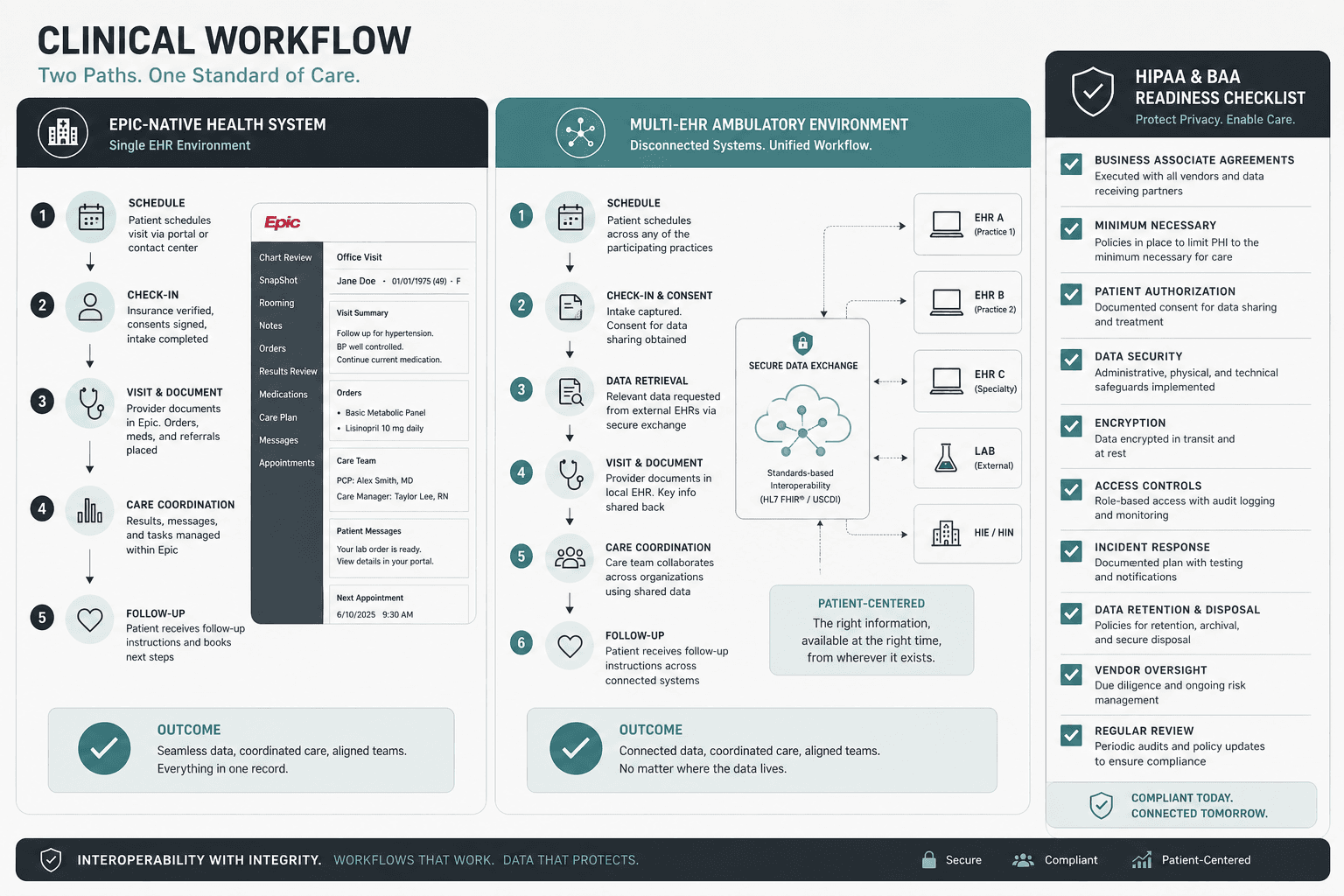
Fork on EHR reality first. Deep Epic health system with Haiku / Canto / Hyperdrive workflow needs → Abridge is the default shortlist member. Mixed EHR estate (Epic + athena + Oracle Health + others) or ambulatory multi-specialty breadth → Nabla’s multi-EHR story is the competing default.
KLAS (retrievable): Abridge’s press release states #1 Best in KLAS for Ambient AI (RCM / ambient speech category framing) for 2025 and 2026. KLAS’s Ambient Speech 2026 ranking page shows a Best in KLAS winner overall score of 94.7. TechTarget reporting attributes that 94.7 to Abridge (Ambience Healthcare close behind at 94.4). Treat KLAS as buyer-survey evidence, not a lab accuracy benchmark.
Peer-reviewed / health-system evidence (partially verified here): Kaiser Permanente published lessons from large-scale ambient AI documentation in NEJM AI, with a Permanente Medicine summary describing QA methods, PDQI-style scoring averaging 4.35/5, and scale into millions of encounters. Abridge’s blog frames that NEJM AI work around Abridge evaluation. Read the primary paper yourself before claiming effect sizes in an RFP - full text may be paywalled.
Compliance catch: A signed BAA before PHI flows is non-negotiable for U.S. covered entities. Free tiers that lack a BAA are evaluation toys, not production. Confirm training-on-data defaults, audio retention, and subprocessors in writing - marketing pages are not your MSA.
Neither publishes a clean public price list for enterprise health systems. Budget from a written quote + implementation + EHR project time. Third-party per-clinician dollar figures exist online; they are estimates, labeled as such below.
What an ambient scribe is (and is not)
Is: ambient capture of the visit conversation → transcript / structured draft note → clinician review and edit → EHR documentation (and, increasingly, coding / revenue-cycle adjacent workflows).
Is not: a diagnostic engine, an autonomous order writer you ignore, a substitute for informed consent conversations about recording, or a HIPAA free pass because the vendor said “compliant” on a homepage.
Typical failure modes that kill ROI:
1. Draft quality that requires more edit time than typing (specialty-dependent).
2. EHR integration that forces copy-paste or dual systems.
3. Consent / recording policies that clinicians will not run in real rooms.
4. Compliance gaps (no BAA, unclear retention, surprise training use of audio/PHI).
Your evaluation should measure edit time, note acceptance, workflow clicks, and safety event process - not demo wow.
Abridge in one page
Abridge positions as an enterprise clinical-conversation AI platform for health systems: ambient documentation with deep EHR integration, Linked Evidence-style mapping of generated text back toward source evidence, and expansion across outpatient, ED, inpatient, and nursing workflows per its 2026 Best in KLAS press materials (Abridge press release, 4 Feb 2026).
Public claims from that press release (vendor + KLAS award context):
Best in KLAS for Ambient AI in 2025 and 2026 (Abridge’s wording; category also described in RCM / ambient speech reporting).
Partnership framing with more than 250 health system partners.
Projection of 80 million clinician-patient conversations supported in the cited year (vendor projection - not an independent audit).
Support for 28+ languages and 50+ specialties (vendor claim in the same release).
Linked Evidence feature called out as responsible-deployment tooling.
Epic angle (widely reported across buyer guides; confirm in your Epic App Orchard / Abridge SOW): Abridge is repeatedly described as embedded across Epic client surfaces such as Haiku, Canto, and Hyperdrive with bidirectional note sync. For Epic-centric systems, that depth is often the entire ballgame. Verify the exact build, note types, and specialty templates in *your* instance - marketplace blurbs are not configuration.
Who it is for: large and complex health systems, especially Epic shops that need procurement-grade references, KLAS coverage, and a vendor used to enterprise QA programs.
Who it is not for (usually): a solo cash-pay clinic that needs a credit-card signup this afternoon. Enterprise motion dominates.
Nabla in one page
Nabla (Nabla Copilot / ambient documentation suite) competes as an ambient scribe with a broad EHR footprint, multilingual and multi-specialty coverage, and a compliance stack that third-party reviews commonly summarize as HIPAA + SOC 2 Type II + ISO 27001 + GDPR (European roots). Confirm each attestation on current trust materials - certificates expire and scopes matter.
Buyer-facing differentiators that show up consistently in 2026 comparisons (verify on Nabla’s current site / MSA):
Integrations spanning many EHR systems (buyer guides often say 20+, naming Epic, athenahealth, Oracle Health, NextGen, Greenway, and others). Breadth is the pitch; depth per EHR varies - test *your* EHR, not a logo wall.
Flexible deployment for ambulatory groups, multi-specialty clinics, and mixed estates where one Epic-only vendor is a non-starter.
Historical freemium / Pro motion for individual clinicians; 2026 reporting indicates a shift toward demo / contract sales for paid org plans, with conflicting third-party price listings. Treat live pricing as confirm with vendor.
Who it is for: organizations that need one scribe vendor across heterogeneous EHRs; groups that weight language coverage and specialty templates heavily; buyers who want a path that is not “Epic health system RFP only.”
Who it is not for (until proven): an Epic mega-system whose CIO has already standardized on a Best in KLAS Epic-native stack *and* will not staff a second ambient program - political reality matters as much as model quality.
Head-to-head matrix
| Dimension | Abridge | Nabla |
|---|---|---|
| Primary GTM | Enterprise health systems | Ambulatory → enterprise; historically clinician-friendly entry |
| EHR story | Deep Epic embed (widely reported) | Broad multi-EHR (20+ claimed in secondary sources) |
| Evidence / awards (see caveats) | Best in KLAS Ambient AI 2025 & 2026 (Abridge PR); KP / NEJM AI-related coverage | KLAS has published Emerging Technology-style materials historically; not the 2026 Ambient Speech #1 in sources retrieved here |
| Languages / specialties | 28+ languages, 50+ specialties (Abridge PR) | Broad multilingual / multi-specialty claims in secondary reviews - confirm current counts with Nabla |
| Pricing transparency | Enterprise quote | Previously more public Pro pricing; 2026 reports say sales-led / page offline - confirm |
| Compliance homework | Enterprise BAA / HITRUST-or-equivalent expectations vary by health system | BAA on appropriate tiers; free-tier BAA gaps reported by third parties - confirm |
| Biggest win condition | Epic + KLAS + scaled QA culture | Mixed EHR + speed-to-pilot outside mega-Epic RFPs |
| Biggest risk | Overkill / inaccessible for small groups; quote opacity | Integration depth variance; pricing/BAA tier confusion |
Epic, EHR fit, and the real buying fork
Stop leading with “which model is smarter.” Lead with where the note has to land and how many clicks the clinician will tolerate.
If you are Epic-centric
Prioritize:
1. Native workflow in the Epic clients your clinicians actually use (mobile + desktop).
2. Note write-back reliability, cosign / attest patterns, and specialty note templates.
3. References from peer Epic shops of similar size - KLAS interviews skew this way for a reason.
4. Ambient + revenue-cycle adjacency if your CFO is funding the deal (Abridge’s KLAS category placement in RCM reporting is part of that conversation).
Abridge belongs on that shortlist by default in 2026. Nabla can still win an Epic subunit or a parallel ambulatory pod - but you must prove Epic depth in *your* build, not from a generic slide.
If you are multi-EHR or non-Epic
Prioritize:
1. One contract covering the EHR mix you will still have in 24 months.
2. Specialty coverage for the clinics that burn out first (primary care, behavioral health, etc.).
3. Admin tooling for a group without a 40-person digital team.
4. Clear BAA and retention settings that your DPO / privacy officer will sign.
Nabla’s breadth pitch is aimed here. Abridge may still appear via health-system parent standards even when some clinics are non-Epic - clarify governance early.
Accuracy, KLAS, and studies - what you can cite
KLAS - buyer satisfaction, not a BLEU score
Retrieved:
KLAS Best in KLAS Ambient Speech 2026 shows a Best in KLAS winner with overall performance score 94.7 (100-point scale). The fetched page emphasizes the category and score; pair it with named reporting.
TechTarget, 5 Feb 2026: Abridge took the ambient speech technology top spot again at 94.7, with Ambience Healthcare at 94.4.
Abridge press release, 4 Feb 2026: claims #1 Best in KLAS for Ambient AI two years running, A+ ratings across Culture, Loyalty, Relationship, and Value pillars in their summary of KLAS interviews.
How to use this: KLAS is strong procurement signal for large U.S. providers. It is not independent proof that every specialty note is hallucination-free. Score it as customer experience / loyalty evidence.
Kaiser Permanente / NEJM AI - methods matter more than marketing pull-quotes
Retrieved (Permanente Medicine summary, 26 Mar 2025): Kaiser Permanente described QA lessons from a large ambient AI clinical documentation rollout tied to a NEJM AI report. Highlights from that summary (permanente.org article):
10-week pilot before broader deployment across regions / medical offices / hospitals.
Voluntary clinician use; patient approval before recording; audio not maintained (per their description); draft summary edited by physicians before charting.
Star ratings and structured PDQI-style surveys; average PDQI-related score 4.35 out of 5; thoroughness was a weaker domain vs “free from bias.”
Minority of users reported multi-speaker tracking issues, omissions, or erroneous assumptions corrected by physicians.
Explicit framing: tool does not make care decisions; clinicians remain decision-makers.
Scale note in the summary: technology used to support more than 4 million encounters after rollout (organizational claim in the article).
Abridge’s framing: Abridge blog on Kaiser Permanente NEJM AI research states peer-reviewed NEJM AI research on evaluating Abridge, citing 1,306 users’ feedback volumes (star ratings, self-reviews, free-text) and the 4.35/5 optimized PDQI figure, plus 4M+ encounters as of Nov 2024 in their bullets.
What we could not fully verify in this writing pass: the complete NEJM AI full-text PDF (paywall / access limits). Label any effect-size claims you cannot open and read (e.g., specific “61% cognitive load” style stats that circulate in secondary social posts) as unverified here until you pull the paper or a detailed methods supplement. For your RFP, prefer: study design, population, note types, edit requirements, and safety monitoring - not a single percentage on a LinkedIn card.
Nabla evidence posture
Public peer-reviewed, KP-scale NEJM AI packages comparable to the Abridge/KP narrative were not retrieved as a like-for-like head-to-head in this pass. That absence is not proof Nabla is “inaccurate”; it means your evaluation must lean harder on your specialty pilots, EHR write-back tests, and quality sampling. Do not invent a Nabla NEJM study to “balance the table.”
HIPAA, BAA, and the compliance catch
U.S. covered entities and business associates: if the vendor creates, receives, maintains, or transmits PHI for you, you need a Business Associate Agreement that matches the real data flows (audio, transcript, draft note, analytics, support access).
Non-negotiables before any live clinic day
1. Signed BAA on the exact tier you will use (not “enterprise later”).
2. Written answers on: audio retention defaults, transcript retention, who can access recordings, encryption, subprocessors, breach notification, and whether customer content trains models.
3. Consent workflow that matches state law + your policy (ambient recording is a people process, not a checkbox in the app).
4. Clinician attestation culture: every note is reviewed; ambient output is a draft.
5. BA / security review of mobile offline behavior, BYOD, and EHR OAuth scopes.
Catch patterns reported in secondary sources (confirm yourself)
Free tiers without a BAA: multiple 2026 Nabla writeups warn that free / student-style tiers may not include a BAA. If true on the current offer, that tier is unsuitable for real PHI. Verify on Nabla’s order form / MSA (Nabla MSA references BAA attachment in public MSA text - still confirm which SKUs are covered).
Training defaults: at least one secondary index claims Nabla session data used for training by default. Other reviews claim no training on PHI. These conflict. Do not guess - get the DPA answer in writing and make “no training on customer PHI” a contract line if that is your policy.
“HIPAA compliant” homepage language: meaningless alone. Ask for the BAA, the SOC 2 report under NDA, retention configuration screenshots, and a data-flow diagram.
Abridge enterprise deals are built around health-system security review; that does not mean you skip the questionnaire. It means the vendor expects one.
International note: Nabla’s GDPR posture matters for EU data. Abridge’s U.S. health-system center of gravity does not automatically equal your residency needs. Map data residency explicitly.
Pricing reality (mostly unpublished)
| Vendor | What is public | What secondary sources say (unverified estimates) | How you should budget |
|---|---|---|---|
| Abridge | Enterprise / health-system sales; no standard public rate card found | Occasional third-party guesses on the order of thousands USD per clinician per year - not confirmed here | Written quote + EHR integration project + training + quality program FTE |
| Nabla | Pricing page reportedly offline / sales-led in 2026 coverage; MSA is public | Older publicly discussed Pro figures around ~$119/clinician/mo appear in reviews; treat as historical / unverified for current SKUs | Confirm current Pro vs Enterprise packaging; do not assume freemium includes BAA |
Math you can do without inventing prices:
Measure minutes of documentation per encounter before/after on a 2-week baseline.
Multiply time saved (only if edit quality holds) by fully loaded clinician cost.
Subtract vendor quote + IT + ambient device / mic logistics + privacy ops.
Kill the deal if savings require assuming zero edit time - that assumption fails in multi-speaker and complex specialty visits (KP’s own QA narrative flagged thoroughness and multi-speaker issues as real).
When each wins / when NOT
Choose Abridge when…
You are an Epic-heavy health system optimizing for native workflow and peer references.
KLAS / large-system procurement filters are real at your organization.
You can staff QA monitoring similar in spirit to what KP describes (feedback loops, specialty-aware rollout).
Ambient + documentation integrity / RCM adjacency is part of the business case.
Choose Nabla when…
You run multiple EHRs or a non-Epic ambulatory footprint and need one scribe vendor.
Speed-to-pilot for clinics matters more than winning a 12-month health-system bakeoff.
Language / specialty breadth for your specific panels is a gated requirement - and Nabla proves it on *your* note types.
Your privacy team clears the BAA tier you will actually deploy.
When you should NOT buy either (yet)
You will not require clinician review of drafts (unsafe and non-compliant with how these tools are meant to be used).
You cannot operationalize patient consent for recording.
Your “evaluation” is a weekend with PHI on a free tier that lacks a BAA.
The bottleneck is coding staff shortages alone - you may need CDI / RCM tooling, not only ambient capture.
Leadership wants a press release more than edit-time metrics.
Evaluation protocol you can run
Design (2-4 weeks):
1. Pick 3 specialties with different talk patterns (e.g., primary care, orthopedics, behavioral health).
2. 10-20 encounters per specialty per tool (or sequential A/B if you cannot dual-run).
3. Blind a reviewer to vendor where possible; score: omissions, wrong attributions, fabricated details, edit time, and “would I sign this.”
4. Measure EHR clicks to finalize.
5. Log any safety concerns into your existing event process - do not invent a side channel.
Pass bar examples (set yours explicitly):
Median edit time ≤ your baseline documentation time.
Zero tolerated fabricated meds / allergies / diagnoses in sampled notes without catch-on-review controls.
Consent completion rate your compliance office accepts.
Clinician willingness-to-continue ≥ a pre-declared threshold.
Run the same protocol for both vendors. Do not declare a winner from a keynote demo.
FAQ
Is Abridge more accurate than Nabla?
No honest public head-to-head with identical specialties, note types, and review protocols was retrieved for this article. Abridge currently has stronger large-system / KLAS / KP-NEJM AI narrative evidence in sources we could open. Accuracy for *you* is an empirical pilot result. Anyone selling a universal percentage is selling theater.
Does Best in KLAS mean we must buy Abridge?
No. It means many large customers report strong experience. Your EHR mix, specialty mix, and contract terms can still favor Nabla or another vendor (Nuance DAX, Ambience, Suki, etc. are out of scope here but belong in a full RFP).
Can we use a free ambient scribe with real patients?
Only if a signed BAA covers that tier and your counsel agrees. Multiple secondary sources warn that some free tiers omit BAAs. Default answer for PHI: no BAA, no live patients.
Will ambient scribes replace clinicians?
No. KP’s own public messaging stresses clinicians remain decision-makers; the tool drafts documentation. Treat “AI doctor” marketing as a red flag.
What about hallucinations?
Generative drafts can omit, misattribute speakers, or invent plausible details. Mitigation is workflow: Linked Evidence-style verification (Abridge marketing), mandatory clinician edit, specialty QA sampling, and clear escalation. Your policy should assume errors exist.
Is this HIPAA certification?
There is no simple government “HIPAA certified product” stamp that replaces your BAA + risk analysis. Ask for attestations (SOC 2, ISO 27001, HITRUST if required), then still do due diligence.
Should small practices start with Nabla?
Often Nabla’s motion has been easier for smaller groups historically - but 2026 pricing packaging is in flux per secondary reports. Get the current BAA-bearing SKU in writing. Compare against other self-serve scribes if enterprise Abridge is out of reach.
References
Accessed September 2026.
1. Abridge - Best in KLAS 2026 press release (4 Feb 2026): https://www.abridge.com/press-release/best-in-klas-2026-press
2. KLAS - Best in KLAS Ambient Speech 2026 (score 94.7 winner page): https://klasresearch.com/best-in-klas-ranking/ambient-speech/2026/487
3. TechTarget - Abridge / ambient speech KLAS coverage (5 Feb 2026): https://www.techtarget.com/revcyclemanagement/news/366638784/Abridge-Microsoft-earn-top-spots-for-revenue-cycle-tech
4. Permanente Medicine - QA lessons / NEJM AI ambient documentation summary (26 Mar 2025): https://permanente.org/quality-assurance-informs-large-scale-use-of-ambient-ai-clinical-documentation/
5. Abridge - Kaiser Permanente NEJM AI research blog: https://www.abridge.com/blog/kaiser-permanente-nejm-ai-research-2025
6. NEJM Catalyst - Ambient AI scribes learnings after 1 year / 2.5M+ uses (related KP ambient program literature; vendor transitions noted in abstract): https://catalyst.nejm.org/doi/full/10.1056/CAT.25.0040
7. Nabla - Master Subscription Agreement (BAA attachment referenced): https://nabla.com/master-subscription-agreement
8. Secondary comparison indexes used only with labels (pricing/BAA tier caveats; not primary evidence): AI Health Index Abridge vs Nabla; Litmus / CompareScribes Nabla reviews - re-verify any dollar figure or training-default claim directly with the vendor.
Could not fully verify in this pass: complete NEJM AI full-text PDF statistics beyond what Permanente Medicine and Abridge’s blog summarize; current live Nabla public price sheet (reported offline / sales-led); any HITRUST certificate numbers without trust-portal access.
Related from Vantaige
HIPAA-aware AI documentation primers (non-scribe)
Health AI buyer’s guides that start from EHR constraint tables
Evaluation scorecards for vertical AI (pilot metrics over demo scores)
---
*Written as Aymen B for Vantaige.io - 2 September 2026. Not medical advice. Not legal advice. Re-check BAA, DPA, and primary studies before deployment.*
Get the best new AI tools and guides, weekly
One short email a week. The tools worth trying, the guides worth reading, nothing else.
No spam. Unsubscribe anytime.
Aymen B
Contributing writer at Vantaige, covering the AI tools ecosystem.
Similar articles
Vantaige Launches the LLM VRAM Calculator: A Free GPU Compatibility Finder for Open-source and Open-Weight AI

Xiaomi MiMo-V2.6 Deep Dive: The 1-Trillion-Parameter Open-Source Titan Disrupting the Frontier