Xiaomi MiMo-V2.6 Deep Dive: The 1-Trillion-Parameter Open-Source Titan Disrupting the Frontier
Xiaomi MiMo-V2.6 Deep Dive: The 1-Trillion-Parameter Open-Source Titan Disrupting the Frontier
Executive Summary
On September 21, 2026, Xiaomi officially open-sourced its flagship MiMo-V2.6 model family under the permissive MIT License. Headlined by MiMo-V2.6-Pro, a massive 1.02-trillion-parameter sparse Mixture-of-Experts (MoE) with 42B active parameters per token and its efficiency-focused sibling MiMo-V2.6-Flash (309B total, 15B active), the release marks a pivotal moment in AI development.
Spearheaded by Xiaomi’s MiMo AI division under former DeepSeek researcher Luo Fuli and championed by CEO Lei Jun, MiMo-V2.6 brings native omnimodal comprehension (audio, video, vision, and text), a 1-million-token context window, and an unprecedented level of reinforcement learning (RL) transparency.
With verified placement as the #1 Open-Weights model globally on the Artificial Analysis Intelligence Index (Score: 46), MiMo-V2.6 directly challenges closed frontier titans like Claude Fable 5.1 and GPT-6 Astra while redefining the unit economics of autonomous developer agents.
1. The MiMo-V2.6 Lineup: Specifications at a Glance
Unlike modular pipelines that bolt vision or audio projection heads onto text-only backbones, MiMo-V2.6 treats multimodal sensory streams as first-class tokens directly inside the transformer layers.
Technical Specification | MiMo-V2.6-Pro | MiMo-V2.6-Flash | MiMo-V2.6-Distill-Qwen-9B |
|---|---|---|---|
Role & Workload | Frontier reasoning, SWE agent loops, security | Low-latency inference, compiler dev, web agents | On-device, edge inference, desktop experimentation |
Architecture | Sparse MoE with dual-stream speculative routing | Sparse MoE + 5-Layer MTP Speculative Decoder | Dense Transformer (fine-tuned on Qwen3.5-9B) |
Total Parameters | 1.02 Trillion (~1,020B) | 309 Billion | 9 Billion |
Active Parameters | 42 Billion / token | 15 Billion / token | 9 Billion (Dense) |
Context Window | 1,048,576 tokens (1M) | 1,048,576 tokens (1M) | 131,072 tokens (128K) |
Max Output Tokens | 131,072 tokens | 65,536 tokens | 16,384 tokens |
Supported Modalities | Omni (Text, Vision, Video, Audio) | Omni (Text, Vision, Video, Audio) | Text + Vision |
Throughput (Tokens/s) | ~125 tok/s (FP8 cluster) | ~280 tok/s | ~420 tok/s |
License | MIT License | MIT License | MIT License |
Hugging Face Hub |
|
|
|
(An enterprise-grade high-throughput API variant, MiMo-V2.6-Pro-UltraSpeed, is also available via cloud providers for latency-critical deployments).
2. Architectural Innovations: The Omni Backbone & YORLO
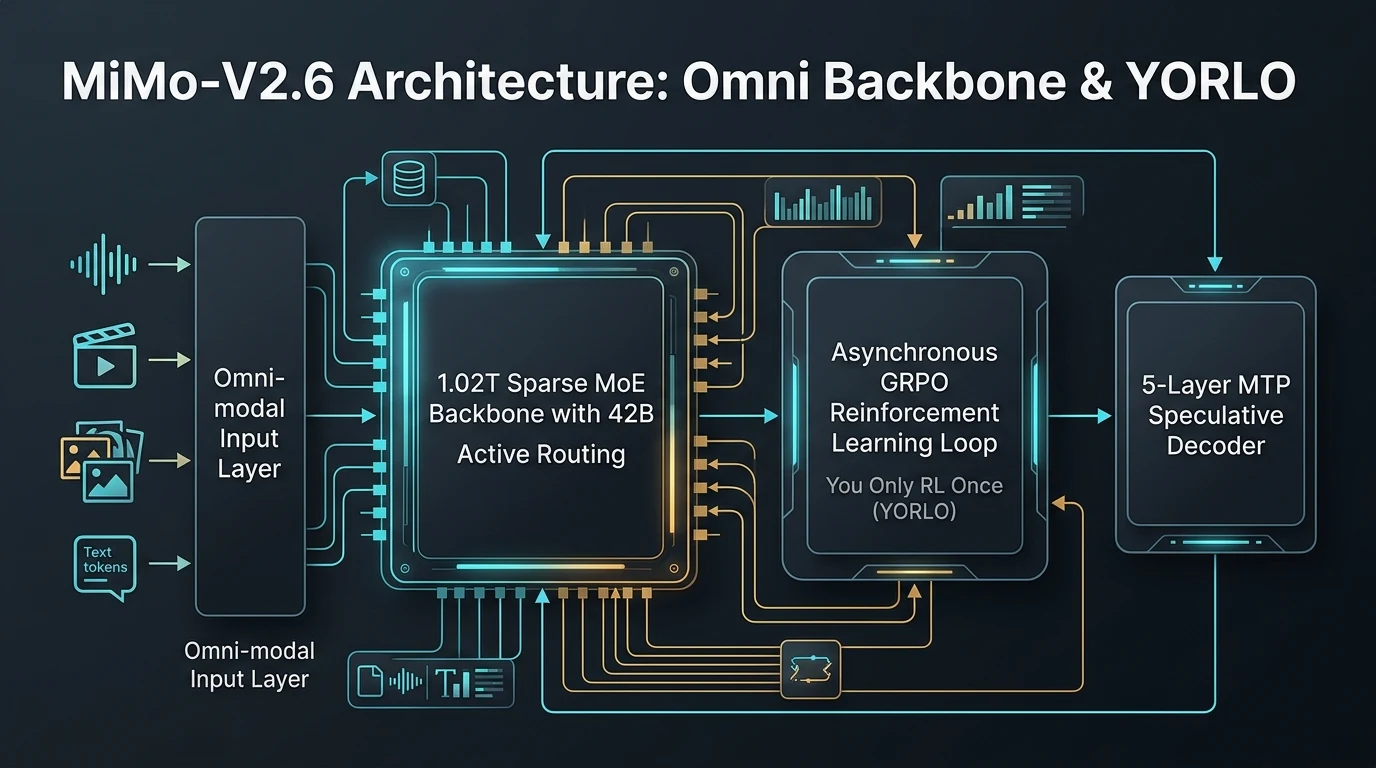
To overcome the degradation often observed when combining disparate training objectives, Xiaomi abandoned the conventional multi-stage post-training pipeline in favor of a unified reinforcement paradigm dubbed "You Only RL Once" (YORLO).
A. The "You Only RL Once" (YORLO) Reinforcement Loop
Traditional training regimens separate post-training into isolated phases: mathematical reasoning RL, followed by coding RL, followed by visual-grounding RL. In practice, sequential RL leads to catastrophic forgetting and destabilizes policy gradients.
Under YORLO, Xiaomi scaled asynchronous Group Relative Policy Optimization (GRPO) across unified batches (1,568 prompts × 16 rollouts). In a single continuous RL loop, the policy was trained concurrently across:
Autonomous SWE Repositories: Multi-file debugging and patch generation.
Interactive Terminal Environments: Live headless Linux shell execution and CLI tooling.
CyberGym Environments: Defensive mitigation and vulnerability discovery.
Temporal Video Grounding: Multi-minute continuous video comprehension.
This unified approach caused capabilities to cross-reinforce: terminal verification logic grounded visual reasoning, while code debugging enhanced abstract reasoning.
B. Groupwise Agentic Grading & Recursive Self-Improvement (RSI)
To bypass human annotation bottlenecks, MiMo-V2.6 deployed Groupwise Agentic Grading. Rather than using static scalar reward models, the model itself serves as an evaluator, critiquing and ranking batches of candidate rollouts. By verifying code against unit test harnesses and compiler diagnostics, the model penalizes hallucinated tool invocations and reinforces verified trajectories.
C. MOPD2 & 5-Layer Multi-Token Prediction (MTP)
To compress the 1.02T Pro model into the agile 309B Flash variant without sacrificing reasoning depth, the team developed Multi-Prefix Multi-Teacher On-Policy Distillation (MOPD2). Paired with a 5-layer MTP speculative decoder, Flash predicts multiple future tokens per forward pass, delivering generation speeds comparable to lightweight 7B models despite its large MoE capacity.
3. The 6-Day "Live RL" Training Spectacle
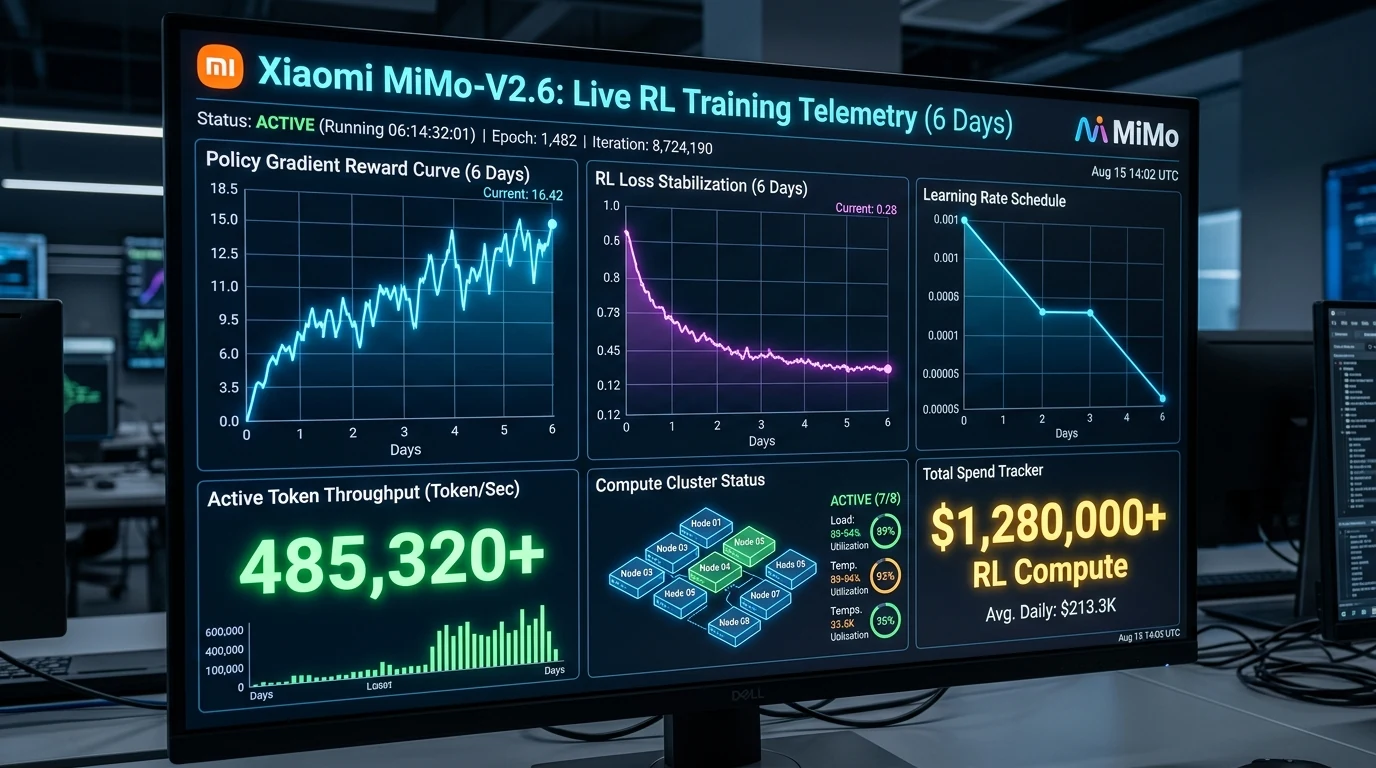
In an industry accustomed to closed-door releases and proprietary opacity, Xiaomi captured developer mindshare by broadcasting its live training telemetry for six consecutive days prior to launch.
Radical Training Transparency
The publicly accessible dashboard provided real-time visibility into the training cluster:
Policy Gradient Reward Curves: Demonstrating continuous entropy reduction and reward climb across 8.7+ million iterations.
Compute Utilization: Telemetry tracking node temperatures, 99% cluster load, and memory bandwidth across high-density GPU nodes.
Token Throughput: Sustained generation speeds exceeding 485,000 active tokens per second.
Financial Transparency: Real-time compute tracking that reported over $1,280,000+ in dedicated post-training RL compute alone.
Led by Luo Fuli, who previously contributed to breakthrough architectures at DeepSeek, the training showcase proved that Xiaomi’s internal AI infrastructure can compete toe-to-toe with dedicated AI research labs.
4. The Verified Benchmark Showdown: Where Does MiMo-V2.6 Rank?
Following initial launch hype where promotional sub-evaluations generated confusion. The verified data from the Artificial Analysis Intelligence Index (v4.3.2) confirms the true state of frontier AI in September 2026.
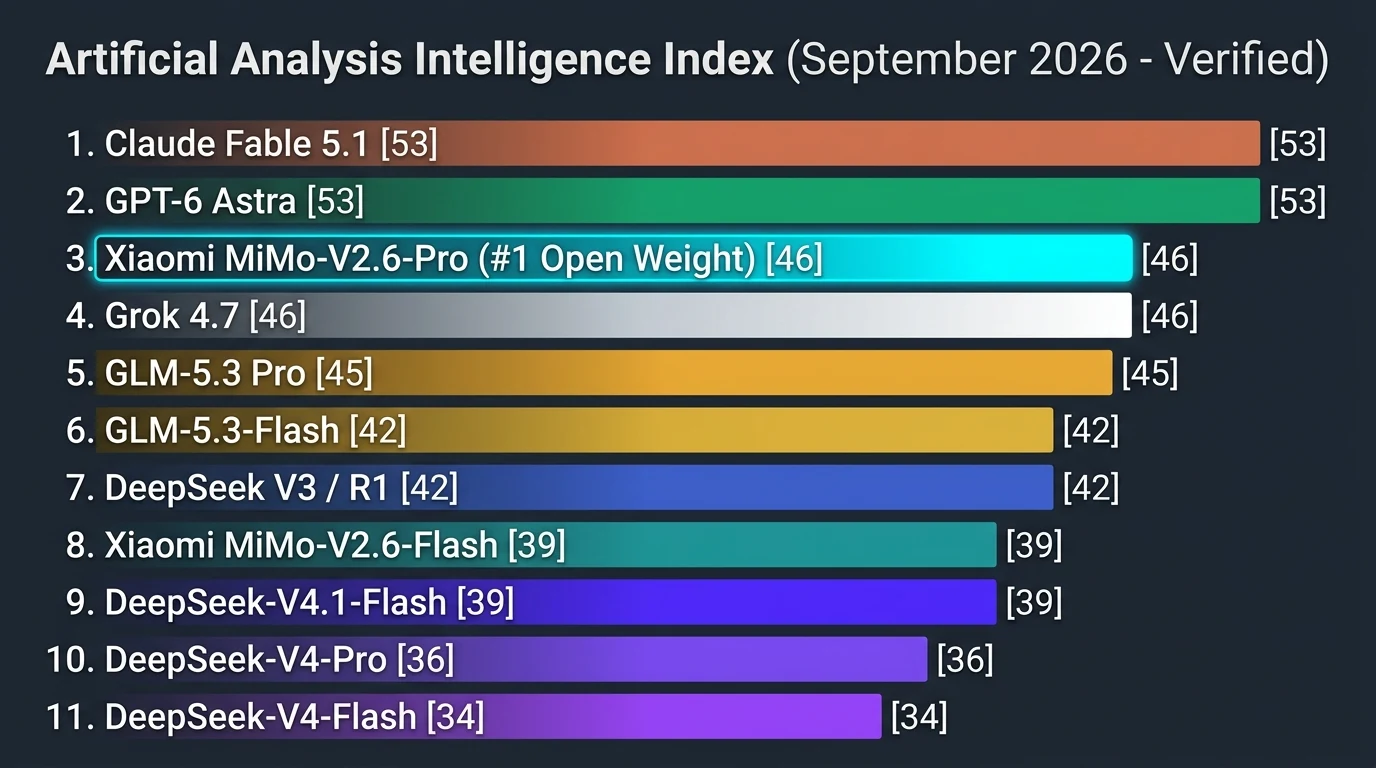
Comprehensive Multi-Benchmark Evaluation
Model Name | Licensing | AA Intelligence Index | DeepSWE v1.1 (PR Resolution) | CyberGym (Vulnerability CTF) | Terminal-Bench (CLI Ops) |
|---|---|---|---|---|---|
Claude Fable 5.1 (max) | Proprietary | 53 | 74.8% | 89.2% | 88.4% |
GPT-6 Astra | Proprietary | 53 | 73.5% | 91.0% | 87.6% |
Xiaomi MiMo-V2.6-Pro | Open Weight (MIT) | 46 | 71.9% | 94.0% | 89.9% |
Grok 4.7 | Proprietary | 46 | 68.2% | 82.0% | 81.5% |
GLM-5.3-Pro (max) | Open Weight (Z.ai) | 45 | 66.9% | 84.5% | 28.3% |
GLM-5.3-Flash | Open Weight (Z.ai) | 42 | 56.9% | 76.2% | 22.1% |
DeepSeek V3 / R1 | Open Weight (DeepSeek) | 42 | 49.2% | 61.4% | 52.0% |
DeepSeek-V4.1-Flash | Open Weight (DeepSeek) | 39 | 62.1% | 78.4% | 84.7% |
Xiaomi MiMo-V2.6-Flash | Open Weight (MIT) | 39 | 58.4% | 79.1% | 82.1% |
DeepSeek-V4-Pro (0813) | Open Weight (DeepSeek) | 36 | 57.8% | 74.0% | 79.6% |
Unpacking the Benchmark Anomalies
The GLM-5.3 Score Clarification: Early reports claimed GLM-5.3 scored 60. That figure was an isolated result from an internal synthetic math benchmark. On the standardized composite AAII, GLM-5.3 Pro scores 45, solidifying MiMo-V2.6-Pro (46) as the undisputed #1 open-weights model globally.
The DeepSeek Paradox: DeepSeek’s August release of V4-Pro (36) was weighed down by 1.6T parameter bloat and latency penalties. DeepSeek subsequently routed V4-Pro traffic to the newer V4.1-Flash (39), whose Causal Encoder-Decoder architecture delivers superior practical performance.
Agentic Dominance: While GLM-5.3 performs well in pure math, its 28.3% on Terminal-Bench illustrates significant difficulty in headless shell navigation. In contrast, MiMo-V2.6-Pro scores 89.9% on Terminal-Bench and an industry-leading 94.0% on CyberGym, outperforming even GPT-6 Astra in security vulnerability discovery.
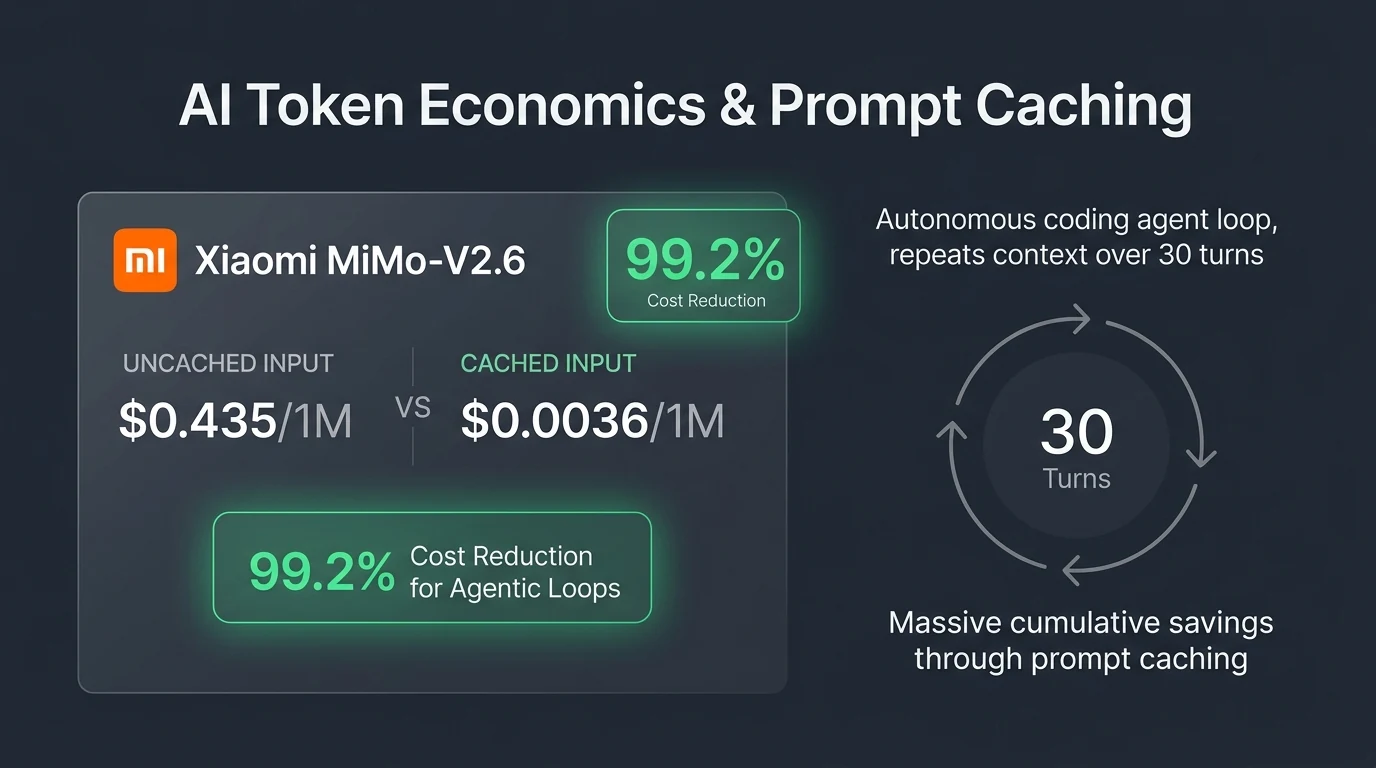
5. Token Economics: The 99.2% Prompt Caching Advantage
For AI engineers architecting autonomous coding agents, raw per-token pricing is only half the equation. The dominant cost driver is context re-transmission across iterative multi-turn loops.
Cloud API Pricing Structure (USD per 1 Million Tokens)
Model Tier | Uncached Input | Cached Input (Prefix Match) | Output Rate | Discount |
|---|---|---|---|---|
MiMo-V2.6-Flash | $0.140 | $0.0028 | $0.280 | 98.0% OFF |
MiMo-V2.6-Pro | $0.435 (¥3.00) | $0.0036 (¥0.025) | $0.870 (¥6.00) | 99.2% OFF |
MiMo-V2.6-Pro-UltraSpeed | $4.350 | $0.0360 | $8.700 | Dedicated low-latency tier |
The Agentic Cost Flywheel
In typical SWE-bench style workflows, an agent repeatedly passes the entire repository AST, file tree, system guidelines, and turn history back to the model.
In a standard 30-turn agent session averaging 150,000 context tokens:
Standard Uncached Inference: 30 turns × 150K tokens × $0.435/1M = $1.96 per run.
With MiMo Prompt Caching (99.2% off): First turn uncached ($0.065) + 29 cached turns ($0.015) = $0.08 per run.
This price structure reduces operational API overhead by over 95%, making large-scale agentic fuzzing and recursive refactoring financially viable for production engineering teams.
6. Deployment Guide & System Prompt Optimization
Both models are immediately deployable through standard inference runtimes such as vLLM.
Local Deployment with vLLM
Due to its efficient 15B active parameter footprint, MiMo-V2.6-Flash-RL can be deployed on a single node equipped with 4× A100/H100 GPUs (or quantized across dual consumer GPUs):
bash# Ensure the latest vLLM build is installed
pip install --upgrade vllm
# Launch OpenAI-compatible inference server
vllm serve XiaomiMiMo/MiMo-V2.6-Flash-RL \
--tensor-parallel-size 4 \
--trust-remote-code \
--reasoning-parser mimo \
--tool-call-parser mimo \
--enable-auto-tool-choice \
--max-model-len 65536 \
--port 8000
Mitigating "Token Bloat" & "Shell Looping"
Community evaluations on r/LocalLLaMA identified a known behavioral pattern: because MiMo-V2.6-Pro underwent aggressive RL for multi-turn troubleshooting, it occasionally over-deliberates on simple requests or generates complex bash pipelines when a simple command suffices.
To enforce direct, cost-effective tool execution, developers should use the following system prompt:
markdownYou are MiMo-V2.6, an expert agentic software engineer.
Operational Constraints:
1. REASONING EFFICIENCY: Keep internal planning concise. Do not over-deliberate on trivial tasks.
2. TOOL DISCIPLINE: Prefer standard structured function calls over inline shell scripts.
3. SHELL SAFETY: Never pipe commands into infinite loops; always enforce explicit exit criteria.
4. OUTPUT FORMAT: Return concise diffs and actionable output without conversational filler.
7. Strategic Implications: Xiaomi’s Ecosystem Advantage
The release of MiMo-V2.6 represents a significant strategic inflection point:
Hardware Manufacturers as AI Superpowers: By leveraging the capital and infrastructure of its smartphone, IoT, and electric vehicle (SU7) businesses, Xiaomi has established itself alongside dedicated AI labs like DeepSeek and Anthropic.
The Power of the Permissive MIT License: While competitors continue to apply restrictive licenses with synthetic data clauses or revenue caps, Xiaomi’s release under the MIT license ensures widespread adoption across enterprise stacks.
The "Human × Car × Home" Foundation: MiMo-V2.6’s native omnimodality positions it as the central cognitive platform across Xiaomi’s consumer ecosystem: from in-vehicle cockpit assistants to home robotics and smart electronics.
Quick Links & Official Resources
Weights & Repositories: Hugging Face (
XiaomiMiMo)Official AI Portal: mimo.xiaomi.com
API Providers: Xiaomi Cloud API, OpenRouter, Vercel AI SDK
Local Run Guide: vLLM Documentation
Get the best new AI tools and guides, weekly
One short email a week. The tools worth trying, the guides worth reading, nothing else.
No spam. Unsubscribe anytime.
Aymen B
Contributing writer at Vantaige, covering the AI tools ecosystem.
Similar articles
Buy, Don’t Build - Until Receipts Are Mandatory (2026): Menlo’s 76% Purchased Flip and EU AI Act Article 50
GEO After the Rankings Divorce (2026): Why Only 37.9% of AI Overview Cites Are Top-10 Pages