After-Hours Inquiry Capture for Local Businesses: AI Form + Voice Fallback (2026)
After-Hours Inquiry Capture for Local Businesses: AI Form + Voice Fallback (2026)
You close at 5pm. The salon, the clinic, the repair shop, the restaurant, the brokerage. The phone rings, the website form pings, the DM lands, and nobody is there to answer. By 9am that lead has called your competitor, booked elsewhere, and forgotten your name. This guide shows the architecture for after-hours inquiry capture in a local business, the four compliance rules you cannot skip, and the morning queue your owner actually wants to wake up to.
TL;DR
Most after-hours inquiries die in voicemail or a silent form.
One AI agent qualifies form, chat, voice, and DM into one record.
Caller gets an SMS confirm in 60 seconds with a callback slot.
Missed call triggers an auto-callback from a voice agent inside 90 seconds.
Owner wakes up to a ranked, summarized, already-booked queue.
Published 2026-05-21. Last reviewed 2026-05-21. 14 min read.
What is after-hours inquiry capture for a local business?
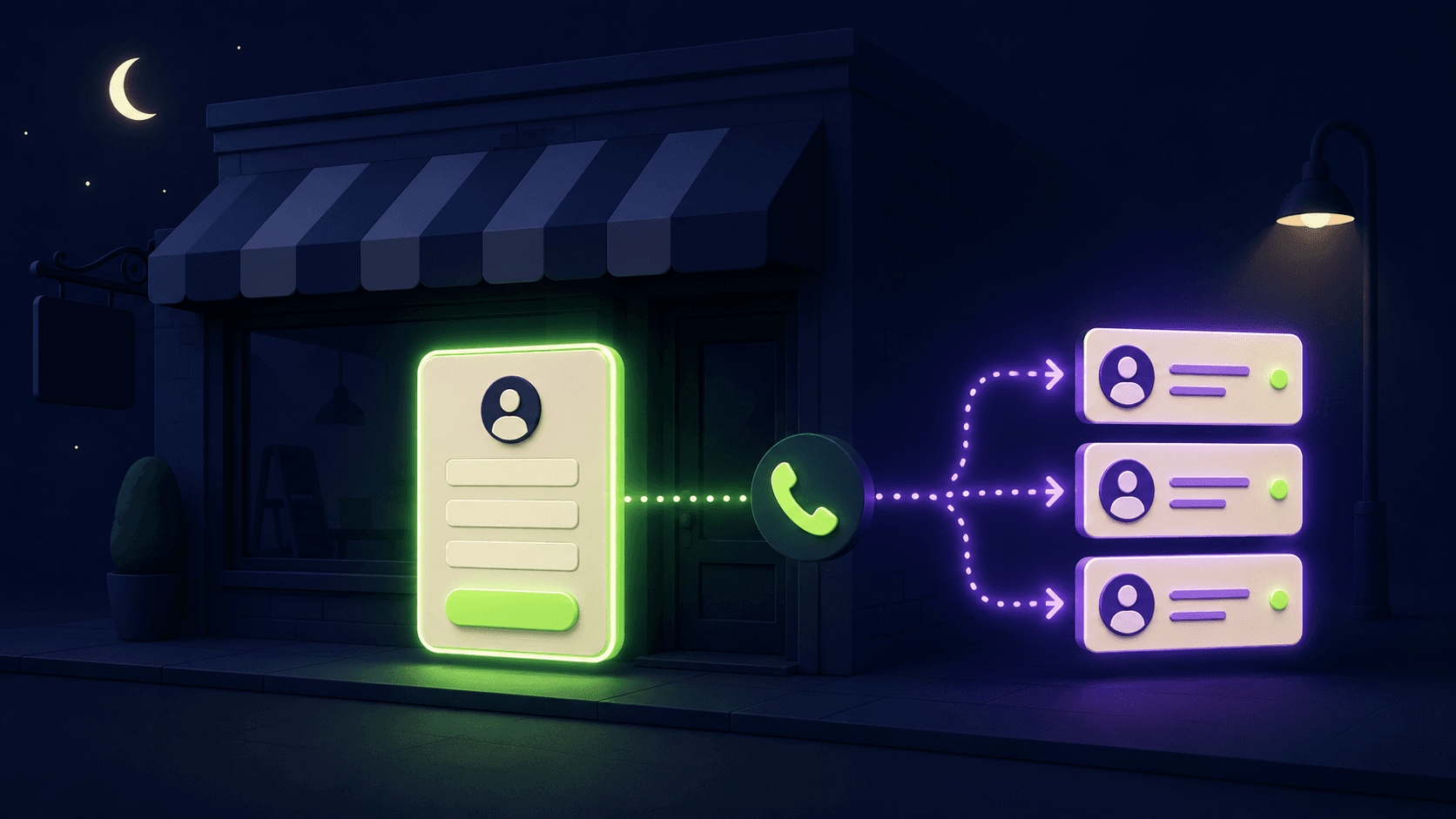
After-hours inquiry capture is a small automated system that catches every web form, chat message, DM, and missed call your business receives outside open hours, qualifies the lead with one AI agent, confirms the caller in 60 seconds by SMS, and books a morning callback on the owner's calendar. It runs between closing and opening, replaces the silent voicemail box, and replaces the static "we are closed" page with a working intake.
The reason this is buildable in 2026: voice and SMS latency collapsed. The OpenAI Realtime API ships sub-300ms voice. Vapi and Bland wrap it with hosted call orchestration. Twilio SMS delivers in under five seconds across US carriers. The caller hears a calm intake operator at 11pm and gets a confirmation text before the kettle has boiled. The agent must announce itself as automated on every interaction.
Why do local businesses lose so many inquiries after 5pm?
Local businesses lose after-hours inquiries because response speed is the single biggest predictor of conversion. The Harvard Business Review's 2011 lead response study tracked 1.25 million sales leads and found companies that responded inside an hour were nearly seven times more likely to qualify the lead than those who waited an extra hour. Invesp reports 78 percent of customers buy from the company that responds first.
The after-hours pattern is worse. Invoca's missed-call research reports 85 percent of callers who reach voicemail do not call back, and a missed call from a high-intent prospect translates into a lost-customer cost in the hundreds of dollars. For a restaurant taking a private-event inquiry, a salon taking a last-minute booking, a clinic taking a new patient call, the gap between closing and opening is the most expensive eight hours of the day.
How does the after-hours inquiry architecture actually work?
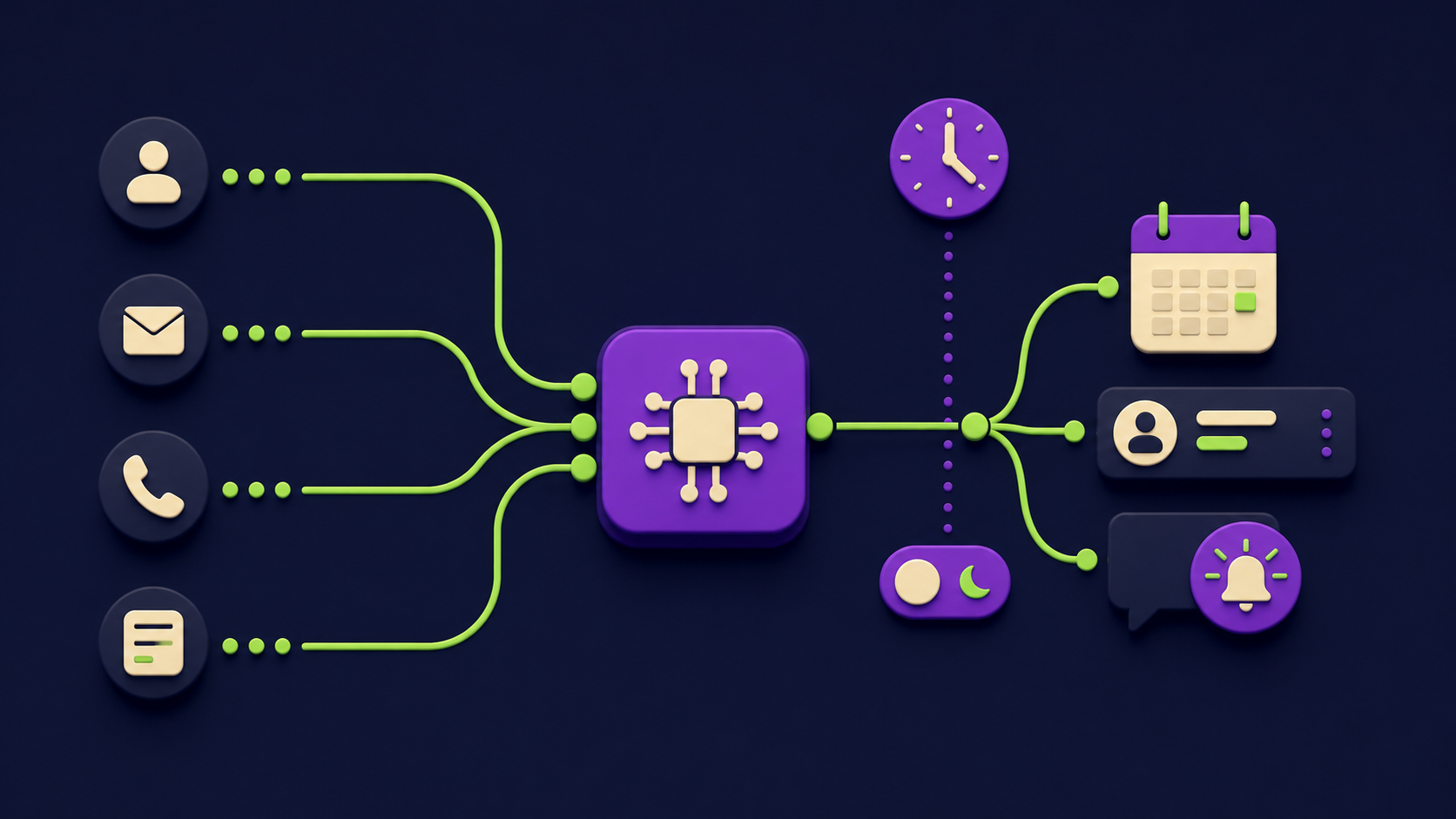
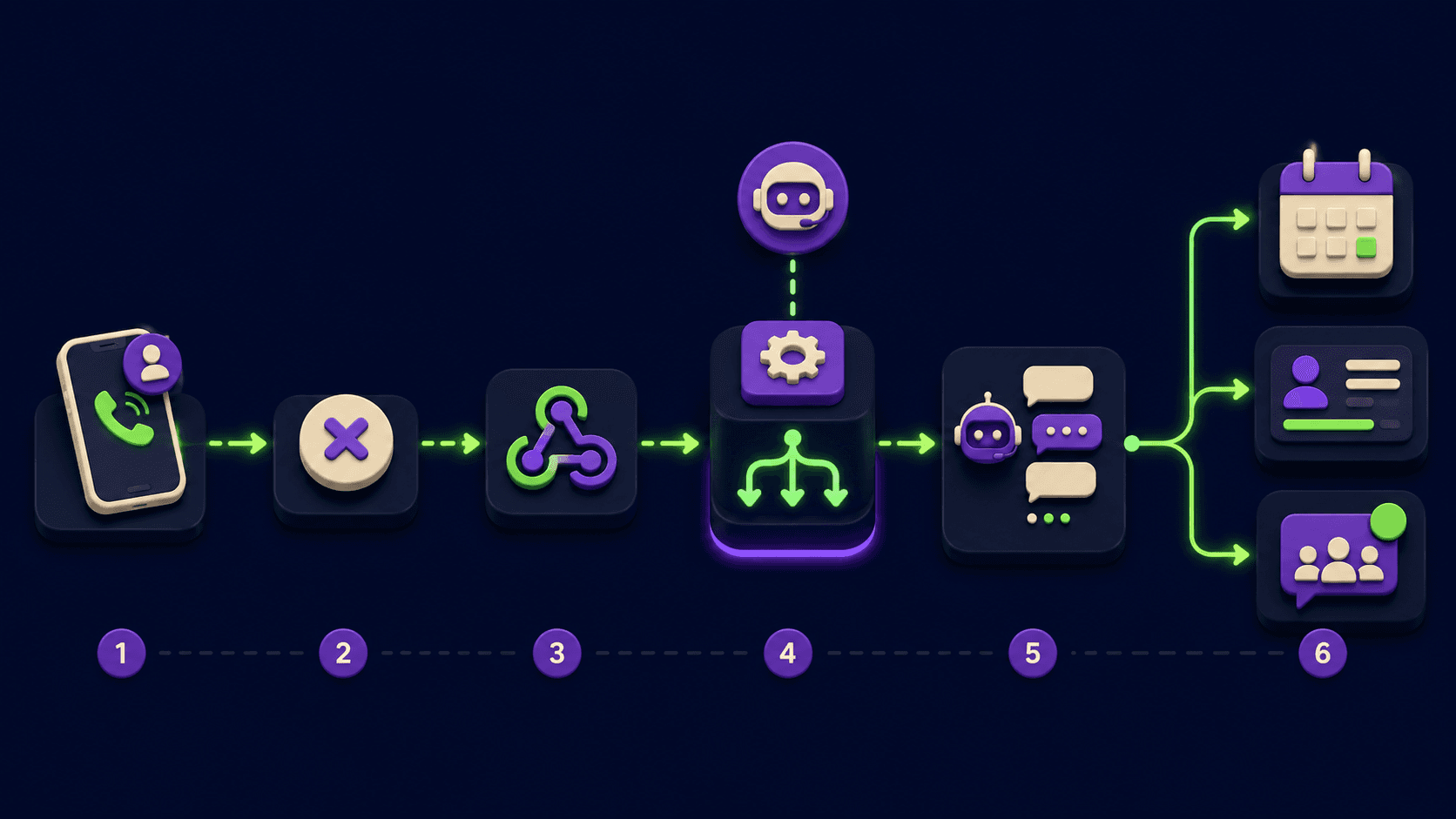
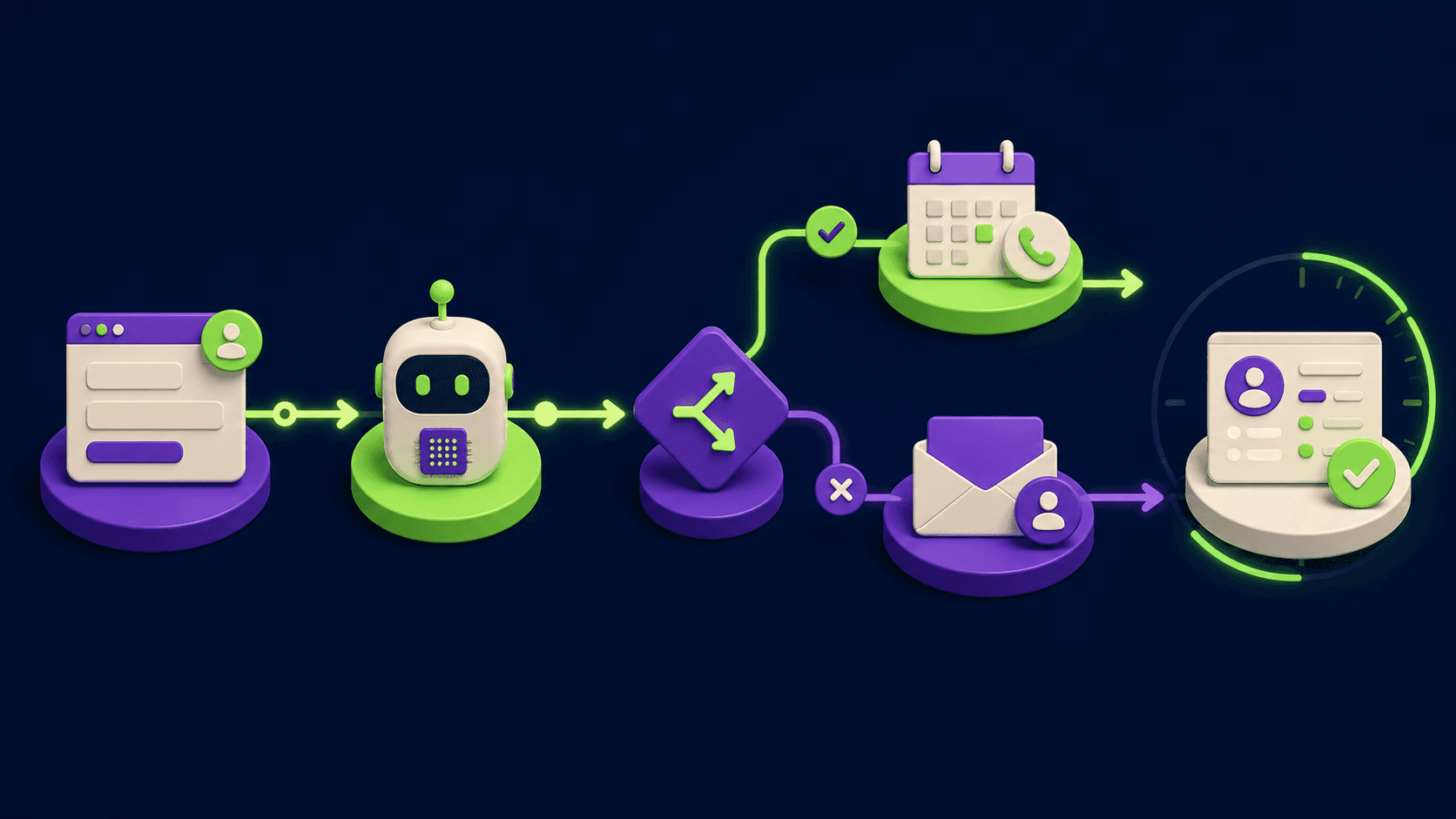
The architecture is a five-piece chain. A Schedule Trigger flips the site into after-hours mode at closing. Every inbound channel (web form, chat, voice, DM) routes into one AI qualification agent that classifies intent, urgency, and fit, then writes a confirmation in-channel inside 60 seconds. The orchestrator drops a callback slot into the owner's calendar, logs the lead to the CRM, and posts a Slack alert. Every channel maps to one AI handler, one escalation rule, and one thing that actually hits the owner.
Inquiry channel | AI handler | Escalation rule | What hits the owner |
|---|---|---|---|
Web form (contact, quote, booking) | n8n Webhook to AI Agent: classify intent, urgency, fit, send SMS confirm via Twilio | If urgency = "now" and category is on the emergency list, page owner cell phone | Cal.com slot already booked + Slack one-line summary + CRM contact created |
Site chat widget | AI Agent two-turn intake in the widget: what + when; offers next slot | If high-intent and after-hours, escalate to voice callback in first AM slot | Chat transcript in CRM + Cal.com slot + Slack alert with summary |
Missed inbound call | Twilio status callback fires no-answer, Vapi or Bland auto-callback inside 90s, runs intake script | If caller declines AI ("let me leave a message"), record + SMS transcript to owner | Voice transcript + Cal.com slot + Slack alert + SMS confirm to caller |
Direct SMS to business line | Twilio inbound SMS webhook to AI Agent: 2 to 4 turn text intake, capture name + window | If conversation stalls or caller unclear, log "needs human", alert owner | SMS thread in CRM + AM callback slot + Slack alert |
Google Business Profile message | GBP messaging webhook to AI Agent; same intake, new-lead unless customer matched | If review-related or complaint, route to owner-only queue | GBP reply + SMS confirm + CRM log |
Instagram or Facebook DM | Meta webhook to AI Agent; two-turn intake, capture phone for SMS confirm only if willing | Hand off to owner inbox if topic is influencer, press, or partnership | DM reply + optional SMS confirm + CRM contact |
Which tools do local businesses actually wire together for this?
The stack is short by design: a workflow orchestrator, a phone and SMS layer, a voice agent, a scheduler, a CRM, and a chat alert. Six named services. Every extra integration is another failure mode and another vendor review.
The orchestrator is n8n: the only place you write conditional logic (after-hours window, dedupe, intent routing, slot selection, escalation). The Schedule Trigger flips "after_hours" on at 5pm and off at 9am; every workflow checks the flag at its first IF node. The phone and SMS layer is Twilio Voice plus Twilio Messaging: buy a number, forward your existing line, and configure the Voice status callback so n8n hears every missed call.
The voice agent is one of three. The OpenAI Realtime API gives lowest latency if you write the call-flow logic yourself. Vapi and Bland wrap it with hosted call management, function calling, and recording. For an owner-operator with no engineer, Vapi or Bland is realistic. For an agency reusing the pattern, OpenAI Realtime plus n8n keeps the per-call bill lower.
The scheduler is Cal.com or Acuity, with OpenTable or Resy for restaurants needing real inventory. The agent's only legal booking options are what the scheduler returns. The CRM is whatever the business already uses, usually HubSpot or Pipedrive. The chat layer is Slack: one channel for new leads, one for emergencies, owner's cell gets SMS only when urgency is "now."
What does the qualification step actually look like?
The qualification step is a short deterministic loop the agent runs on every contact: intent in one of four categories (book, quote, info, complaint), urgency in one of three bands (now, this week, browsing), and fit in two boolean checks (in-service-area zip + in-budget-band, asked only if a starting price is published). The output is a structured JSON record the orchestrator routes by rule.
The step takes the agent under 15 seconds for a form, under 90 seconds for a call. The JSON carries caller name, callback number, intent, urgency, fit, one-sentence summary, and a suggested AM slot. The orchestrator routes by combining urgency and fit: now + fit goes to the top of the queue, browsing + no-fit gets a polite "we will be in touch" email and no morning slot. The agent never negotiates price.
What you should NEVER let the AI do after hours
The agent must never do five things: auto-confirm paid reservations without verification, quote pricing on regulated work, override emergency rules, ignore disclosure laws, or take payment card numbers over the phone. Each is a license, fraud, or regulatory exposure. Stop the model in the system prompt, the orchestrator's branch rules, and a weekly adversarial test.
Never auto-confirm paid reservations without verification. A restaurant with a credit-card hold, a salon booking with a non-refundable deposit, a clinic with a paid intake: none get a "confirmed" from the AI alone. The agent proposes a slot, the booking system enforces verification (card check, deposit link, owner-side approval), and the owner reviews in the morning. This is the difference between a working intake and a chargeback magnet.
Never give pricing on regulated work. A dental crown, a legal consult, a real-estate listing price, an electrical job that needs a load calc, a medical procedure: any priced answer on regulated work is a license risk. The agent gives a starting band or links the rate card, never a binding number. Phrasing: "starting at X for the basic service, the owner will confirm in your morning callback."
Never override the emergency rules. Plumbing flood, smoke smell at a salon, child injured at a clinic, gas leak at a restaurant: the agent's only job is to read the hard-coded emergency script, give the right emergency number, and page the owner's cell. No triage, no scheduling, no qualifying.
Never ignore disclosure laws. The agent identifies itself as automated on every channel, call, SMS thread, and DM. The FCC TCPA guidance requires identification of automated callers. Two-party consent states require a recording disclosure and affirmative consent before recording. Skipping the disclosure to shave 10 seconds is the cheapest way to turn an asset into a liability.
Never take payment card numbers over the phone. Unless the stack is PCI-DSS compliant and the voice provider supports PCI-mode redaction (most do not on starter tiers), the agent never takes card numbers. Payment goes through a tokenized link in the SMS confirm, processed by Stripe or Square. The call recording never touches the card.
What compliance applies: TCPA, two-party consent, automated-assistant disclosure?
Compliance sits on four pillars: TCPA on automated calls and texts, state two-party consent on recording, automated-assistant disclosure on every channel, and CAN-SPAM on email confirmations. Get one wrong and the system is a liability.
The automated-call rules are federal under the Telephone Consumer Protection Act, enforced by the FCC. The FCC robocall and robotext guidance requires identification of the caller on automated outbound calls and prior express consent for automated marketing texts. The cleanest design: the agent only places outbound calls and texts to numbers that contacted you first in the same session, and the SMS confirm is transactional, not marketing.
The recording consent regime is state-by-state. Two-party consent states include California, Florida, Illinois, Massachusetts, Maryland, Montana, Nevada, New Hampshire, Pennsylvania, and Washington. The Digital Media Law Project maintains a state-by-state map. If you operate in any two-party state, capture a recorded affirmative consent at the top of the call before recording begins, and store the consent audio alongside the call.
The automated-assistant disclosure is the rule that catches first-time builders. The agent identifies itself by name, business, and that it is automated, on every channel. On the call: "Hi, this is the automated assistant for [business]." On SMS: "this is the automated assistant at [business]." In chat: a "Automated assistant" tag at the top. Non-negotiable. For email confirmations, the FTC's CAN-SPAM guide requires accurate from and subject lines, a physical postal address, and a clear opt-out.
How do you actually build and launch this in a week?
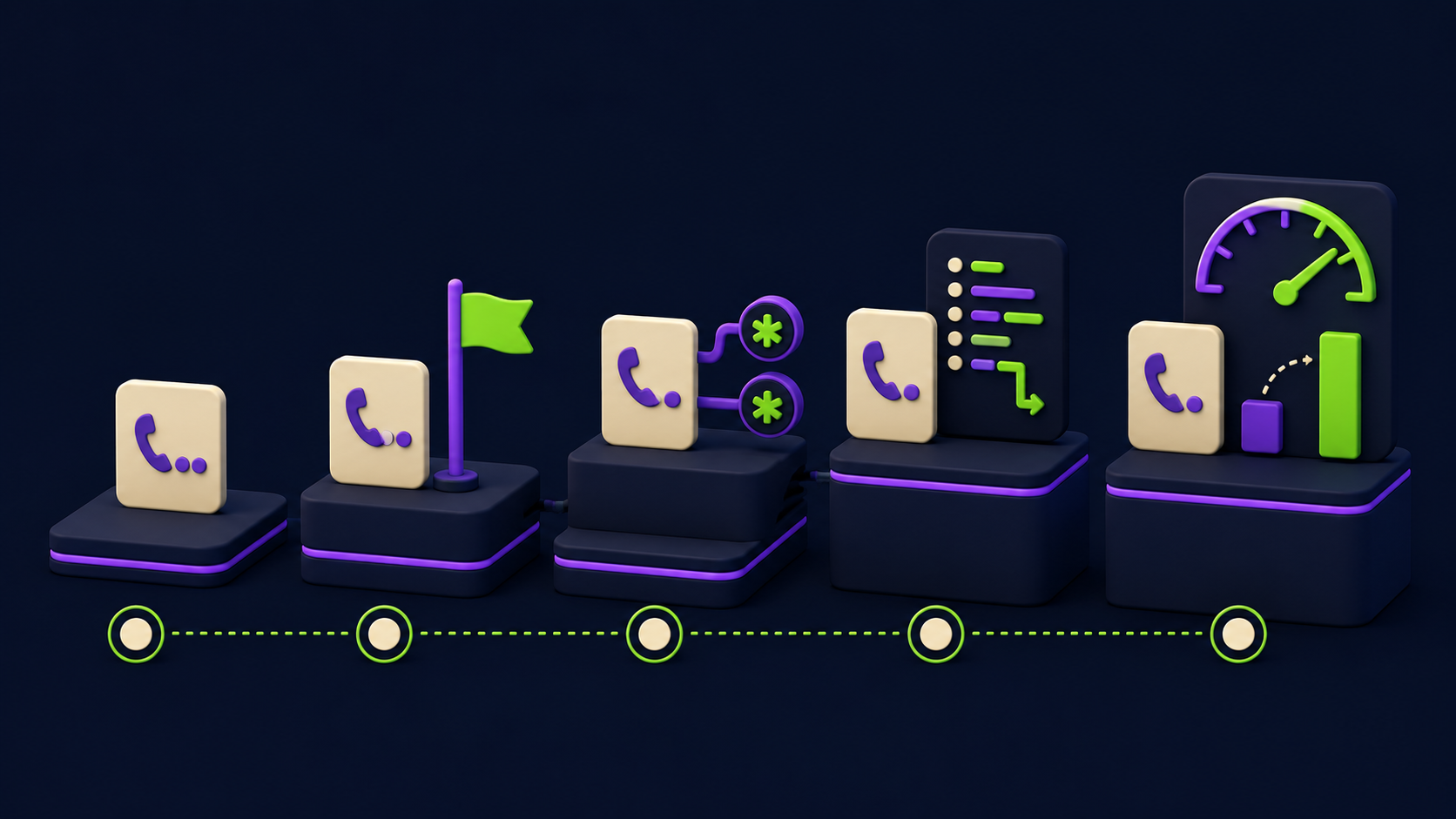
You launch in a week with a five-step plan: turn on the after-hours flag, wire form and chat capture, wire the missed-call auto-callback, freeze the qualification script, and run a 5-day shadow test before cutover. The goal of week one is a measured side-by-side between the new system and your current "voicemail and morning callbacks" baseline.
Day 1, the after-hours flag. In n8n, set up a Schedule Trigger that sets "after_hours=true" at 5pm local and back to false at 9am. Every workflow's first IF node reads the flag and short-circuits to the human path during open hours.
Day 2, form and chat capture. Add a Webhook node to n8n with one URL per form. Each form POSTs to the webhook alongside its existing handler. Wire the AI Agent that returns the JSON record, an SMTP node for email, and an HTTP Request node to Twilio Messaging for the SMS confirm.
Day 3, missed-call auto-callback. Configure Twilio Voice with a status callback to an n8n webhook. On "no-answer" or "busy" plus "after_hours=true", spawn an outbound call via Vapi or Bland running the intake script. Sub-90 seconds from missed call to callback ringing is the target. If the caller declines the AI, the agent ends and SMSes the owner the transcript.
Day 4, the callback queue. Build the n8n branch that lands the qualified lead: Cal.com (or OpenTable / Resy / Acuity) books the owner's first available AM slot, HubSpot or Pipedrive contact and deal created, Slack alert in #after-hours-leads with summary and slot, SMS to owner's cell only when urgency = "now." Morning view is the calendar plus one Slack channel.
Day 5 through 9, shadow test. Route a small share (10 to 25 percent) of inbound to the new system while keeping the existing voicemail live. Review every transcript. Track misclassified intent, wrong urgency, off-fit leads getting morning slots, and any SLA promise the agent should not have made. Day 10 is cutover, only after the shadow numbers are clean. The n8n graph mirrors our lead form to qualified call automation writeup.
What are the most common mistakes on the first build?
Local businesses make six predictable mistakes on a first after-hours build. Each converts the system into either a refund magnet or a one-star review.
Mistake 1: no after-hours flag. The agent answers during open hours too and the actual receptionist gets blindsided. Always gate every workflow on the Schedule Trigger flag.
Mistake 2: letting the agent quote final prices. The model tries to be helpful and quotes "$200 for that" by inferring a number from the rate card. The customer arrives expecting $200, the actual job is $340, you lose the customer or eat the difference. Hard-refusal in the system prompt: "never quote a final price."
Mistake 3: promising a callback time you cannot keep. "I will have someone call you at 8am sharp" is a complaint waiting to happen. Use availability bands, not exact times. The Cal.com slot is the source of truth, not a phrase the agent invented.
Mistake 4: skipping the disclosure to keep the call shorter. The disclosure is 8 to 12 seconds. Skipping it in a two-party consent state turns a useful recording into a liability and a complaint-defense asset into a complaint-creation engine.
Mistake 5: routing every after-hours lead to the owner's cell. Week one the owner is delighted to wake up to seven SMS alerts at 3am, by week two they hate the system. Reserve cell-phone pages for "now" urgency only. Everything else lands in Slack and the morning calendar.
Mistake 6: forgetting the off-ramp. Every interaction needs an option to reach a real human, an option to leave a plain message, and an option to end. Bake "would you rather leave a message for the owner?" into every branch. Compare against the patterns in our voice agent for missed calls in service businesses guide.
What does the owner's morning actually look like?
The owner opens the laptop at 8:30am. Cal.com shows three booked AM callbacks tagged with intent and urgency. The Slack #after-hours-leads channel shows six overnight entries ranked by urgency and fit, each with a one-line summary and a link to the full transcript. The HubSpot or Pipedrive pipeline has the new contacts in the right stage. The owner makes three calls and is done before the first walk-in arrives.
That is the payoff: a dead voicemail box traded for a ranked, summarized, already-scheduled queue. In our builds, operators see the after-hours window stop being a cost center and start contributing similar week-over-week bookings as open hours. The structural move is "missed inquiry is gone" becoming "missed inquiry is queued."
FAQ
How much does an after-hours AI capture system cost a local business per month?
An after-hours capture system typically runs $40 to $250 a month in 2026 depending on volume. Twilio is roughly $1.15 per number plus $0.0085 per inbound minute and $0.0075 per outbound SMS. OpenAI Realtime, Vapi, and Bland charge $0.07 to $0.20 per voice minute. A business with 80 after-hours contacts a month at 3 voice minutes and 1 SMS confirm each lands at roughly $60 to $120 all in. n8n self-hosted is free aside from a small VPS.
Will customers be annoyed when they realize they are talking to AI after hours?
Customers tolerate an AI intake well after hours because the alternative is voicemail. Invoca shows 85 percent of callers who hit voicemail never call back. Operators see after-hours hang-up rates on the AI opener running 5 to 12 percent, comparable to or lower than a traditional IVR. The disclosure does not lose them; latency and warmth lose them. Use a sub-300ms voice model, a friendly script, and a clear "would you rather leave a message" off-ramp.
Do I need a different system for forms, chat, and calls, or can one stack handle all three?
One stack handles all three because the qualification step is identical regardless of channel. Form, chat, call, and DM all post into the same n8n workflow, run the same intent + urgency + fit classifier, and produce the same JSON record. Only the in-channel reply differs. The shared classifier is also the only place you tune the system as you learn from real cases, which keeps maintenance cost low.
What does the SMS confirmation message actually say?
The SMS confirmation is short, transactional, and identifies the business. Typical version: "Hi [name], this is the automated assistant at [business]. We received your [form, call, message] at [time]. The owner will call you back at [AM slot] tomorrow. Reply STOP to opt out. Reply HUMAN to leave a different time." This satisfies the FCC's identification rule, names the business, includes a STOP keyword as Twilio recommends, and lets the caller override the slot.
What happens to an after-hours lead the agent cannot qualify?
When the agent cannot confidently classify intent, urgency, or fit, the lead falls into a "needs human" queue instead of being booked or filtered. The orchestrator logs the contact, sends the standard SMS confirm with "the owner will be in touch," and posts a Slack alert. The owner reviews unclassified first thing before the booked list. Unqualified is not ignored; the lead still gets a 60-second confirmation.
How do I make sure the agent never books an appointment that needs a licensed professional to approve?
You enforce the rule at the booking layer, not in the model prompt. In Cal.com or your booking system, configure two event types: a "consult or assessment" type the agent can book freely, and a "service" type the agent cannot book until the pro has approved it. The agent only sees the consult type. The pro reviews and converts to the service type after the morning callback. This works the same for dental, legal, real-estate, contractor, and clinical bookings, and avoids every "the AI booked a procedure" complaint.
Would rather have this built and tuned to your booking system?
If you would rather not learn n8n, configure Twilio, write the system prompt, and tune the classifier yourself, we build the full after-hours capture stack end to end and wire it into the booking and CRM you already use. Output: working pipeline across form, chat, voice, and DM, compliance disclosures for your state, and a one-page runbook the front-of-house can operate. Reach us at vantaige.io/contact with business type, channel mix, and weekly inquiry volume.
Related from Vantaige
References
Twilio. "Programmable Voice API documentation." https://www.twilio.com/docs/voice
Twilio. "Programmable Messaging API documentation." https://www.twilio.com/docs/messaging
Twilio. "Voice status callbacks." https://www.twilio.com/docs/voice/api/call-resource#statuscallback
Twilio. "Messaging opt-in and opt-out." https://www.twilio.com/docs/messaging/services/opt-in-out
OpenAI. "Realtime API guide." https://platform.openai.com/docs/guides/realtime
Vapi. "Voice AI platform documentation." https://docs.vapi.ai/
Bland. "Bland AI developer documentation." https://docs.bland.ai/
Cal.com. "API reference." https://cal.com/docs
Acuity Scheduling. "API documentation." https://acuityscheduling.com/api
OpenTable. "Platform integrations." https://platform.opentable.com/
Resy. "Developer documentation." https://developers.resy.com/
HubSpot. "API overview." https://developers.hubspot.com/docs/api/overview
Pipedrive. "API v1 reference." https://developers.pipedrive.com/docs/api/v1
Slack. "Web API reference." https://api.slack.com/
n8n. "Workflow automation documentation." https://docs.n8n.io/
n8n. "Schedule Trigger node." https://docs.n8n.io/integrations/builtin/core-nodes/n8n-nodes-base.scheduletrigger/
Federal Communications Commission. "Stop Unwanted Robocalls and Texts (TCPA)." https://www.fcc.gov/consumers/guides/stop-unwanted-robocalls-and-texts
Federal Trade Commission. "CAN-SPAM Act compliance guide for business." https://www.ftc.gov/business-guidance/resources/can-spam-act-compliance-guide-business
Digital Media Law Project. "Recording Phone Calls and Conversations: State Law Map." https://www.dmlp.org/legal-guide/recording-phone-calls-and-conversations
Harvard Business Review. "The Short Life of Online Sales Leads." https://hbr.org/2011/03/the-short-life-of-online-sales-leads
Invesp. "Online lead response time research." https://www.invespcro.com/blog/online-lead-response-time/
Invoca. "Missed phone calls cost business." https://www.invoca.com/blog/missed-phone-calls-cost-business
Get the best new AI tools and guides, weekly
One short email a week. The tools worth trying, the guides worth reading, nothing else.
No spam. Unsubscribe anytime.
Aymen B
Contributing writer at Vantaige, covering the AI tools ecosystem.