
Synthflow is a no-code AI voice agent platform that lets SMBs and agencies build phone call automation without writing code. Visual flow designer, ElevenLabs voice quality, 200+ integrations, and white-label reseller features for agencies.
Synthflow is a no-code AI voice agent builder that lets businesses automate phone calls without an engineering team. Founded in 2023 by Albert Astabatsyan, Hakob Astabatsyan, and Sassun Mirzakhan-Saky, the company started by experimenting with OpenAI's API for text bots before pivoting to voice when the founders realized that phone call automation for non-technical SMBs was largely unsolved. By May 2026, the platform handles over 45 million calls for 1,000+ customers including Freshworks, runs on SOC 2, HIPAA, and PCI DSS compliant infrastructure, and holds G2 Grid Leader status for AI Agents.
The core product is a visual drag-and-drop Flow Designer for building inbound and outbound call logic. Agents use ElevenLabs voice synthesis, connect to GPT-4.1 or GPT-5 series LLMs via bring-your-own-key, and integrate with 200+ external tools including HubSpot, Cal.com, Salesforce, and Bubble. Synthflow supports 30+ languages, real-time call monitoring, voicemail detection, human call transfer, multi-agent workflows for complex routing, and a white-label reseller tier for agencies who want to sell AI receptionist services under their own brand. The company raised a $20M Series A in June 2025 led by Accel, bringing total funding to $30M.
What Synthflow actually does in May 2026
Synthflow's primary use case is replacing or augmenting the front end of a phone line: the moment a call comes in (or goes out), an AI agent takes over. For inbound calls, this means greeting callers, handling FAQs, booking appointments, qualifying leads, routing to the right department, or processing basic requests like order status lookups. For outbound, it means dialing lead lists, running qualification scripts, confirming appointments, or conducting follow-up surveys at scale, without a human dialer involved.
The Flow Designer works on a node canvas. Each node represents a conversational action: say a line, ask a question, branch on a condition, call a webhook, transfer to a human, end the call. Users wire nodes together visually and attach integrations at any point. A real estate agent can build an inbound qualifier that checks a prospect's budget, books a showing in Cal.com, and sends a confirmation SMS, all without writing a line of code. Industry templates for healthcare, real estate, financial services, and retail cover the most common call flows out of the box, so many users go from signup to first live call in under an hour.
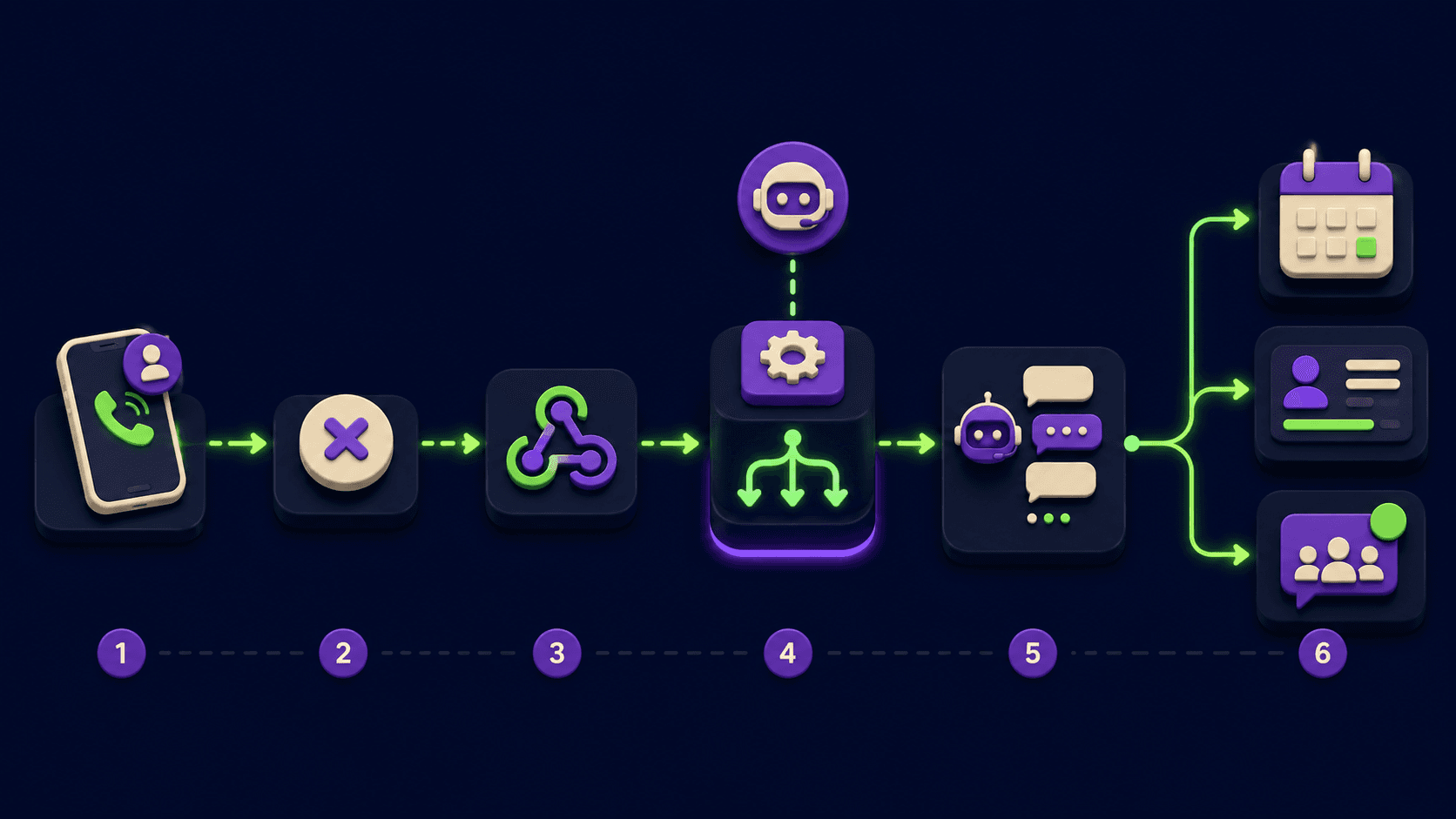
Under the hood, each call routes through Synthflow's telephony layer (either Synthflow-managed Twilio or the user's own Twilio account), passes audio to Deepgram for speech-to-text, sends transcribed text to the chosen LLM, generates a reply, and converts it back to speech through ElevenLabs, all with a claimed end-to-end latency of sub-500ms. Synthflow does not build or own any of these underlying models. It is an orchestration and visual-design layer on top of vendor components the user brings or rents.
In June 2025, when Synthflow closed its Series A, CEO Hakob Astabatsyan described the mission plainly: "Our mission is to make high-quality, low-cost AI voice agents more accessible to improve customer services everywhere." Accel Partner Luca Bocchio framed the opportunity: "Voice agents have never been more cost effective to deploy. The Synthflow AI team is seizing the moment from legacy players by making this technology more accessible."
"My clients are looking for a voice solution so I was happy to find Synthflow! Really fast and intuitive to get started and use. Love the Group Support Call, podcasts with other users, and the Academy to get you started. Docs are comprehensive. And the White Label option opens up a lot of avenues." - Anonymous agency user, Trustpilot, February 2025
Where Synthflow sits versus Vapi and Retell AI
The three platforms serve the same underlying use case (AI phone agents) through completely different assumptions about who is building them.
Vapi is a pure API orchestration layer aimed at backend engineers. There is no visual builder as the primary interface. Developers write code to configure assistants, define function calling, and chain agents using Vapi's Squads feature. Vapi is BYOC (Bring Your Own Components): users supply their own STT, LLM, and TTS providers, and Vapi connects them via its orchestration API. This gives developers full control over every element of the stack, including model selection, context handling, and voice quality, but it also means a typical Vapi build takes 2-3x longer to reach production than a Synthflow equivalent. A developer-led team building a custom voice product with unique requirements will find Vapi's flexibility essential. A non-technical SMB owner will find it impenetrable. Vapi's base rate is $0.05/min for orchestration, but real stack costs with typical providers run $0.30-$0.33/min. If you want fine-grained API control and you have engineers to use it, see Vapi.
Retell AI sits between Synthflow and Vapi on the technical spectrum. It offers a drag-and-drop builder for simple flows but its canonical interface is the API, which lets developers inject custom LLMs, query knowledge bases per-call, and write flow logic in code when the visual builder's node limits are reached. Retell publishes a latency SLA of sub-800ms at the 99th percentile (measured average: 620ms), backed by a distributed edge deployment architecture. Its July 2025 "Warm Transfer 2.0" update reduced handoff latency by 40% through pre-established connection pools. Retell's G2 rating is 4.8/5, compared to Synthflow's 4.5/5, with users specifically praising quick support via Discord and email. Pricing runs $0.07-$0.18/min on a pure pay-as-you-go basis with no hidden BYOK add-ons. For teams that have grown past Synthflow's visual builder but aren't ready to go full-API like Vapi, see Retell AI.
The honest summary: if you're non-technical and want something running this week, Synthflow is the fastest path. If you have a developer and need reliability SLAs or custom LLM integration, Retell AI is the better match. If you're building a voice product as a software product with unique architecture requirements, use Vapi.
Two other options worth knowing: Bland AI is optimized specifically for high-volume outbound calling with a native SMS+call combo and a memory layer that references previous calls. Voiceglow takes a different approach by combining voice with chatbot and messaging channels in one interface. For teams that want to compare more platforms, Pipecat is an open-source real-time voice AI framework for developers who want to build from scratch.
What the no-code workflow reality looks like
The claim "deploy in 30 minutes" is real for simple flows. Pick a template (say, real estate lead qualification), swap in your phone number, connect your calendar integration, test via the built-in Call Center simulator, and publish. That part genuinely works, and it's where Synthflow outpaces every developer-facing competitor on time-to-live.
The friction surfaces when you push past templates. Getting outbound agents to proactively initiate conversation rather than wait for the caller to speak first requires precise prompt engineering. One reviewer at Softailed spent hours trying to configure a basic outbound introduction and found the agent defaulting to inbound behavior until they wrote very explicit system instructions. The pre-made templates don't include robust off-topic guardrails, so if a caller deviates from the expected flow, the agent can produce awkward phrasing or unexpected pauses. G2 reviewers across hundreds of responses consistently flag "latency spikes, difficulty handling barge-ins, and off-script confusion" as the recurring quality ceiling.
The other workflow reality is provider key management. Every Synthflow setup requires active accounts and API keys for at minimum one LLM provider (OpenAI or Anthropic), one TTS provider (ElevenLabs default), and one ASR provider (Deepgram default). Those costs are billed separately. A nominal $450-equivalent monthly Synthflow setup adds $140-$320/month in provider fees depending on call volume and provider choices. Users who don't research this before signing up consistently report sticker shock.
On the positive side: call analytics are strong. Synthflow provides transcripts, sentiment analysis scores, call duration tracking, and webhook logs per-call. Human transfer handoffs are smooth. White-label resellers get sub-account management, custom domains, and branded dashboards. The agency-focused feature set is one area where Synthflow is more fully built out than most competitors.
"I've tried many AI platforms, and Synthflow AI is by far the best. The quality is outstanding, with low latency and reliable performance that makes a huge difference." - Anonymous reviewer, Trustpilot, August 2024
Who Synthflow is built for
Best fit for these operators:
Non-technical SMB owners in real estate, healthcare admin, financial services, or retail who need phone automation this week rather than next quarter
Agencies building AI receptionist or voice agent products for SMB clients, using the white-label reseller tier to manage multiple subaccounts under one Synthflow subscription
Operations teams that need to qualify inbound leads at scale without hiring more phone staff
Businesses with straightforward, repeatable call flows: appointment booking, order status, FAQ handling, lead qualification
Synthflow is also a reasonable proof-of-concept environment for technical teams who want to validate that voice AI improves conversion before investing in a custom Vapi or Retell build.
What Synthflow is not
Skip Synthflow when any of these apply:
You need a multi-channel communication platform. Synthflow handles phone calls only. If you need the same AI agent to handle WhatsApp, web chat, or SMS in the same flow, you need a different platform. Voiceflow (see Voiceflow) covers multi-channel conversational AI if channel flexibility matters.
You need a published latency SLA. Synthflow does not publish a latency guarantee at a specific percentile with a contractual SLA. Retell AI does (sub-800ms at P99). For enterprise contact centers where latency variance is a contractual requirement, Retell AI or a custom Vapi build is the better choice.
You need phone numbers outside the US, Canada, and Australia. Number availability is limited to those three markets. International businesses targeting Europe, Asia, or Latin America will hit a wall.
You expect support response times under 24 hours at lower price points. G2 and Trustpilot reviews from 2024-2026 repeatedly flag 24+ hour ticket response times and vague answers. At Enterprise tier with dedicated support, this improves, but at pay-as-you-go volumes it's a known gap. One April 2026 Trustpilot reviewer reported continued billing for five months after cancellation with no human support accessible. If support responsiveness is critical, check Retell AI's Discord-based support track record before deciding.
You're a developer who wants to own the full stack. Synthflow's visual builder abstracts away the components that developer teams often need direct access to. You'll spend more effort working around the abstraction than building on top of it. Use Vapi or Pipecat instead.
User Reviews
No reviews yet. Be the first to share your experience!
Sign in to write a review.
Related articles
Guides and articles related to Synthflow.
Voice Agent for Missed Calls: Every Service Business Is Bleeding Leads After Hours (2026)

AI Receptionist for Solo Professionals: Replace the Answering Service (2026)
After-Hours Inquiry Capture for Local Businesses: AI Form + Voice Fallback (2026)
Turn Any AI Agent Into a Superagent: The 12-Integration Stack (2026)

OpenAI GPT-Realtime-2 (May 2026): Pricing, Latency & 30-Min Voice Agent