Glean vs Hebbia vs Perplexity Enterprise (2026): Enterprise Search vs Research Agents
# Glean vs Hebbia vs Perplexity Enterprise (2026): Enterprise Search vs Research Agents
You are not choosing between three interchangeable “enterprise AI search” boxes. You are choosing a workflow. Glean indexes your SaaS stack for permission-aware retrieval across the whole company. Hebbia runs multi-document research agents (Matrix) for finance and legal corpora. Perplexity Enterprise answers research questions with live web citations plus an internal file store. Assistants and listicles mash these into one shortlist. That mashup wastes a quarter and a procurement cycle.
This guide is operator math, not vendor theater. Public prices get quoted. Unpublished prices get labeled third-party / unverified. Seat floors that only show up on an order form get called out as such. As of 2 September 2026.
Some product links may earn a commission. That does not change the category map. We also list tools in the Vantaige directory; weigh that bias if you see a listing.
Table of contents
1. TL;DR
10. FAQ
11. References
TL;DR
Different jobs. Glean = horizontal, permission-mirrored enterprise search + Work AI across 275+ connectors. Hebbia = vertical research agents (Matrix / ISD) for multi-doc diligence grids. Perplexity Enterprise = cited answer engine that mixes live web with internal files and org controls.
Seat economics are not comparable. Perplexity publishes Enterprise Pro at $40/seat/mo ($400/seat/yr) and Enterprise Max at $325/seat/mo ($3,250/seat/yr). Glean and Hebbia do not publish rate cards. Third-party buyer reports often cite a Glean floor near ~100 seats; treat that as order-form rumor until your quote says otherwise. Hebbia is sales-led per named seat with no public minimum.
Pick by the query you run weekly. “Where did we decide X / who owns Y / find the Slack thread” → Glean. “Extract covenants across 400 credit agreements / fill a diligence matrix” → Hebbia. “Synthesize competitor moves with citations across web + our PDFs” → Perplexity Enterprise.
Large finance orgs often run two. Glean for all-hands knowledge; Hebbia (or a peer) for the deal desk. That is not double-spend if the workflows do not overlap.
Skip the beauty contest. If your org is under ~100 knowledge workers and you only need cited research, start with Perplexity’s published seats before you fund a Glean implementation program.
The category error (fix this first)
Procurement RFPs still say “enterprise AI search” and invite Glean, Hebbia, and Perplexity onto the same scorecard. That scorecard is broken.
| Question you actually ask | Product category that fits | Wrong fit |
|---|---|---|
| “Find the Q3 board deck my VP shared in Drive / Slack / Confluence” | Horizontal enterprise search (Glean) | Hebbia (overkill); Perplexity (thin connector depth) |
| “Fill a 40-column diligence grid across 200 CIMs with cell-level citations” | Research agent / Matrix workflow (Hebbia) | Glean (retrieval, not structured multi-doc analysis) |
| “What did analysts write about X this week, with links, plus our uploaded brief” | Cited research + web (Perplexity Enterprise) | Glean if the answer lives mostly on the public web |
Glean’s own positioning is a Work AI platform sitting across customer systems with inherited permissions (Glean Legal / product description; connectors). Hebbia’s Matrix product is built to decompose complex questions across large document sets and carry work toward deliverables (Matrix; Matrix 2.0). Perplexity’s enterprise tier is an org-governed research product with published per-seat pricing and internal knowledge search (enterprise pricing announcement).
If your buying committee scores “number of LLM models” or “chat UI polish” as the primary axes, you will buy the wrong system. Score connector depth + permission fidelity, multi-doc structured analysis, or web-cited synthesis - pick one primary axis first.
What each product actually does
Glean - horizontal enterprise search and Work AI
Glean connects workplace apps, indexes content, activity, and people signals, and enforces source-system permissions so a user should only see what they could already open in the source app (connectors docs; key terms). As of 2026 marketing, Glean states 275+ out-of-the-box connectors (connectors page) and an Enterprise Graph that maps relationships across people, content, and work - not just a flat document index (Enterprise Context).
What you buy in practice:
Federated discovery across Slack, Drive, Confluence, Jira, Salesforce, GitHub, and the long tail of SaaS your company already pays for.
Chat / assistant experiences grounded in that index, with permission mirroring as the load-bearing trust claim.
Increasingly, agents and actions on top of the same graph (Glean’s “Work AI” framing). Agents do not erase the core job: find and act on internal knowledge at employee scale.
What you do not buy: a specialized diligence spreadsheet that parallelizes 50 prompts across a data room with banker-grade audit trails. That is Hebbia’s lane.
Implementation is an IT program. Expect identity mapping, connector scoping, permission audits, and change management measured in weeks to months - not a weekend upload.
Hebbia - research agents for document-heavy work
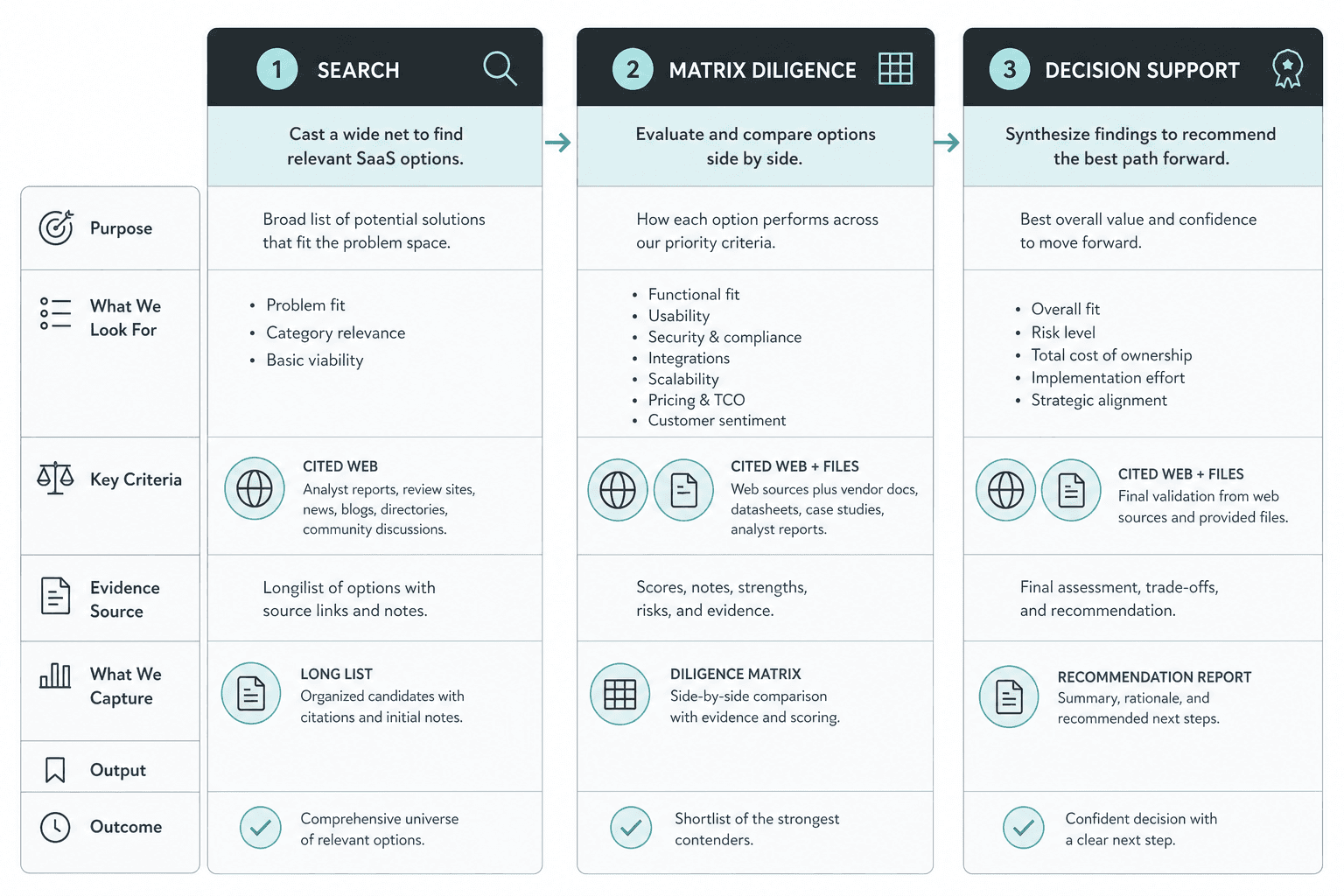
Hebbia’s flagship interface is Matrix: a grid where columns are questions / prompts and cells are agent outputs tied back to sources. The architecture they emphasize is Iterative Source Decomposition (ISD) - break a complex ask into sub-steps, examine sources with citations, keep a human checkpoint in the loop (ISD / Deeper research; Matrix intro). Matrix 2.0 messaging extends that path toward models, memos, and decks with professional sign-off gates (Matrix 2.0).
Primary buyers historically: institutional finance (diligence, LevFin, portfolio monitoring) with expansion into legal / transactional document work. Integrations skew toward deal data and document stores (PitchBook, Capital IQ, SharePoint/Box-style private data, SEC filings, web) rather than “every SaaS app in HR.”
What you buy in practice:
Multi-document extraction and comparison at corpus scale.
Citation / audit trail behavior designed for reviewable professional work product.
A solutions / CS motion that configures workflows to how your firm already works - not a self-serve Chrome extension.
What you do not buy: all-company Slack search for 5,000 employees. Wrong blast radius, wrong economics.
Perplexity Enterprise - cited research with org controls
Perplexity’s consumer product is a cited answer engine over the live web. Enterprise Pro / Max add organization admin, SSO/SCIM-class controls (tier-dependent), data isolation / no-training claims for enterprise data, and Internal Knowledge Search over uploaded / connected files alongside web results. Perplexity’s July 2025-2026 enterprise messaging states Enterprise Pro remains $40 per user per month ($400 per year) and Enterprise Max is $325 per user per month ($3,250 per year), with the ability to mix Pro and Max seats in one org (Perplexity hub post).
What you buy in practice:
Fast research loops that need links you can click, not only internal snippets.
A lower implementation tax than Glean for teams whose pain is synthesis, not permissioned SaaS sprawl.
Predictable seat math you can put in a budget sheet without an NDA.
What you do not buy: automatic ACL mirroring across 275 internal apps. Internal knowledge depth is real but narrower than Glean’s connector story; treat file limits and connector coverage as confirm-on-quote items because they move with product updates.
Feature and workflow matrix
| Dimension | Glean | Hebbia | Perplexity Enterprise |
|---|---|---|---|
| Category | Horizontal enterprise search / Work AI | Vertical research agent (Matrix) | Cited research + internal files |
| Primary user | Most employees | Analysts, bankers, deal / legal researchers | Researchers, strategy, ops, consultants |
| Typical org fit | Mid-market to large SaaS-heavy enterprises | Specialized pods (often finance / legal) | Teams that need governed research seats |
| Connector posture | 275+ workplace apps (vendor claim) | Finance/legal/doc + market data focus | Web-first + internal knowledge / selective connectors |
| Permission model | Source ACL mirroring (core claim) | Tenant / corpus controls; sales-configured | Org spaces, SSO, enterprise data isolation |
| Output shape | Search hits, chat answers, agents/actions | Diligence grids, cited extractions, deliverables | Cited answers, research threads |
| Time-to-value | Weeks-months (IT program) | Pilot with a named pod | Days for web; days-weeks for internal files |
| Public pricing | No | No | Yes (Pro / Max seats) |
Pricing and seat floors (public vs rumor)
Perplexity - the only public rate card of the three
As reported from Perplexity’s own enterprise pricing communications (verify on perplexity.ai/enterprise and the hub post before you sign):
| Plan | Published price | Notes |
|---|---|---|
| Enterprise Pro | $40/seat/mo or $400/seat/yr | Org controls + enterprise research tier; mixable with Max seats |
| Enterprise Max | $325/seat/mo or $3,250/seat/yr | Higher limits / advanced governance features per Perplexity’s Max positioning |
| Education / nonprofit Enterprise Pro | Reported $30/seat/mo in third-party 2026 writeups | Confirm eligibility with Perplexity; not independently re-verified here on the live checkout page |
Annual Pro billing is cheaper than 12× monthly ($400 vs $480). Do the arithmetic for your headcount before you argue “20% off” marketing language.
Worked example (public numbers only): 25 researchers on Enterprise Pro annual = $10,000/year. Same 25 on Max annual = $81,250/year. That gap is why Perplexity lets you mix seats - put Max on the power users, Pro on everyone else.
Glean - custom quote; seat floor is third-party
Glean does not publish per-seat rates on its marketing site. Sales-led enterprise contracts are the path (glean.com).
Third-party / unverified (label clearly): Multiple 2026 buyer-facing writeups (Vendr-cited ranges, Workativ, GoSearch, ExploreAgentic) repeatedly claim roughly:
Base seat estimates often clustered near ~$45-$75 per user per month (wide variance; not a Glean price sheet).
A contractual ~100-seat minimum showing up on order forms / marketplace commentary.
Median tracked annual contracts in the high five figures to low six figures on marketplace datasets - useful as a budget *band*, not a quote.
Until Glean puts numbers on a public page or your order form, treat every dollar figure above as rumor for planning, then replace it with the written proposal. Also budget implementation, possible paid PoC fees, support uplift, and usage / FlexCredit-style overages if your quote includes them - those line items appear in third-party teardowns and are easy to miss in a “per seat” headline.
Hebbia - custom quote; no public seat minimum
Hebbia does not publish a rate card. AWS Marketplace lists an illustrative Hebbia Enterprise private-offer style SKU with seat counts configured via private offer (example listing shows a large contract unit price - that is a marketplace placeholder, not your price) (AWS Marketplace: Hebbia).
Third-party / unverified: Legal and AI review sites in 2026 circulate Lite seats in roughly the low thousands USD per user per year and Professional seats near ~$10,000 per user per year. Those are not Hebbia-published figures. Do not put them in an RFP as facts. Ask for: named-seat definition, overage, data retention, training policy, and whether solutions engineering is bundled.
Math that does matter without inventing rates: Hebbia is priced for tens of specialized seats, not thousands of all-hands seats. If your spreadsheet assumes “Glean-like company-wide rollout” economics for Hebbia, your model is wrong even before the first quote arrives.
Security and data-boundary notes
High-level only - your security questionnaire wins over this section.
| Topic | Glean | Hebbia | Perplexity Enterprise |
|---|---|---|---|
| Compliance posture (public claims) | SOC 2 Type II; BAA available per legal pages | SOC 2 Type II / enterprise security messaging; confirm attestations under NDA | Enterprise tiers market SOC 2 / org data controls; confirm current attestations |
| Permission story | Inherit source ACLs (central claim) | Corpus / tenant isolation for uploaded and connected deal data | Org admin, SSO; internal knowledge scoped by product controls - not full SaaS ACL mirroring |
| Training on your data | Confirm current DPA; enterprise default is customer-controlled | Vendor messaging emphasizes no training on customer content - confirm in contract | Enterprise marketing: org data not used for training - confirm in DPA |
| Typical review friction | Connector + identity + exfiltration review | Data room / material non-public info handling | Web egress + file upload policy |
None of these replace your counsel. If you are in a regulated vertical, the data boundary (does this tool need to see everything, or only a sealed corpus?) often decides the shortlist before features do.
When each wins
Choose Glean when…
Knowledge is fragmented across many SaaS apps and employees lose hours finding “the thing someone already wrote.”
Permission fidelity is a hard requirement (legal, HR, finance content living next to general knowledge).
You want one governed context layer for assistants / agents across the company, not a research pod tool.
You can fund an implementation program and a seat count that matches how Glean actually sells (often company-wide knowledge workers).
Choose Hebbia when…
The weekly pain is multi-document structured analysis (diligence grids, covenant extraction, portfolio-wide comparisons), not “search Slack.”
Users are a specialized team that will live in a Matrix-style interface and accept a sales-led rollout.
Citations and human checkpoints are load-bearing for clients, IC memos, or counsel review.
You may already have (or will add) a horizontal search tool for everyone else - Hebbia does not have to be the company intranet.
Choose Perplexity Enterprise when…
Research needs live web citations plus a manageable internal file set.
You want published seat prices and a short path to value.
Team size is research-shaped (dozens to low hundreds of seats), not a 5,000-person search deployment.
Governance needs are real (SSO, admin, no-training enterprise data) but you do not need Glean-depth ACL mirroring across the whole SaaS estate.
Running two is normal
A bank or PE shop can run Glean (or equivalent) for firm-wide retrieval and Hebbia for the deal team. A strategy consultancy can run Perplexity Enterprise for external research and keep SharePoint search for internal templates. Overlap waste happens when two tools are bought for the *same* weekly query.
When you should NOT buy any of them
You only need ChatGPT / Claude Team with file uploads. If the corpus is small and web citations are enough via a general assistant, do not force an “enterprise search” RFP.
Your real problem is taxonomy and ownership, not retrieval. No search product fixes a culture where nobody writes things down or every team invents folder schemes.
You are under the practical Glean floor and refuse Perplexity’s published seats. Forcing a horizontal enterprise search buy for 40 people is how you get an unused six-figure contract.
You need a system of record. None of these replace your CRM, DMS, or contract lifecycle tool. They sit on top.
You will not staff evaluation. Glean needs IT. Hebbia needs a deal-team champion. Perplexity needs someone to define what may be uploaded. Unowned pilots fail.
A 30-day evaluation plan
Week 1 - Write the query set, not the feature wishlist. Collect 25 real questions from the last month. Tag each: *find internal artifact* / *analyze many docs* / *synthesize web + files*. Majority tag = primary shortlist.
Week 2 - Paper diligence. Security questionnaire, DPA/BAA if needed, admin model, retention, training policy, subprocessors. Kill anything that fails here before demos consume calendar.
Week 3 - Workflow pilot.
Glean: connect 5-10 high-value apps in a limited OU; measure time-to-find on the “find internal” tagged questions.
Hebbia: one sealed corpus (one deal or one covenant library); score cell accuracy + citation usefulness with a senior reviewer.
Perplexity: Enterprise trial/org with a defined internal folder; score citation quality on the “web + files” tagged questions.
Week 4 - Seat math and decision. Build a 12-month cost model with only written quotes for Glean/Hebbia and published Perplexity seats. Add implementation hours. Pick the tool that wins on the majority tag *and* clears security - not the best demo narrative.
FAQ
Is Hebbia a Glean competitor?
Only in slideware. Hebbia optimizes multi-document research workflows for specialized users. Glean optimizes permissioned retrieval and Work AI across the employee base. Comparing “AI search accuracy” between them without fixing the workflow is a category error.
Does Perplexity Enterprise replace Glean?
Usually no. Perplexity is stronger when answers need the public web and a bounded internal set. Glean is stronger when the answer lives in permissioned Slack / Drive / ticketing sprawl. Some teams use both for different jobs.
What is the Glean seat minimum?
Glean does not publish an official public minimum on its pricing page. Third-party buyer reports in 2025-2026 frequently cite ~100 seats. Confirm on your order form; do not budget from a blog.
How much does Hebbia cost per seat?
Not publicly disclosed. Ignore viral “$X,000 per seat” screenshots unless they are your quote. Ask for named-user definitions and what happens when a contractor needs temporary access.
Can I start with Perplexity and “upgrade” to Glean later?
Yes as a sequencing strategy: validate research habits on published seats, then justify Glean if internal discovery - not web synthesis - is the bottleneck. Do not assume migration of indexes; they are different systems.
Do large enterprises really run more than one?
Yes. Horizontal search and vertical research agents solve different weekly queries. The failure mode is paying twice for the same query, not owning two tools.
Which should a 200-person SaaS company buy first?
Default: map the query tags. If pain is “we can’t find our own docs,” shortlist Glean *and* cheaper search alternatives, and verify seat floors. If pain is “competitive / market research with citations,” Perplexity Enterprise Pro math is usually the fastest honest test. Hebbia only if you have a document-heavy specialized team (often not the default at a 200-person product company).
References
Accessed September 2026 unless noted.
1. Glean - Connectors (275+ claim): https://www.glean.com/platform/connectors
2. Glean Docs - How connectors power Glean / Enterprise Graph concepts: https://docs.glean.com/connectors/connectors-power-glean
3. Glean Docs - Key terms (permission mirroring): https://docs.glean.com/connectors/key-terms
4. Glean - Enterprise Context: https://www.glean.com/enterprise-context
5. Glean - Legal / product description & compliance links: https://www.glean.com/legal
6. Hebbia - Introducing Matrix: https://www.hebbia.com/blog/introducing-matrix-the-interface-to-agi
7. Hebbia - Matrix 2.0: https://www.hebbia.com/blog/introducing-matrix-2-0
8. Hebbia - Inside the Deeper research agent / ISD: https://www.hebbia.com/blog/inside-hebbias-deeper-research-agent
9. AWS Marketplace - Hebbia (private offer / seat framing): https://aws.amazon.com/marketplace/pp/prodview-yfszkhgnwq7wq
10. Perplexity - Enterprise Pro / Max published pricing note: https://www.perplexity.ai/hub/blog/power-your-organization-s-full-potential
11. Perplexity Enterprise hub: https://www.perplexity.ai/enterprise
12. Third-party pricing triangulation (labeled unverified in body): Workativ Glean pricing teardown; ExploreAgentic Glean seat-minimum note; Vendr-cited ranges in secondary articles - use only as planning bands, not quotes.
Related from Vantaige
Rogo AI and other finance research agents (when Hebbia-adjacent IB workflows are the real need)
Perplexity setup / research workflows (consumer vs enterprise seat math)
Enterprise AI buying guides that start from workflow tags, not vendor categories
---
*Written as Aymen B for Vantaige.io - 2 September 2026. Operator guide, not investment advice. Prices and connector counts change; re-check primary links before you sign.*
Get the best new AI tools and guides, weekly
One short email a week. The tools worth trying, the guides worth reading, nothing else.
No spam. Unsubscribe anytime.
Aymen B
Contributing writer at Vantaige, covering the AI tools ecosystem.
Similar articles
Vantaige Launches the LLM VRAM Calculator: A Free GPU Compatibility Finder for Open-source and Open-Weight AI

Xiaomi MiMo-V2.6 Deep Dive: The 1-Trillion-Parameter Open-Source Titan Disrupting the Frontier