
AutoGen is Microsoft Research's open-source Python framework for building multi-agent AI applications. It lets developers define autonomous agents that collaborate through message passing, supporting both conversational workflows and complex agentic pipelines. Free, MIT-licensed, self-hostable.
AutoGen is a Python framework built by Microsoft Research for orchestrating multiple AI agents in collaborative workflows. Released in 2023 and now at version 0.7.x, it lets developers compose autonomous agents that communicate through structured message passing, delegate tasks, call tools, and write and execute code, all within a runtime that can run locally or distributed across processes. The framework sits at 57,500 GitHub stars and remains one of the most-cited open-source agent frameworks in production use.
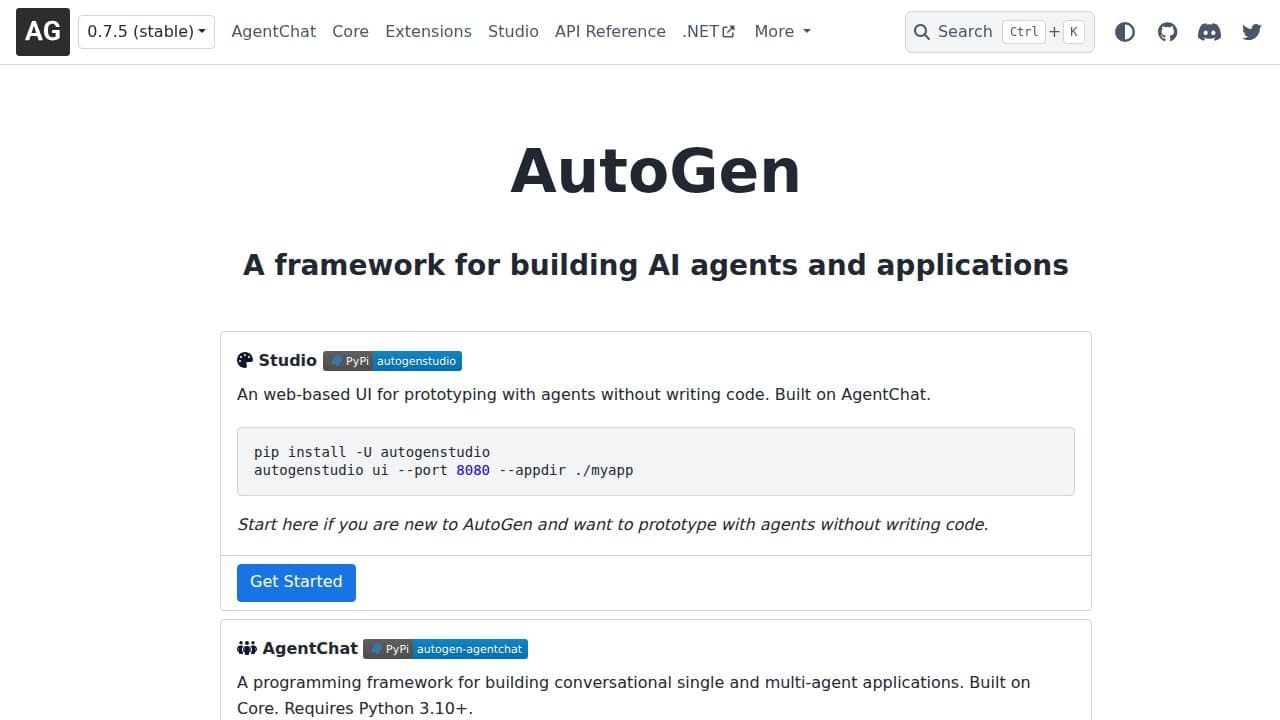
The core framework ships three layers: AutoGen Core (actor-model runtime with async event-driven message passing), AgentChat (a higher-level API for common patterns like two-agent chat and group chat), and Extensions (integrations for OpenAI, Azure OpenAI, and MCP servers). AutoGen Studio provides a no-code web GUI for prototyping and debugging workflows without writing Python. Magentic-One, a generalist multi-agent preset bundled with the framework, achieved competitive benchmark results on GAIA, AssistantBench, and WebArena in late 2024. Cross-language support covers Python 3.10+ and .NET.
What AutoGen actually does in April 2026
AutoGen's current stable release (v0.7.x, with v0.7.5 tagging September 2025) builds on the v0.4 architectural rewrite that shipped in January 2025. That rewrite replaced the original synchronous conversation loop with an actor-model runtime: agents are independent computational units that receive and send typed messages through a central runtime, rather than calling each other in a linear chain. This decouples message delivery from message handling, which means agents can run in separate processes, on separate machines, or in separate languages.
Practically, this unlocks a broader set of patterns: fan-out tasks to parallel agents, compose pipelines that checkpoint mid-run, stream partial results back to a user proxy, or hand off between a coder agent and a reviewer agent based on runtime conditions. The AgentChat layer preserves the simpler API familiar to AutoGen 0.2 users, so existing two-agent and group-chat patterns still work without a rewrite.
AutoGen Studio, bundled as a web interface and Python package, renders agents and team configurations as a drag-and-drop canvas. It targets the prototyping and debugging use case: developers can swap models, adjust agent prompts, and replay sessions without touching code. Microsoft notes explicitly that AutoGen Studio is a research prototype and not a production deployment target.
Magentic-One, a preset multi-agent system built on top of AgentChat, wires together a planning orchestrator with four specialist agents: a web browser, a file navigator, a code executor, and a terminal. On the GAIA benchmark it scored 38%; on WebArena, 32.8%. These numbers are competitive with the leading open-source systems at the time of publication.
"A step ahead of LangChain agents and seems to be receiving more attention and development than LangChain was interested in committing to agents." - anais9, Hacker News, October 2023
Where AutoGen sits versus CrewAI and AG2
The two most direct comparisons are CrewAI (the most popular alternative for new projects) and AG2 (the community fork that split from AutoGen in late 2024).
AutoGen vs. CrewAI: CrewAI uses a role-based declarative model where developers define a "crew" of agents by assigning role text, goal text, and backstory text, and the framework infers coordination. A basic CrewAI pipeline requires roughly 20 lines of Python. AutoGen's AgentChat layer requires more boilerplate to specify agent types, termination conditions, and message routing, but it supports conversation patterns CrewAI does not: multi-party group debates, consensus protocols, and dynamic role switching within a session. Token overhead benchmarks consistently show AutoGen running higher than CrewAI (approximately 24% vs. 18%) because its conversation-centric model preserves full message history per turn. CrewAI has grown faster in GitHub stars during 2025-2026 and is the default recommendation in most "getting started with agents" tutorials.
AutoGen vs. AG2: In September-October 2024, original AutoGen lead Chi Wang and co-author Qingyun Wu departed Microsoft. Wang subsequently joined Google DeepMind. The two researchers forked the AutoGen 0.2 codebase into AG2 under a new GitHub organization (ag2ai), relicensed it under Apache 2.0, and rebranded it as "the community-governed fork." AG2 maintains backward compatibility with AutoGen 0.2 and has attracted maintainers from Meta, IBM, and several universities. The key mechanical difference is governance and trajectory: AG2 is building toward a v1.0 with open governance, while Microsoft's AutoGen has officially entered maintenance mode with no new features planned, and Microsoft is directing new enterprise users toward Microsoft Agent Framework. For teams on AutoGen 0.2 who need stability and backward compatibility, AG2 is the natural migration path. For teams building net-new agentic systems, the field has fractured.
"AutoGen is very much alive, very much still being invested in.. underlying agent systems in multiple first-party products." - Marc Sweet, Microsoft architect, in response to community fragmentation concerns, late 2024
What the agent loop reality looks like day-to-day
A typical AutoGen workflow involves defining a UserProxyAgent (which can execute code and represent the human) and one or more AssistantAgents (which call the LLM), then initiating a chat. The framework handles turn-taking, termination conditions, and code sandboxing. By default, code execution runs inside Docker containers, which provides isolation but adds latency and a dependency on Docker being available in the environment.
Recurring friction points from developer forums and GitHub issues cluster around four areas. First, agent loops: without carefully tuned termination conditions, agents can enter repetitive exchange cycles that burn tokens without converging. Second, cost opacity: because each agent turn appends to a growing conversation buffer, multi-agent sessions generate token counts that are difficult to predict before running. A complex group-chat run can cost significantly more than a single-LLM call solving the same task. Third, the v0.2-to-v0.4 migration: the architectural rewrite was not backward compatible, and teams that built production systems on v0.2 faced a partial rewrite. Microsoft maintained a v0.2 legacy branch but added no new features to it. Fourth, the package name confusion: five different PyPI packages (autogen, pyautogen, autogen-agentchat, ag2, and autogen-core) circulate simultaneously, and installing the wrong one produces unexpected behavior.
The AG2 fork adds a political layer. Teams choosing AutoGen today are implicitly choosing the Microsoft maintenance trajectory over the community-governed fork. Neither option is obviously superior for all use cases, but the choice matters for long-term dependency management.
Who AutoGen is built for
AutoGen is best suited for Python developers who need flexible conversational agent patterns and are comfortable managing their own infrastructure. The framework rewards engineers who want fine-grained control over message flow, termination logic, and agent composition. Teams building research prototypes, internal tools, or one-off agentic pipelines get the most value from it. The .NET SDK makes it one of the few open-source agent frameworks with native support for enterprise C# codebases.
AutoGen Studio lowers the floor for non-engineers experimenting with agent configurations, but it is explicitly a prototyping tool. Teams that need production reliability, UI observability, or managed hosting should treat Studio as a sandbox only.
Microsoft's own positioning has shifted. The company now recommends Microsoft Agent Framework for net-new enterprise projects, framing AutoGen as the research prototype that informed it. AutoGen continues to receive security patches and bug fixes, but feature velocity has dropped substantially since the v0.4 release.
What AutoGen is not
AutoGen is not a managed service. There is no hosted API, no cloud runtime, no built-in observability dashboard, and no vendor support tier. Every deployment decision, from model selection to container configuration to cost management, falls on the implementing team.
It is not the easiest path to a working agent in 2026. CrewAI reaches a functional demo faster with less boilerplate. LangGraph provides more explicit state management and better tooling for production conditional workflows. If your primary goal is to ship an agentic feature in a product, AutoGen's learning curve and maintenance uncertainty make it a harder sell than it was in 2023.
It is also not a good fit for teams who need vendor guarantees. The MIT license means you can use it freely, but Microsoft has signaled reduced investment. Teams building critical automation on AutoGen should have a migration plan, either toward Microsoft Agent Framework (enterprise path) or AG2 (community path), before the maintenance posture matters.
User Reviews
No reviews yet. Be the first to share your experience!
Sign in to write a review.
Featured in collections
Curated lists that include AutoGen.
Related articles
Guides and articles related to AutoGen.
Run a Company With AI Agents: The Open-Source Orchestration Setup (2026)
How AI Agents Work: Architecture & Implementation Guide (2025)
Orchestrator-Workers: The Multi-Agent Pattern That Actually Scales (2026)
Turn Any AI Agent Into a Superagent: The 12-Integration Stack (2026)
AI Agents for Business: What They Actually Are and 12 Things You Can Automate Today