AI Agents for Business: What They Actually Are and 12 Things You Can Automate Today
AI Agents for Business: What They Actually Are and 12 Things You Can Automate Today
"AI agent" is the most overused phrase of 2026 and the least explained. Strip the hype and an agent is simple: software that takes a goal, decides the steps, uses tools to act, and checks its own work. This guide defines agents in plain terms, then maps 12 concrete things a business can automate right now across content, sales, and operations, with the realistic payoff and the honest limits of each.
TL;DR
An agent takes a goal and decides the steps itself
That makes it different from a fixed automation or chatbot
12 real use cases span content, sales, and operations
Start with bounded, low-risk tasks that have clear success checks
Humans stay in the loop for judgment and exceptions
What is an AI agent, in plain language?
An AI agent is software that pursues a goal by deciding its own steps, calling tools to take action, and adjusting based on results, rather than following a fixed script. A normal automation runs the same steps every time. A chatbot answers and waits. An agent is given an outcome ("triage this inbox," "research these 50 accounts") and works out how to get there, looping until done.
The practical difference is adaptability. A fixed workflow breaks when the input changes shape; an agent reasons about the new input and adapts. That power is also the risk: an agent making decisions needs guardrails, logging, and a human check on anything irreversible. If you want the deeper mechanics, our guides on how AI agents work and what AI agents are go layer by layer. Browse the tools on the AI agents and automation directory.
How is an agent different from a Zapier-style automation?
A traditional automation is a fixed pipeline: trigger, then the same steps every run. An agent decides the steps at runtime based on the goal and what it finds. Both have a place, and most real systems blend them: deterministic automation for the predictable parts, an agent for the parts that need judgment.
The deciding question is variance. If the task is the same every time (move this row to that sheet), use plain automation; it is cheaper and more reliable. If the task varies (read this email and decide what it needs), an agent earns its keep. Choosing the right tool per task is most of the skill, and getting it wrong (an agent where a rule would do) is how teams overspend on tokens and add fragility. Platforms like n8n and Lindy let you mix both in one flow.
12 things a business can automate with agents today
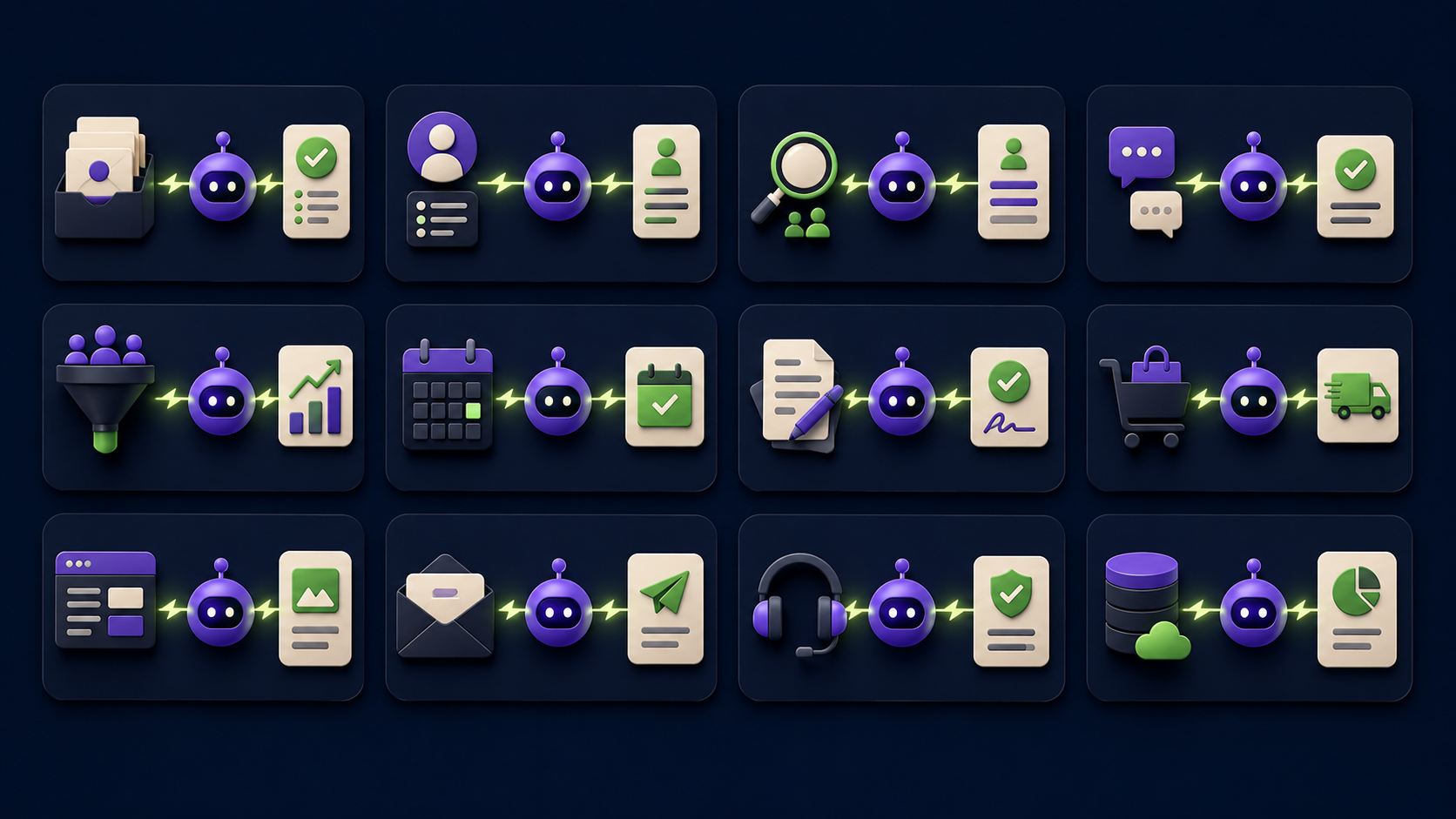
These are use cases that work now, grouped by function. Each is bounded enough to deploy without betting the company on it. The payoff figures are operator-reported ranges, not guarantees.
# | Use case | Function | Typical payoff |
|---|---|---|---|
1 | Inbox triage and drafted replies | Operations | Hours back per week per person |
2 | Lead research and enrichment | Sales | Faster, deeper prospect lists |
3 | Personalized first lines at scale | Sales | Higher reply rates |
4 | Content brief and draft generation | Content | More output per editor |
5 | Repurposing one post into many | Content | Full channel coverage from one source |
6 | Customer support triage and deflection | Operations | Lower ticket volume to humans |
7 | Meeting notes to CRM and tasks | Operations | No manual logging |
8 | Invoice and document extraction | Finance | Fewer manual entry hours |
9 | Inbound voice and phone answering | Operations | Captured after-hours inquiries |
10 | Internal knowledge questions (RAG) | Operations | Faster answers, less Slack noise |
11 | Quote and proposal drafting | Sales | Faster turnaround on bids |
12 | Weekly reporting and status rollups | Operations | Reports build themselves |
Which agents make sense for content?
For content, agents work best on the research, drafting, and repurposing stages where the input varies but the success check is clear. A content agent can take a keyword, build a brief from live search data, produce a first draft, and hand it to a human editor; a repurposing agent can take one published post and generate the social, email, and short-form variants.
The boundary that keeps this safe is the human edit pass: the agent drafts, a person approves. That is the whole content stack we lay out in the AI content automation stack, with the repurposing piece detailed in turning one post into 30. Agents multiply an editor; they do not replace editorial judgment.
Which agents make sense for sales and outreach?
In sales, agents shine at research, enrichment, and personalization, the parts of outbound that are high-volume and judgment-light per item but impossible to do well by hand at scale. An agent can research an account, pull signals, and draft a specific opening line for each prospect, feeding a human or a sequencer.
What agents should not own yet is closing and qualified-reply handling, where nuance and relationship matter. The winning pattern is hybrid: agents do the top of the funnel, humans take the warm conversations. We map the full picture in how to build an AI outbound stack and run the economics in AI SDR versus human SDR. Tools like Clay turn this into a repeatable workflow.
Which agents make sense for operations?
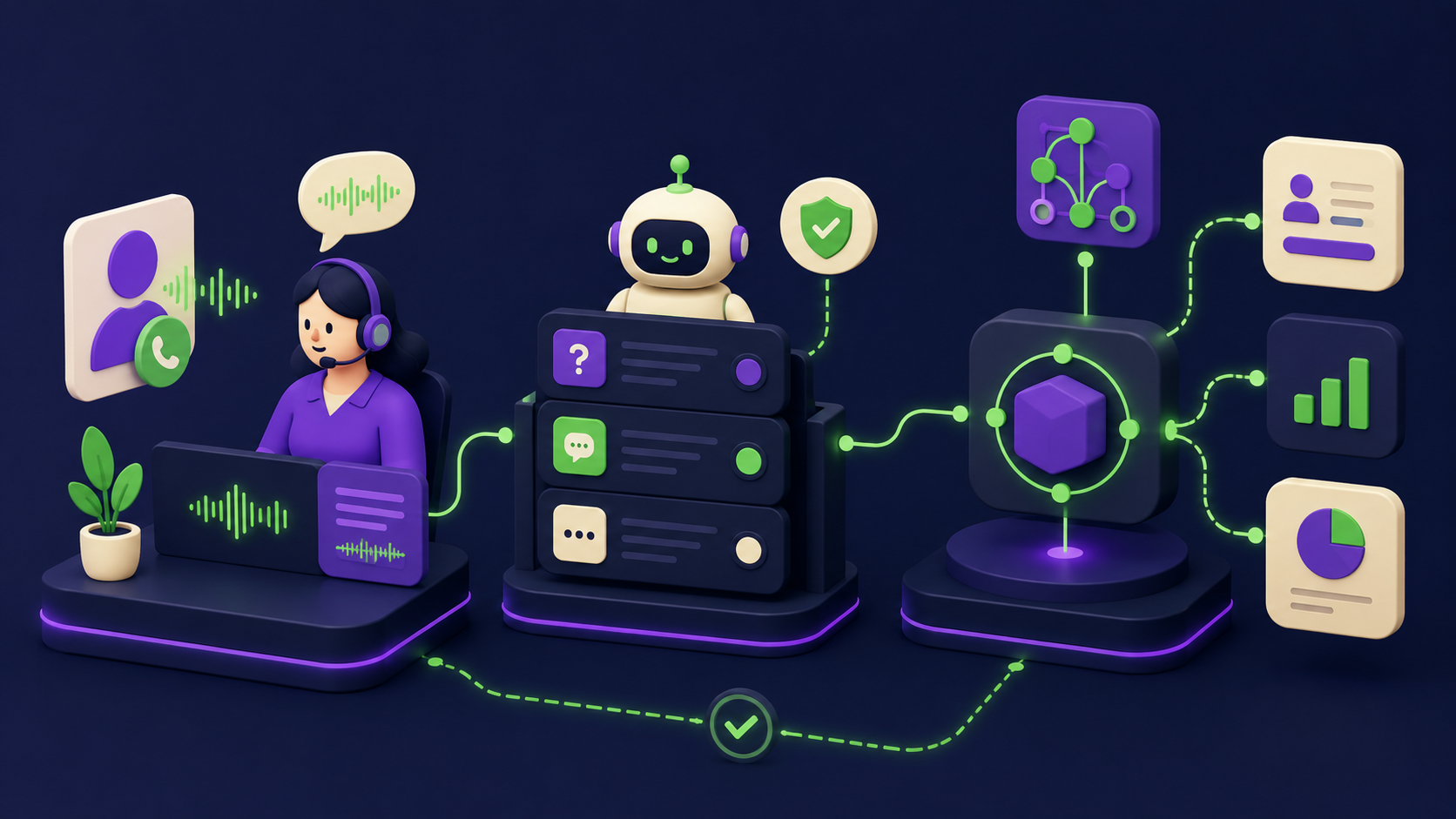
Operations is the broadest and often highest-value area, because back-office work is full of repetitive, rules-plus-judgment tasks: inbox triage, support deflection, document processing, meeting-to-CRM logging, internal knowledge lookup, and inbound phone answering. Each is bounded, measurable, and currently eating staff hours.
Voice is a standout in 2026: agents built on Vapi or Retell answer calls, qualify, and book, capturing inquiries that used to go to voicemail. Support deflection through a tool like Tidio handles the repetitive tickets so humans take the hard ones. The orchestration tying these to your systems is usually n8n, and the ready-made patterns live in our 15 n8n workflows guide.
Where should a business actually start?
Start with one bounded task that has a clear success check, runs often enough to matter, and carries low blast radius if it errs. Inbox triage, lead enrichment, and meeting-notes-to-CRM are classic first wins: high frequency, easy to verify, low risk. Prove value on one, build trust, then expand.
The mistake is starting with an ambitious, high-stakes agent that touches money or customers directly. Those come after you have logging, guardrails, and a track record. The maturity curve runs from assisted tasks to supervised agents to trusted automation, and skipping steps is how pilots blow up. A short audit usually surfaces the right first three, which is exactly what we do before building anything.
Want your back office automated for you?
Vantaige audits your operations, finds the hours bleeding into manual work, and builds the AI workflows that reclaim them. Book a free process automation audit and we will show you the first three workflows worth building.
FAQ
Are AI agents reliable enough for real business use?
For bounded tasks with clear success checks and human review on exceptions, yes, today. For open-ended, high-stakes, fully autonomous decisions, not yet. The reliability you get is a function of how tightly you scope the task and how good your guardrails and logging are.
Do I need developers to use AI agents?
Not to start. No-code platforms like n8n and Lindy let operators build useful agents without writing code. Developers help when you need custom integrations or complex logic, but the first wins are usually buildable without them, or with a short done-for-you setup.
How much do business AI agents cost to run?
Costs are usage-based (model tokens) plus the platform subscription, and they scale with volume. A bounded agent on a sensible model is inexpensive per task; the cost trap is running an expensive model on a task a simple rule could handle. Right-sizing the model per task is most of the savings.
What is the difference between an agent and a chatbot?
A chatbot responds to messages. An agent pursues a goal across multiple steps and tools, acting on the world rather than just replying. A chatbot can be one tool an agent uses, but the agent is the thing deciding what to do next.
Which function should automate first: content, sales, or ops?
Whichever has a high-frequency, painful, bounded task you can measure. For many businesses that is operations (inbox, support, reporting) because the busywork is obvious and the success check is clear. The right answer is specific to where your hours are leaking, which an audit pinpoints.
Will agents replace my team?
The realistic 2026 pattern is multiplication, not replacement: agents take the repetitive volume so your team does the judgment work. Roles shift toward reviewing, exception-handling, and strategy. Teams that redeploy freed hours into higher-value work get the most from agents.
Related from Vantaige
References
Anthropic, "Building effective agents." anthropic.com
n8n, AI agent node documentation. docs.n8n.io
Lindy, AI agent platform overview. lindy.ai
Vapi, voice agent documentation. vapi.ai
Get the best new AI tools and guides, weekly
One short email a week. The tools worth trying, the guides worth reading, nothing else.
No spam. Unsubscribe anytime.
Aymen B
Contributing writer at Vantaige, covering the AI tools ecosystem.