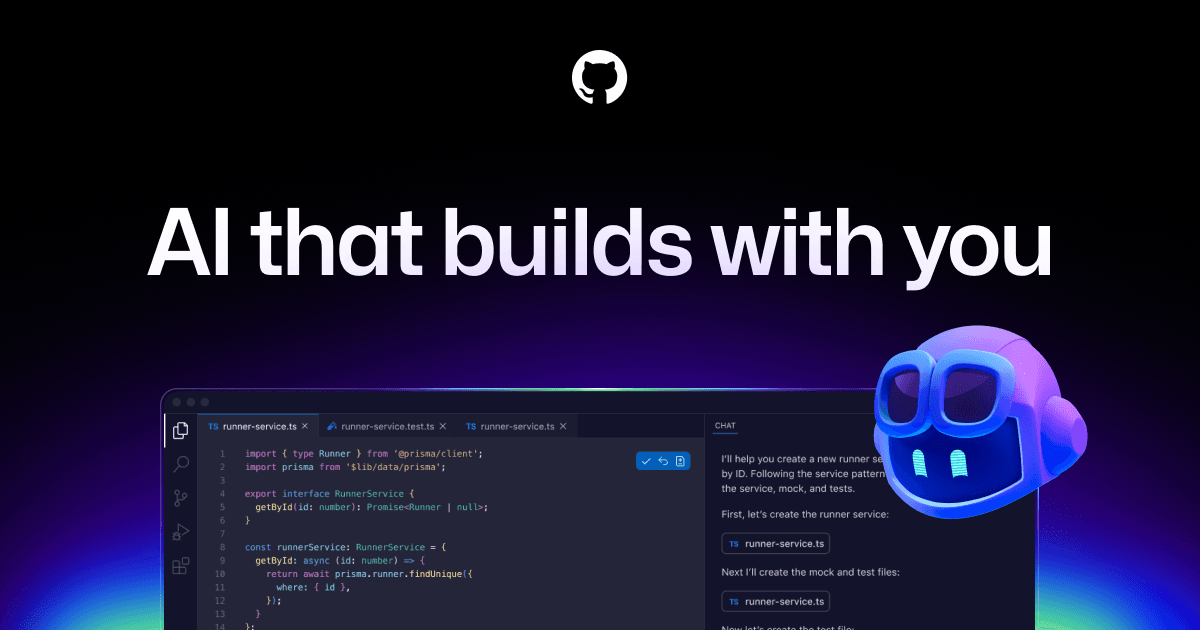

GitHub Copilot is GitHub's freemium coding assistant for inline completions, chat, Agent Mode, cloud agent (issue-to-PR), CLI, and code review. As of September 2026 individuals sit on Free / Pro ($10) / Pro+ ($39) / Max ($100) with GitHub AI Credits metering chat and agents; orgs buy Business ($19/seat) or Enterprise ($39/seat). Paid plans expose a multi-model picker including GPT-5.6 Sol/Terra/Luna and Claude Sonnet 5; Free/Student use auto model selection only.
Inside a 40,000-line TypeScript monorepo, GitHub Copilot autocompleted a Prisma database migration in under two seconds, inferred the schema from the models already open, generated the correct ALTER TABLE sequence, and sat waiting in grey inline text before a single key was pressed. That is Copilot at its best: invisible, fast, accurate for the kind of repetitive structural code that taxes experienced developers and overwhelms beginners. The question for April 2026 is whether that best case still describes the median experience, or whether a string of product missteps has narrowed it to an edge case.
The honest answer is complicated. Copilot retains the strongest installed base in AI-assisted coding, the most generous free tier in the market, and the only autonomous coding agent that runs natively inside GitHub's PR workflow without additional tooling. It also carried, into early 2026, a token-counting bug that triggered rate-limit lockouts mid-week for paying subscribers, injected promotional ads into more than 1.5 million pull requests without user consent, and disclosed a CVSS 9.6 vulnerability that allowed chat sessions to silently exfiltrate source code from private repositories. Each of those incidents resolved. GitHub patched CamoLeak, disabled PR ads, and offered prorated refunds, but the cumulative effect on trust among the developers who depend on it daily is real and measurable.
What GitHub Copilot can actually ship as of September 2026
Copilot's surface area in April 2026 is much wider than the autocomplete tool that launched in 2021. The current product spans five distinct working modes:
Inline suggestions remain the core. Tab-to-accept completions appear in VS Code, JetBrains IDEs, Visual Studio, Neovim, Vim, Eclipse, and Xcode. Next-edit suggestions, introduced in April 2025, go beyond completing the current expression: they predict the next logical edit in the file based on the changes you just made, then pre-fill it. In practice, fixing a function signature autocompletes the corresponding call sites elsewhere in the file before you navigate to them.
Copilot Chat is available in every supported IDE, at github.com, in GitHub Mobile, and in Windows Terminal. With the paid-plan model picker (as of September 2026), individual messages can route across documented Copilot models including OpenAI GPT-5.6 Sol / Terra / Luna, GPT-5.5, GPT-5.4, GPT-5.3-Codex, Anthropic Claude Sonnet 5 and Claude Opus 5 (plus Sonnet/Opus 4.x still listed), Google Gemini 3.x Flash / 3.1 Pro (preview), and others on docs.github.com-without a separate provider API key. Copilot Free and Copilot Student are limited to auto model selection only (no manual frontier picker).
Copilot Edits handles multi-file changes initiated through natural language. Describe what needs to change across several files, review the inline diff, iterate. It bridges the gap between single-file autocomplete and full agent delegation.
Agent Mode in VS Code and JetBrains operates autonomously: given a task description, it determines which files to modify, runs terminal commands, reads error output, and iterates until the task completes or it runs out of context, without requiring manual steering between steps. It is well-suited for contained, well-defined features. It degrades on large-scale refactoring across unfamiliar codebases.
The Copilot Coding Agent, generally available since September 2025, is the most architecturally interesting piece. Assign it a GitHub issue. It provisions a branch inside GitHub Actions, reads the repository, writes code, runs the test suite, completes a security scan, and opens a draft pull request for human review. No developer presence required during execution. ThoughtMinds documented the output: "there was a pull request open, with tests passing, self-reviewed, and a security scan completed, without a single prompt after the initial assignment." GitHub reported the agent solves approximately 60% of assigned issues without additional steering.
The Coding Agent's reliability improves significantly with an AGENTS.md instruction file in the repository root. Teams that encode constraints, prohibited SQL patterns, required test coverage thresholds, naming conventions, security guidelines, consistently get cleaner first-pass output with fewer review cycles.
Where GitHub Copilot shines, and where it silently hurts you
Copilot's clearest wins are in the autocomplete loop and in GitHub-native workflows. For developers who spend the majority of their time in a single IDE and a single repository, the tab-to-accept cycle reduces the volume of boilerplate and pattern-repetition code by a measurable amount. One reviewer stated directly: "Nothing beats Copilot for the 'type and tab' workflow." At $10/month for Pro, or free for the first 2,000 completions, the value density for that use case is high even relative to alternatives that cost five to ten times more.
The failures are structural rather than incidental. Agent Mode degrades at scale in ways that are hard to predict in advance. Developer Maxim Saplin documented the pattern directly after switching from Cursor mid-project:
"Copilot's agent got lost mid-implementation after summarization triggered. Plan mode outputs generic text from subagents rather than executable plans. There's no dialog branching, a growing context thread can't be pruned or restarted from mid-session without losing work."
. Maxim Saplin, direct comparison on dev.to, 2026
An Intuition Labs analysis put Copilot's accuracy on projects exceeding 10,000 lines of code at roughly 50%, compared to higher figures from Cursor's more tightly integrated context system. The inline suggestion acceptance rate sits at 35–40%, below Cursor's reported 42–45%.
The autocomplete aggressiveness issue also remains real. The GitHub Community discussion "Can I make Copilot less intrusive?", active across May through July 2025, accumulated hundreds of responses. The complaint pattern is consistent: Copilot's inline suggestions intercept keystrokes, conflict with native editor indentation, and interrupt thought mid-expression. Microsoft released VS Code update 17.14.13 in August 2025 with configurable suggestion controls, framing the goal as making Copilot feel "like a tool you reach for rather than a presence that interrupts your flow." The controls help; they do not fully resolve the problem for all configurations.
Language and framework support: the reality check
Copilot's suggestion quality is not uniform across languages. The gap between its strongest and weakest coverage is significant enough to affect whether the tool earns its subscription cost for a given developer's stack.
The strongest performance is in Python, JavaScript, TypeScript, Go, and Ruby, languages with large, high-quality training corpora and strong representation in public GitHub repositories. For these languages, inline completions are often production-quality on the first suggestion. Framework-specific patterns. React hooks, Express middleware, Django ORM queries, Prisma migrations, are recognized and completed correctly more often than not.
Performance drops measurably for Rust, Kotlin, Swift, and Scala. It degrades further for domain-specific languages, internal frameworks with no public representation, and codebases with heavy use of custom abstractions. Copilot's context window is bounded by the files currently open in the editor on the Free and Pro tiers, it does not index the full repository by default. Enterprise tier adds codebase indexing, which partially addresses the problem for large monorepos, but the cost jumps to $39/seat/month.
For Free and Student, model access is auto model selection only (not a manual GPT-5 mini / Haiku picker). Manual model choice-including Claude Sonnet 5, GPT-5.6 Sol/Terra/Luna, and other premium models on the published matrix-requires a paid plan. Metering for chat, agents, CLI, Spaces, and Spark is GitHub AI Credits (1 credit = $0.01), not the older premium-requests quotas. Official individual totals as of 2 Sep 2026: Pro $10/mo = 1,000 base + 500 flex = 1,500 credits; Pro+ $39/mo = 3,900 + 3,100 = 7,000; Max $100/mo = 10,000 + 10,000 = 20,000. Completions / next-edit suggestions stay unlimited on paid plans and do not consume AI credits. Exact Free credit allotment is stated only as an allowance in docs; marketing FAQ still cites 2,000 completions and 50 chat requests on Free.
A real workflow: using GitHub Copilot on a legacy codebase
The most consistently reported non-obvious Copilot workflow is reverse documentation of legacy code before any rewriting begins. Couchbase engineer Tugdual Grall documented the approach in October 2025: rather than using Copilot to immediately rewrite legacy code, start by generating comprehensive documentation from the existing code, module by module, then use that documentation as the implementation foundation.
The setup: configure a custom "doc writer" agent mode with a system prompt focused on description rather than generation, write .github/copilot-instructions.md files that explain architectural constraints, then iterate through services or components generating documentation. Human review of the generated documentation surfaces misunderstandings before any code changes begin. The refactoring phase then proceeds against a shared documentation baseline that both developer and agent can reference.
Here is the shape of what Copilot produces for a simple test-generation task, given a partially written function, the autocomplete fills in the test structure before a second keystroke:
// Developer types:
function parseCSVRow(line: string): string[] {
  // Copilot suggests:
  return line.split(',').map(cell => cell.trim().replace(/^"|"$/g, ''));
}

// In the test file, developer types:
describe('parseCSVRow', () => {
  it('handles quoted fields', () => {
    // Copilot autocompletes:
    expect(parseCSVRow('"hello, world","foo","bar"')).toEqual([
      'hello, world',
      'foo',
      'bar',
    ]);
  });
});
The suggestion above, a regex for stripping CSV quote wrappers plus the corresponding test assertion, appears inline within one to two seconds of opening the test file. It is not always correct, but it is usually a useful starting point. The free tier's 2,000 completions per month gives meaningful evaluation time for exactly this kind of pattern.
Security, licensing, and code leakage
Security is the section of any Copilot evaluation that changed most materially between 2025 and 2026.
In June 2025, security researchers disclosed CVE-2025-59145, dubbed CamoLeak, with a CVSS score of 9.6. The vulnerability was in GitHub Copilot Chat specifically. The exploit embedded malicious instructions inside invisible markdown comments in files or web content; when a developer opened Copilot Chat with that content in context, the AI encoded source code, API keys, and cloud credentials character by character into pre-signed image URLs and transmitted them to an attacker-controlled server. No user interaction beyond opening Copilot Chat was required. GitHub patched the vulnerability, but the attack surface it revealed. AI-assisted exfiltration through prompt injection in untrusted content, has no complete technical remedy while LLMs process unstructured text.
Separately, GitGuardian's analysis of repositories using Copilot found a 6.4% secret leakage rate, approximately 40% higher than the baseline for traditional development. The causal link is contested, but the correlation is documented.
On data retention: prompts and suggestions are retained for 28 days even on paid plans when Copilot is accessed through github.com or GitHub Mobile. Enterprise tier offers content exclusion policies, audit logging, and IP indemnity, but the gap between Business and Enterprise data handling is significant enough that regulated industries (healthcare, finance, government) should evaluate Enterprise controls rather than assuming Business tier protections are sufficient.
The PR injection incident from March 2026 added reputational damage on a separate axis. Copilot injected promotional "tips", including Raycast ads, into more than 1.5 million pull request comments without user consent or disclosure. GitHub VP Martin Woodward confirmed the feature was removed after backlash. Copilot principal PM Tim Rogers acknowledged the failure directly on Hacker News:
"Letting Copilot make changes to PRs written by a human without their knowledge was the wrong judgement call."
. Tim Rogers, Copilot Principal PM, Hacker News, March 2026
The incident raised a structural concern that had not previously been articulated: a tool embedded in the code review workflow can modify the artifacts of that workflow without the developer's knowledge.
GitHub Copilot vs. Cursor vs. Claude Code
GitHub Copilot is the right choice when: you want to stay inside your existing IDE, you need GitHub-native agentic workflows (issue-to-PR), your team is already on GitHub Business or Enterprise, or you need the lowest-cost entry point ($0 free tier, $10/month Pro) with genuine multi-model access. The infrastructure integration and the breadth of supported IDEs. VS Code, JetBrains, Visual Studio, Neovim, Vim, Eclipse, Xcode, mean zero editor switching cost.
Cursor is the right choice when agent reliability on complex, multi-file tasks is the primary requirement. Cursor is a full fork of VS Code built around AI from the ground up rather than an extension bolted onto an existing editor. Its Tab completion model, derived from Supermaven, achieves a reported 72% acceptance rate versus Copilot's 35–40%. Its Composer and Agent modes handle large-scale refactoring more coherently than Copilot's Agent Mode, particularly in codebases exceeding 10,000 lines. The tradeoff: Cursor's top tier reaches $200/month, and it requires migrating to a new editor. HN commenter lolinder summarized the risk to Copilot directly: "GitHub risks losing mindshare to better-designed competitors" because Cursor's next-edit suggestions are more refined than Copilot's current integration.
Claude Code is the right choice when the task is architectural, multi-file refactoring, codebase comprehension across a large unfamiliar project, or agent sessions requiring coherent long-horizon planning. It is a terminal-based tool with no IDE dependency; its competitive advantage is codebase understanding depth. Developer Maxim Saplin, who compared both tools directly, described Claude Code's context handling as more coherent across long sessions than Copilot's agent, which can lose track mid-implementation when the context thread grows. Claude Code starts at $20/month, twice Copilot Pro, but for teams whose primary bottleneck is the agent rather than the autocomplete, the quality difference is measurable. SoftPicker described the experience as "pair programming with a senior developer who already read your codebase."
Pricing for solo devs, teams, and enterprise
The rate-limit controversy of March–April 2026 changed the practical meaning of every tier. The nominal request allocations are no longer a reliable guide to how many tasks a developer can complete in a month; the actual throughput depends on which models are used and whether the token multiplier for frontier models has consumed the budget.
Free tier (2,000 completions, 50 chat/agent requests per month) is still the most generous no-cost AI coding offer in the market. For developers evaluating whether $10/month is worth it, the free tier provides enough throughput to form a genuine opinion. Completions on standard models (GPT-5 mini, Haiku 4.5) do not consume the premium request budget, only chat and agent tasks using frontier models do.
Pro ($10/month, 300 premium requests) was paused for new sign-ups in April 2026. Existing subscribers are not affected; new access is temporarily unavailable pending infrastructure capacity improvements. GitHub offered prorated refunds through May 20, 2026 for subscribers who wanted to exit during the disruption period.
Pro+ ($39/month, 1,500 premium requests) provides the widest model access including Claude Opus 4.7, but with the 7.5x token multiplier for Opus, the effective budget is significantly narrower than the nominal figure suggests. Best suited for developers who use agent mode heavily and mix model selection based on task type.
Business ($19/seat/month) and Enterprise ($39/seat/month) are the stable choices for teams. Enterprise adds codebase indexing, custom fine-tuned models, BYOK for Anthropic/OpenAI/xAI API keys, and the IP indemnity and audit logging that compliance-sensitive organizations require. The Business-to-Enterprise pricing jump is steep but the data handling and compliance controls are substantively different.
User Reviews
No reviews yet. Be the first to share your experience!
Sign in to write a review.
Featured in collections
Curated lists that include GitHub Copilot.
Related articles
Guides and articles related to GitHub Copilot.

Claude Code vs Cursor vs Codex vs Devin vs Replit Agent 3: 2026 Scorecard

Replit Pricing Explained (2026): Core vs Pro and Effort-Based Agent Billing

SWE-bench Pro Explained: Why the Benchmark Changed (2026)

Run a Company With AI Agents: The Open-Source Orchestration Setup (2026)
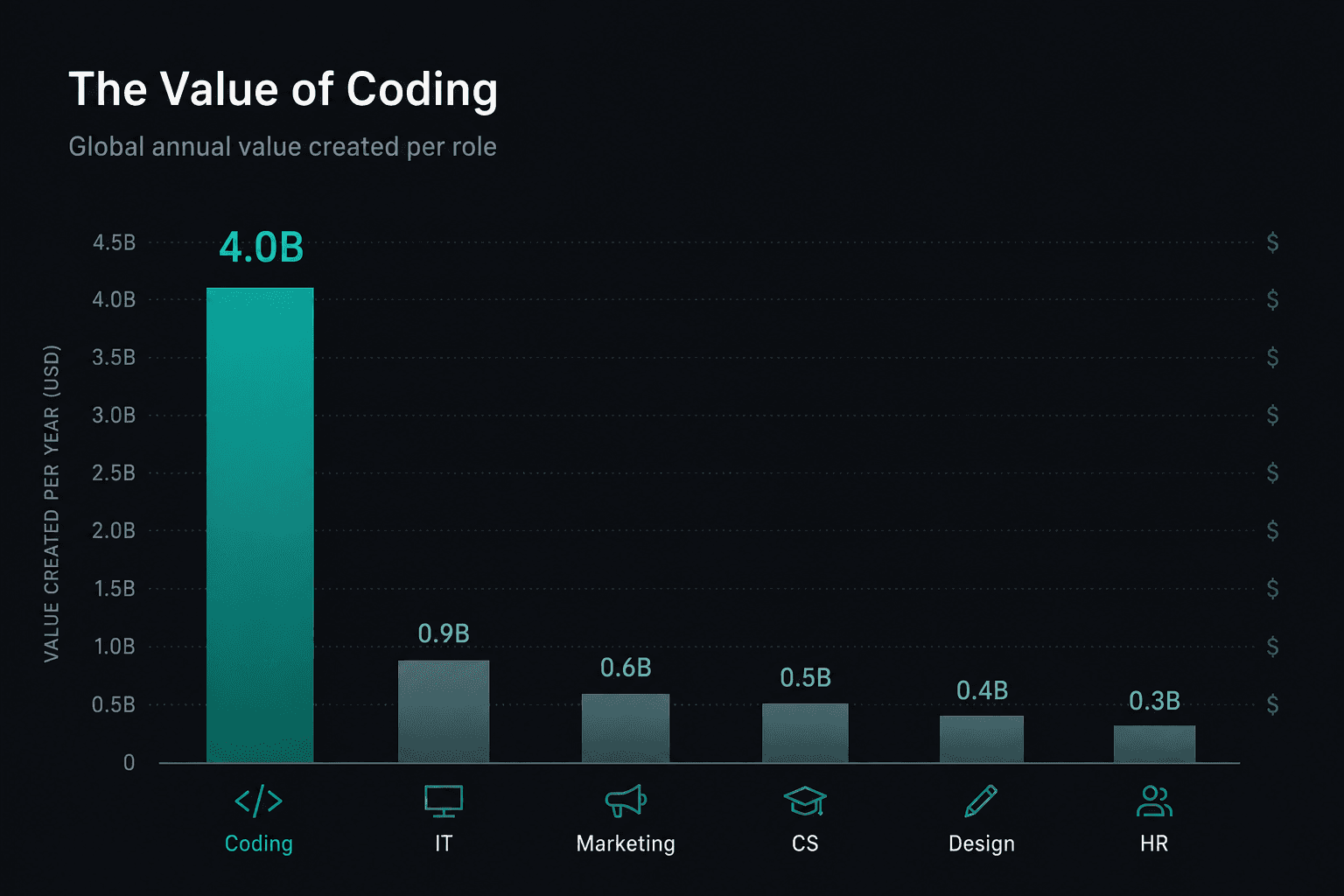
Coding Ate Enterprise AI (2026): The $4B Use Case, Anthropic’s Share, and Seat vs API Math