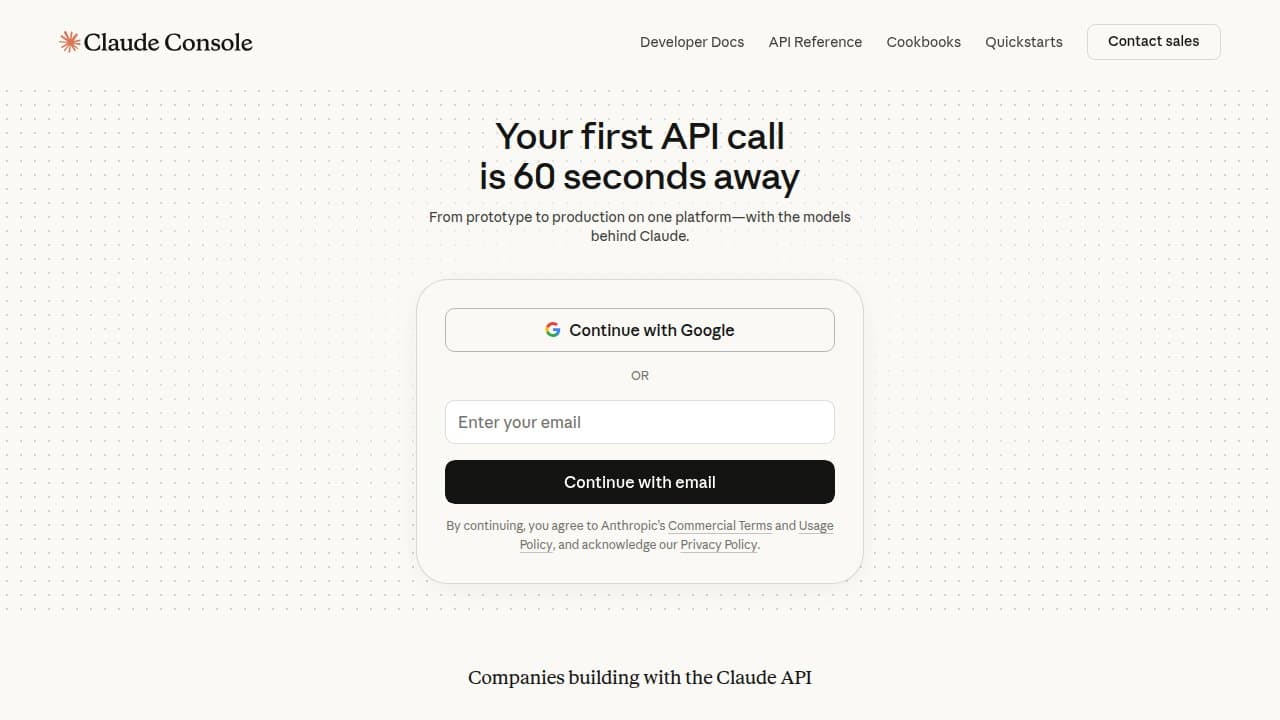

Anthropic Console is the developer hub for building with Claude. It combines the Workbench prompt editor, a structured Eval framework, API key management, and (as of April 2026) a Managed Agents deployment surface for long-running AI workflows.
Anthropic Console (console.anthropic.com) is the official developer platform for building, testing, and deploying applications using Claude, the AI model family built by Anthropic. It is not a standalone AI assistant -- it is the control plane for every Claude API integration. Developers who want any access to Claude via API start here to generate keys, set spending limits, and monitor usage. The Console is the required entry point for the Claude API, so its adoption mirrors API adoption itself.
The platform has three major surfaces: the Workbench, a live prompt editor where developers prototype system prompts and test parameters before writing code; the Evaluate tab, a structured test suite environment with automated test case generation, side-by-side prompt version comparison, and 5-point human grading; and Managed Agents, a hosted agent infrastructure service that launched in public beta on April 8-9, 2026, offering persistent file systems, session state management, and sandboxed execution for long-horizon agent workflows. The Console also exposes the Files API, prompt caching controls, and, from October 2025, Skills -- packaged instruction sets that can be version-controlled and deployed programmatically via the /v1/skills endpoint.
What Anthropic Console actually does in April 2026
The Workbench is the most-used surface for new API developers. Before writing a single line of SDK code, you can paste a system prompt, configure model parameters (temperature, max tokens, extended thinking budget), and fire off test messages against any Claude model in the current lineup: Opus 4.7, Opus 4.6, Sonnet 4.6, or Haiku 4.5. When you have behavior you want, one click exports a production-ready API call. This shortens the typical prompt design loop from days to hours for teams without existing evaluation infrastructure.
The Evaluate feature, released in July 2024, fills the gap between informal Workbench testing and production confidence. Developers describe a task, Claude generates a structured prompt using chain-of-thought techniques, then test cases are created via three methods: manual entry, CSV import, or automatic generation by Claude against real-world scenarios. All test cases run in one batch, outputs appear side-by-side across prompt versions, and subject matter experts grade each response on a 1-5 scale. This lets non-engineers participate in prompt quality review without access to code.
The Prompt Improver, added in November 2024, takes an existing prompt and automatically refines it using Anthropic's documented prompt engineering techniques. Nick Garnett, who ran a structured review of the Console in March 2025, found measurable gains from this feature: "A classification prompt saw 30% accuracy improvement. A summarisation prompt achieved 100% adherence to word count requirements." The catch is verbosity -- generated prompts tend to be more elaborate than necessary, and he noted "you'll often trim generated prompts rather than use them verbatim."
Managed Agents, the most significant April 2026 addition, turns the Console from a prompt testing tool into a full agent deployment surface. Developers define agent behavior and tool access, then delegate runtime responsibilities -- orchestration, sandboxing, session state, credential handling -- to Anthropic's infrastructure. Agents are billed at $0.08 per runtime hour plus standard model token costs. Persistent memory entered public beta on April 23, 2026, storing agent memory as files on a managed filesystem that developers can inspect, edit, and export via API or directly in the Console.
"The Console focuses on Claude-specific techniques. Prompts developed here work brilliantly with Claude but may need adjustment for other AI models." -- Nick Garnett, Substack, March 2025
Where Anthropic Console sits versus OpenAI Platform and Google AI Studio
These three platforms are not interchangeable -- each is locked to its own model family. The mechanical differences are substantial.
OpenAI Platform vs Anthropic Console: The most significant gap is fine-tuning. OpenAI Platform supports supervised fine-tuning (SFT), direct preference optimization (DPO), and reinforcement fine-tuning (RFT) across the GPT-4.1 model family. Anthropic offers no fine-tuning for Claude 4.x at all -- the only Claude fine-tuning is Claude 3 Haiku, available only through Amazon Bedrock, not through the Console. This means any developer who needs domain-specific model customization cannot use Anthropic Console as the only platform; they will need OpenAI Platform or Bedrock. OpenAI's eval dashboard also integrates directly into fine-tuning pipelines, creating a data flywheel where eval results feed training iterations. Anthropic's Evaluate tab has no such downstream connection because there is no fine-tuning destination to connect it to.
OpenAI Platform also offers first-party multimodal APIs -- image generation (DALL-E), speech-to-text (Whisper), text-to-speech, and embeddings -- from the same dashboard and billing account. Anthropic Console covers text and vision only. No Anthropic-native embeddings, no TTS, no image generation. For teams building multimodal pipelines, OpenAI Platform is significantly more integrated even if the language model performance favors Claude for text-heavy tasks.
Google AI Studio vs Anthropic Console: Google AI Studio is a lighter-weight prototype environment. Its primary advantage is accessibility: no credit card required to start, free tier with generous rate limits via the Gemini API, and native support for text, images, audio, and video in a single interface. But it lacks a structured eval framework. Google AI Studio has no equivalent to the Evaluate tab's automated test case generation, prompt versioning, or human grading workflow. Developers who want eval infrastructure on Gemini must use third-party tools like LangSmith or Langfuse and build evaluation pipelines themselves. On pricing, Gemini 2.5 Flash's input token cost is roughly 10x cheaper than comparable Claude models, which is a real constraint for cost-sensitive, high-volume applications.
"Claude models support up to 1 million tokens of context and the platform includes a Workbench for prompt iteration, an evaluation tool for testing prompt quality across test cases, and a prompt generator that creates system prompts from natural language descriptions." -- OpenAI vs Anthropic vs Google cost comparison, LLMGateway.io, 2026
What the agent and evaluation workflow reality looks like
For a typical team building a customer support automation, the Console workflow runs like this: An engineer opens the Workbench and describes the use case in plain English. The Prompt Generator produces a structured system prompt with role definition, task instructions, output format, and edge case handling. The engineer creates test cases -- some manually from real support tickets, some auto-generated by Claude -- and runs them in batch. A domain expert (customer service manager, not an engineer) grades responses in the Evaluate tab. The engineer iterates on the prompt version, re-runs the full test suite, and can see both versions side-by-side to measure improvement. When the prompt is production-ready, clicking "Get Code" outputs a copy-paste API call.
The Shareable Prompts feature (March 2025) lets organizations build a centralized prompt library. PMs, QA specialists, and engineers can collaborate on prompt iterations without requiring code access. Version history is tracked so teams can roll back to earlier prompt versions if a change degrades performance.
For agent deployments (April 2026), the workflow extends further: teams define agent tools and constraints in the Console UI, deploy to Managed Agents infrastructure, and monitor agent sessions via dashboard. Agents operate in isolated sandboxes, each with a persistent filesystem for multi-session state. The April 23, 2026 persistent memory beta lets agents remember context across separate sessions -- useful for customer relationship workflows where an agent needs to recall prior interactions.
Who Anthropic Console is built for
Every developer building a Claude API integration will use the Console by necessity -- there is no other way to obtain API keys. Beyond that mandatory use, the Workbench and Eval framework are most valuable for teams doing systematic prompt engineering: writing, testing, and iterating on system prompts that need to perform reliably in production. Organizations with non-technical stakeholders who need to participate in quality review benefit most from the Evaluate tab's human grading UI.
Enterprise teams who want to run agent workloads without managing their own infrastructure now have a clear path through Managed Agents, though at $0.08/hour plus token costs, the economics favor this for moderate-volume production agents rather than high-throughput pipelines.
What Anthropic Console is not
The Console is not model-agnostic. Every feature -- Workbench, Eval, Skills, Managed Agents -- is Claude-specific. Prompts optimized here may need adjustment for GPT or Gemini, and there is no multi-provider prompt management. Developers who need to compare providers or maintain portability should look at third-party tools like Helicone, LangSmith, or Langfuse.
The Console does not provide fine-tuning for Claude 4.x. Teams who need custom model behavior beyond what system prompts and few-shot examples can achieve have no path through Anthropic directly for the flagship models.
Rate limits and quota management have been a documented point of friction. Since early 2026, developers have reported hitting API rate limits faster than expected, particularly with Claude Code integrations. The April 2026 Opus 4.7 tokenizer change, which consumes 1.0-1.35x more tokens per request compared to earlier Claude models, caught some teams with cost surprises that weren't clearly communicated at launch.
Skip Anthropic Console if your use case requires: fine-tuned custom models (use OpenAI Platform); first-party embeddings, TTS, or image generation from the same vendor (use OpenAI Platform); model-agnostic prompt management (use LangSmith or Helicone); or bulk token throughput at minimum cost where Gemini 2.5 Flash's 10x pricing advantage matters (use Google AI Studio).
User Reviews
No reviews yet. Be the first to share your experience!
Sign in to write a review.
Related articles
Guides and articles related to Anthropic Console.

Claude Code Dreaming (Memory Consolidation): 2026 Setup Guide
Cut Your AI Agent Token Bill 5x: The Claude Code Efficiency Patterns (2026)

Replit Pricing Explained (2026): Core vs Pro and Effort-Based Agent Billing
Grok 4.3 API for Agents (May 2026): Pricing, Benchmarks, Migration

Google vs OpenAI vs Anthropic Agents: The May 2026 Platform Showdown