
Orchids is a Y Combinator-backed AI app builder that converts plain-English prompts into deployable web apps, mobile apps, Chrome extensions, and more. It ranks first on UI Bench for design output quality and supports bring-your-own-AI-subscription billing.
Orchids is a prompt-driven AI app builder from Y Combinator's Winter 2025 cohort, founded by Kevin Lu (ex-AWS Generative AI, Stanford HAI) and Bach Tran (ex-Addepar) in 2024. The core pitch is straightforward: describe what you want to build in plain language, and Orchids generates a deployable app, complete with frontend, backend integrations, and hosting. The platform ranked first on both App Bench (76% score) and UI Bench (TrueSkill rating 30.08) in benchmarks pitting it against Cursor, Bolt, Replit, Devin, and v0. Where most AI builders churn out designs with a recognizable "AI-made" sameness, Orchids produces output that reviewers consistently describe as looking like the work of a professional designer.
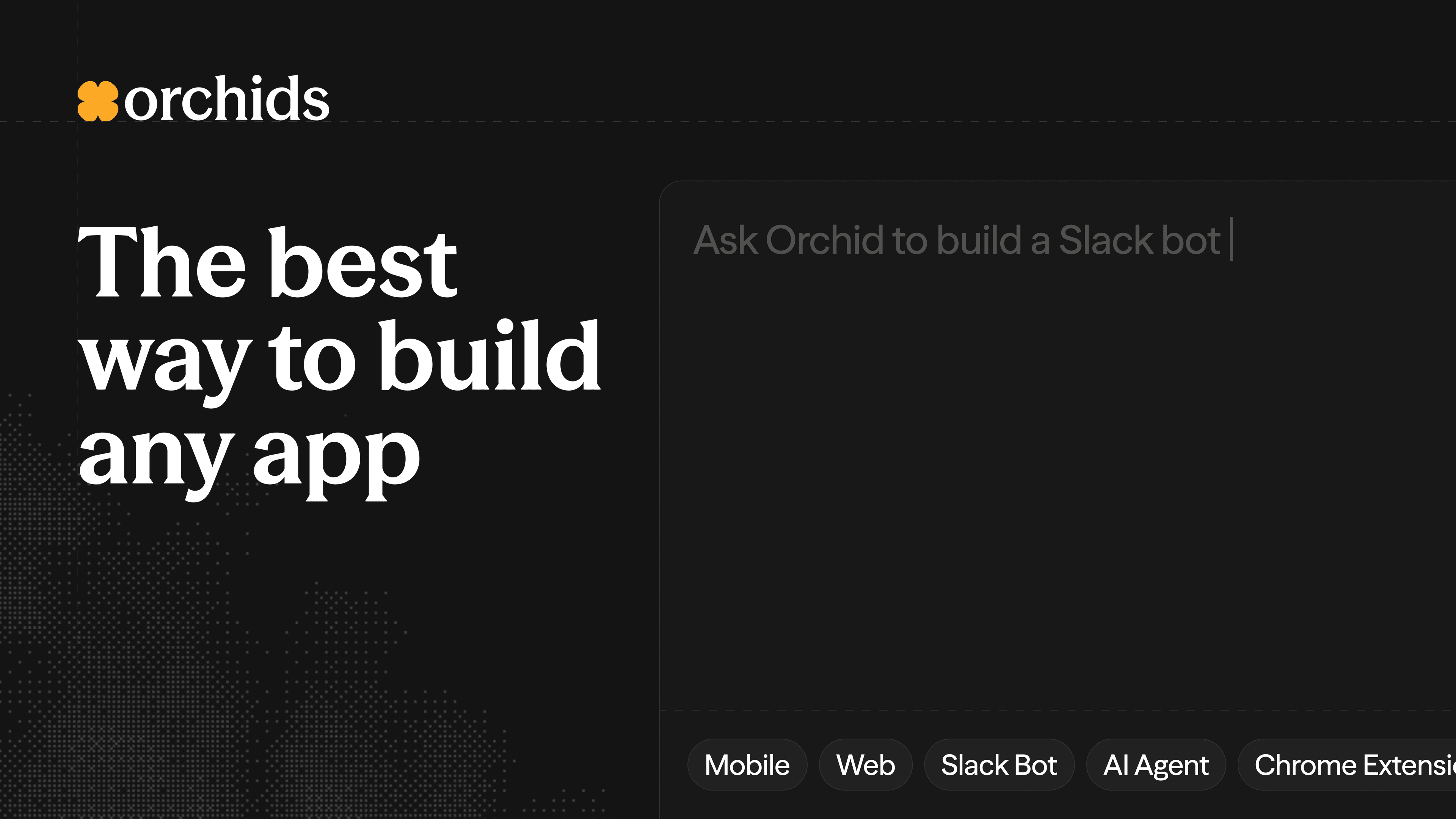
The February 2026 Orchids 1.0 release expanded the platform well beyond web apps. Users can now build mobile applications, Chrome extensions, Slack bots, AI agents, and CLI tools from a single interface. The bring-your-own-subscription model is a genuine differentiator: connect an existing ChatGPT, Claude, Gemini, or GitHub Copilot plan (or any raw API key) instead of purchasing Orchids-branded credits. Key capabilities include a URL cloning feature that reproduces any existing website's structure pixel-perfectly as a starting point, Supabase/Firebase/Stripe integrations, a checkpoint-based version control system, a built-in VS Code editor on desktop, and one-click deployment. Projects from Lovable, Bolt, v0, and GitHub can be imported directly.
What Orchids actually does in June 2026
Orchids operates as a full-stack coding agent wrapped in a conversational interface. Type a description (or paste a URL to clone), and the platform's agent plans the architecture, writes the code, runs setup commands, integrates external services, and deploys to a live URL. The agent handles state persistence, dark/light mode, form validation, CRUD operations, and API error handling without requiring user intervention at each step.
Since Orchids 1.0 launched on February 10, 2026, the platform supports multi-platform output from the same prompt interface. Web apps, React/Next.js frontends, Python backends, Swift and Flutter mobile apps, and Chrome extensions all ship from the same workspace. The checkpoint system creates restorable snapshots during longer builds, which matters given that some users have hit session-loss issues on complex projects.
The bring-your-own-AI model is worth understanding. On paid plans or the Mac desktop client, you connect your existing AI subscriptions rather than drawing down Orchids-issued tokens. This routes your prompts through whatever model you already pay for (Claude Sonnet 4.6 was added to the supported list in February 2026), which can meaningfully cut the effective cost for heavy users.
The URL cloning capability is the most-cited differentiator in hands-on reviews. Paste any public website URL, and Orchids reproduces its structural layout as an editable starting point. Designers and agencies use this to rapidly spin up redesigns of client sites; founders use it to clone competitor sites for competitive research or as design scaffolding.
"The agents are incredibly responsive and helpful, and the overall UI is clean, intuitive, and a joy to use." - Rushil, Product Hunt, 2026
Where Orchids sits versus Lovable and v0
The three tools serve meaningfully different jobs, even though their surface-level pitches overlap.
Lovable is the production-deployment choice for founders who need a full-stack app that can handle real users. Its core advantage is a native Supabase integration that wires up database, authentication, and file storage in a single documented flow. GitHub codebase export is built in, meaning developers can take the generated code and continue in a traditional IDE. Lovable holds SOC 2 and ISO certifications, making it viable for enterprise-adjacent use cases. It has the larger community and more extensive tutorial library. The trade-off: its design output tends toward the generic. Lovable's Starter plan runs $20/month with 100 credits; Orchids Pro is $25/month with 2 million tokens, making the token economics more transparent for users who want to predict spending.
v0 by Vercel operates at a completely different abstraction level. It is a component generator, not an app builder. Paste a design prompt and v0 outputs a React/Tailwind/shadcn component you can copy-paste into an existing codebase. There is no app deployment, no backend, no hosting. It targets developers who want design-system-consistent UI components without writing them from scratch. If you are starting from zero and need a working, deployed application, v0 is the wrong tool. Orchids and v0 only compete when a developer's goal is "generate one polished UI screen" rather than "ship a working product." For component-level work, also see v0 by Vercel on Vantaige.
Orchids sits between these two: better design output than Lovable by benchmark, broader stack support than v0, but less mature in production tooling than Lovable and carrying a more recent security question mark. For comparison across the broader vibe-coding category, see Bolt.new and Lovable.
What the agent loop reality looks like
Starting a project takes under two minutes: sign in, type a prompt, and Orchids begins generating. Reviewers consistently report reaching a publishable site in 8-15 minutes for landing pages, portfolios, and simple web apps. More complex projects with databases and authentication take longer, and the token consumption scales non-linearly with complexity. A simple button addition costs roughly 100 tokens; a multiplayer game with backend infrastructure can consume 30,000 tokens in a single session.
The Select to Edit feature (added in Orchids 1.0) lets users click any rendered element and modify it through conversation rather than hunting through generated code. This makes iteration on design details significantly faster than traditional code editors.
Context persistence across sessions is a recurring praise point. Unlike some AI builders that start fresh on each chat, Orchids maintains project context, meaning you can continue a build across multiple sessions without re-explaining the architecture. The checkpoint system creates restorable save points, though some users have reported session data disappearing on the free tier before they could checkpoint manually.
"Website in less than 10 minutes, looks better than what I used to spend hours on." - Reddit user, r/vibecoding, 2025
The agent handles external service integrations with less hand-holding than traditional development. Supabase, Stripe, and Firebase connections are documented integration paths rather than custom glue code each time. That said, complex database schemas with intricate relational logic still require the user to validate the AI's assumptions, and several reviews note that the first draft often needs iteration to get the data model right.
Who Orchids is built for
Non-technical founders who need something on the internet quickly are the primary audience. If you can describe what you want in a sentence and need a live URL within an hour, Orchids delivers that without requiring knowledge of React, SQL, or deployment pipelines. The free tier (100K tokens/day, one deployed project) is usable enough to validate a concept before committing to a paid plan.
Freelancers and small agencies benefit from the URL cloning workflow for client work. Cloning a reference design and iterating beats starting from a blank canvas, and Orchids' design output quality means the baseline is already above generic template level.
Developers who already subscribe to Claude, ChatGPT, or Gemini can use Orchids as an IDE layer on top of their existing subscriptions. The bring-your-own-key model means they pay Anthropic or OpenAI directly (at API rates) rather than Orchids' token markup, which can cut effective costs for heavy builders.
Indie hackers in early-stage experimentation also fit well. Orchids' September 2025 project import feature (500K free credits per imported project from Lovable, Bolt, v0, or GitHub) is a low-friction way to consolidate scattered prototypes or migrate from another tool without starting over.
What Orchids is not
Orchids is not a production-ready platform for applications that need enterprise security clearance. The February 2026 BBC demonstration of a zero-click vulnerability (researcher Etizaz Mohsin remotely gained access to a journalist's computer through an Orchids project, demonstrated live on BBC News) is a material data point. Orchids has no SOC 2 certification, no ISO 27001, and the security incident showed a response posture that was slow: the team reportedly missed roughly a dozen contact attempts across email, LinkedIn, and Discord before responding. Teams handling sensitive user data or targeting enterprise clients should choose Lovable or build with traditional tooling until Orchids publishes a security audit.
Orchids is not a replacement for a developer when your project grows beyond MVP. The agent loop produces strong first drafts; it struggles with complex relational database schemas, custom authentication flows, and multi-service architectures requiring precise integration logic. Specialists who want to understand and control every line of code will find the abstraction layer frustrating rather than helpful.
Orchids is also not the cheapest tool in the category if you need high build volume. Token consumption on complex sessions runs high, and the credit system depletes faster than many users expect on the lower-paid tiers. Bolt.new offers a more generous free tier for web-only projects; see Bolt.new for a direct comparison on cost-per-output.
Finally, Orchids is not for teams that need collaborative, multi-seat workflows. The platform is single-user by design at current tier structures, and the account management controls are limited compared to tools built for team environments.
User Reviews
No reviews yet. Be the first to share your experience!
Sign in to write a review.
Related articles
Guides and articles related to Orchids.

Replit Pricing Explained (2026): Core vs Pro and Effort-Based Agent Billing

15 AI Agent n8n Workflows You Can Build This Weekend (2026)

The Personal AI Productivity Stack (2026): One Tool Per Job, Nothing Extra

Run a Company With AI Agents: The Open-Source Orchestration Setup (2026)

Replace 6 SaaS Subscriptions With 4 n8n AI Agents (2026)