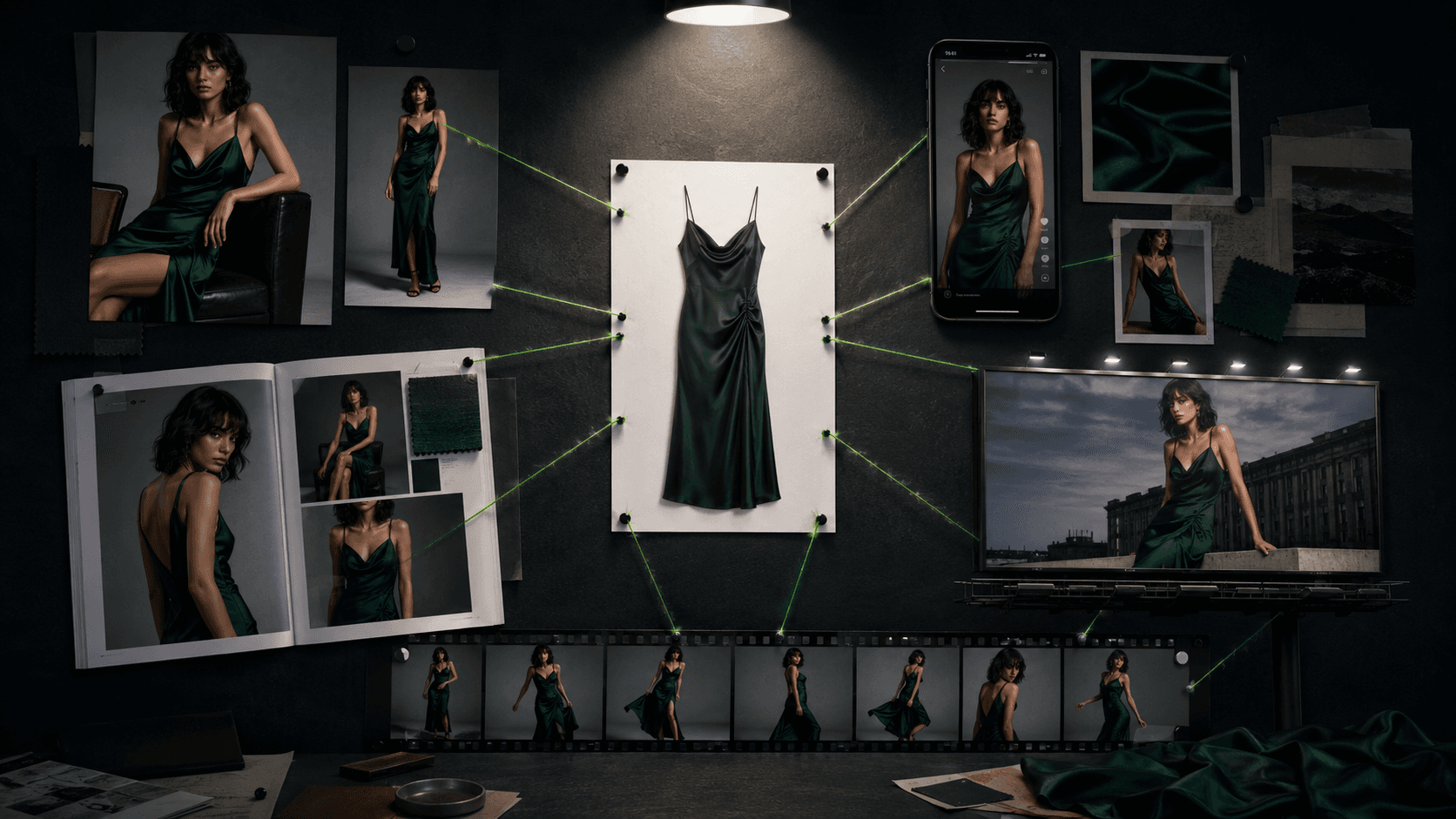

PixVerse is an AI video generator by Aiquino-Pixverse Inc. that converts text and images into short clips with one-click viral effects, lip sync, and character consistency. Used by over 100 million creators, it runs on web, iOS, Android, and API.
PixVerse is an AI video generation platform built by Aiquino-Pixverse Inc., a company that has served over 100 million creators across 175 countries since 2023. It converts text prompts and uploaded images into short video clips, with a particular strength in consumer-facing viral effects (AI Hug, AI Kiss, AI Muscle) and character-consistent multi-shot sequences. The platform ranked 25th on a16z's Top 50 Gen AI Consumer Apps list in August 2025, achieved unicorn status in March 2026, and has accumulated over 800 million user-generated videos. If you know tools like Runway or Pika, PixVerse occupies a different lane: faster, more effects-driven, and built from the ground up for mobile-first social creators.
The current model lineup runs from V5 through V6, with V6 (launched March 30, 2026) generating 15-second 1080p clips with native audio, over 20 cinematic lens controls (focal length, aperture, depth of field, chromatic aberration), and a multi-shot engine that sequences scene transitions in one pass. Earlier versions V5.5 and V5.6 added native 4K output, multi-character support for up to three distinct identities, and automatic audio-visual synchronization. The mobile app for iOS and Android has been downloaded over 50 million times and is the primary access point for a significant share of the user base. A separate API platform (platform.pixverse.ai) serves enterprise and developer workflows with per-second billing by model and resolution.
What PixVerse outputs in April 2026
PixVerse V6 is the current flagship, and the output specs changed substantially from V5. A single generation can now produce a 15-second clip at 1080p with integrated audio synthesis, eliminating the previous need to manually sync sound in post. The multi-shot engine builds structured scene transitions within one prompt, meaning a content creator can write a three-shot sequence (establishing shot, close-up dialogue, action cut) and receive a coherent clip rather than three disconnected files to stitch together manually.
Camera controls are the clearest upgrade over V5.6: V6 exposes over 20 cinematography parameters including lens distortion, vignetting, chromatic aberration, and real depth-of-field simulation, not just basic pan and tilt. Testing confirmed the system maintains complex character traits (custom ears, hair color, styled clothing) across all three shots of a 15-second sequence, and handles fisheye POV and rapid lighting transitions without visual smearing. Physics behavior improved significantly: in documented tests, water splashes now move away from a character's legs, not through them.
The January 2026 R1 model (available at realtime.pixverse.ai) operates differently from the main generation models. R1 is a real-time world model that responds to user input as continuous interactive video rather than fixed-length clip generation. It uses autoregressive modeling with a memory-augmented attention mechanism, enabling infinite streaming rather than 15-second segments. R1 was initially invite-only on launch and is free to existing PixVerse users for a limited period.
Earlier models remain accessible: V5.6 for native 4K, V5.5 for structured multi-shot audio storytelling, V4.5 for lower credit cost on simpler workflows. Credit consumption varies sharply by model and resolution, which matters for planning: V5.5 at 540p costs 45 credits per 5 seconds; V5.5 at 1080p costs 120 credits; V5 at 1080p costs 240 credits per 5-second clip.
Where PixVerse sits versus Hailuo and Kling AI
Hailuo AI (MiniMax) is the closest mechanical competitor on the physics side of video generation. Hailuo's model is trained on physics simulation datasets, producing more convincing fluid dynamics, fabric behavior, and gravity-driven motion in close-up scenes. Its default camera posture favors static or minimally moving shots, creating an observational quality well-suited to cinematic narrative. Character identity is stable across Hailuo frames with minimal morphing or limb warping. For a creator making a nature documentary aesthetic or a product-in-motion shot, Hailuo's physics-first output will frequently outperform PixVerse. However, Hailuo clips top out at 6-10 seconds per generation, versus PixVerse V6's 15 seconds, and Hailuo lacks the effects template library that drives PixVerse's social media use case. API pricing favors Hailuo: approximately $2.80/min versus PixVerse V6 at approximately $4.80/min.
Kling AI takes a different approach centered on temporal consistency for action sequences. Kling 3.0 handles limb collisions and joint rotations with minimal artifacts even during fast body rotations, and it consistently maintains limb count and body proportions through quick camera cuts. This makes it the better choice for martial arts sequences, sports footage, or anything with rapid human motion. Kling supports up to 10 seconds per generation at 1080p/30fps, and its atmospheric lighting for night scenes and volumetric effects outperforms PixVerse. Where PixVerse wins: effects templates, multi-shot generation in one pass, mobile app accessibility, and per-minute cost. Kling Pro costs approximately $15/mo at roughly $10.08/min for 720p Standard quality, about twice PixVerse's per-minute cost for equivalent resolution. Facial identity persistence is also a Kling limitation under drastic lighting changes, while PixVerse V6 maintains identity across multi-shot sequences.
For broader context on the video generation landscape, Sora and Luma AI occupy different positioning: Sora prioritizes long-form coherence and cinematic realism at the cost of accessibility; Luma AI (Dream Machine) leans cinematic with strong lighting but a narrower effects catalog. Higgsfield is the niche alternative for social-specific character motion. PixVerse's advantage is the combination of social effects, mobile app, and competitive API pricing within a single platform.
"Great text-to-video generation results, especially landscapes and humans." - Alex Bollati, Product Hunt, 2025
"The interface is clean, controls are intuitive, and every step feels guided. If you're a content creator with zero editing experience, PixVerse won't leave you guessing." - reviewer, techpoint.africa, 2025
The real cost of generating video with PixVerse
The free tier gives 90 initial credits plus 60 daily renewal credits. At V5.5/540p (45 credits per 5-second clip), that daily 60-credit renewal buys one clip per day. At V5/1080p (240 credits per 5-second clip), the full 90-credit starter pack covers less than one clip. The free plan also caps output at 360p with watermarks, which makes it genuinely useful for exploring the interface but not for publishable output.
The Standard plan at $8/mo (annual) or $10/mo (monthly) includes 1,200 credits and unlocks 720p. At V5.5/1080p consumption of 120 credits per 5-second clip, that is 10 publishable 5-second clips per month. Active creators with iterative workflows will burn through this within days. The Pro plan at $24/mo bumps to 6,000 credits and 1080p, yielding around 50 5-second clips at top resolution per month, which covers a moderate content calendar. Premium at $48/mo provides 15,000 credits; Ultra at $149/mo provides 25,000 credits with priority processing.
Add-on credit packs are available from $10 (1,000 credits) to $5,000 (500,000 credits). There is no rollover: unused credits expire at billing cycle end. For API users, PixVerse platform plans start at $100/mo (Essential: 15,000 credits) scaling to $6,000/mo (Business: 1,069,500 credits), with pay-as-you-go credit packs available at the same rates as the consumer store.
The real hidden cost is generation failure. Multiple users report that failed or unusable generations still deduct credits. At V5/1080p rates, a session that requires 10 attempts to get one usable clip costs 2,400 credits, nearly double a Standard plan's monthly allotment, for a single video.
Where PixVerse consistently breaks
Prompt sensitivity is the core reliability problem. Simple prompts with clear subjects and minimal competing elements typically yield smooth output. Complex prompts involving multiple characters interacting, fine-grained clothing details, or specific environmental conditions produce variable results. The community shorthand: "PixVerse is hit or miss." Documented failure modes include characters randomly transforming mid-sequence (a reported instance: a scene with a girl resolving into a giraffe), frozen backgrounds behind moving subjects, merged body parts in multi-person scenes, and character faces drifting away from reference images across cuts.
The credit system compounds this. Failed generations deduct credits, meaning iterating toward a specific output on a Standard plan is economically impractical. Community feedback is consistent: users report "so much time and credits wasted," and some characterize repeated generation failures as a mechanism designed to accelerate credit consumption rather than a technical limitation.
Billing practices have generated significant Trustpilot complaints: double billing, difficulty canceling subscriptions, subscription continuation after account deletion, and paid users still receiving watermarked output. These complaints are numerous enough across review platforms to represent a pattern rather than edge cases.
On the mobile app, Android users in particular report repeated crashes and freezes mid-workflow, which is especially disruptive given the app's credit-consumption model: a crash mid-generation can leave users uncertain whether credits were charged.
E-commerce and catalog use cases are explicitly outside PixVerse's design intent. The model is not optimized for static product accuracy, consistent object geometry, or precise brand asset reproduction. Reviewers specifically recommend against using PixVerse for commercial catalog shots requiring stable product presentation.
Best use cases versus skip-this scenarios
PixVerse is strongest for short-form social video. The effects library (AI Hug, AI Kiss, AI Muscle, AI Jesus Hug, and hundreds of community-contributed templates) makes it the fastest path from a photo to a publishable TikTok or Instagram Reel. The mobile app's streamlined flow means someone with no video editing background can generate and post a clip in under two minutes. The January 2025 "Jesus Hug" template went globally viral with billions of combined social impressions, demonstrating how PixVerse's template model creates outsized distribution potential when effects catch a trend.
Marketing and ad teams using PixVerse for early-stage creative prototyping report meaningful cost savings: rough visual concepts for client review that previously required a production shoot can be roughed out in minutes. The 30-60 second generation time and competitive pricing per clip support rapid iteration at the concept phase, even if final production requires higher-end tools.
For developer and enterprise integration, the V6 API with CLI support for agentic workflows makes PixVerse a functional option for automated video pipelines. The per-second billing model with multiple model tiers allows teams to balance cost against quality based on the use case.
Skip PixVerse when you need precise character consistency across many sessions without reference-image support, when you are producing e-commerce catalog content requiring accurate product geometry, when you need clips longer than 15 seconds without editorial stitching, or when billing predictability is critical and a high failure-to-usable-output ratio would be economically damaging. For those workflows, Runway Gen-4 or Kling AI offer more controllable results at higher per-clip cost.
User Reviews
No reviews yet. Be the first to share your experience!
Sign in to write a review.
Related articles
Guides and articles related to PixVerse.

AI Video Generator Prompting: The Filmmaker's Real Workflow
Sell AI-Generated Short Films on TikTok Shop, Instagram & YouTube (2026)
AI Fashion Prompts That Stay Consistent: The Working Formula (2026)

How to Make Money Selling AI UGC Content for Brands (2026)

AI Instagram Reels Factory: 30 Reels/Day on Autopilot (2026)