
Quivr is an open-source Python library for adding retrieval-augmented generation to any application. Apache 2.0, self-hostable, supports OpenAI, Anthropic, Mistral, and Groq. Built by a YC W24 team, with 39,000+ GitHub stars since its 2023 launch.
Quivr is an open-source RAG (Retrieval-Augmented Generation) framework built by Stan Girard and the QuivrHQ team, a Y Combinator W24 company. It started in May 2023 as a personal "second brain" tool for chatting with documents, went viral on GitHub within days of launch, and has since evolved into an opinionated developer library for embedding generative AI document retrieval into existing applications. It is licensed under Apache 2.0, hosted at github.com/QuivrHQ/quivr, and installs via pip install quivr-core.
The framework supports any OpenAI-compatible LLM including GPT-4, Anthropic Claude, Mistral, Groq, and Gemma, plus any vectorstore: PGVector, Faiss, and ChromaDB all work out of the box. Quivr ships with opinionated defaults for chunking, retrieval, and generation so teams can focus on their product rather than the pipeline plumbing. A hosted cloud version at quivr.app provides a no-install web interface for building "brains" (named knowledge bases) from PDFs, URLs, and files. The self-hosted option is entirely free; the cloud version runs on a freemium credit model. The project reached 39,100 GitHub stars as of early 2026 and built a companion file-parsing library called Megaparse that hit 6,000+ stars on its own.
What Quivr actually does in May 2026
At its core, Quivr is a Python library you import into your own application to handle the full RAG pipeline: document ingestion, embedding, storage, retrieval, and generation. A minimal integration looks like a few dozen lines of Python. You pass in files, choose an LLM, point it at a vectorstore, and ask questions. Quivr handles chunking strategy, similarity search, and context assembly behind the scenes.
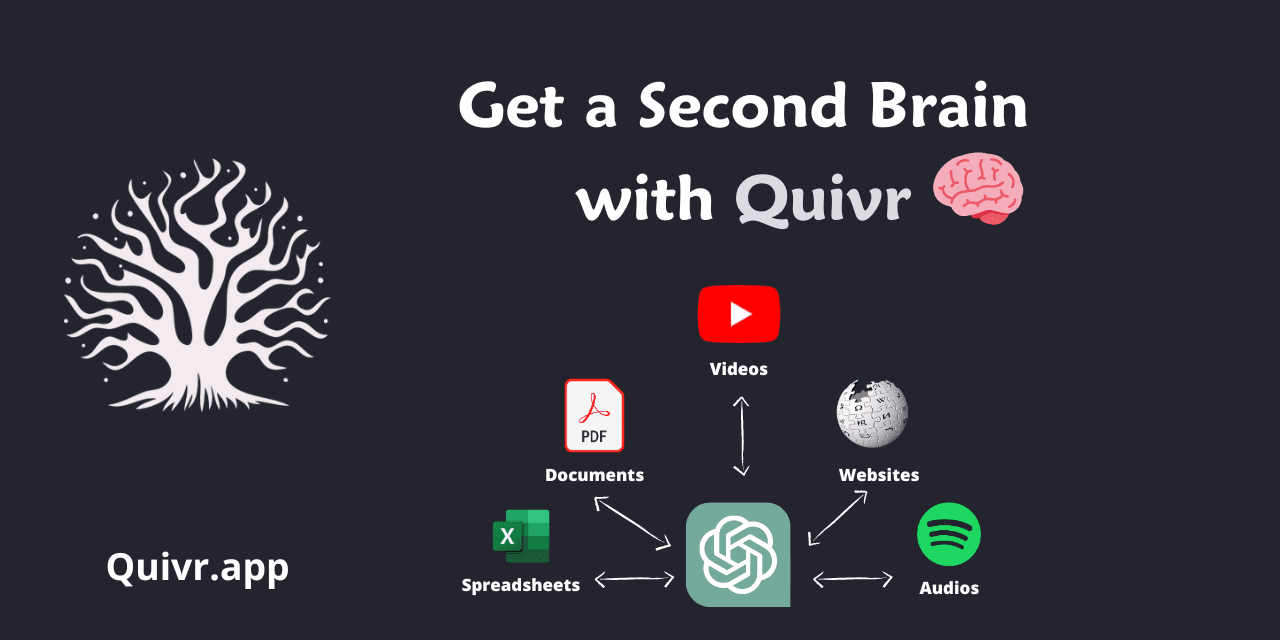
The library integrates with Megaparse for parsing complex file formats: PDFs, Word documents, Excel files, Markdown, plain text, code files, and URLs. LLM support covers OpenAI's full model lineup, Anthropic Claude 3.x, Mistral, Groq-hosted Llama variants, and any API that follows the OpenAI spec. Vectorstore backends include PGVector (Postgres), Faiss (local), and ChromaDB. The framework is intentionally opinionated: rather than exposing every possible RAG configuration knob, it ships with sensible defaults so the integration path is short.
The hosted consumer app, quivr.app, lets non-developers use the same technology through a browser. Users create named "brains," upload documents or paste URLs, and chat with the combined knowledge base. The free tier gives 25 message credits; GPT-3.5 costs 1 credit per message while GPT-4 costs 20, so the free tier can vanish inside a single GPT-4 conversation. The paid cloud tier extends credits and brain count. For developers, the library is free in perpetuity under Apache 2.0 regardless of cloud usage.
In late 2024, Stan Girard publicly separated the project into three open-source repositories: Quivr (the RAG algorithm library), Megaparse (file parsing into Markdown), and Le Juge (evaluation algorithms, in progress). Enterprise UI features remain in a private repository. This architecture lets the open-source community use and contribute to the core algorithms while the company builds commercial differentiation on top.
Where Quivr sits versus AnythingLLM and Open WebUI
Understanding where Quivr belongs requires knowing what problem it is solving compared to the two most visible alternatives in the self-hosted RAG space.
AnythingLLM (Mintplex Labs, 54,000+ GitHub stars) is a full-stack deployable application. You download it, launch it, and you have a complete RAG-powered chat interface with workspace isolation, RBAC, built-in vector storage via LanceDB, agent tools, and a desktop app for Mac, Windows, and Linux. It is not a library. You cannot import AnythingLLM into your own product; you deploy it as a standalone product. Its RAG pipeline handles chunking and retrieval internally with configurable overlap and external vectorstore options. For teams who want to USE a document Q&A system rather than BUILD one, AnythingLLM is the more complete out-of-the-box choice.
Open WebUI (56,000+ GitHub stars) is a chat interface layer that connects to any OpenAI-compatible backend or Ollama instance. It added document upload and basic RAG support, but the RAG implementation is less mature and relies on simple retrieval without the advanced pipeline management of dedicated frameworks. Open WebUI's strength is as a polished front-end; it was never designed to be a RAG framework you embed in your own apps.
Quivr occupies the developer library position that neither AnythingLLM nor Open WebUI fills. If you are building a SaaS product and need a "chat with your documents" feature for your users, Quivr is the one you pip install and integrate into your existing codebase. The tradeoff is that you are responsible for the hosting, the UI, and the application layer. Quivr handles the retrieval pipeline; everything else is yours to build.
A third relevant comparison is RAGFlow (InfiniFlow), which takes a deep-document-understanding approach with OCR models, Yolov8 layout detection, RAPTOR indexing, and self-RAG techniques built in. RAGFlow is significantly more capable for complex documents with mixed layouts, scanned content, or tables requiring cell-level parsing. Quivr is simpler, faster to integrate, and works well for standard text-heavy documents; RAGFlow is the heavier option for enterprise document complexity. Quivr's opinionated defaults are a feature for teams that want speed; they are a limitation for teams that need fine-grained control over chunking and reranking strategies.
"web apps are, for PKM, inherently too slow and not accessible via key binding" - Douglas Keiller, Product Hunt, 2023
What the developer integration reality looks like
Setting up Quivr as a developer is genuinely fast. The Python package installs in seconds, connects to an existing Postgres database with pgvector, and a basic RAG workflow is operational in under an hour for anyone comfortable with Python. The documentation covers the most common patterns: basic RAG, custom LLM configuration, custom vectorstore setup, and Megaparse file ingestion.
The framework's opinionated approach means defaults are sensible but not always optimal. Teams with complex chunking requirements, domain-specific reranking, or multi-hop reasoning workflows will hit the edges of what the defaults handle. The library does not expose RAGFlow-level document parsing sophistication out of the box. Heavy PDF files with complex tables, mixed languages, or scanned pages work better pre-processed through a dedicated OCR pipeline before ingestion.
The hosted quivr.app consumer experience is separate from the library experience. Non-developers using the web app encounter a clean dashboard, fast upload processing, and accurate retrieval for typical PDF and text content. The frustrations are credit-based: users chatty with GPT-4 hit the free tier ceiling fast, and there is no automatic credit replenishment signal before you run out mid-conversation.
The community around Quivr is active on Discord and GitHub. The GitHub repo shows 353+ releases as of early 2025, with active issue triage and contributor activity. Stan Girard's company also created Megaparse specifically because Quivr needed better file parsing, which shows the kind of vertical integration that makes the ecosystem self-reinforcing. For context on how Quivr fits into broader GenAI app development patterns, see also LangChain and Dify, which take different architectural approaches to the same problem of connecting LLMs to data.
"We realized that many people were having issues building a RAG, so instead of pushing our full enterprise product, we allow you to easily add a RAG to your product without deploying a full-blown enterprise application." - Stan Girard, LinkedIn, 2024
Who Quivr is built for
Quivr is a good fit for Python developers and engineering teams who need to add document retrieval to a product they are already building. If your product involves users uploading files, querying across a knowledge base, or asking questions about company documents, Quivr gives you a production-ready pipeline without writing the retrieval infrastructure from scratch.
Researchers and knowledge workers who are comfortable with self-hosting and want a fully private document Q&A system are also a strong match. The Apache 2.0 license means no vendor lock-in, no data leaving your infrastructure, and no subscription fees. A researcher with 500 PDFs who knows how to run Docker can have a private, searchable knowledge base in an afternoon.
Quivr is particularly suited to teams already using Postgres, since PGVector integration means no additional infrastructure beyond what they likely already run. It is also well-suited for use cases where the LLM choice needs to stay flexible, such as projects where cost management requires switching between GPT-3.5 and GPT-4 by query complexity, or where compliance requires on-premises models.
The hosted cloud version at quivr.app extends usability to non-developers who just want a personal AI knowledge assistant without infrastructure setup. It works well for individuals with moderate query volumes. Users doing heavy daily research against large document collections will outgrow the free tier quickly and need to weigh the paid credit cost against self-hosting complexity.
For teams evaluating the broader RAG-enabled app space, RAGFlow is worth reviewing for complex enterprise document workflows requiring advanced parsing.
What Quivr is not
Quivr is not a standalone application. If you want to download something, launch it, and have a finished product ready for your team to use, AnythingLLM or a similar all-in-one tool is the right choice. Quivr requires a host application around it.
Quivr is not a chat interface. It has no built-in UI. The hosted quivr.app provides one, but the open-source library itself has no front-end. Teams who need a UI layer still need to build or adopt one separately.
Quivr is not suited for non-technical users who need polished knowledge management software with features like daily notes, graph views, or wiki-style linking. Those users are better served by Notion AI, Obsidian with the right plugins, or similar PKM tools. The early Product Hunt reviews reflect this gap: users expecting an Obsidian-like local-first PKM experience found the web app too slow and feature-sparse.
Quivr is also not a replacement for a dedicated document intelligence platform. For organizations processing scanned insurance documents, mixed-language contracts, or complex financial tables, RAGFlow's deep-document-understanding approach with OCR and layout detection will outperform Quivr's simpler ingestion pipeline on those specific document types.
User Reviews
No reviews yet. Be the first to share your experience!
Sign in to write a review.
Featured in collections
Curated lists that include Quivr.
Related articles
Guides and articles related to Quivr.
Build an Internal Knowledge Bot (RAG) for Your Company: A No-Nonsense Guide
Turn Any AI Agent Into a Superagent: The 12-Integration Stack (2026)
Google Vision AI Explained (2026): Pricing Per 1,000 Units, Free Tier, and Alternatives

Nous Hermes 4: The Self-Hosted Open-Weight Agent Brain (2026)
RFP and Proposal Auto-Fill: The Agent That Handles 80% of the Repeating Questions (2026)