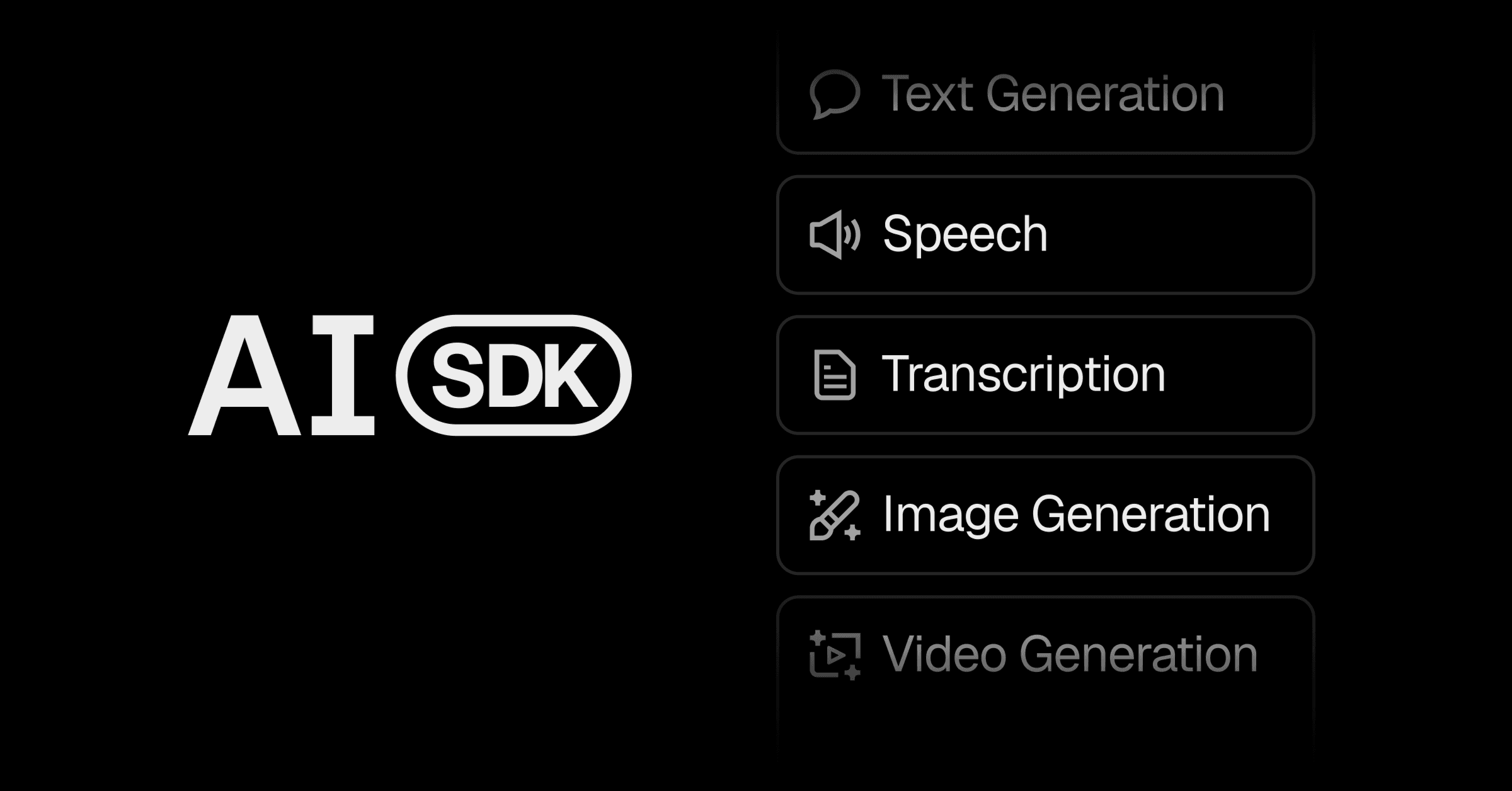
Vercel AI SDK is an open-source TypeScript toolkit for building AI-powered applications and agents. It provides a unified API across 20+ model providers, streaming UI hooks for React and Vue, structured output with Zod, and a full agent abstraction layer.
The Vercel AI SDK is an open-source TypeScript library built by Vercel, the company behind Next.js, for building AI-powered full-stack applications and autonomous agents. Released under Apache 2.0, it eliminates the need to learn each provider's proprietary API by exposing a single, consistent interface for text generation, structured object output, tool calling, image generation, speech, embeddings, and streaming UI across OpenAI, Anthropic, Google, Mistral, Amazon Bedrock, and 15+ other providers. The SDK reached version 6 in October 2025, having shipped v5 in July 2025, and as of April 2026 it reports over 20 million monthly downloads from more than 95,000 dependent projects.
The SDK ships in two parts: AI SDK Core and AI SDK UI. Core covers the server-side primitives, including generateText, generateObject (with Zod schema integration for type-safe structured output), streamText, streamObject, tool calling with multi-step loops, image generation and editing, reranking, and a formal Agent abstraction introduced in v6. AI SDK UI provides framework-agnostic hooks (useChat, useCompletion, useAssistant) with full feature parity across React, Next.js, Vue, Svelte, and Angular. An optional companion product, Vercel AI Gateway (launched August 2025), adds unified routing across hundreds of models with sub-20ms latency overhead, automatic failover, and zero price markup above provider rates. All of it is free and open-source; you pay only for the provider API tokens you use.
What the Vercel AI SDK actually does in April 2026
As of v6, the SDK's core loop is built around three patterns. The first is single-call generation: generateText or streamText takes a model reference, a prompt or messages array, and optional tools, then returns a typed response. Swapping from GPT-4o to Claude Sonnet 3.7 means changing one import; the rest of the call stays identical. The second pattern is structured extraction: generateObject accepts a Zod schema and returns a fully typed object, with the SDK handling schema-to-prompt conversion and response parsing automatically. The third is the Agent abstraction: you define an agent once with its model, system instructions, tools, and memory configuration, then instantiate it anywhere in the application. The stopWhen parameter controls when the tool-calling loop exits, replacing the ad-hoc maxSteps pattern from earlier versions.
The v5 release in July 2025 crossed the 2 million weekly downloads milestone and introduced speech generation and transcription, dynamic tools that the model can define at runtime, Vue and Svelte full parity with React, and the global provider feature that lets you address any model by a plain string ID through the AI Gateway. The v6 release in October 2025 formalized the Agent class, added tool approval for human-in-the-loop workflows, launched DevTools for in-browser debugging of LLM calls and agent traces, extended image generation to accept reference images for editing, and added native reranking via a rerank function. Full MCP (Model Context Protocol) support arrived in v6 as well, covering OAuth, resources, and prompts.
"The AI SDK is the only perfect abstraction I've seen so far. v5 continues that track record. Everything feels right." - Ben Hylak, raindrop.ai, Vercel AI SDK 5 launch post, July 31, 2025
The 20+ model providers include OpenAI (GPT-4o, GPT-5, o1/o3), Anthropic (Claude 3.5/3.7 Sonnet, Claude Opus), Google (Gemini 2.0/2.5 Flash, Gemini Pro), Meta Llama (via Groq or Bedrock), Mistral, Cohere, xAI Grok, and Amazon Bedrock. Provider capability varies: not every provider supports every feature (computer use, PDF input, embeddings, image editing), and the SDK documents per-provider capability tables to help developers navigate this. Switching providers mid-project is the SDK's strongest selling point; Thomson Reuters rebuilt their CoCounsel product using the AI SDK with just 3 developers in 2 months, consolidating 10 separate provider integrations into one system now serving 1,300 accounting firms.
Where the Vercel AI SDK sits versus LangChain JS and Mastra
LangChain JS is the most direct point of comparison for JavaScript developers. LangChain's bundle weighs in at 101.2 kB gzipped versus the AI SDK's 67.5 kB, and it relies on Node.js filesystem APIs that make it incompatible with edge runtimes. LangChain's strengths are in RAG infrastructure: it ships document loaders, vector store retrievers, and pre-built agent architectures (ReAct, Plan-and-Execute) that the AI SDK doesn't provide. The AI SDK's strengths are in UI integration, edge compatibility, streaming hooks, and raw simplicity: a task that requires multi-step message array instantiation in LangChain is a single generateText call in the AI SDK. In comparative benchmarks, LangChain averaged ~50ms p99 latency versus the AI SDK's ~30ms. For teams building Next.js chat UIs, the AI SDK wins on almost every dimension. For teams building complex Python-adjacent RAG pipelines or multi-vector retrieval, LangChain is the better starting point.
Mastra occupies a different lane. It is a TypeScript agent framework with durable workflows, built-in Observational Memory (scoring 94.87% on LongMemEval without requiring a vector database), a visual Studio debugger for replaying agent runs, and fluent orchestration syntax (.then/.parallel/.branch/.foreach). Mastra does not ship streaming UI hooks; it is a server-side agent infrastructure library, not a full-stack SDK. The AI SDK covers more surface area (from useChat in React down to provider calls) but offers less opinionated memory and workflow orchestration. Teams sometimes combine both: Mastra for the agent layer and persistence, the AI SDK for the streaming UI layer. Mastra has roughly 300K weekly downloads versus the AI SDK's 20M+ monthly, reflecting a more specialized audience. LiteLLM is a third reference point: it operates as a provider proxy layer rather than an application library, has no frontend integration, and is primarily Python-oriented. It often serves as a backend gateway that Vercel AI SDK applications call through.
"The move from streamText to composable agents is tasteful..The amount of care the team has put into API design is wild." - Josh, Upstash, Vercel AI SDK 6 blog, October 2025
What the daily development experience looks like
The standard starting point for most teams is a Next.js App Router project. You install ai and a provider package (@ai-sdk/openai, @ai-sdk/anthropic, etc.), create a route handler that calls streamText and returns a StreamingTextResponse, then use the useChat hook on the client. The hook manages message history, input state, streaming concatenation, error handling, and form submission. Teams consistently report going from empty repo to working streaming chatbot in under 30 minutes.
The structured output path is equally clean. generateObject accepts a Zod schema definition and returns a typed TypeScript object, with all prompt engineering for schema adherence handled by the SDK layer. This makes it the go-to approach for data extraction, classification, and any task where you need reliable output shape. In the v6 Agent abstraction, you define a reusable agent with a model, instructions, tools, and optional memory settings, then call agent.generate() or agent.stream() wherever needed in the application. The DevTools panel, new in v6, overlays in the browser during development and shows each LLM call, tool invocation, token usage, and latency in a timeline view, which meaningfully reduces the debugging cycle for multi-step flows.
For teams deploying outside Vercel, the SDK runs on any Node.js server, edge runtime, Cloudflare Workers, AWS Lambda, or Docker container. The Vercel AI Gateway is optional; you can use the SDK entirely with direct provider API keys. The v0 by Vercel product uses the AI SDK internally for its UI generation features, which is worth knowing if you want to understand how Vercel dog-foods the library. The OpenAI Agents SDK is a conceptually similar tool restricted to OpenAI providers, useful for comparison when evaluating whether provider lock-in matters for your stack.
Who the Vercel AI SDK is built for
The primary audience is TypeScript and JavaScript developers building web applications with AI features. The SDK is particularly well-suited for React and Next.js developers who want streaming chat UIs, as the useChat hook abstracts all the stateful plumbing that becomes tedious to write from scratch. It also fits teams that need to ship AI features quickly and expect to iterate on model choices: the provider-agnostic API makes it straightforward to A/B test GPT-4o against Claude Sonnet or drop in a cheaper model for non-critical paths without refactoring call sites. Startups and agencies building client projects repeatedly cite the SDK as their default starting point because the time-to-working-demo is consistently fast.
Enterprise teams doing TypeScript-first development get the most long-term leverage: end-to-end type safety across tool call inputs and outputs, structured object generation tied directly to Zod schemas, and the ability to centralize provider configuration and cost tracking through the AI Gateway. The Thomson Reuters case (3 developers, 2 months, production-grade legal AI across 1,300 firms) is the most-cited example of what a focused team can build when the provider abstraction layer isn't the bottleneck.
What the Vercel AI SDK is not
The SDK is TypeScript-only. Python teams will find no first-party equivalent and should look at LangChain Python, LlamaIndex, or Genkit's Python SDK instead.
The SDK is not a RAG framework. It has no built-in document loaders, chunking utilities, or vector store retrievers. Teams building knowledge-base retrieval pipelines will need to add those components separately (LlamaIndex.TS, Mastra's RAG primitives, or a vector database SDK). The LangChain JS ecosystem has heavier-weight RAG infrastructure if the retrieval pipeline is the core engineering challenge.
The SDK is also not a long-running agent runtime. When deployed on Vercel's own hosting, route handlers have a maximum execution time (15 seconds by default, 300 seconds on Pro) that constrains autonomous agents doing iterative research or multi-step planning. Teams running agents that require minutes of execution time need to deploy on infrastructure without those constraints, whether that means self-hosted Node, Cloudflare Workers with Durable Objects, or a dedicated agent execution platform. The RSC incident in October 2024 is worth knowing about: Vercel shipped Generative UI / React Server Components streaming as a major SDK 3.0 feature in March 2024, attracted adoption, then paused development 7 months later citing "long-standing limitations..with no good solutions in the near term." This pattern of ambitious platform-coupled features hitting architectural walls has made some teams cautious about building on experimental SDK features.
Bundle size is a legitimate concern for edge-optimized applications. At 186 kB for a single OpenAI request versus 87 kB for the official OpenAI library alone, the SDK carries overhead that matters in cold-start latency or constrained edge budgets. Developers who need absolute minimal footprint may prefer writing direct provider calls.
User Reviews
No reviews yet. Be the first to share your experience!
Sign in to write a review.
Featured in collections
Curated lists that include Vercel AI SDK.
Related articles
Guides and articles related to Vercel AI SDK.
Google vs OpenAI vs Anthropic Agents: The May 2026 Platform Showdown
Ship Your First MCP Server in 20 Minutes (2026)
Grok 4.3 API for Agents (May 2026): Pricing, Benchmarks, Migration
Turn Any AI Agent Into a Superagent: The 12-Integration Stack (2026)
Build a 70-Language Live Voice Agent With GPT-Realtime-Translate (2026)