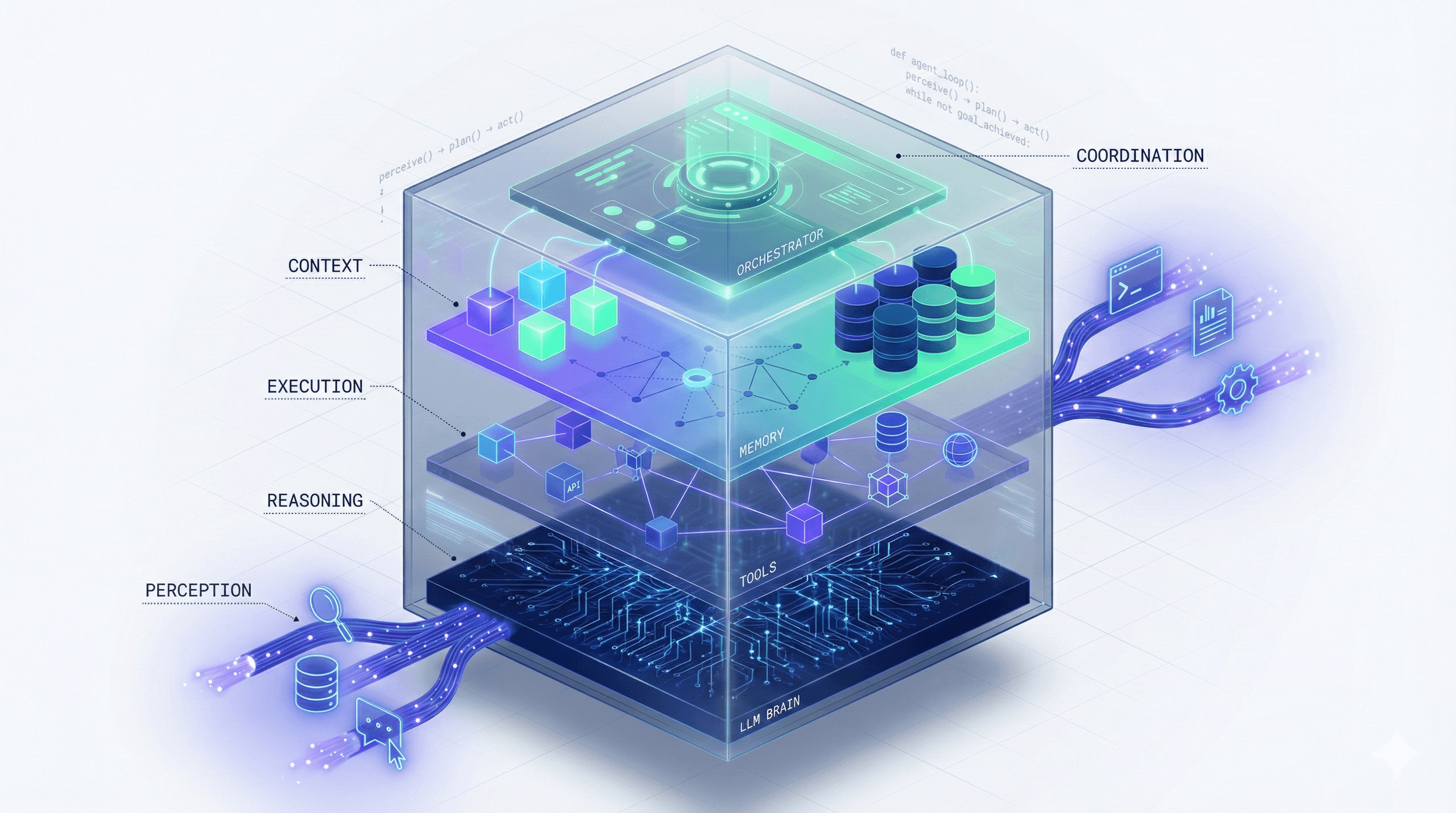

Mastra is an open-source TypeScript framework for building production AI agents, from the team behind Gatsby. It ships agents, durable workflows, RAG, built-in memory with SOTA LongMemEval scores, and a visual debugging studio.
Mastra is an open-source TypeScript framework for building production-ready AI agents and multi-step AI applications. It was created in October 2024 by the team behind Gatsby, led by Sam Bhagwat (CEO, Gatsby cofounder), Abhi Aiyer (CTO, former Netlify principal engineer), and Shane Thomas (CPO, former Gatsby staff engineer). The framework entered Y Combinator's Winter 2025 batch and raised a $13 million seed round in October 2025 with backing from Paul Graham, Guillermo Rauch (Vercel CEO), and Amjad Masad (Replit CEO). The core is Apache 2.0 licensed and free to self-host.
Mastra ships six primitive building blocks: Agents for open-ended reasoning with tool access, Workflows for deterministic multi-step orchestration using a fluent .then/.parallel/.branch/.foreach chaining syntax, RAG pipelines for document retrieval, Memory with built-in Observational Memory (94.87% on the LongMemEval benchmark without requiring a vector database), Evals for model-graded and rule-based quality assurance, and MCP (Model Context Protocol) server integration. The framework routes across 40+ model providers including OpenAI, Anthropic, and Gemini. A companion tool called Mastra Studio lets developers replay any agent run, inspect each tool call, and review token usage for debugging. By April 2026 the project had 23,500+ GitHub stars, 300,000+ weekly npm downloads, and production deployments at Replit, PayPal, Adobe, and Sanity.
What Mastra actually does in April 2026
At its core, Mastra is a backend TypeScript framework. You define agents by composing a model provider, a set of tools, and optionally a memory configuration. Workflows chain those agents and plain TypeScript functions together using a graph-style primitive that reads like ordinary module code rather than requiring graph theory knowledge. The suspend/resume system lets a workflow pause mid-execution, wait for human approval or an external event, and pick up exactly where it left off. Agents can run against any of the 40+ supported model providers and switch providers without rewriting agent logic.
Mastra Studio is a local development UI that ships alongside the framework. Every agent run is stored with a full trace: which tool calls fired, what each returned, token counts per step, and the exact prompt sent. Studio lets you replay any historical run to diagnose failures without relying on console.log output. One developer writing in March 2026 described the experience: "The first time he replayed an agent run and actually understood why it failed, he realized how rare that experience is."
The Observational Memory system, launched in February 2026, uses background agents to compress old conversation history into structured observations rather than naive conversation truncation. This approach hit 94.87% on the LongMemEval benchmark without a vector database, which the team reports as state-of-the-art at time of publication. RAG pipelines integrate natively with the same retrieval infrastructure, so teams building knowledge-base agents can use a single coherent memory stack rather than gluing together separate tools.
The @mastra/[email protected] release on April 28, 2026 is the latest stable version. The framework supports deployment on Vercel, Cloudflare Workers, Netlify, and any standard Node.js server. Server Adapters, introduced in the Mastra 1.0 release in January 2026, automatically expose agents, workflows, tools, and MCP servers as HTTP endpoints for Express, Hono, Fastify, or Koa applications. This means a Mastra agent is also an API endpoint with zero extra configuration.
Where Mastra sits versus Vercel AI SDK and LangChain
The most common comparison is with Vercel AI SDK, and it deserves a precise answer because these tools are often used together rather than against each other. Vercel AI SDK is a streaming-optimized toolkit for building React and Next.js UI components that consume AI models. It handles model streaming, basic tool calling, and React hooks for chat interfaces. Mastra actually uses AI SDK v6 internally for model routing. The typical production pattern, documented across multiple community posts, is AI SDK for frontend streaming components and Mastra for backend agent logic. The key mechanical limits of using AI SDK alone for agents: a 5-minute maximum execution timeout and a 4.5MB request body limit on Vercel hosting, neither of which constrains self-hosted Mastra deployments.
LangChain is the broader competitor. LangChain ships hundreds of integrations versus Mastra's 50-60 as of early 2026. But LangChain.js has consistently lagged the Python original: the JS port typically runs several versions behind, most community examples are Python-first, and Stack Overflow answers skew Python. A December 2025 benchmark from NextBuild measured developer experience at 9/10 for Mastra versus 5/10 for LangChain, task completion rate at 94.2% vs 87.4%, and P95 latency at approximately 1,240ms vs 2,450ms (the LangChain number includes Python subprocess overhead in the benchmark setup). Setup time for a comparable production agent was 18 hours in Mastra versus 41 hours in LangChain. One developer writing on dev.to in January 2026 noted that TypeScript compilation caught "malformed tool outputs that would silently pass in Python but threw compile-time errors in TypeScript," a type-safety advantage that disappears in a Python-first workflow.
For teams already comparing Mastra to other TypeScript agent frameworks, CrewAI is Python-based and excels at role-based multi-agent collaboration but requires running a Python process. LlamaIndex has a deeper RAG-specific feature set but less complete agent and workflow orchestration than Mastra. LangChain and LangGraph remain dominant in the Python ML ecosystem but have documented parity gaps in their JavaScript ports.
"If you write TypeScript and need AI agents without Python overhead, Mastra is the strongest option." -- reviewer, OpenAIToolsHub.org, 2025
"Most 'playground' tools in AI frameworks are demo toys. Studio actually helped me debug." -- reviewer, OpenAIToolsHub.org, 2025
What the agent loop reality looks like
A basic Mastra agent takes roughly 15-20 lines to define: import the framework, configure a model provider, attach tools as typed TypeScript functions, and instantiate the agent. That agent is then available as a local object or, via Server Adapters, as an HTTP endpoint. Adding memory is a one-line configuration change that connects the Observational Memory backend. Workflows compose agents and plain TypeScript functions using the fluent chaining API.
Where the complexity appears is in branching logic that falls outside Mastra's intended patterns. Multiple HN users at the 1.0 launch in January 2026 noted that complex conditional branching in workflows felt "clunky" compared to imperative code, and that some edge cases required dropping down to custom Hono routes to get the right behavior. This is a real limitation of any opinionated framework: the 80% case is dramatically easier, but the 20% case requires working around design assumptions.
Teams familiar with LiteLLM or OpenRouter for model routing will find Mastra's provider abstraction familiar but more tightly integrated: provider switching is a configuration line rather than an API call, and the eval and observability tools know which provider was used for each trace.
Who Mastra is built for
Mastra is the right choice for TypeScript and Node.js teams that want production AI agents without adding Python to their stack. This includes full-stack JavaScript teams at startups and mid-size companies, Next.js developers building agent-powered features, teams deploying to Vercel or Cloudflare who want a single TypeScript codebase from frontend to backend, and backend engineers who want typed tool interfaces and compile-time safety in their AI code. Production companies confirmed using Mastra as of early 2026 include Replit, PayPal, Adobe, Sanity, and Marsh McLennan.
The framework rewards teams that have hit the limits of quick-start AI SDKs. If you have used AI SDK or a bare OpenAI client and found that debugging agents is painful, adding memory is non-trivial, or running evals requires building custom tooling, Mastra addresses all three of those gaps in a single dependency. The three-part combination, specifically agents with typed tools, durable workflows with suspend/resume, and the Observational Memory system, represents the production-grade baseline that most AI frameworks deliver only in pieces. Mastra ships all three as first-class primitives under one Apache 2.0 license.
The community growth mirrors this positioning. At YC Demo Day in March 2025 Mastra was one of the few developer tool companies presenting a framework that developers were actually using in production rather than demoing a playground. By the October 2025 seed round announcement, the team could point to 300+ contributors, 4,800 Discord members, and a confirmed install base at companies ranging from Replit to PayPal. Matt Pocock, a well-known TypeScript educator, described the framework as selling "tools you can debug, extend, and trust," which captures what distinguishes Mastra from the crop of agent libraries that prioritize demos over debuggability.
Teams evaluating Mastra for their first agent project should expect to spend meaningful time reading the Discord and source code once they move past the documented examples. The docs cover basic patterns well but have gaps in advanced workflow branching and memory customization that require community support to fill. This is typical for a framework at 15 months old with aggressive shipping cadence, and the team has committed to improving documentation as a priority in 2026.
What Mastra is not
Mastra is not a Python framework and has no Python bindings. If your team is Python-first or your infrastructure depends on the scientific Python ecosystem for ML pipelines, the framework is not a fit. LangChain or LangGraph will serve that context better despite their DX tradeoffs.
Mastra is not a complete no-code tool. You are writing TypeScript. There is no visual drag-and-drop workflow builder for non-developers. Teams that need a no-code agent builder should look elsewhere.
Mastra is not a replacement for a full observability platform like Datadog or Honeycomb. Mastra Studio covers agent-specific tracing well, but infrastructure-level observability still requires external tooling.
The integration count limitation is real. If your agent needs to connect to one of the dozens of services LangChain integrates but Mastra does not yet support, you will need to write a custom tool adapter. For greenfield TypeScript projects this is often fine; for porting an existing LangChain agent, the integration gap requires assessing each dependency manually.
Finally, Mastra is not suited to long-running agents on Vercel hosting specifically (not Mastra's fault, but worth flagging): Vercel's 5-minute timeout and serverless execution model constrains any agent that needs to run longer or hold state. The self-hosted path on a standard Node.js server removes these constraints.
User Reviews
No reviews yet. Be the first to share your experience!
Sign in to write a review.
Featured in collections
Curated lists that include Mastra.
Related articles
Guides and articles related to Mastra.
Turn Any AI Agent Into a Superagent: The 12-Integration Stack (2026)
Orchestrator-Workers: The Multi-Agent Pattern That Actually Scales (2026)
Run a Company With AI Agents: The Open-Source Orchestration Setup (2026)
Ship Your First MCP Server in 20 Minutes (2026)

Replace 6 SaaS Subscriptions With 4 n8n AI Agents (2026)