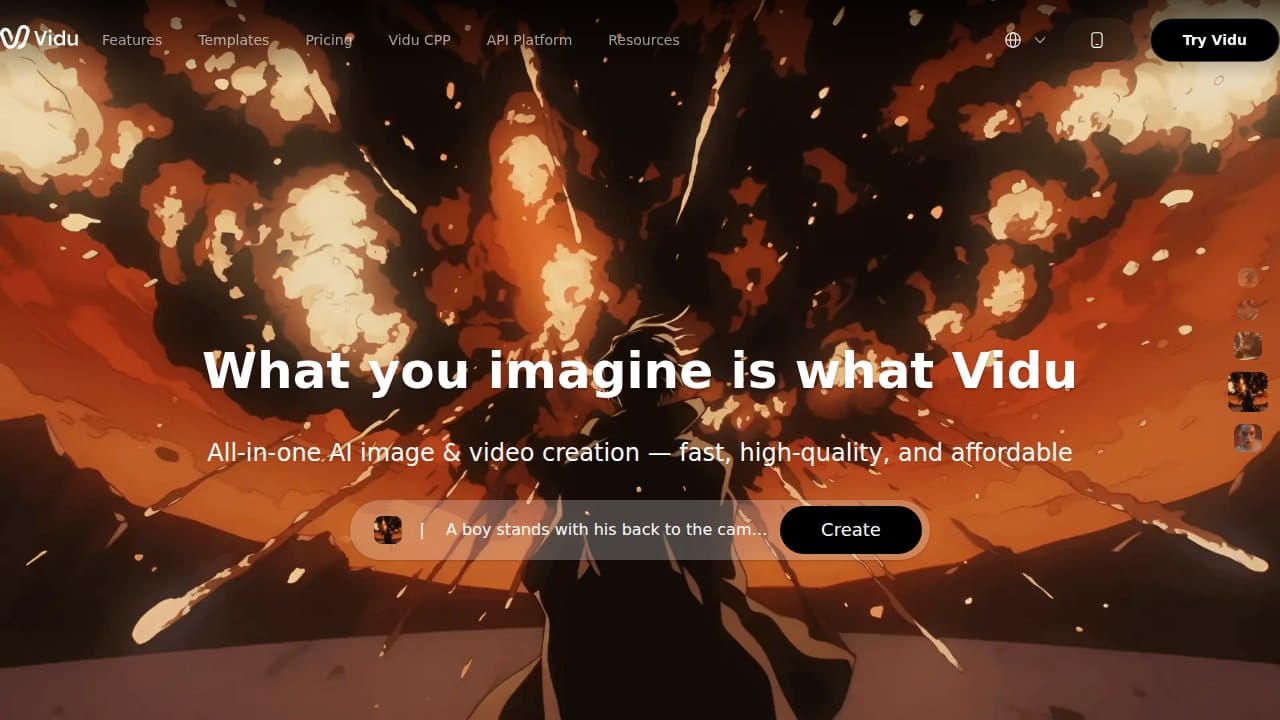

Vidu is Shengshu Technology's AI video platform that generates 16-second, 1080p clips with native audio in a single pass. Built on U-ViT architecture, it supports text-to-video, image-to-video, and multi-reference workflows for animation and ad production.
Vidu is an AI video generation platform developed by Shengshu Technology, a Beijing-based company co-founded by researchers affiliated with Tsinghua University. First released publicly in July 2024, Vidu has shipped a rapid sequence of model versions culminating in Vidu Q3 -- the current flagship as of April 2026. It runs in over 200 countries, has generated more than 500 million clips to date, and closed a Series B round of approximately RMB 2 billion (roughly $275 million USD) led by Alibaba Cloud in April 2026. Unlike most Chinese AI video tools that gained traction primarily inside China before attempting global expansion, Vidu has consistently targeted international creators and developers from its earliest releases.
Vidu Q3 generates up to 16 seconds of continuous video at 1080p and 24fps with native audio production in a single inference pass: dialogue, ambient sound, sound effects, and background music are generated alongside the video frames, not layered on afterward. The platform supports text-to-video, image-to-video, and reference-to-video workflows -- the last of which accepts up to 7 reference images to lock characters, props, costumes, and environments across clips. Six cinematic effect types (particle systems, fluid simulation, dynamic motion, camera control, transitions, and lighting) and directorial camera commands (push-ins, pans, tracking shots) can be specified in prompts. A free plan with 80 monthly credits and unlimited Off-Peak Mode generation is available, with paid tiers starting at $10/month for 800 credits.
What Vidu outputs in April 2026
The Vidu Q3 model produces clips up to 16 seconds long at 1080p resolution and 24fps, which is the longest continuous generation window among leading competitors as of this writing. Unlike prior generations that required audio to be added separately, Q3 natively generates synchronized audio alongside video in one model pass. That audio includes: ambient environmental sound, motion-driven sound effects (footsteps, impacts, mechanical movement), atmospheric layers, foley-style effects, and emotion-driven music cues. Multilingual dialogue generation with lip synchronization is supported, though precise micro-level lip accuracy is still improving.
Vidu's reference-to-video workflow accepts subjects, environments, costumes, props, and visual styles as reference inputs -- up to 7 entities simultaneously. The Q3 Reference-to-Video launch on April 13, 2026 expanded this with "Smart Cuts," a multi-shot composition feature that strings scene transitions directly into a single generation rather than requiring manual stitching. Vidu also operates at a lower price per second than Kling: approximately $0.07/second versus Kling's $0.126/second, a difference that matters significantly for high-volume production workflows.
In independent benchmark testing, Vidu Q3 ranked No.1 on SuperCLUE's Reference-to-Video leaderboard and No.2 globally on the Artificial Analysis Video Arena benchmark at launch, placing ahead of Runway Gen-4.5 and behind only Sora 2 in overall quality assessments.
"AI video generation has reached a stage where individual clips can look impressive, but producing consistent narrative content at scale remains difficult." -- Yihang Luo, CEO of ShengShu Technology, SXSW 2026, March 16, 2026
Where Vidu sits versus Kling and Hailuo
The three dominant Chinese video generation platforms each take structurally different approaches, and those differences matter for workflow selection.
Kling AI (Kuaishou): Kling 3.0 uses a Diffusion Transformer (DiT) architecture with a unified generation-editing-audio pipeline. Its character consistency mechanism is reference-video extraction: it processes 3-8 seconds of source video, extracts character feature embeddings, and carries them into independent generation calls. This gives Kling strong within-clip character fidelity -- better than Vidu's in complex scenes with multiple moving subjects. Kling maxes out at 10 seconds per clip (vs. Vidu's 16) and costs roughly 45% more per second ($0.126/sec vs. $0.07/sec). For cinematic composition and premium commercial video, Kling is the stronger all-around performer; for duration, cost efficiency, and multi-shot workflows, Vidu wins.
Hailuo (MiniMax): Hailuo 2.3 runs on a Noise-aware Compute Redistribution (NCR) framework that redistributes computational resources according to diffusion noise levels, delivering approximately 2.5x training and inference efficiency improvements. This architecture optimizes throughput over output length: Hailuo 2.3 caps at 6 seconds at native 1080p (10 seconds at 720p) versus Vidu's 16 seconds. Pricing is comparable to Vidu (~$0.08/sec). Audio quality in Hailuo 2.3 is rated below Vidu Q3 in third-party comparisons, and character consistency in complex prompts is weaker than either Kling or Vidu. Hailuo is the budget-efficiency choice for social media clips that don't require long duration or multi-reference stability.
The architectural differentiator for Vidu is its U-ViT (Universal Vision Transformer) backbone, which bridges U-Net and Vision Transformer designs. This hybrid allows the model to handle longer temporal windows than most competing architectures without degrading spatial coherence, which is why Vidu achieves 16-second generation at competitive quality. The tradeoff is that complex multi-subject scenes with active motion still show character drift at the tail end of longer clips.
"Character consistency is way better than before, and the overall video quality really surprised me." -- hazel.visuals, App Store review, June 2025
The real cost of generating video with Vidu
Vidu's credit system is tiered by duration and quality setting. A 4-second clip at Standard quality consumes approximately 4-5 credits; an 8-second clip at Standard costs around 10 credits; a 16-second clip at Cinema quality can consume 30-40 credits. The Free plan's 80 monthly credits translate to roughly 8-20 short clips depending on settings, which is enough for experimentation but not sustained production work. Free plan videos carry a watermark and cannot be used commercially.
At the Standard plan ($10/month, 800 credits), a reasonable production assumption is 40-80 finished clips per month, depending on quality tier. The Premium plan ($35/month, 4,000 credits) unlocks the Cinema quality tier and the 32-second generation window, and is where most serious commercial users operate. The Ultimate plan ($99/month, 8,000 credits) is designed for agencies or developers running high daily volumes.
The platform does provide unlimited generation via Off-Peak Mode, which waives credit costs during lower-demand periods. This is genuinely useful for rough-draft generation before committing credits to final outputs. However, the credit-waste issue is real: failed or off-prompt generations consume credits with no retry protection or credit refund. Several users have reported burning 700 credits to get 24 satisfactory videos when closer to 200 were expected.
Where Vidu consistently breaks
Prompt adherence is the most documented weakness. Users across App Store reviews, third-party walkthroughs, and review aggregators consistently report that complex or detailed prompts produce results that only partially match the intent. One App Store reviewer estimated a 60% satisfaction rate, meaning roughly 2 in 5 generations require a retry. Reference images get distorted in specific ways: logos lose their shape, hairstyle details shift, and scene layouts don't always reproduce faithfully. Objects occasionally violate physical consistency (walking through furniture, detached limbs in action sequences).
Audio at the micro level is the second consistent failure point. While Vidu Q3's macro audio (ambient soundscapes, background music, general voice tone) is strong, precise lip-sync accuracy and exact foley timing need improvement. The WaveSpeed Q3 review specifically calls out "dialogue lip-sync precision" as an ongoing limitation despite the overall audio-visual pipeline being genuinely impressive.
Character consistency breaks down in busy multi-subject scenes. The multi-reference feature works well for 1-3 characters in controlled compositions; in crowd scenes or action sequences with many moving subjects, character drift appears toward the end of longer clips. The 16-second ceiling also forces editorial stitching for any content longer than a short scene, which is manageable but not frictionless.
Customer support is the platform's clearest operational weakness. Across Trustpilot, App Store, and review forums, slow or absent support is the highest-volume complaint. Some users report waiting days with no response; a small number report subscription cancellation difficulties. This matters most for commercial users who need resolution on generation failures or billing questions.
Best use cases versus skip-this scenarios
Use Vidu for: Social media content where 16 seconds is sufficient and native audio saves post-production steps. Ad production workflows where character and product consistency across multiple clips is required. Animation or indie film pre-visualization where the SXSW-announced animated series workflow (structured subject library, spatial structure control, episode continuity) matches your production model. API-based integrations where cost per second matters and Vidu's $0.07/sec rate is competitive.
The SXSW 2026 announcement made Vidu the first Chinese AI video platform to demonstrate purpose-built animated series tooling at a Western creative conference -- a signal that the company is investing specifically in long-form narrative use cases, not just clip-level generation.
Skip Vidu when: Your projects require clips longer than 16 seconds without stitching. You depend on complex, detailed prompts being followed precisely -- the 60% hit rate on intricate prompts makes it an expensive tool for precision work. Your team relies on responsive customer support for commercial production deadlines. You need exact lip-sync for dialogue-heavy content where misalignment is visible. You are on the Free plan but need commercial licensing -- the watermark and commercial restriction make Free unusable for client deliverables.
User Reviews
No reviews yet. Be the first to share your experience!
Sign in to write a review.
Related articles
Guides and articles related to Vidu.
AI Video Generator Prompting: The Filmmaker's Real Workflow
Sell AI-Generated Short Films on TikTok Shop, Instagram & YouTube (2026)
Grok 4.3 API for Agents (May 2026): Pricing, Benchmarks, Migration

Google Vision AI Explained (2026): Pricing Per 1,000 Units, Free Tier, and Alternatives
AI Fashion Prompts That Stay Consistent: The Working Formula (2026)