GEO After the Rankings Divorce (2026): Why Only 37.9% of AI Overview Cites Are Top-10 Pages
# GEO After the Rankings Divorce (2026): Why Only 37.9% of AI Overview Cites Are Top-10 Pages
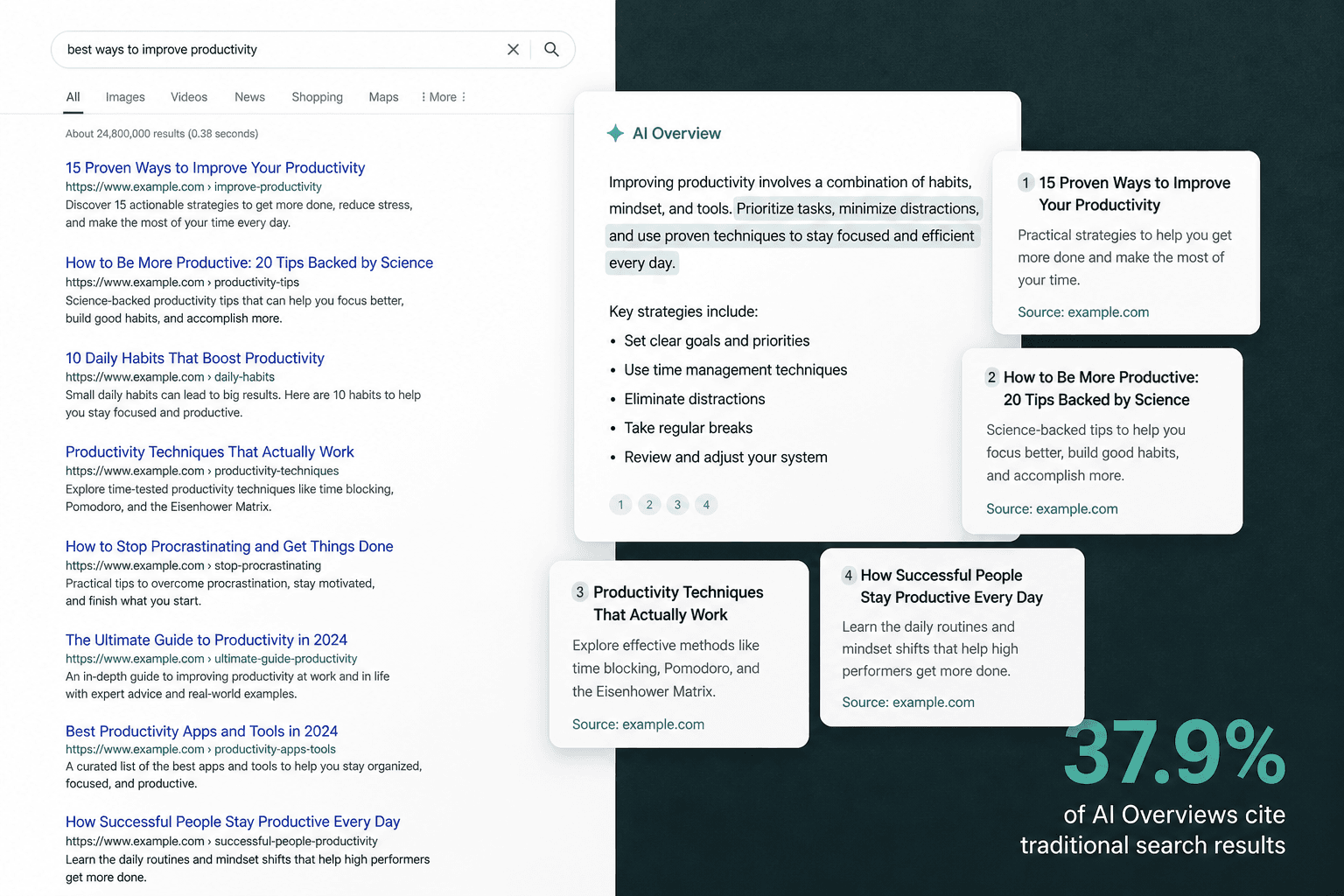
For a decade, “rank #1-10” was a reasonable proxy for “we will be the answer.” Google AI Overviews broke that proxy. Ahrefs’ March 2, 2026 Brand Radar study - 863K keyword SERPs, 4M AIO citation URLs - finds only 37.9% of AI Overview citations also appear in the top 10 organic results (blocks view). Positions 11-100 account for 31.2%; beyond the top 100 another 31.0%. A prior Ahrefs cut (July 2025) sat near ~76% top-10 overlap - not fully comparable, because Ahrefs improved its parser and Gemini 3 began powering AIOs as of January 2026. The rankings divorce is real enough to change how you write. It is not a clean year-over-year algorithm chart.
This deep dive stays inside primary evidence: Ahrefs’ AIO citation study, the Princeton GEO paper (KDD 2024) with up to ~40% visibility lifts from citation-grade edits, YouTube’s 5.6% share of all AIO URLs, and the BrightEdge ~17% conflict that proves methodology is the product. At the end: a citation packet template Vantaige writers can ship on every authority piece - plus a worked packet filled with this article’s own hero numbers. As of 2 September 2026.
Some product links may earn a commission. Directory listings are a separate bias - label them when you use them.
Table of contents
1. TL;DR
13. FAQ
14. References
TL;DR {#tldr}
Ahrefs (Mar 2, 2026): 37.9% of Google AI Overview citations are also in the top 10 (blocks view); 31.2% from positions 11-100; 31.0% beyond top 100; sample 863K SERPs / 4M citation URLs. Organic-only view: top 10 37.1%; beyond top 100 36.7%.
Prior Ahrefs (Jul 2025): ~76% top-10 overlap - parser + Gemini 3 confounds; Ahrefs itself cautions full comparability. Do not ship a causal “loyalty halved” chart from those two percentages alone.
BrightEdge (Feb 2026 panel): ~17% top-10 overlap - different methodology; do not average with Ahrefs.
YouTube: 5.6% of all AIO URLs; 18.2% of non-top-100 citations; Brand Radar citation growth +34% over prior 6 months; most-cited domain in that framing.
GEO (Aggarwal et al., KDD 2024): controlled edits (cite sources, quotations, statistics) boosted visibility up to ~40% on GEO-bench (10,000 queries); keyword stuffing underperformed baseline.
Operator response: ship citation packets (stat block + method box + quotable summary + structure + multimodal) and cover query fan-out - not only head-term SEO.
What “rankings divorce” means {#what-it-means}
Classic SEO assumed a tight coupling: pages that win blue links also win the featured answer. AI Overviews cite URLs as evidence chips inside a generated synthesis. That synthesis can pull from mid-SERP pages, long-tail URLs, and multimodal destinations even when a different set of pages occupies the top 10 organic slots.
Divorce, precisely stated: being in the top 10 is neither necessary nor sufficient for AIO citation at the rates Ahrefs measured in March 2026. 37.9% overlap means a majority of AIO citations (62.1%) are not top-10 pages in the blocks view. Organic-only framing in the same study still shows a minority dependence on classic top-10 slots (37.1%).
This does not mean “SEO is dead.” It means ranking alone is a weak citation strategy. Authority brands that never crack a competitive head term can still earn AI citations if they publish extractable facts, methods, and structured answers. That is the GEO bet - generative engine optimization as content engineering, not keyword theater.
For a directory-and-media site like Vantaige, the divorce is operationally good news *if* you write like a primary source. Calculators, dated comparison tables, and method boxes are citation bait. Thin “Top 10 AI tools” rewrites of other listicles are not - regardless of whether they somehow rank.
Ahrefs Mar 2026: the 37.9% number {#ahrefs-379}
Source: Ahrefs blog - AI Overview citations vs top 10
URL: https://ahrefs.com/blog/ai-overview-citations-top-10/
Date: March 2, 2026
Sample: 863K keyword SERPs; 4M AIO citation URLs (Brand Radar)
| Finding | Figure |
|---|---|
| AIO citations also in top 10 (blocks view) | 37.9% |
| Positions 11-100 | 31.2% |
| Beyond top 100 | 31.0% |
| Organic-only top 10 | 37.1% |
| Organic-only beyond top 100 | 36.7% |
How to quote this without lying:
Say: “In Ahrefs’ March 2026 Brand Radar analysis of 4M AIO citation URLs across 863K SERPs, 37.9% of citations also appeared in the top 10 (blocks view).”
Do not say: “Only 37.9% of top-10 pages get cited” - that inverts the conditional.
Do not say: “Google stopped citing top results” - 37.9% is still a large share; it is just no longer dominant enough to be your only plan.
Prefer “blocks view” or “organic-only” explicitly when you reuse a cell from the table.
Fan-out matters. Ahrefs’ guidance, echoed in the research dump’s GEO section, is to cover sub-intents, not only head keywords. AI systems pull supporting facts from pages that answer the side questions inside a generated overview - pricing caveats, methodology conflicts, “when not to use,” definitions. Those side answers are often where mid-ranked and long-tail URLs win chips.
The ~76% caveat (do not misuse YoY) {#76-caveat}
Ahrefs’ July 2025 study reported roughly ~76% top-10 overlap. Headline writers love “76% → 38%.” The research dump’s writer rule is stricter:
> No assertion that Ahrefs 76%→38% is purely algorithmic change (parser + Gemini 3 confounds acknowledged by Ahrefs).
Confounds called out:
1. Parser improved - better extraction can change measured overlap even if Google’s behavior is stable.
2. Gemini 3 powering AIOs as of January 2026 - model/stack change between the two study windows.
3. Study design deltas - always re-read the March 2026 methodology notes before you chart a cliff.
Allowed framing: “Ahrefs’ comparable *question* (top-10 overlap of AIO citations) produced ~76% in a July 2025 cut and 37.9% in a March 2026 cut; Ahrefs flags imperfect comparability due to parser and Gemini 3 changes.”
Disallowed framing: “Google cut top-10 citation loyalty in half last year” as a causal claim from those two percentages alone.
If you need a chart for social, annotate the gap between bars with a literal “not fully comparable” label. Unannotated cliffs travel faster than corrections.
BrightEdge ~17% and why studies disagree {#brightedge}
BrightEdge conflict: roughly ~17% top-10 overlap in a February 2026 panel - different methodology from Ahrefs. seoClarity and other vendors often answer adjacent but non-identical questions (per-citation vs per-overview, different SERP samples, different AIO detection).
A useful explainer of disagreement patterns: https://crawlmind.ai/blog/why-ai-citation-studies-disagree
Operator rule: pick one primary study for a claim, name its method, and treat others as conflict notes - never blend Ahrefs 37.9% and BrightEdge ~17% into a fake “average overlap.” If your board wants a range, report the range with labels: “Ahrefs Mar 2026 blocks-view 37.9%; BrightEdge Feb 2026 panel ~17%; methods differ.”
Disagreement is evidence that measurement product matters as much as Google’s ranking product. Budget for a measurement stack (below), not for a single influencer screenshot. The same discipline applies inside Vantaige articles: when Menlo, McKinsey, and MIT disagree on “does AI pay off,” we show the conflict table rather than picking the most shareable number.
YouTube at 5.6%: multimodal is not optional {#youtube}
From the same Ahrefs March 2026 study family (Brand Radar):
| Finding | Figure |
|---|---|
| YouTube share of all AIO URLs | 5.6% |
| YouTube among non-top-100 citations | 18.2% of those |
| YouTube citation growth | +34% over prior 6 months |
| Position in “most-cited domain” framing | Most-cited domain (Brand Radar framing in dump) |
Practical bar for publishers:
Ship a talking-head or screencast that restates the article’s three quotable stats.
Optimize title, description, and transcript with the same named sources and numbers - models and AIO pipelines consume that text.
Put the hero number on a lower-third in the first 20 seconds so a frame grab still carries the citation payload.
Do not treat YouTube as “brand awareness only.” At 5.6% of all AIO URLs it is a first-class citation surface; among long-tail (non-top-100) citations its 18.2% share is even more aggressive.
If your competitor ranks #3 organically with a thin page and you sit at #42 with a methods-heavy article plus a transcript-rich video, Ahrefs’ distribution says you still have a citation path. For Vantaige specifically: every deep dive that introduces a new appendix table should get a 3-6 minute “how to read this table” twin, not a 25-minute brand film.
GEO paper (KDD): what actually lifted visibility ~40% {#geo-paper}
Paper: Aggarwal et al., *GEO: Generative Engine Optimization*, arXiv:2311.09735; KDD 2024.
Bench: GEO-bench, 10,000 queries.
Headline result: methods such as citing sources, adding quotations, and adding statistics boosted visibility up to ~40% on position-adjusted metrics; relative lifts were higher for mid-ranked sites in some cuts. Keyword stuffing underperformed baseline.
That last sentence should be on a sticky note above every brief. The GEO toolkit is evidence density + attribution + structure, not density of exact-match keywords.
Evidence-backed content patterns (GEO + Ahrefs guidance)
| Pattern | Evidence | Practical bar |
|---|---|---|
| Original statistics | GEO paper; Ahrefs AIO behavior | Primary research, surveys, first-party tables |
| Methods sections | Trust / quotability | How measured, n=, dates, limitations |
| Comparison tables | Extractable by models | Dated, sourced cells |
| Named expert quotations | GEO “quotation addition” | Attribution + role |
| Definitions + direct answers high on page | Answer-engine formatting | H2 question → 40-60 word answer → depth |
| Multimodal (esp. YouTube) | Ahrefs 5.6% of AIO URLs | Transcripts + titles + descriptions |
| Fan-out topical coverage | Ahrefs Mar 2026 | Cover sub-intents, not only head terms |
Relative lifts for mid-ranked sites matter for Vantaige’s competitive reality. We will not out-rank every incumbent on every head term. We *can* out-document them on method boxes, conflict logs, and dated price cards - the exact interventions GEO-bench rewarded.
What lost power {#what-lost-power}
From the research dump’s §7.2:
Pure top-10 SEO as a sufficient condition for AIO citation - overlap in the Ahrefs series moves from ~76% to ~38% across study vintages (with caveats); BrightEdge prints even lower (~17%).
Keyword stuffing - GEO paper: below baseline.
Still useful, but demoted from “strategy” to “hygiene”:
Exact-match title tags without a fact payload.
Thin listicles that restate other listicles.
Unsourced “experts say AI is transforming X” paragraphs with no n=, no date, no URL.
Freezing a single LMSYS Elo or SWE-bench screenshot into evergreen copy without a date and harness note (different article, same disease).
Winning classic rankings remains valuable for click traffic and for the 37.9% of citations that still overlap the top 10. It is no longer the whole game.
Operator playbook: fan-out and extractability {#playbook}
Ahrefs’ March 2026 work is not only a doom chart for SEOs. It is a production brief.
1. Start from the question the overview must answer, not the keyword you want to own.
Write the 40-60 word direct answer under the first H2. Then expand. Generative engines prefer pages that front-load definitions.
2. Build a fan-out outline before drafting.
Example fan-out for *this* topic:
What % of AIO cites are top-10? → 37.9% (Ahrefs Mar 2026)
Was it higher before? → ~76% Jul 2025 with parser/Gemini caveats
Why do vendors disagree? → BrightEdge ~17%; methods differ
Does YouTube matter? → 5.6% of AIO URLs; +34% growth
What content edits help? → GEO up to ~40% via stats/quotes/citations
What hurts? → Keyword stuffing (below baseline)
How should a newsroom ship? → Citation packet (below)
Each bullet becomes an H2, FAQ, or table row. That is fan-out coverage.
3. Make every number extractable.
Tables beat prose. Cells beat adjectives. Publisher + date + URL in the same visual block beat a footnote graveyard.
4. Pair text with a multimodal twin when the claim is board-level.
Hero stats from Ahrefs and GEO qualify. A pricing tweak in a tool roundup might not.
5. Log conflicts instead of deleting them.
The BrightEdge note belongs *in* the article. Hiding it makes you fragile when a client’s agency quotes 17%.
Vantaige citation packet template {#citation-packet}
Use this packet on every Vantaige authority deep dive and major guide. It is designed so a human editor, an AIO citation monitor, and a ChatGPT/Perplexity answer can all extract the same facts.
Packet structure (copy into the brief)
```text
CITATION PACKET - {article slug}
As-of date: {YYYY-MM-DD}
Owner: {writer}
Primary claim (one sentence): {…}
1) STAT BLOCK (3-7 rows max)
| ID | Claim | Value | Unit | As-of | Publisher | URL | Method note |
|---|---|---|---|---|---|---|---|
| S1 | … | … | … | … | … | … | … |
2) METHOD BOX (120-180 words)
Population / sample
Window / access date
What is included / excluded
Known conflicts with other publishers
What we are NOT claiming
3) QUOTABLE SUMMARY (40-60 words)
Plain-language restatement of the primary claim with publisher + date inline.
No adjectives that are not in the stat block.
4) DEFINITION BLOCK
Term A = …
Term B = … (prevent category errors, e.g. “market size” vs “investment”)
5) TABLE / COMPARISON (if applicable)
Dated cells; every numeric cell cites publisher.
6) EXPERT / SOURCE QUOTE (optional but GEO-positive)
“…” - Name, role, venue, date
7) MULTIMODAL TWIN
YouTube title (≤70 chars) mirroring primary claim
Description first 2 lines = quotable summary + source URL
Chapters aligned to H2s
On-screen lower third with the one hero number
8) FAN-OUT OUTLINE
Head query
5-12 sub-intents (people-also-ask / internal search / sales objections)
Which sub-intents get their own H2 vs FAQ
9) SCHEMA / EXTRACTABILITY
FAQPage questions that mirror H2s
Dataset/Table where stats are original
“Last verified” date in byline
10) CONFLICT LOG
| Other publisher | Their number | Why different | How we label in-article |
|---|
```
Editorial gate: if a paragraph cannot survive the packet, it does not ship as a “stat.” Adjectives are free; numbers are not. Writers may use voice; they may not invent percentages.
Worked packet: this article’s hero claim {#worked-packet}
Primary claim: Only a minority of Google AI Overview citations also appear in the top 10 organic results in Ahrefs’ March 2026 Brand Radar analysis - with important caveats versus earlier Ahrefs and BrightEdge figures.
| ID | Claim | Value | Unit | As-of | Publisher | URL | Method note |
|---|---|---|---|---|---|---|---|
| S1 | AIO citations also in top 10 (blocks view) | 37.9 | % | Mar 2, 2026 | Ahrefs | ahrefs.com/blog/ai-overview-citations-top-10/ | 4M URLs / 863K SERPs |
| S2 | AIO citations from positions 11-100 | 31.2 | % | Mar 2026 | Ahrefs | same | Same study |
| S3 | AIO citations beyond top 100 | 31.0 | % | Mar 2026 | Ahrefs | same | Same study |
| S4 | Prior Ahrefs top-10 overlap | ~76 | % | Jul 2025 | Ahrefs | same article referencing prior | Parser changed - caution YoY |
| S5 | YouTube share of AIO URLs | 5.6 | % | Mar 2026 | Ahrefs | same | Brand Radar |
| S6 | YouTube among non-top-100 citations | 18.2 | % | Mar 2026 | Ahrefs | same | Of that subset |
| S7 | GEO visibility lift from citation-grade edits | up to ~40 | % | 2024 | Aggarwal et al. KDD | arxiv.org/abs/2311.09735 | GEO-bench 10,000 queries |
| S8 | BrightEdge top-10 overlap (conflict) | ~17 | % | Feb 2026 | BrightEdge | via conflict explainers | Different methodology |
Method box (shippable):
Ahrefs analyzed Google AI Overview citation URLs using Brand Radar (published Mar 2, 2026). Sample size: 863K keyword SERPs and 4M citation URLs. The 37.9% figure is the share of AIO citations that also appear in the top 10 results under Ahrefs’ blocks view; organic-only top-10 overlap in the same study is 37.1%. A July 2025 Ahrefs cut near ~76% is not fully comparable because of parser improvements and Gemini 3 powering AIOs as of January 2026. BrightEdge’s February 2026 panel (~17%) answers a related question with a different method and must be labeled as conflict, not averaged. We are not claiming a causal half-cut in Google’s preference for top-10 pages from the 76→38 headline alone.
Quotable summary (40-60 words):
“In Ahrefs’ March 2, 2026 study of 4 million AI Overview citation URLs across 863,000 SERPs, only 37.9% of citations also appeared among the top 10 results (blocks view) - a different measurement window from Ahrefs’ earlier ~76% figure, which is not fully comparable.”
Definition block:
Top-10 overlap (blocks view) = share of AIO citation URLs that also appear in the top 10 results as Ahrefs defines blocks.
GEO = Generative Engine Optimization (Aggarwal et al.) - content interventions aimed at generative engine visibility, distinct from classic blue-link SEO.
Citation packet = Vantaige shipping unit that binds stats, methods, and quotable summaries before publish.
Multimodal twin sketch:
Title: “Only 37.9% of AI Overview Cites Are Top-10 (Ahrefs 2026)”
Description line 1: quotable summary above
Description line 2: link to Ahrefs primary + this article
Chapters: 0:00 claim · 0:40 method · 1:30 76% caveat · 2:20 BrightEdge · 3:00 YouTube 5.6% · 3:45 GEO +40% · 4:30 packet template
Lower third: 37.9% / Ahrefs Mar 2026
Conflict log:
| Other publisher | Their number | Why different | In-article label |
|---|---|---|---|
| Ahrefs Jul 2025 | ~76% | Parser + Gemini 3 confounds | “not fully comparable” |
| BrightEdge Feb 2026 | ~17% | Different methodology/panel | “conflict note” |
Measurement stack {#measurement}
From the research dump’s recommended Vantaige stack:
Ahrefs Brand Radar / AI Overview citation reports - primary public methodology for the 37.9% claim family.
LLM visibility tools (Profound, Peec, Otterly, and peers - category evolving) - directional share-of-answer monitors; treat vendor dashboards as products, not gospel.
GA4 referrals from chatgpt.com, perplexity.ai, gemini.google.com, copilot.microsoft.com - partial, but useful for “are humans clicking through.”
Cadence: re-verify hero numbers when Ahrefs (or your chosen primary) publishes a new AIO methods note; do not silently refresh 37.9% to a new figure inside an evergreen URL without changing the as-of date in the citation packet.
Fail modes to watch:
Dashboard says “cited” but the citation is a homepage, not the deep dive - fix with clearer titles and on-page definitions.
Video gets the citation, article does not - strengthen the article’s stat block so either surface can stand alone.
Agency report mixes Ahrefs and BrightEdge into one KPI - send them the conflict log.
FAQ {#faq}
Does 37.9% mean SEO no longer matters?
No. It means top-10 presence is a partial predictor of AIO citation in Ahrefs’ March 2026 blocks view. Keep ranking work; add citation-grade packets and multimodal twins.
Can I say citations fell from 76% to 38%?
Only with Ahrefs’ comparability caveats (parser improvements; Gemini 3 powering AIOs from Jan 2026). Do not present it as a pure algorithmic loyalty drop.
Why does BrightEdge show ~17%?
Different methodology and panel. Report it as a conflict note, not as a correction factor on Ahrefs.
What single change helps most on GEO-bench style gains?
The GEO paper’s winning interventions cluster around statistics, citations, and quotations - up to ~40% visibility lift - while keyword stuffing hurt.
Is YouTube worth it for a text-first site?
Ahrefs attributes 5.6% of all AIO URLs to YouTube and 18.2% of non-top-100 citations, with +34% citation growth over the prior six months in Brand Radar’s framing. For authority brands stuck outside the top 10, video is a citation channel, not a vanity channel.
What is a “citation packet”?
Vantaige’s shipping unit: stat block, method box, quotable summary, definitions, tables, optional expert quote, multimodal twin, fan-out outline, schema notes, and conflict log - so every public number is extractable and dated.
Should we stop investing in classic rankings?
No. 37.9% overlap is still material, and organic clicks remain a business. Stop treating rankings as *sufficient*. Start treating citation packets as *required* for authority URLs.
References {#references}
1. Ahrefs - AI Overview citations vs top 10 (Mar 2, 2026): https://ahrefs.com/blog/ai-overview-citations-top-10/
2. Aggarwal et al. - *GEO: Generative Engine Optimization* (arXiv:2311.09735; KDD 2024): https://arxiv.org/abs/2311.09735
3. CrawlMind - why AI citation studies disagree: https://crawlmind.ai/blog/why-ai-citation-studies-disagree
4. BrightEdge Feb 2026 panel (~17% top-10 overlap) - cited as conflict; verify BrightEdge primary materials before legal/investor use
5. Internal stats compilation:
/workspace/vantaige-ai-market-research-2026.md(compiled 2026-09-02) - Appendix rows M41-M44, §4.5, §7
Related from Vantaige {#related}
Editorial process / last-verified norms on vantaige.io
Companion Sep 2026 deep dives: Three AI Markets Problem; Agentic ROI Gap; Coding Ate Enterprise AI ($4B); Buy Don’t Build + EU Art 50
Tools hub - when a calculator or directory page is the quotable artifact, put the citation packet on that page too
Get the best new AI tools and guides, weekly
One short email a week. The tools worth trying, the guides worth reading, nothing else.
No spam. Unsubscribe anytime.
Aymen B
Contributing writer at Vantaige, covering the AI tools ecosystem.
Similar articles
Coding Ate Enterprise AI (2026): The $4B Use Case, Anthropic’s Share, and Seat vs API Math
The Agentic ROI Gap (2026): Why Gartner Says >40% of Agent Projects Cancel While Spend Explodes