AI Content Quality Control: How to Avoid Publishing AI Slop

AI Content Quality Control: How to Avoid Publishing AI Slop (The 20-Point Editorial Checklist, 2026)
AI slop is the term readers and platform algorithms now use for content that is technically coherent but experientially hollow: accurate-sounding facts that cannot be verified, generic advice that could apply to anyone, and a voice that reads like a committee wrote it in a vacuum. A Reuters Institute 2026 report found that content teams running AI at volume without editorial gates are producing exactly this kind of output at scale. This guide gives you a concrete 20-point quality-control checklist, grouped into five editorial categories, that any content team can run before every publish. Save it, adapt it, and run it on every draft your AI tools produce.
AI-suspected content reduces reader trust by nearly 50%, per a Raptive survey of 3,000 U.S. adults.
50% of Gen Z users have already unfollowed accounts whose content felt like AI slop.
Google's 2024 Helpful Content integration rewards E-E-A-T and penalises automated content lacking original insight.
A 20-point checklist grouped by accuracy, originality, voice, SEO, and compliance covers every failure mode.
Teams that run this gate before publish stop slop; teams that skip it get caught by algorithms and readers.
What is AI slop, and why is it a real publishing risk in 2026?
AI slop is content that passes a grammar check but fails a human reader: no original data, no first-hand expertise, no verifiable sources, and a tone that sounds like every other article on the topic. It is not defined by whether AI wrote it. It is defined by whether a human took responsibility for it.
The scale of the problem is real. EMarketer forecasts that up to 90% of web content may be AI-generated by 2026, with some AI-driven sites producing 1,200 articles daily purely for ad arbitrage. Readers have noticed. A Raptive survey of 3,000 U.S. adults documented a nearly 50% drop in trust for content perceived as AI-made, and a 14% fall in purchase consideration for products advertised alongside it. On social media, Sprout Social's 2026 pulse survey found that 62% of consumers are less likely to engage with AI content, and 50% of Gen Z users have already unfollowed accounts they identified as running on AI slop.
The risk is not theoretical. It is a direct threat to organic reach, newsletter open rates, and the consulting credibility that content marketing is supposed to build.
What does Google actually penalise in 2026?
Google does not penalise AI authorship. It penalises content that fails its E-E-A-T criteria: Experience, Expertise, Authoritativeness, and Trustworthiness. Since the March 2024 Helpful Content integration, these signals are baked into core ranking, not a separate periodic update.
In practice, that means Google downgrades pages that are automated, lack original insight, or exist primarily to fill a keyword rather than answer a reader. Google's own guidance on original, quality content specifically rewards pages that add information not already present in the top results, what SEO teams now call "information gain." AI slop, by definition, has zero information gain: it restates what the LLM absorbed from existing content.
The practical consequence for content teams: every draft that passes through an AI tool needs a human editorial layer that adds something only that team could add. The 20-point checklist below makes that layer systematic.
How do you run editorial QA on AI-assisted content without slowing down production?
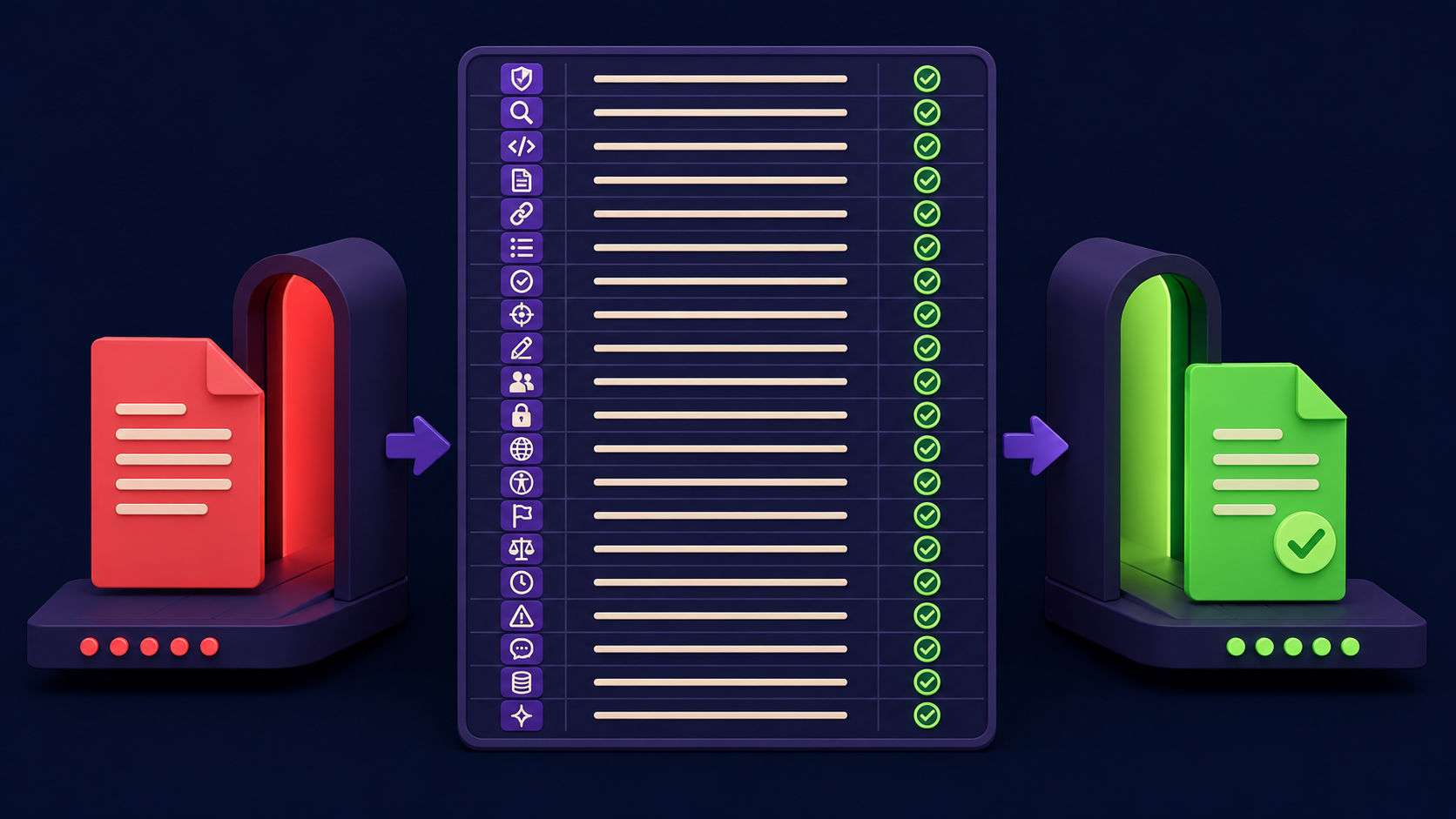
The answer is a structured checklist that runs in parallel with the draft review, not after it. The checks below are grouped into five categories so a single reviewer can move through them in order without context-switching. On a 1,500-word article, a trained reviewer clears all 20 points in about 25 minutes.
Teams using Jasper or Surfer SEO for structured content workflows can embed this checklist directly into their standard operating procedure, running it as the final stage before scheduling. The content creation tools category on Vantaige profiles every major AI writing assistant with notes on where each one tends to produce hollow output (typically in the "background" and "conclusion" sections, which LLMs fill with summaries of their own prior paragraphs).
The 20-point AI content quality-control checklist
This table is designed to be saved and used as a repeatable gate. Each check is one yes/no decision. A draft passes when every row is green. If any row fails, fix before scheduling.
Section | # | Check | Why it matters |
|---|---|---|---|
Accuracy & Sourcing | 1 | Every factual claim that is not common knowledge is linked to a named, dateable source. | AI tools hallucinate citations. Unverified claims are the fastest way to lose reader trust and invite corrections that damage E-E-A-T. |
Accuracy & Sourcing | 2 | Statistics include the year of the study or survey (not just the number). | A 2021 survey presented as current in 2026 misleads readers and will be caught by fact-checkers. |
Accuracy & Sourcing | 3 | Tool names, product versions, and pricing figures are confirmed as of the publish date. | AI models are trained on historical data. Prices and feature sets change; outdated specifics kill practical credibility. |
Accuracy & Sourcing | 4 | No fabricated quotes. Any direct quote is attributed to a named, traceable person and a dated source. | LLMs invent plausible-sounding quotes. A fabricated expert quote is a trust-destroying error that gets screenshot and shared. |
Originality & Experience | 5 | The draft contains at least one piece of information the author's team produced: a test result, a metric from a real project, a first-hand observation, or a screenshot. | Google's E-E-A-T "Experience" signal requires evidence the author engaged with the topic directly. This is the single most common gap in AI-assisted content. |
Originality & Experience | 6 | The draft does not simply restate the top three Google results for the target keyword. Run a quick search and compare: does your article add anything those do not cover? | Zero information gain is the core characteristic of AI slop. If your draft could have been assembled by summarising the existing SERP, it will not outrank it. |
Originality & Experience | 7 | The introduction does not start with "In today's" or any variant of the genre-defining AI-slop opener. | These openers are a reliable signal to readers and classifiers that the content was not reviewed by a human with a point of view. |
Originality & Experience | 8 | Originality.ai or GPTZero (or equivalent) AI-detection score is noted internally, and any sections flagging above 80% AI probability are reviewed for rewriting with first-hand context. | Disclosure is a coming regulatory and platform norm. Knowing your score internally lets you decide what to rewrite before readers or algorithms decide for you. |
Voice & Readability | 9 | A named editor read the draft aloud and confirmed it sounds like the brand, not like a corporate newsletter. | AI output tends toward a flattened, neutral register that is technically correct but distinctively bland. Brand voice is what readers remember. |
Voice & Readability | 10 | No inflated marketing adjectives or tech-hype cliches appear in the draft. The tell is any word that promises transformation without a concrete specific behind it. | These words are AI fingerprints. Readers who encounter them stop trusting the rest of the sentence. They also tell Google nothing about your content's relevance. |
Voice & Readability | 11 | Paragraph length varies. No more than three consecutive paragraphs at the same approximate length. | AI drafts produce uniform paragraph cadences. Visual rhythm variation is a reliable human-writing signal and improves on-page engagement metrics. |
Voice & Readability | 12 | Readability score (Flesch-Kincaid or equivalent) is appropriate for the audience. For B2B content teams and marketers: aim for grade 10 to 12, not grade 15+. | AI drafts written for "experts" often trend toward academic sentence complexity that reduces comprehension without adding precision. |
Structure & SEO | 13 | The target keyword appears in: H1, first 100 words, at least one H2, and one image alt attribute. Total keyword density is under 1.5%. | AI tools stuffing keywords into every paragraph produce the inverse effect: Google's systems now detect density patterns as a spam signal. |
Structure & SEO | 14 | Every H2 is self-contained. A reader landing on any single section gets a complete answer without needing to read "as mentioned above." | LLM retrievers (used by Perplexity, ChatGPT Browse, and AI Overviews) chunk content by heading. Non-self-contained sections are not cited. Chunk-ready structure using tools like NeuronWriter for outline planning improves AI citability significantly. |
Structure & SEO | 15 | Internal links point to real, live pages. No links to staging URLs, deleted posts, or pages that redirect. | Broken internal links dilute crawl budget and signal poor editorial maintenance to both Google and readers. |
Structure & SEO | 16 | A TL;DR block of 3 to 5 bullets appears near the top. Each bullet is under 15 words and can stand alone without the rest of the article. | This is the chunk that AI Overviews and LLMs lift for citation. It also reduces bounce rate by confirming to readers immediately that the article answers their question. |
Structure & SEO | 17 | The article has a FAQ section of at least 4 questions, each modelled on real "People Also Ask" or forum phrasings, not invented by the author. | FAQPage schema entries are parsed by Perplexity, ChatGPT, and Gemini for citation attribution even after Google deprecated FAQ rich results in SERPs. This is the highest-yield citability surface per word written. |
Compliance & Disclosure | 18 | If the article mentions affiliate tools or sponsored products, the disclosure is in the first visible paragraph, not buried in a footer note. | FTC guidelines require clear and conspicuous disclosure. A footer disclosure on a long-form article does not meet the standard. Platform ad policies are tightening on this in 2026. |
Compliance & Disclosure | 19 | No income projections appear in the body. If the article discusses monetisation, it frames outcomes as case examples, not reader promises. | Income promises create FTC liability and damage credibility with sophisticated readers who know the distribution of results is not the mode. |
Compliance & Disclosure | 20 | The article has a named author with a verifiable role and a publication date in ISO format. "Admin" or "Staff" is not an author. | Google's E-E-A-T Expertise signal requires a real, traceable author. An anonymous byline is the fastest way to fail the Experience dimension of the framework. See how Vantaige handles this at our editorial process. |
Which sections of AI drafts fail this checklist most often?
Based on editorial review across content operations, the three most common failure points are checks 5, 6, and 20: no first-hand artifact, zero information gain over the existing SERP, and an anonymous or generic author. These three failures together account for the majority of content that gets classified as low-quality by both readers and Google's systems.
The sections where AI drafts consistently fail the voice checks (9 through 12) are introductions, conclusions, and any paragraph that begins with "It is important to note that." These are LLM filler constructions that trained readers now recognise on sight. A find-and-replace pass for these patterns before review takes less than two minutes and removes the most obvious AI fingerprints.
For teams producing at volume, the SEO structure checks (13 through 17) are best automated. Tools like Surfer SEO and NeuronWriter flag keyword density issues and heading structure gaps before the human reviewer even opens the draft. This means human review time concentrates on the checks that genuinely require human judgment: accuracy, originality, and voice. See the full breakdown of how these tools fit into a production-grade system in the AI content automation stack.
What does a practical AI content QA workflow look like for a small content team?
A three-person content team (one writer, one editor, one operations lead) can implement this checklist as follows. The writer runs checks 1 through 8 (accuracy and originality) before handing the draft to the editor. The editor runs checks 9 through 17 (voice, readability, and SEO structure) during the review pass. The operations lead or a designated compliance reviewer clears checks 18 through 20 before scheduling.
This split means no single reviewer is responsible for all 20 checks under time pressure. Each person reviews in their area of expertise, which reduces both errors and review fatigue. For teams using n8n automations, the workflow trigger for "draft ready for review" can auto-generate a checklist card per article. The 15 AI agent n8n workflows you can build in a weekend includes a content review routing pattern that fits this structure.
Agencies billing for content services benefit from making this checklist client-facing. Including it in your deliverable documentation signals the quality standard you hold, which is part of what separates a productised content service from freelance work. The 2026 AI automation rate card operators charge shows that operators who document their QA process command meaningfully higher rates than those who deliver outputs without process evidence.
Is AI detection software reliable enough to include in a content QA workflow?

AI detection tools like Originality.ai and GPTZero are useful as internal signals, not as final verdicts. Their false-positive rates on human-written technical content are high enough that a high score should trigger a review, not an automatic rejection. Their real value in a QA workflow is as a prompt to find sections where the draft has low information density, which correlates with high AI-probability scores because LLMs tend to pad sections where they lack real data.
Run detection as check 8 in the originality section and use the score to identify which paragraphs need a human rewrite with first-hand context. Do not use it to certify content as "human-written." The goal is not to pass an AI detector. The goal is to produce content that a knowledgeable reader would find useful, accurate, and worth sharing, which is a different and more demanding standard.
How does this checklist relate to Google's E-E-A-T framework?
The 20 checks map directly to the four E-E-A-T dimensions. Experience is addressed by check 5 (first-hand artifact) and check 20 (named author with verifiable role). Expertise is addressed by checks 1 through 4 (accurate sourcing) and check 6 (information gain). Authoritativeness is addressed by checks 13 through 17 (SEO structure that earns citation) and check 4 (no fabricated quotes). Trustworthiness is addressed by checks 18 and 19 (disclosure and no income promises).
The checklist does not replace E-E-A-T evaluation. It operationalises it into a format a reviewer can run in 25 minutes without needing to hold the full framework in their head. For teams building an AI content system from scratch, understanding how this QA layer sits within a broader content operation is covered in boring B2B AI agent niches that pay and in the Claude and Microsoft Office setup guide for teams using Office 365 as their editorial environment.
FAQ: AI content quality control
What is the fastest way to tell if a piece of content is AI slop?
Read the introduction and the conclusion. If the introduction starts with a broad statement about the current state of an industry and the conclusion is a restatement of the headers, the draft was not reviewed by a human with a point of view. AI models default to these structural patterns because they are statistically common in training data. A genuinely edited piece has an introduction that states a specific, defensible position and a conclusion that goes somewhere the introduction did not.
Does publishing AI content hurt SEO in 2026?
Publishing unreviewed AI content without original insight, named authorship, or sourced facts will hurt SEO in 2026. Google's March 2024 Helpful Content integration made E-E-A-T signals part of core ranking. AI content that passes the 20-point checklist above, meaning it has first-hand experience, accurate sourcing, a named author, and genuine information gain, is not penalised. The penalty is for automated mass production of hollow content, not for using AI as a writing tool.
How long does it take to run this 20-point checklist?
A trained reviewer clears all 20 checks on a 1,500-word article in approximately 25 minutes when the checks are split across three reviewers by section (accuracy, voice/SEO, compliance). Solo reviewers working sequentially should budget 35 to 40 minutes. The most time-consuming checks are 5 and 6 (originality verification) because they require a brief SERP comparison and confirmation that the draft contains first-hand information that competing articles do not.
Can you run this checklist on content that was written by humans, not AI?
Yes, and you should. The checklist is an editorial quality gate, not an AI-detection system. Poorly researched human-written content fails checks 1 through 6 just as readily as unreviewed AI output. The checklist is useful for any content team that wants a consistent, documented standard for what "ready to publish" means, regardless of how the first draft was produced.
What should a content team do with drafts that fail the checklist?
Return them to the writer with the specific failed check number and a one-sentence explanation of what is missing. Do not request a full rewrite unless more than five checks fail. A draft failing check 5 (no first-hand artifact) typically needs one new paragraph, not a rebuild. A draft failing checks 1 through 4 across multiple claims needs a sourcing pass, not a structural rewrite. Specific failure points produce faster fixes than general feedback like "this needs more depth."
Does AI detection software accurately identify AI-generated content?
Not reliably enough to use as a binary pass/fail gate. Tools like Originality.ai and GPTZero flag high-probability AI sections with meaningful accuracy, but produce false positives on technical human writing and false negatives on lightly edited AI output. Use them as a signal to prompt targeted review of specific paragraphs, particularly any section where the prose is dense but the information is generic. The goal is identifying where to add first-hand expertise, not certifying the content as human.
How does this checklist support AI discoverability beyond Google?
Checks 16 and 17 (TL;DR block and FAQ section) directly increase the probability that Perplexity, ChatGPT Browse, and AI Overviews cite your content. LLM retrieval systems chunk content by heading and favour answers that are self-contained, concise, and structured as question-answer pairs. A draft that passes checks 14, 16, and 17 is formatted for AI citability, not just human readability. This is a meaningful distribution advantage as AI-generated search summaries absorb a growing share of informational query traffic.
Want this content system built for you?
Vantaige designs and deploys done-for-you AI content operations: the stack, the prompts, and the publishing pipeline, configured to your brand in weeks. Book a free content automation audit and we will map what to automate first.
Related from Vantaige
References
Get the best new AI tools and guides, weekly
One short email a week. The tools worth trying, the guides worth reading, nothing else.
No spam. Unsubscribe anytime.
Aymen B
Contributing writer at Vantaige, covering the AI tools ecosystem.