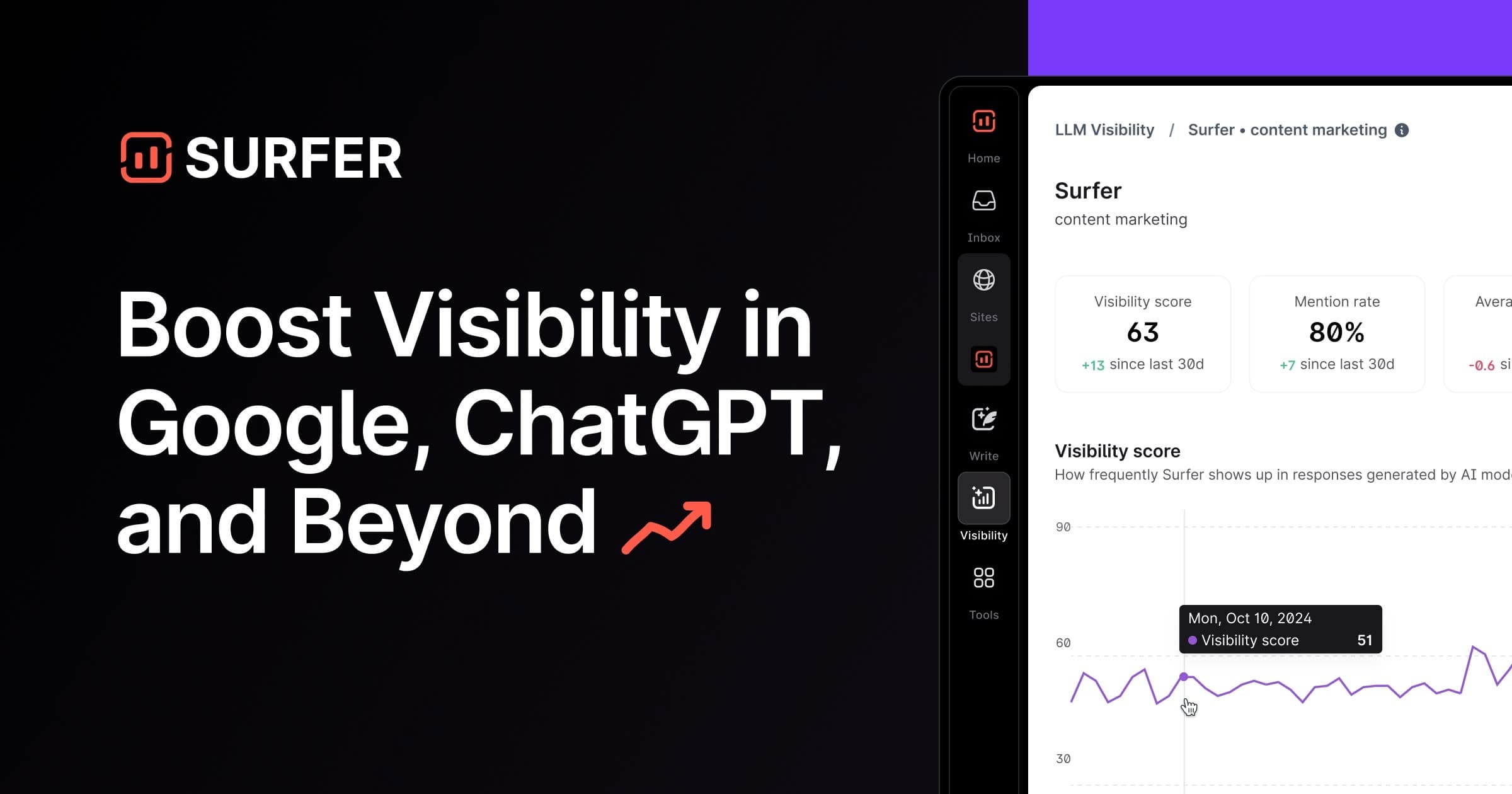

Surfer SEO is an AI-powered content optimization platform that analyzes top-ranking competitors and tells writers exactly what to include. Built since 2017, it is the category benchmark for NLP-driven on-page SEO, used by content teams and agencies worldwide.
Surfer SEO is a content optimization platform built around one core idea: the best-ranking pages share measurable patterns, and writers who match those patterns rank higher. Founded in 2017 by Lucjan Suski, Michal Suski, and Tomasz Niezgoda in Wroclaw, Poland, Surfer reaches its targets by scraping the top organic results for any keyword, extracting NLP entities and structural signals, and presenting writers with a live Content Score (0-100) that updates as they type. By April 2026, the company serves more than 12,000 paying customers across agencies, in-house SEO teams, and enterprise brands, with 150,000 active users per month.
The flagship feature is the Content Editor, a real-time writing environment that integrates directly with Google Docs and WordPress. Beyond the editor, the platform includes Surfer AI for full article generation, an AI Humanizer, SERP Analyzer, Keyword Research, Topical Maps, Content Audit, Cannibalization Reports, and an AI Tracker that monitors brand visibility inside ChatGPT, Perplexity, Google AI Overviews, and Gemini answers. The API is available on the top-tier Peace of Mind and Enterprise plans, making it accessible to teams building custom workflows. Surfer was acquired by Positive Group, a European marketing automation company, in October 2025.
What Surfer SEO writes in April 2026
Surfer's primary output is an optimization layer on top of whatever you are writing. The Content Editor scores existing drafts, outlines, and new articles against the top-ranking pages for the target keyword. It analyzes more than 500 on-page signals including word count, heading structure, NLP entity usage, keyword prominence, and image frequency. The score reflects how closely your content matches the aggregate pattern of pages that currently rank in positions 1-10.
Surfer AI extends the platform into full draft generation. Provide a keyword and Surfer AI returns a complete article draft organized around the NLP terms and structure the SERP data recommends. The draft comes pre-optimized for the Content Score, meaning the structural scaffolding is already aligned with what ranks. The trade-off is output quality: the generated content consistently scores around 91% on AI detection tools, including Surfer's own AI Detector, and nearly all reviewers report it requires significant editing before it is ready to publish.
The AI Humanizer was added to address the AI detection problem by rephrasing content for natural language flow. This creates a documented tension in the product: the Humanizer rewrites sentences in ways that reduce keyword density and entity coverage, which can lower the Content Score that the rest of the tool is designed to raise. Users who run both features in sequence often find themselves re-optimizing content after humanizing it.
The Content Audit feature identifies underperforming pages on an existing site and calculates a Content Score for each, giving SEO managers a prioritized refresh queue. Internal Linking suggestions are available on Pro and above, recommending relevant internal links to add based on topical relevance across the site's content inventory.
"Surfer's Content Editor is AWESOME. Easily their best feature. I have a love/hate relationship with Surfer's SERP Analyzer though - it's not practical to optimize for all that stuff." - Brian Dean, Backlinko review
Where Surfer SEO sits versus Frase and Clearscope
Frase.io and Surfer SEO overlap on the core function of real-time content optimization but differ in their entry point and NLP depth. Frase starts from the research and brief stage: it auto-summarizes the top-ranking pages, extracts common questions, and builds a content outline before the writer starts drafting. Surfer's Content Editor is primarily a live writing and scoring environment rather than a brief-builder - it is strongest when you already know what you want to write and need on-page optimization guidance while writing it. Frase's real-time score uses "smart insights" panels alongside the document; Surfer uses a gamified 0-100 counter that rewards adding more terms to the text. At $15/mo for Frase's Solo plan versus $89/mo+ for Surfer, Frase is the budget choice for teams where cost sensitivity outweighs NLP depth. Surfer runs deeper statistical analysis across more on-page signals; Frase pulls broader competitor summaries but does less granular term-frequency work. Surfer also includes AI writing, topical maps, cannibalization reports, and the AI Tracker - features Frase does not replicate. Teams using Surfer often also use NeuronWriter or SEO Content AI for markets where Surfer's NLP coverage is thinner.
Clearscope operates at the opposite end of the pricing spectrum and deliberately avoids the gamification that defines Surfer's UX. Clearscope uses IBM Watson for NLP and grades content on a letter scale from A++ to F - a format designed for editorial teams where writers need a clear pass/fail signal without needing to understand what a "Content Score of 78" means. Clearscope targets enterprise content organizations where the primary need is consistency and writer onboarding speed, not optimization depth. It starts at $170/mo per user, roughly 3-4x Surfer's entry price per seat, and does not include AI writing generation. Surfer covers more of the content production workflow at a lower per-seat price; Clearscope is simpler and faster for organizations with non-SEO writers who just need a clear grade on each draft. Content teams at scale sometimes pair Surfer for NLP depth with tools like Jasper or Copy.ai for the actual writing throughput, then use Surfer's Content Score as the final quality gate.
What real Surfer users keep hitting
The most common frustration is the scoring system working against natural writing. Surfer's 0-100 Content Score is deliberately gamified, and multiple forum discussions identify what happens when writers treat it as a target rather than a guide: content becomes stuffed with keyword variants, reads mechanically, and prioritizes the algorithm over the reader. Surfer's own July 2025 study on 1 million SERP entries recommended targeting a Content Score between 70 and 85, explicitly acknowledging that over-optimization is a real risk - but the tool's interface still rewards pushing the number higher. Reddit discussions on this pattern are consistent: Surfer can produce content that ranks poorly because it reads poorly, and there is no friction in the product that stops a writer from over-optimizing.
Credit and plan limits create friction at the agency scale. Teams running 30+ articles per month on mid-tier plans report exhausting their allocations in the first two weeks. The pay-per-article credits cost between $15 and $19 each at list price, which adds up quickly. Long-term subscribers have also reported that Surfer's periodic restructuring of plan tiers has removed features they previously had access to, requiring upgrades to recover the same capability set.
"The AI humanizer typically undoes all of its optimization work.. data quality requires manual verification, and the AI frequently ignores custom reference materials. At five times the cost of comparable tools, the value delivery is insufficient." - Amin N., CMO, Capterra, April 2025
Keyword research is a recurring limitation. Surfer's built-in keyword research tool is widely considered supplemental rather than primary. Users who rely on it for discovery miss keyword variations and search volume trends that dedicated tools like Ahrefs and SEMrush surface. Most serious Surfer users maintain a separate keyword research workflow and bring the target keyword into Surfer only at the content production stage.
Non-English content optimization sees quality drops. The NLP entity extraction that makes the Content Score accurate in English is thinner in Spanish, German, and other languages. Carolina M., a Content Specialist who reviewed Surfer on Capterra in October 2025, specifically called out weak Spanish language support as a meaningful limitation despite otherwise rating the tool highly.
The October 2025 acquisition by Positive Group introduced a new category of uncertainty. Positive Group is a French marketing automation company that acquired Surfer to create a full-funnel visibility stack from CRM and email into AI-powered search. All three co-founders remain with the business, and the official communication emphasized continuity. But acquisitions by marketing platform rollups have a documented pattern of pricing changes and feature bundling that concerns independent agency users, and competitor commentary (Clearscope published an immediate response post) suggests the acquisition is being watched closely by the market.
Where Surfer SEO earns its place
For content teams producing more than 10 articles per month, Surfer's Content Editor removes the guesswork from on-page optimization in a way that is difficult to replicate with a general AI writing tool. The NLP analysis across 500+ signals and the real-time scoring create a measurable quality bar that can be enforced consistently across multiple writers with different SEO experience levels. Surfer's own correlation study (0.28 Spearman correlation between Content Score and Google ranking position, vs 0.17 for backlinks) provides stronger statistical backing than most competitors have published for their scoring systems.
The AI search visibility tracking is a genuinely differentiated capability introduced in 2025-2026 that no pure content optimization tool matches. For brands that care about appearing in ChatGPT, Perplexity, and Google AI Overview responses, the AI Tracker on Pro and above is the only tool in this stack that monitors those surfaces natively. Writers and content strategists who work with Scalenut or Longshot for initial drafts frequently bring Surfer in as the final optimization layer before publishing, because the Content Score provides a SERP-grounded benchmark that AI-first writing tools do not generate.
Agencies value the workflow integrations. The Google Docs add-on, WordPress plugin, Zapier connection, and Contentful integration mean writers rarely need to leave their existing environment to access the Content Score. The Topical Map feature helps content strategists plan cluster coverage, which reduces the cannibalization identified in the Cannibalization Reports. For agencies managing 5+ clients, the multi-workspace structure on Pro and above keeps client content separated without requiring separate accounts.
Who should and shouldn't use Surfer SEO
Surfer fits best for: content teams producing at least 10 articles per month where consistency of on-page optimization across multiple writers is the problem; agencies who need a defensible, data-backed quality standard to show clients; SEO managers running content refreshes on underperforming pages; and enterprise marketing teams tracking brand visibility in AI-generated search results alongside traditional SERP rankings.
Skip Surfer if: you are a solo blogger writing one or two posts per month (the credit model is expensive at low volume); your primary workflow is non-English content (NLP accuracy gaps are real in non-English markets); you need strong keyword discovery as part of the same tool (Surfer's keyword research is supplemental, not primary); or you expect Surfer AI to produce publish-ready drafts without heavy editing (every practitioner review confirms the output needs substantial rework). Writers who work primarily on transactional, local, or navigational queries should also note that Surfer's Content Score correlation is lowest for those intent types, per the company's own 2025 research.
Teams evaluating the full SEO writing stack often compare Surfer alongside Article Fiesta for automated production, noting that Surfer's optimization depth and the AI Tracker capability justify the premium for teams where search visibility is a primary revenue driver rather than a secondary consideration.
User Reviews
No reviews yet. Be the first to share your experience!
Sign in to write a review.
Related articles
Guides and articles related to Surfer SEO.

AI SEO Content at Scale: Publish 20 Posts a Month Without Hiring Writers

Undetectable AI Review (2026): What It Does, What It Costs, and 7 Alternatives

The AI Content Automation Stack: 7 Tools That Run a Full Blog Without a Team

AI Content Quality Control: How to Avoid Publishing AI Slop

How to Repurpose One Blog Post Into 30 Pieces With AI (The Step-by-Step System)