The AI Content Automation Stack: 7 Tools That Run a Full Blog Without a Team

The AI Content Automation Stack: 7 Tools That Run a Full Blog Without a Team
You do not need a content team to publish consistently. You need seven connected slots: research, writing, optimization, image, publishing, distribution, and analytics, each handled by a tool that hands its output to the next. This is the exact stack we configure for clients, the job each slot does, and the one rule that separates a content system from a slop machine. Build it yourself from this blueprint, or use it as the spec for a done-for-you setup.
TL;DR
A content stack is seven slots, each feeding the next
Research and optimization slots decide whether you rank
The human edit pass is the anti-slop layer, never skip it
One brand-voice system keeps every tool on-message
Distribution and analytics close the loop
What is an AI content automation stack?
An AI content automation stack is the connected set of tools that takes a keyword from research to a published, optimized, distributed post with AI doing the heavy lifting at each step and a human owning quality control. It is a production line, not a single writing tool: research feeds the brief, the brief feeds the draft, the draft gets optimized, imaged, published, distributed, and measured.
The reason teams stall on content is not writing speed; it is the dozen handoffs around the writing. A stack removes the handoffs. The seven slots below map to the real stages of publishing, and the value is in connecting them so a post moves through without a person babysitting each transition. Browse options on the content creation tool directory; the architecture below is what turns a pile of tools into a system.
The seven slots, in production order

Here is the full stack. Each slot is a stage in publishing, not a brand preference. Swap tools freely; keep the sequence.
Slot | Job | Tools that do it well |
|---|---|---|
1. Research and briefs | Find topics, cluster keywords, build the brief | |
2. Drafting | Turn the brief into a first draft in brand voice | |
3. SEO optimization | Match search intent, structure, and coverage | |
4. Human edit pass | Fact-check, add experience, kill slop | A person plus your QA checklist |
5. Images | Featured and inline visuals on brand | Canva, image generators |
6. Distribution | Schedule social and repurpose the post | |
7. Analytics | See what ranks and what converts | Search Console, your CMS analytics |
Slot 1 and 3: Why research and optimization decide rankings
Research and optimization are the slots that decide whether anyone ever reads the post, which is why they bookend the writing. Slot 1 turns a vague topic into a real brief: the search intent, the questions to answer, the entities to cover, and the angle competitors missed. Tools like Surfer and NeuronWriter build this from live SERP data.
Slot 3 checks the finished draft against that same data: did you cover the topic as completely as the pages that rank, with the right structure. Skipping these two slots is why so much AI content reads fine and ranks nowhere. The writing was never the bottleneck; the brief and the coverage were. For publishing at real volume, this discipline is the backbone of the content-at-scale model.
Slot 2 and 4: Drafting fast, then the edit pass that saves you
Drafting is where AI saves the most time and where unmanaged AI does the most damage, so it pairs with a mandatory human edit. A tool like Jasper or Copy.ai turns a strong brief into a complete first draft in minutes. That draft is a starting point, not a finished post.
Slot 4, the human edit pass, is the single layer that separates a content system from a slop machine. A person fact-checks every claim, adds real experience and specifics the model could not know, cuts filler, and runs a quality checklist. This is non-negotiable: it is what keeps you out of the "unhelpful content" penalty box and what makes readers trust you. Automate the draft; never automate the judgment. We treat this QA layer as part of every system we build.
Slot 5 and 6: Images and distribution without manual busywork
Images and distribution are the slots that usually get dropped under deadline, which is exactly why they belong in the automated stack. Slot 5 produces a branded featured image and any inline visuals; a tool like Canva with brand templates keeps every post visually consistent without a designer in the loop for each one.
Slot 6 is where one post becomes many. Schedule the social pushes through Buffer, Hootsuite, or Later, and feed the post into a repurposing flow so it becomes threads, clips, and a newsletter. That repurposing step is worth its own system, which we detail in how to turn one post into 30 pieces.
The rule that ties it together: one brand-voice system
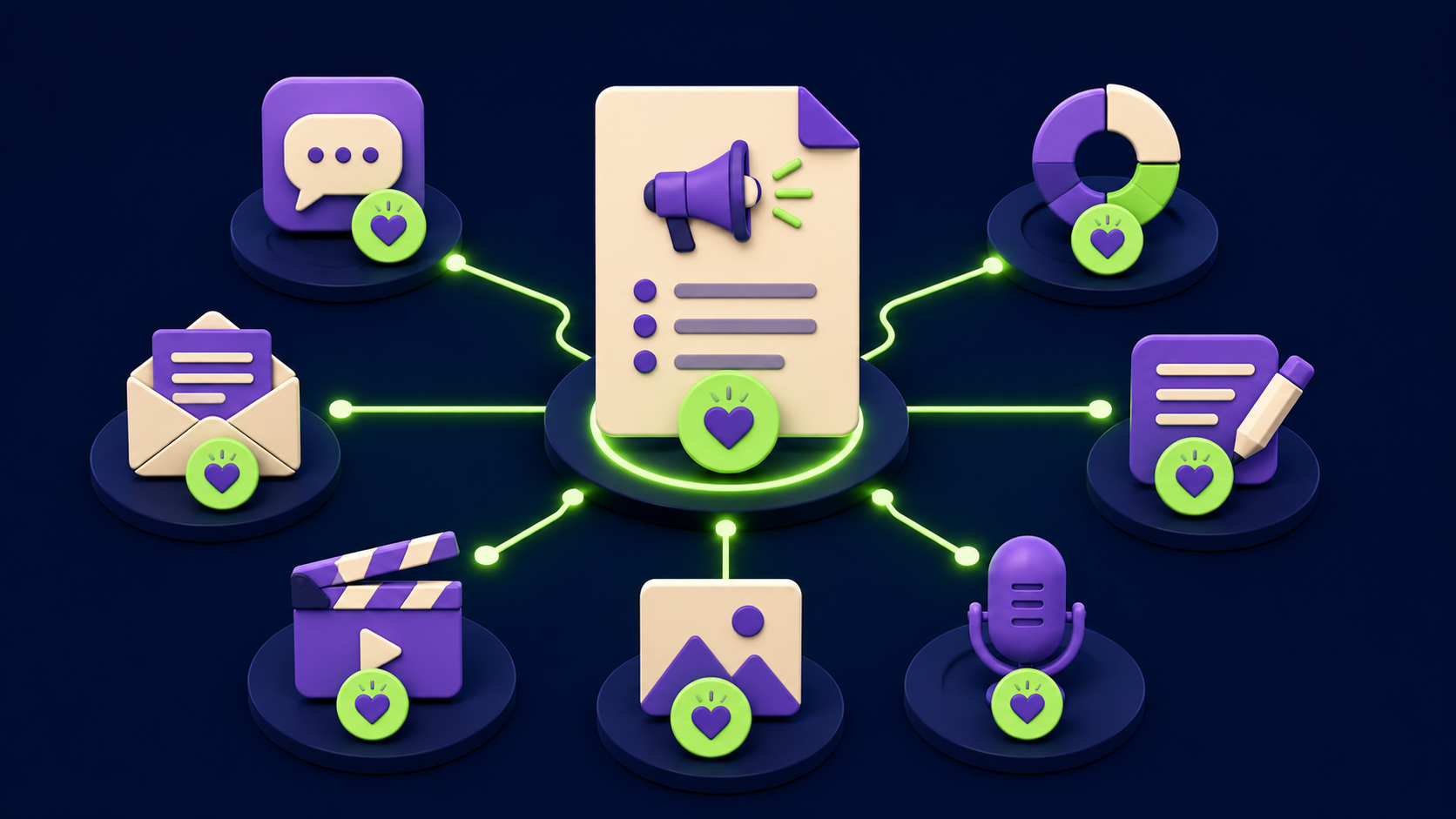
The thing that makes seven tools feel like one team is a single brand-voice definition that every drafting and repurposing step references. Without it, slot 2 writes in one voice, slot 6 repurposes in another, and the output feels assembled by strangers. With it, everything sounds like you.
Build it once: a voice audit of your best existing content, a corpus of examples, and a system prompt that encodes tone, vocabulary, banned phrases, and structure rules. Feed that into every AI step. This is the unglamorous layer that makes the difference between "we use AI for content" and "our content happens to be made with AI," and readers can tell which one you are.
What does running this stack actually cost?
The tools are mostly monthly SaaS in predictable market ranges, and the real cost is the editor's time on slot 4, not the software, which you can model against agency and freelancer rates in our 2026 rate card. A solo operator can run this stack; a small team can run it for several brands at once.
The honest case for done-for-you: the seven slots are knowable, but wiring them into a pipeline that produces on-brand, ranking content without a person nursing each handoff is the work. That assembly, plus the brand-voice system and the QA checklist, is exactly what we configure and hand over.
Want this content system built for you?
Vantaige designs and deploys done-for-you AI content operations: the stack, the prompts, and the publishing pipeline, configured to your brand in weeks. Book a free content automation audit and we will map what to automate first.
FAQ
Can one tool replace this whole stack?
No tool does all seven slots well. Some all-in-one platforms cover three or four, but research, optimization, and the human edit pass are where shortcuts cost you rankings and trust. Pick the strongest tool per slot and connect them, rather than settling for a suite that is mediocre at each.
Will AI content hurt my Google rankings?
Google targets unhelpful content, not AI authorship. Content that is accurate, experience-backed, and genuinely useful ranks regardless of how it was drafted. The slot-4 edit pass is what keeps your content on the right side of that line, which is why it is mandatory in this stack.
How many posts a month can a solo operator publish?
With the stack running and a disciplined edit pass, a solo operator can sustain a meaningful weekly cadence, and a small team can multiply that across brands. The limiter is editing capacity, not drafting, which is the opposite of a manual content team.
What is the most important slot to get right first?
Research and briefs (slot 1). A great draft of the wrong brief still fails. Nail topic selection, search intent, and the brief, and every downstream slot gets easier. Most content failures trace back to a weak or missing brief.
How do I keep AI content from sounding generic?
Build the brand-voice system and run a real human edit pass. Generic output comes from generic prompts and no editing. A voice corpus plus an editor who adds specifics and experience is what makes AI-assisted content sound like a person with a point of view.
Do I need coding skills to build this?
No. Every slot has a no-code tool, and the handoffs can be manual at first. Automating the handoffs (so posts flow without copy-paste) is where a no-code automation layer helps, and where a done-for-you build saves the most time.
Related from Vantaige
References
Google Search Central, "Creating helpful, reliable, people-first content." developers.google.com
Surfer SEO, content optimization documentation. surferseo.com
Jasper, brand voice documentation. jasper.ai
Canva, brand kit and templates. canva.com
Get the best new AI tools and guides, weekly
One short email a week. The tools worth trying, the guides worth reading, nothing else.
No spam. Unsubscribe anytime.
Aymen B
Contributing writer at Vantaige, covering the AI tools ecosystem.
Similar articles

AI SEO Content at Scale: Publish 20 Posts a Month Without Hiring Writers

AI Content Automation Services: What a Done-For-You Setup Includes (and Costs)