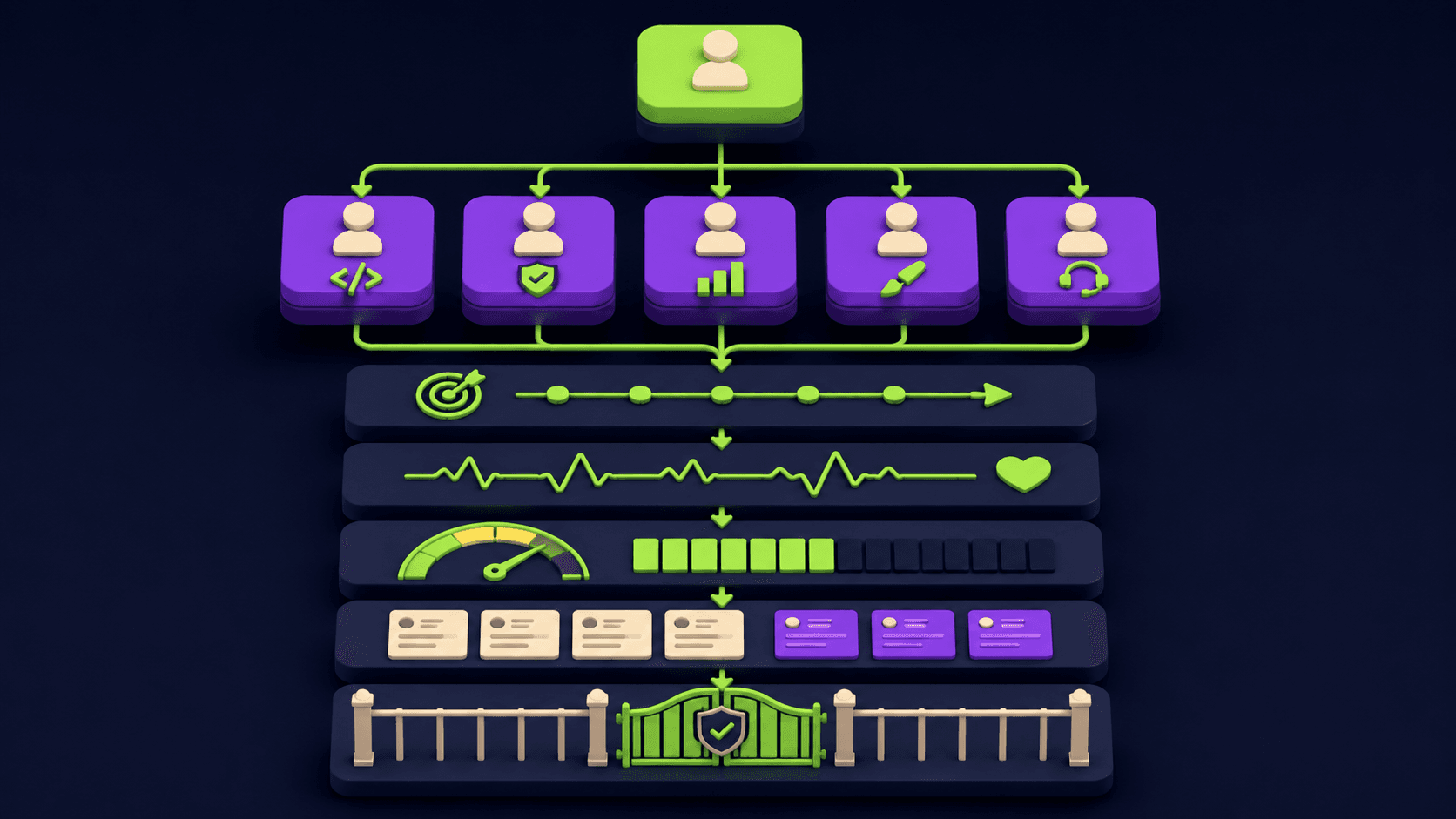
Moonshot AI's Kimi K2.6 is the open-weight model that quietly powered Cursor's Composer 2, tops SWE-Bench Pro at 58.6%, and supports 300-agent autonomous swarms, at a fraction of Claude Sonnet's per-token cost. Verbosity, hallucination rate, and language-dependent censorship are the real limits.
When Cursor launched Composer 2 in March 2026, the marketing described "frontier-level coding intelligence" built through "continued pre-training combined with reinforcement learning." No third-party model was named. Within 24 hours, developer Mark Kretschmann intercepted Cursor's API traffic and found the model identifier: kimi-k2p5-rl-0317-s515-fast. Composer 2 was Kimi K2.5, a model from Beijing-based Moonshot AI, fine-tuned with RL for coding tasks. Cursor co-founder Aman Sanger acknowledged publicly: "It was a miss to not mention the Kimi base in our blog from the start." No legal action followed; Moonshot congratulated the Cursor team and confirmed an authorized commercial partnership through Fireworks AI.
The incident became a news cycle because of what it implied: a well-funded US company valued at over $2 billion, generating an estimated $160M/month in revenue, had chosen a Chinese open-weight model as the foundation for their flagship product. That is a more meaningful signal than any benchmark. Here is what that tells you about where Kimi K2.5 and K2.6 actually sit in April 2026, and where the real traps are.
Kimi at a glance. April 2026
Moonshot AI shipped five significant model releases in under a year. Kimi K2 launched in July 2025 as a 1-trillion-parameter Mixture-of-Experts model with 32B active parameters per token, open weights on HuggingFace, and an explicit focus on agentic use cases. K2 Thinking followed in November 2025, adding chain-of-thought reasoning and a 256K context window. K2.5 in January 2026 added native multimodal input (text plus vision) and expanded the Agent Swarm to 100 sub-agents. K2.6, released April 20, 2026, is the current production version: 300 sub-agents, 4,000 coordinated steps, SWE-Bench Pro at 58.6% (above GPT-5.4 at 57.7% and Claude Opus 4.6 at 53.4%), and the number-one ranked open-weight model on the LM Council leaderboard with a score of 54.
All K2-series weights are released under a Modified MIT License, which permits commercial use and fine-tuning. One carve-out matters for larger teams: any commercial product exceeding $20M/month in revenue or 100M monthly active users must "prominently display Kimi K2.x" in its UI. That clause is what Cursor ran afoul of.
The consumer product at kimi.com offers a free tier and three paid tiers (Moderato, Allegretto, Vivace). The API is available directly through Moonshot and via aggregators including OpenRouter, Groq, Cloudflare Workers AI, and NVIDIA NIM.
What Kimi is actually good at
The clearest strengths break into three areas: large-context code work, agentic orchestration, and cost efficiency at scale.
Large-context code analysis. Kimi K2's 128K–256K context window allows ingesting an entire mid-sized codebase in one request without chunking. Early adoption on r/LocalLLaMA was driven by developers loading full repository trees for refactoring reviews. One developer on Hacker News compared Kimi directly to Claude in a production agent workflow and concluded it was "below Sonnet and Opus 4.0 on capability, but better than Gemini 2.5 Pro on tool calling" and "really worth trying if you don't want to spend the $100 or $200 per month on Claude Max." A separate comparison note: Kimi "wrote much simpler and more readable code than Claude's over-engineered solutions", at the cost of missing subtle edge cases.
Agentic orchestration. K2 was architecturally designed for tool-calling and multi-step autonomous loops, not retrofitted. The BrowseComp score of 60.2% reflects training that treats agentic tasks as first-class objectives. Kilo Code's two-week review found K2.5 "rapidly climbed to top-performer status for architectural planning", before the verbosity problem showed up in the billing statements. K2.6's 300-agent swarm handling 4,000 coordinated steps is the most capable open-weight agentic system available in April 2026.
Price-to-capability ratio. At $0.74 input / $4.66 output per million tokens for K2.6 via OpenRouter (note: third-party aggregator pricing, verify against Moonshot's own API), Kimi is roughly 4–5x cheaper than Claude Sonnet on input tokens. For teams running high-volume inference or building cost-sensitive products, this gap is material, provided the verbosity problem is managed (see below).
"below Sonnet and Opus 4.0 on capability, but better than Gemini 2.5 Pro on tool calling" and "really worth trying if you don't want to spend the $100 or $200 per month on Claude Max". Hacker News commenter, r/LocalLLaMA adjacent thread, July 2025
Where Kimi breaks, the failure modes users keep hitting
The verbosity cost trap. This is the most practically important nuance in Kimi K2.5's profile. Kilo Code's two-week production review found K2.5 generated 89M output tokens on a set of tasks where comparable models produced a median of 14M tokens, a 6x verbosity multiplier. The model over-generates: verbose explanations appended to direct answers, unsolicited edge-case commentary, repeated context. The practical result is that Kimi's cheapest-per-token pricing can produce the most expensive invoice when the model emits six times more output than the task requires. A model priced at $2/M output but generating 14M tokens costs less than a model at $0.74/M generating 89M. Forum users summarized it bluntly: "Ask it a yes/no question and it writes three paragraphs."
Kilo Code's framing from their review: K2.5 "rapidly climbed to top-performer status for architectural planning" but "usage surged past 50B tokens/day" due to verbosity, negating pricing savings.
Hallucination rate. The Artificial Analysis knowledge index scores Kimi K2.5 at -11 versus Claude's +10. This is a third-party measure, not Moonshot marketing. It means the model is materially worse at factual retrieval and citation accuracy than the closed frontier models it competes with on code benchmarks. Kimi is suitable for "find and summarize" work on ingested documents; it is less reliable for "verify and cite from memory" tasks without a grounding step.
Free tier rate limits. The kimi.com free tier is restrictive enough that multiple users hit limits before completing basic conversations. One Hacker News user reported: "The web chat has extremely low limits FYI. I ran into the limit twice before getting a sane answer and gave up." The API has a separate rate limit structure tied to cumulative recharge amount, which confused developers expecting flat RPM tiers.
"The web chat has extremely low limits FYI. I ran into the limit twice before getting a sane answer and gave up.". Hacker News commenter, July 2025
Agent Swarm coordination failures. The multi-agent architecture is the marquee differentiator, but sequential task coordination "sometimes fails when coordination breaks down" according to multiple developer reports. Sub-agents working on the same dataset produce "slightly different column definitions" requiring downstream cleanup. The swarm is most reliable when sub-agent outputs are parallel and independent; it shows breakdowns in sequential pipelines with state dependencies.
API instability on third-party hosts. Users on NVIDIA NIM reported Kimi K2.5 generating 400 (Bad Request) and 429 (Too Many Requests) errors as persistent issues, not isolated spikes. Moonshot's own API is more stable but still subject to tier-based rate limits that differ from Western API conventions.
Kimi vs. DeepSeek-V3/R1 vs. GPT-4o
Kimi K2 vs. DeepSeek-V3/R1. Both use Mixture-of-Experts with Multi-head Latent Attention. Kimi K2 has 1 trillion total parameters with 32B active per token; DeepSeek-V3 runs 671B total with 37B active. Kimi spreads wider, 384 experts, 8 selected per token, 160K vocabulary, MuonClip optimizer, versus DeepSeek’s 256 experts, 2 selected, AdamW. More routing overhead per forward pass but lower KV-cache memory per inference. DeepSeek’s R1 training run cost approximately $294K; Kimi K2’s cost approximately $4.6M, a 15x difference reflecting deliberate training strategy. The core divergence: DeepSeek R1 was trained for math and logical reasoning; Kimi K2 treated tool-calling and autonomous agent loops as first-class training objectives. DeepSeek’s MIT license carries no revenue or MAU thresholds; Kimi’s Modified MIT does.
Kimi K2 vs. GPT-4o. Nathan Lambert (Interconnects.ai), reviewing K2 Thinking, noted that Chinese labs “lack feedback cycles on common user behaviors”, a RLHF data advantage OpenAI and Anthropic have built over years. GPT-4o at approximately $2.50/$10 per million tokens runs 3–4x more expensive than Kimi K2.6 with a substantially better hallucination profile and more consistent out-of-distribution instruction-following. On agentic coding specifically, Kimi K2.6 now edges above GPT-5.4 on SWE-Bench Pro, but that benchmark does not represent all task types.
For high-volume agentic coding where cost matters and you can manage verbosity, Kimi K2 is the open-weight choice. For broad conversational and research work where factual reliability is the priority, GPT-4o or Claude remain better defaults.
Is the paid tier worth it?
The kimi.com free tier is genuinely limited. Quotas for the Moderato, Allegretto, and Vivace plans are not independently verified. Moonshot has not published specific token counts per tier. The full 2M+ token context window is gated behind paid tiers. For production use, the API route (direct from Moonshot or via OpenRouter) is more transparent: pricing is per token, rate limits are documented, and model access is identical.
Kimi K2.6 at $0.74/$4.66 per million input/output tokens (via OpenRouter, third-party aggregator; verify against Moonshot’s own API for production commitments) sits below GPT-4o, Claude Sonnet, and most frontier-class models. The verbosity caveat applies: if K2’s output volume on your tasks runs 3–6x that of a model priced 3x higher, the economics flip. Context cache hits cost approximately $0.15 per million tokens for repeated input.
Best use cases (and when to skip it)
Use Kimi when: You need open-weight deployment on your own infrastructure, the weights are on HuggingFace and Modified MIT allows commercial fine-tuning at scale (as Cursor demonstrated). You are running agentic coding workflows where SWE-Bench performance matters more than hallucination rate. You need large-context document ingestion at production scale without Claude Sonnet pricing. You want to fine-tune a capable base model for a specific task (subject to the $20M/month revenue threshold).
Skip Kimi when: Factual accuracy is non-negotiable, the Artificial Analysis -11 knowledge index is a real gap versus closed models. You need concise, predictable output, the verbosity problem requires explicit prompt engineering to control. You serve Chinese-language users on politically adjacent topics: NIST CAISI (December 2025) found approximately 26% CCP talking-point alignment in Chinese, 7% in English , "highly censored in Chinese" on sensitive political topics. You need enterprise SLAs from a Western provider, audio generation, or native image synthesis. Kimi offers none of these.
The Modified MIT commercial clause: products approaching $20M/month revenue must display the Kimi model name, the Cursor incident confirmed this is enforced.
Getting started with Kimi
The fastest path is kimi.com, phone verification required. For API access, register at platform.kimi.ai, add credits, and query via OpenAI-compatible endpoints (https://api.moonshot.cn/v1, Bearer token auth). K2.6 is also available via OpenRouter at moonshotai/kimi-k2.6.
For self-hosting, K2.6 weights are on HuggingFace under Modified MIT. The 1T parameter model requires significant infrastructure; INT4 quantization-aware training is built into the released weights, reducing memory requirements. Serving configurations are in the Moonshot GitHub at github.com/MoonshotAI/Kimi-K2. iOS and Android apps are available. No browser extension exists as of April 2026.
User Reviews
No reviews yet. Be the first to share your experience!
Sign in to write a review.
Related articles
Guides and articles related to Kimi.
Grok 4.3 API for Agents (May 2026): Pricing, Benchmarks, Migration
Claude Code vs Cursor vs Codex vs Devin vs Replit Agent 3: 2026 Scorecard
Local Agentic Coding May 2026: Qwen 3.6 + BeeLlama.cpp + Star Elastic
Cursor 3.3 Build-in-Parallel Setup: Real-World Refactor Guide
Mistral Medium 3.5 Self Host: 77.6% SWE-Bench on 4 GPUs (2026)