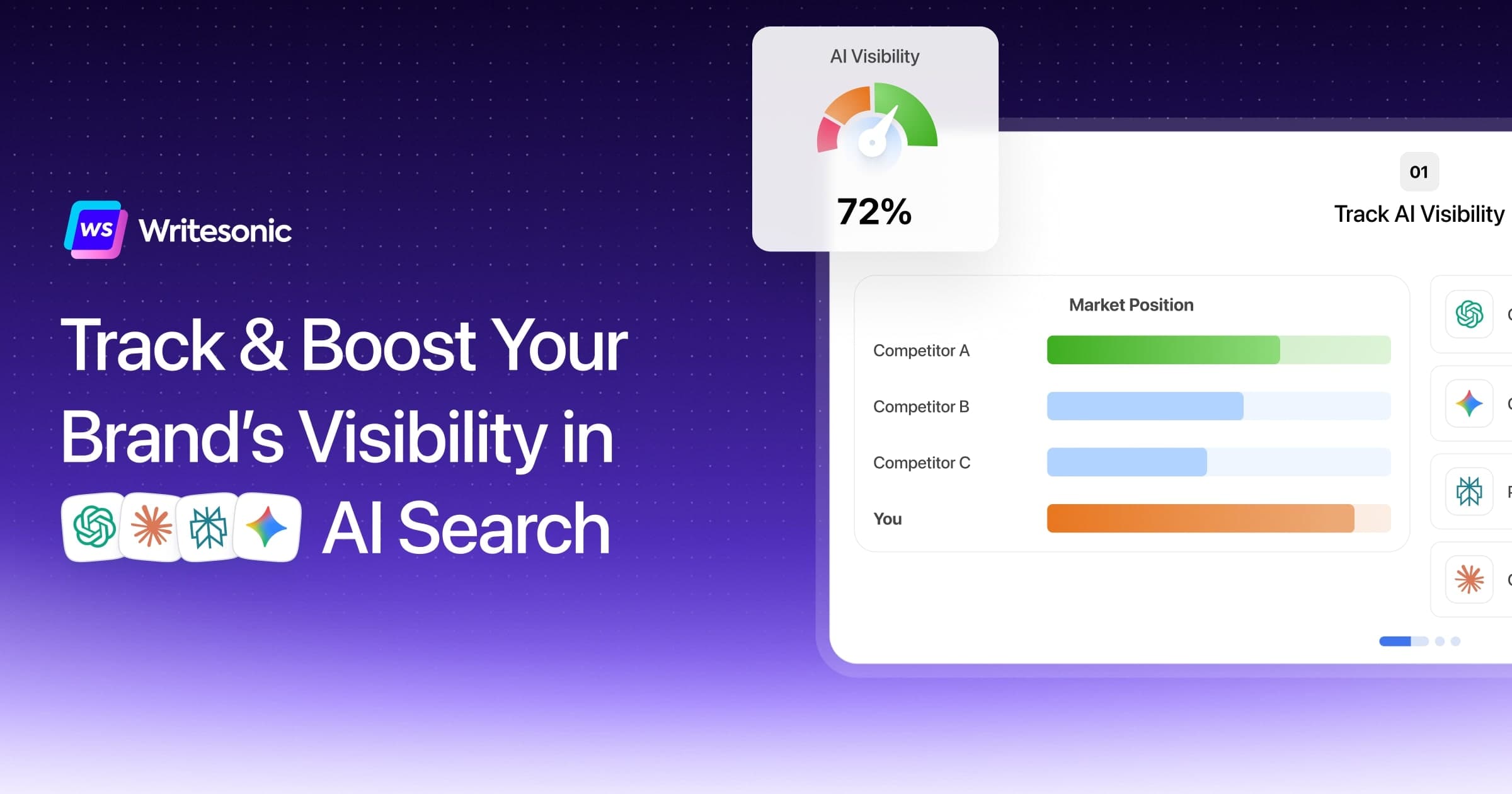

Writesonic pivoted from AI copywriting tool to SEO and GEO content platform. Article Writer 8.0 produces solid structured drafts in under two minutes, but the output still needs editing and its billing practices have left a long trail of complaints.
We gave Writesonic Article Writer 8.0 a real brief: topic "best AI tools for solo founders in 2026," a 250-word brand voice sample, three competitor URLs to analyse, and a 2,000-word article with H2 sections per tool category and a conclusion with a clear recommendation. The three-stage agentic pipeline took 90 seconds. The output was 2,100 words with logical H2 structure and current pricing pulled live. Then we read the opener: "What are the best AI tools for solo founders? Here's what you need to know." A generic question hook, unchanged despite the brand voice training. Three tool descriptions used nearly identical sentence structures. The conclusion restated the body without any original view.
After a 20-minute editing pass, the article was publishable. Door to edited draft: 25 minutes total versus roughly three hours from scratch. The structured first-draft speed is real; the "publish without reading" pitch is not.
What Writesonic catches (and what it misses) in April 2026
Writesonic launched in 2021 as a GPT-3 copywriting template tool. By 2026 it has rebuilt itself as a content and search-visibility suite for teams producing SEO-targeted articles at volume. The pricing page now leads with AI query tracking, site audits, and GEO monitoring, not word counts.
The platform spans five areas. AI Article Writer 8.0 is the flagship: a three-stage agentic pipeline (research, structure, writing) producing 1,500–2,500 word drafts in under two minutes, with Semrush and Surfer SEO scoring integrated. Chatsonic is the conversational layer, drawing on GPT-4o, Claude 3.7 Sonnet, or Gemini, with real-time web search and Deep Research mode. GEO Action Center is the genuine differentiator: it tracks where your brand is cited across ChatGPT, Perplexity, Google AI Overviews, and Gemini, flags where competitors appear instead, and generates remediation recommendations. No direct competitor offers this depth in a single platform as of April 2026. Botsonic is a no-code chatbot builder; Audiosonic and Photosonic handle text-to-speech and image generation.
What Writesonic catches well: broad SEO content on established topics, short marketing copy via 100+ templates, and AI visibility recovery for sites losing citations to AI answer engines. What it misses: niche or expert-voice writing where the agentic defaults are too generic to be useful. One independent tester who supplied 300 words of sample writing and explicit instructions concluded: "I didn't end up using content generated by the Writesonic AI agent because it didn't meet my quality standard."
A real test: AI Article Writer 8.0 on a solo founder brief
Before: An unassisted draft of the same article from scratch takes approximately three hours. The brief in Writesonic's interface, keyword, competitor URLs, brand voice sample, length requirement, took five minutes to configure.
After the agentic pipeline ran: 2,100 words in 90 seconds, with a logical H2 structure and current pricing pulled live from web sources. The brand voice training had a measurable effect, vocabulary was less corporate, matching the sample's informality. The SEO entity mapping surfaced related topic clusters that would have taken manual research to identify.
Where it defaulted: The opener was "What are the best AI tools for solo founders? Here's what you need to know.", a rhetorical question hook unchanged by the brand voice sample. Three tool descriptions used parallel sentence structures. The conclusion restated the body without adding any original recommendation. Roborhythms.com's 2026 review flagged "repetitive article conclusions that restate previous content" as a consistent pattern, not a one-off.
The 20-minute editing pass fixed all three. Door to publishable draft: 25 minutes total versus three hours from scratch. The structured first-draft speed is real. What is not real is the "publish without reading" pitch.
The complaints that keep showing up
Three problems recur in Writesonic reviews across Trustpilot, Reddit, G2, and AppSumo. They are distinct but compound each other.
The first is billing after cancellation. Multiple Trustpilot reviewers describe being charged months or over a year after cancelling, one documented a cycle of cancelling, being charged again, contacting support without response, paying the charge to resolve it, cancelling a second time, and then receiving an invoice for an outstanding balance nearly two years later. From aiwritingpick.com's 2026 review: "Multiple reports of being charged after cancelling their subscription" and "denied refunds" appear consistently across Trustpilot and Reddit.
The second is the AppSumo lifetime deal. Writesonic sold lifetime access through AppSumo in 2021–2022, explicitly promising inclusion of future updates. When the platform restructured, lifetime buyers were locked out of Article Generator 5.0 and its successors. The damage is still visible in review forums four years later:
"I have bought the lifetime subscription in 2021, today in May 2024 I have no use of this application, because I can DO NOTHING with my current plan.". AppSumo reviewer, 2024
"I DO NOT LIKE when LTD supporters are treated as stupid early supporters. And once you get their money, you introduce new features but change your plans so they cannot even get anything unless they pay.". AppSumo reviewer, 2024
The third is the no-rollover policy on monthly article allocations. Unused articles and credits disappear at the end of each billing cycle, a persistent complaint since Writesonic's original credit model. Any month where output volume drops below the plan ceiling is money paid for nothing. The gap between the Starter tier (15 articles/month at $79/month annual) and Basic (25 articles/month at $199/month annual) costs an additional $120/month for 10 more articles, math that frustrates users who consistently produce 16–20 articles per month and cannot justify the tier jump.
Privacy, training data, and your drafts
Writesonic's privacy policy, verified April 2026, draws a clear line between free and paid users, but leaves the paid-plan language less clear than it should be.
Free tier users: Writesonic explicitly retains the right to use your inputs, prompts, and outputs "for the limited purposes of improving, training, and securing our AI models." If you are on the free plan and drafting anything proprietary or confidential, you are training Writesonic's models with that content.
Paid plan users: The training-use restriction for paid accounts is not clearly stated in the public policy. Writesonic's marketing claims a "Zero-Retention Policy where your data is never used to train AI models", but this language appears in enterprise and custom agreement contexts, not in the standard paid plan policy as published. Until that gap is resolved in writing, paid users handling sensitive content should request a Data Processing Agreement before proceeding.
Writesonic claims SOC 2, GDPR, and HIPAA certification, these cover storage and access security, not training-data restrictions specifically. Google and Facebook integration data is excluded from model training in the policy. Payment data is handled by Stripe and PayPal (PCI-DSS). The marketing-to-policy gap on training data is a legitimate concern for anyone handling confidential content: verify the specific terms via a DPA, not the website marketing copy.
Writesonic in your workflow, when it helps vs. when it hurts
The most useful way to evaluate Writesonic is not feature-by-feature but by production volume and content type. The tool has a clear break-even point; below it, the math does not work.
When it helps: Content teams producing 20 or more SEO-targeted articles per month. One tester running Writesonic across an active SEO programme for 30 days reported saving 7–10 hours per week and a 65% organic traffic boost within three months. WordPress publishing, Surfer SEO scoring, and Semrush integration eliminate tool-switching for teams doing structured SEO work. An unexpected use case has grown in 2025–2026: teams using the GEO Action Center to diagnose why previously-ranking pages lost AI citation coverage, treating it as a recovery audit tool rather than a content factory.
When it hurts: Solo bloggers producing fewer than 10 articles per month, for whom the $79/month Starter plan is hard to justify against ChatGPT Plus at $20/month. Niche or technically complex content, where generic pipeline defaults require editing that erodes the time advantage. WordPress integration failures are intermittent: one Reddit user in r/SEO noted "The WordPress integration keeps failing and I have to copy-paste everything manually anyway."
Free vs. paid: is the Starter plan worth it?
Writesonic's pricing restructured significantly in 2025. The old Individual plan at $16/month (cited in many third-party reviews) is gone. The current structure is tiered around SEO and GEO usage. AI queries tracked, articles generated per month, site audits, pages analysed. The free trial requires no credit card but specifics are not published; it functions as an evaluation window, not a permanent tier.
Starter ($79/month annual) covers 15 article generations per month, 50 AI queries tracked, 10 site audits, 100 pages analysed, one seat, and one brand voice. Adequate for a solo content professional with a defined SEO workflow; a low ceiling for anyone at volume. The no-rollover policy means slow months are direct wasted spend.
Basic ($199/month annual) raises the ceiling to 25 articles and 1,200 pages analysed. The jump from 15 to 25 articles costs an additional $120/month annual , $12 per additional article in the increment. Growth ($399/month annual) covers 50 articles, three seats, and 10 brand voices, the tier where Semrush, full GEO Action Center, and SEO AI Agent integration start to carry their cost for a small content team. Enterprise is custom, with a dedicated GEO Strategist and API access.
The decisive question: do you need the SEO and GEO workflow integration, or do you primarily need drafted text? If Surfer, Semrush, GEO Action Center, and WordPress publishing are central to your workflow, Writesonic consolidates real value. If you primarily need article drafts as an individual user, ChatGPT Plus at $20/month covers the writing at one-quarter the Starter price.
Writesonic vs. Jasper vs. ChatGPT
ChatGPT Plus ($20/month) is the pressure Writesonic cannot escape for individual users. GPT-4o with web search, file uploads, and memory covers most of what Writesonic's writing engine delivers, at one-quarter the Starter price. The defensible gap is the SEO workflow: Surfer integration, Semrush data, GEO Action Center, and WordPress publishing. For a solo blogger doing manual SEO, that gap is not worth four times the cost. For a content team running a structured SEO programme, it is.
Jasper (Pro at $59/month annual) is now priced comparably to Writesonic's Starter, a reversal of the old positioning where Writesonic was the budget alternative. Jasper rebuilt itself as an enterprise brand governance platform; Writesonic's strength is SEO and GEO integration. A brand-governance-first team and a search-visibility-first team are solving different problems. Both face the same structural pressure from ChatGPT for individual users.
Writesonic's AppSumo lifetime deal episode and recurring billing complaints are not minor footnotes, they appear in virtually every critical review as evidence of vendor behaviour under pricing pressure. The SEO pivot and Article Writer 8.0 are genuine improvements. The trust damage from 2023 has not been fully repaired.
User Reviews
No reviews yet. Be the first to share your experience!
Sign in to write a review.
Related articles
Guides and articles related to Writesonic.
Undetectable AI Review (2026): What It Does, What It Costs, and 7 Alternatives
AI SEO Content at Scale: Publish 20 Posts a Month Without Hiring Writers

Wix Logo Maker Review (2026): Real Costs, the Edit Catch, and AI Alternatives
AI User Testing in 2026: The Tools That Test Your Product While You Sleep
Google Vision AI Explained (2026): Pricing Per 1,000 Units, Free Tier, and Alternatives