AI Customer Support Automation: Cut Ticket Volume 50% Without Hurting CX
AI Customer Support Automation: How to Cut Ticket Volume 50% Without Hurting CX (2026)
Most support teams handle the same 40 questions on repeat, every day, at human-agent rates. AI customer support automation changes that equation, but only if the architecture is right. This guide walks through the full deflection stack: knowledge base, retrieval-augmented generation (RAG) bot, confidence-based handoff rules, and a QA feedback loop. Built and wired together correctly, operators report 40-60% ticket deflection within 90 days. Built carelessly, you get a bot that traps customers in loops and tanks CSAT. The difference is in the design decisions described below.
TL;DR:
A structured knowledge base is the foundation. A bot is only as accurate as the content behind it.
RAG retrieval beats intent-matching for FAQ depth; confidence threshold below ~65% triggers human handoff.
The handoff experience, not the deflection rate, determines whether CSAT rises or falls.
Operators report 40-60% deflection in production; vendor demo numbers (80-90%) reflect optimal conditions.
A monthly QA loop that feeds failed resolutions back into the knowledge base compounds the deflection rate over time.
What Is Ticket Deflection and How Much Can You Realistically Expect?
Ticket deflection means a customer gets a complete, satisfying answer without a human agent ever touching the conversation. Independent benchmarks across thousands of production deployments land in the 40-60% deflection range for well-implemented systems. Vendor showcases typically report 80-90%, but those draw from their best-performing customers, not the median.
A 2025 survey published by BusinessWire found that teams using agentic AI handled 57% more tickets without adding headcount. Intercom's published benchmark for its Fin AI product, across more than 7,000 customer accounts, puts average autonomous resolution at 67% as of Fin 3 (late 2025). Zendesk's CX Trends 2026 data puts the median tier-1 deflection rate at 41.2%, with the top quartile at 58.7%. The realistic target for an SMB or mid-market support team with a clean knowledge base and proper handoff configuration is 40-55% deflection within the first 90 days, growing toward 60%+ as the QA loop matures.
Deflection and resolution are not the same metric. Deflection measures containment (the conversation stayed in the bot channel). Resolution measures outcome (the customer's problem was actually solved). Build for resolution. Deflection is a byproduct.
What Does the Full Deflection Architecture Look Like?
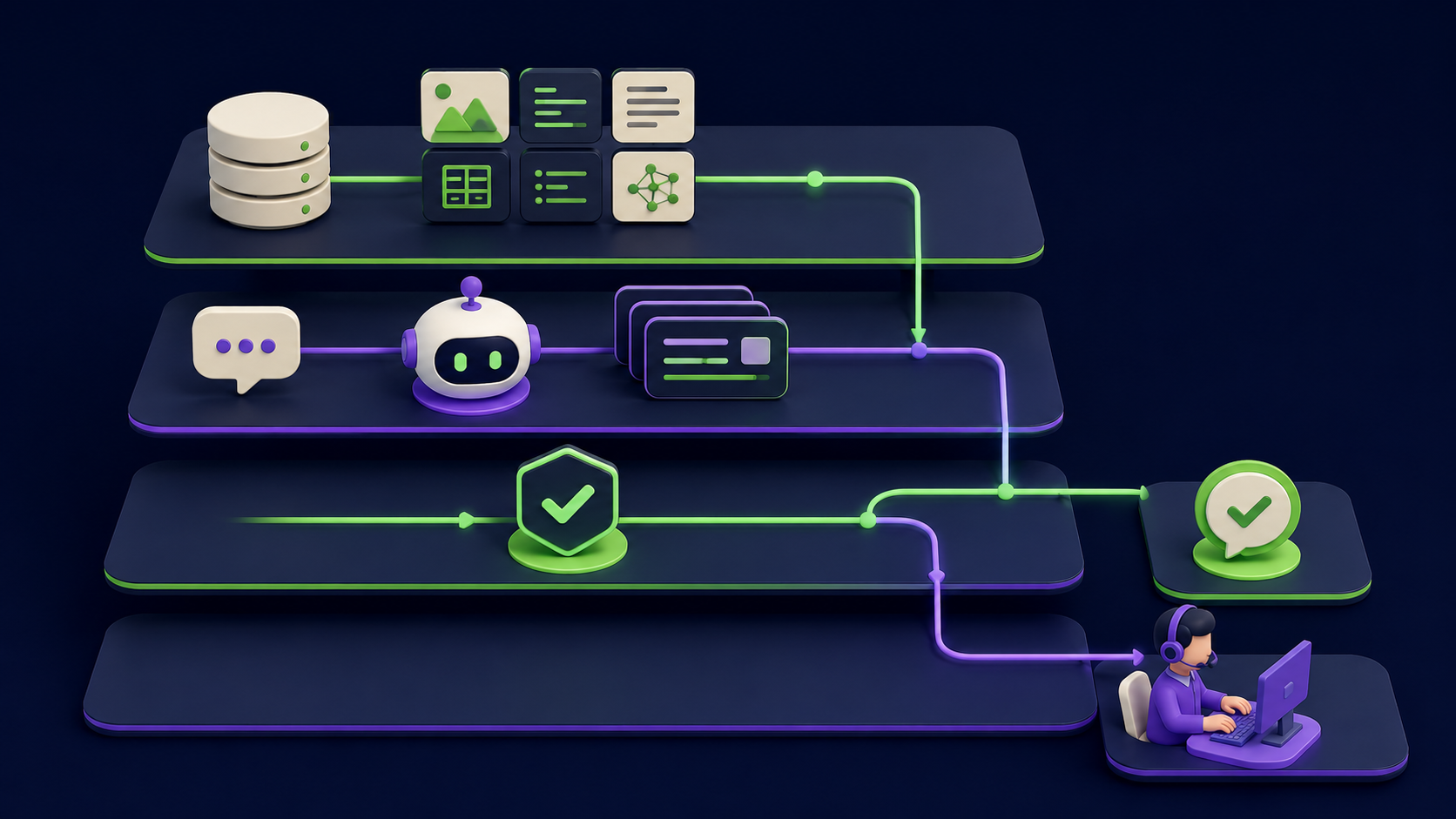
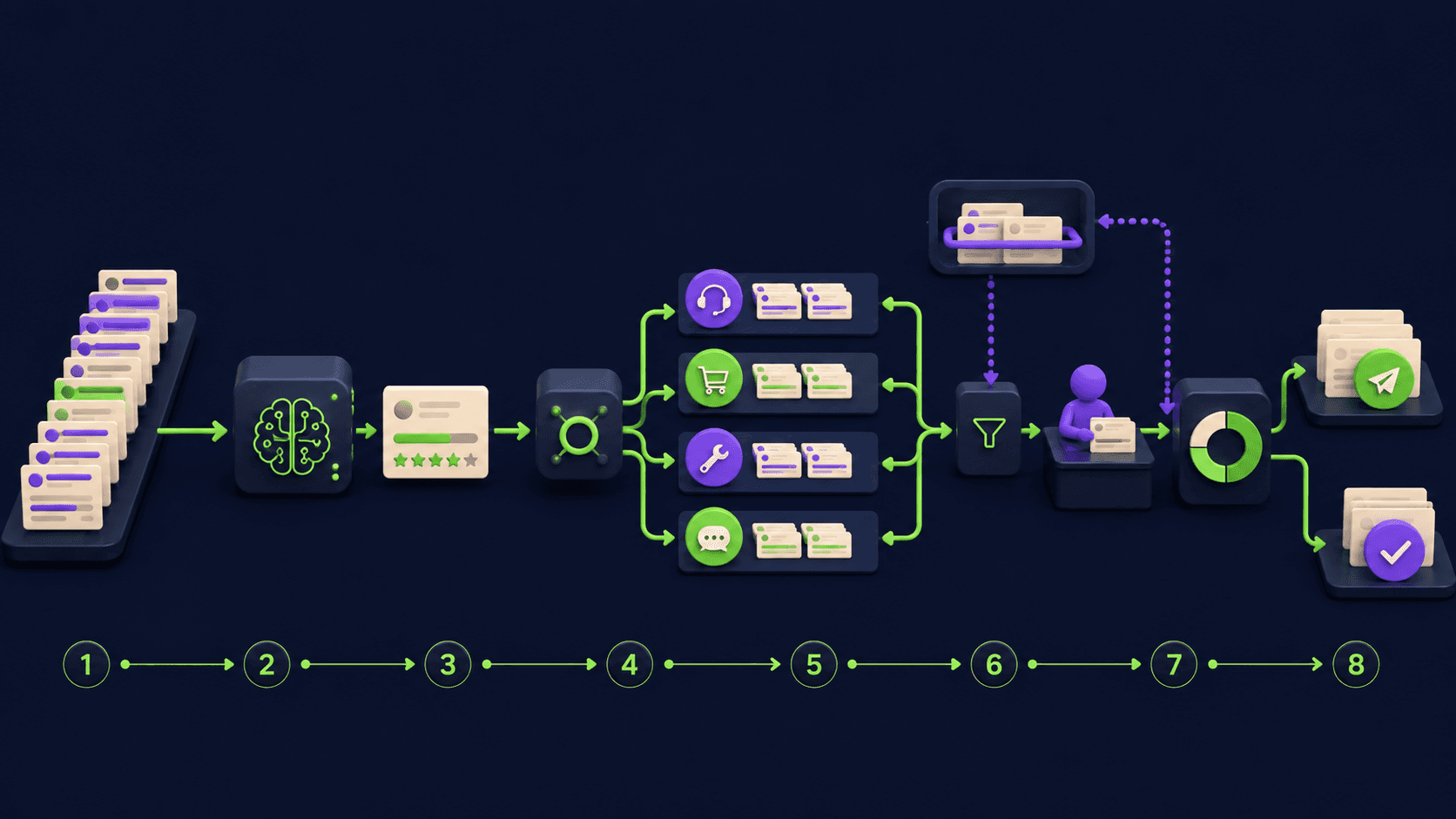
The deflection stack has four layers that must be built in order. Skipping the knowledge base layer and jumping straight to a bot is the most common mistake. Here is how each layer works and how they connect.
Layer 1: Structured Knowledge Base
Every automated answer the bot gives traces back to a knowledge base article. Articles need to be chunk-ready: short headings, one topic per article, specific enough to answer one question. A 3,000-word general FAQ page is much harder for a retrieval system to use accurately than 20 focused articles of 150 words each.
Before touching any bot software, audit your existing help center. Categorize articles as: authoritative and current, accurate but needs chunking, outdated, or missing entirely. The missing-articles list is your build backlog. At minimum, cover your top 20 inbound question types before going live. This step takes one to two weeks and determines 80% of your bot's eventual accuracy.
Layer 2: RAG Retrieval Bot
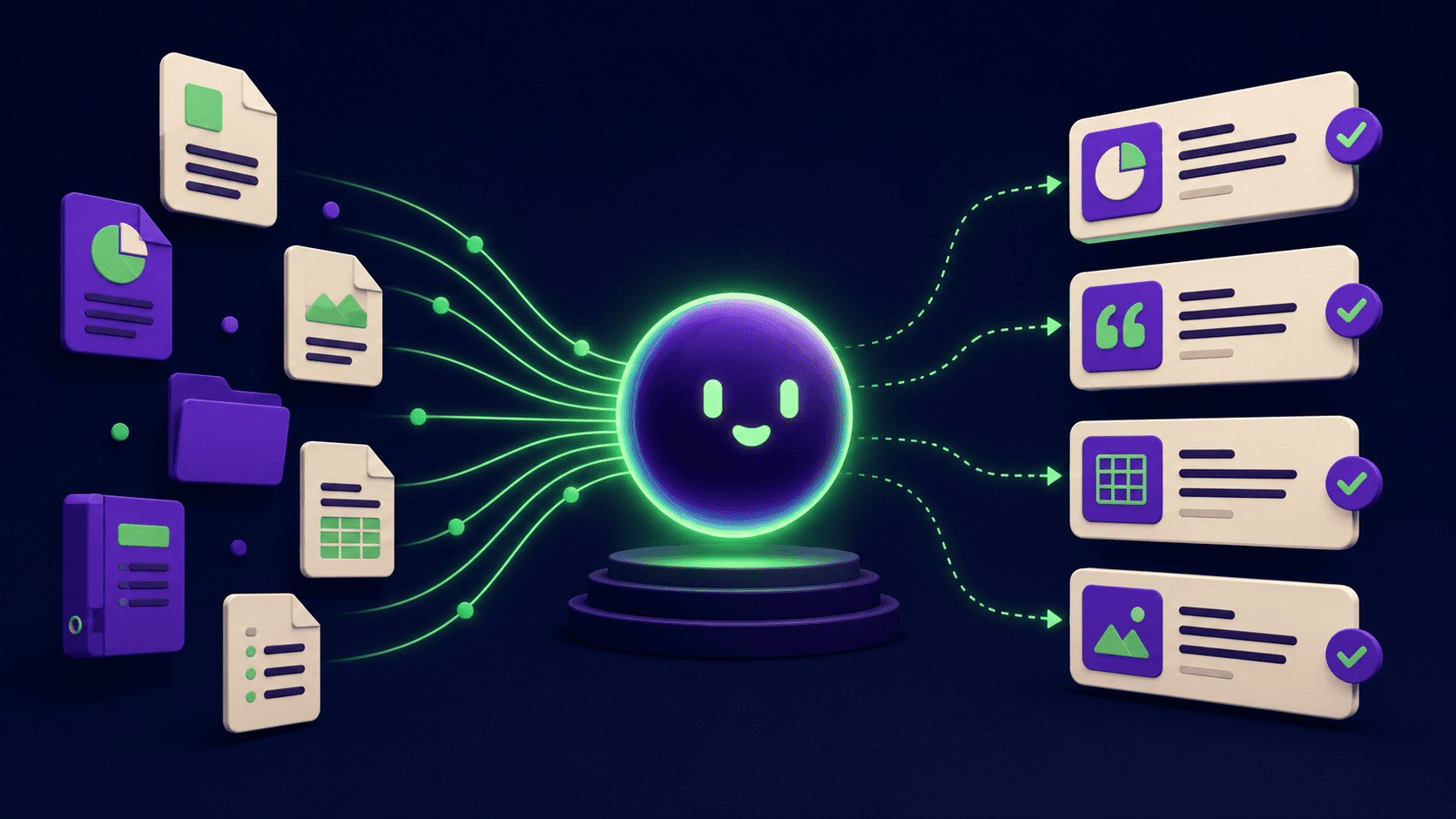
A retrieval-augmented generation bot combines a vector search over your knowledge base with a language model that synthesizes the retrieved chunks into a natural answer. This outperforms intent-matching chatbots for two reasons: it handles phrasing variation without needing to manually map every synonym, and it can compose answers from multiple articles when a question spans more than one topic.
The vector store holds embeddings of your knowledge base chunks. At the open-source end, Weaviate is a production-grade vector database well-suited to this workload. The retrieval layer pulls the top-k most relevant chunks based on the user's query embedding. The LLM layer synthesizes those chunks into a response. If no chunks clear a similarity threshold, the query routes to the handoff layer instead of generating a hallucinated answer.
For orchestration, n8n is the tool most operators at the SMB and mid-market level use to wire this pipeline together. A single n8n workflow can accept an inbound ticket via webhook, query the vector store, call the LLM, evaluate the confidence score, and branch to auto-answer or human queue. See the 15 n8n workflows you can build in a weekend for reference architectures.
For businesses that want a managed support-specific product rather than a custom build, Intercom Fin and Zendesk AI are the leading off-the-shelf options at mid-market scale. For SMBs, Tidio (with its Lyro AI agent) is a frequently cited entry-level option that reports resolving up to 70% of requests automatically. None of these replace the knowledge base work. They all retrieve from it.
Layer 3: Confidence Threshold and Human Handoff
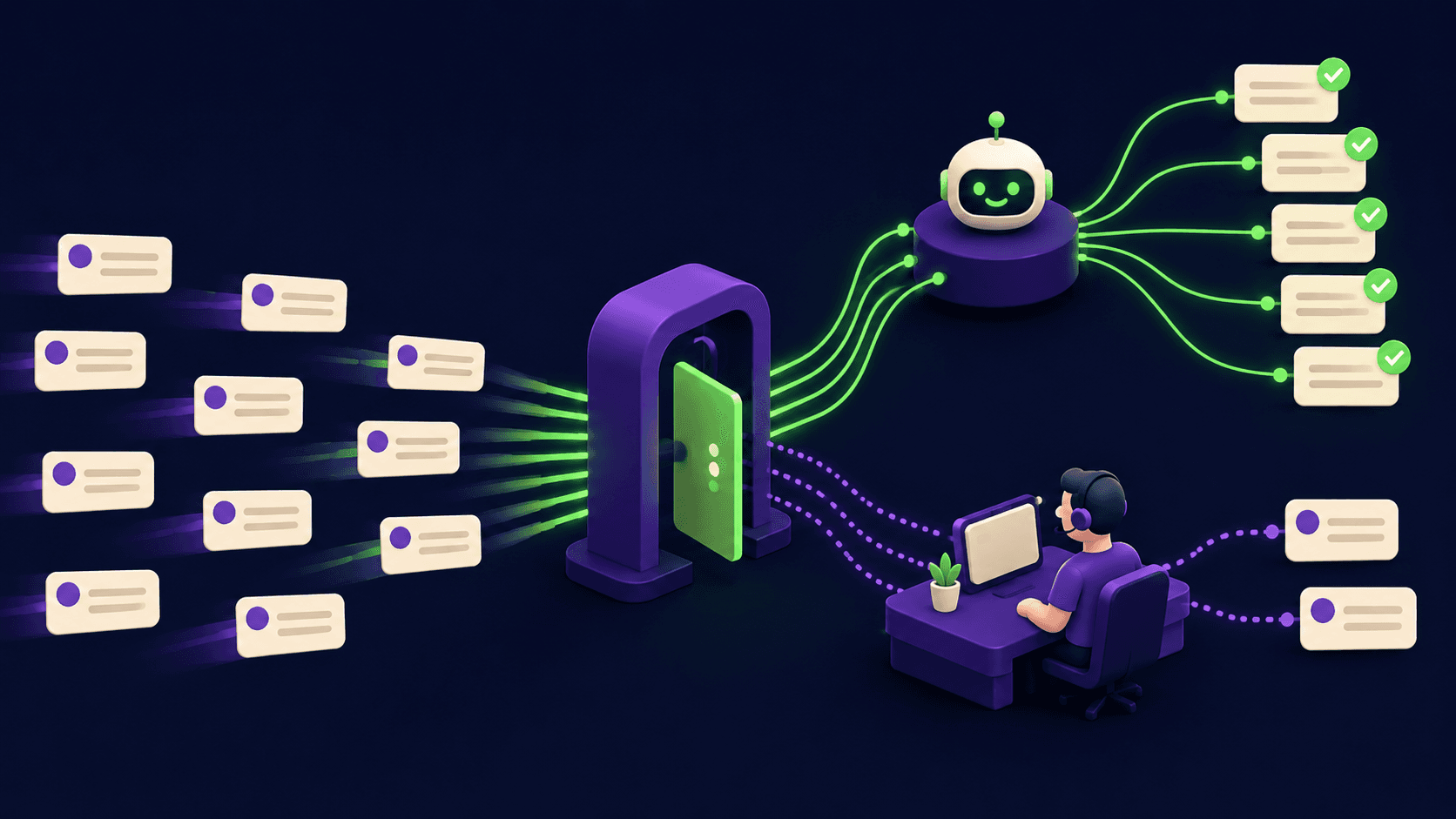
This is where most implementations get into trouble. Two failure modes exist: escalating too eagerly (the bot defers on everything, agents stay buried) and escalating too late (the bot gives low-confidence answers, customers get wrong information, CSAT drops).
The right design is a confidence threshold built into the routing logic. When the retrieval similarity score or the LLM's self-assessed confidence falls below roughly 65%, the conversation routes to a human agent. The exact threshold should be tuned against your CSAT data during the first 30 days.
Beyond the confidence score, certain conversation signals should always trigger immediate escalation regardless of confidence:
The customer states they have already tried the bot's suggested solution and it did not work.
The conversation contains explicit frustration signals ("this is unacceptable," "I want to speak to a person," "cancel my account").
The ticket type is in the "always human" category (see routing table below).
The conversation has looped more than twice on the same question without resolution.
The topic involves billing disputes, legal claims, or personal data removal.
When a handoff triggers, the agent must receive the full conversation history plus a structured summary: the customer's stated issue, what the bot attempted, what the customer said in response, and the confidence score that triggered escalation. Agents who receive context start solving faster. Customers who do not have to repeat themselves report significantly higher post-escalation satisfaction.
The agent handoff pattern guide from BuildMVPFast (2026) documents the implementation patterns in detail, including how to pass structured context across support platforms without losing thread history.
Layer 4: QA Loop and Knowledge Base Feedback
The deflection rate at month one is not the deflection rate at month six, if you run a QA loop. Every conversation the bot failed to resolve is a training signal. Collect them weekly. Categorize each failure: missing article, inaccurate article, retrieval miss, or question outside scope. For the first two, update or create the relevant knowledge base content. For retrieval misses, investigate whether the chunking strategy needs adjustment. For out-of-scope questions that recur, decide whether to build coverage or add them to the explicit "always human" list.
This loop is what separates a 40% deflection rate that stays at 40% from one that climbs to 60% by month three. See how to replace manual processes with n8n AI agents for a pattern that automates the failure-categorization step using a secondary LLM call inside the same workflow.
Which Ticket Types Should You Automate, Assist With, or Always Handle With a Human?
Not every ticket type is the same automation candidate. The table below covers the most common categories. Use it as a starting point for your own routing policy, adjusted for your product and customer base.
Ticket type | Routing decision | Rationale |
|---|---|---|
Order status / tracking | Automate fully | Deterministic answer from order API. No judgment required. |
Password reset / account access | Automate fully | Standard flow, verifiable by system state. |
Return and refund policy questions | Automate fully | Policy is static and well-documented. |
Product FAQ (features, pricing, availability) | Automate fully | High-volume, low-variance. Strong RAG candidate. |
How-to / setup guides | Automate fully | Covered by documentation. Good for retrieval. |
Billing discrepancy (first contact) | Assist (bot drafts, agent reviews) | Bot can pull account data and draft response; agent confirms before sending. |
Bug reports / technical errors | Assist | Bot can triage and collect reproduction info; engineer review needed. |
Complex multi-part questions | Assist | Retrieval may pull partial coverage; agent fills gaps. |
Churn / cancellation intent | Always human | High stakes, relationship-sensitive. Bot intervention increases churn risk. |
Legal or compliance requests (GDPR, data deletion) | Always human | Requires documented process and accountability. |
Escalated complaints (second+ contact) | Always human | Customer has already experienced a failure. Human presence is necessary. |
Safety or sensitive personal situations | Always human | No exception. Emotional context requires human judgment. |
How Do You Protect CSAT While Deflecting More Volume?
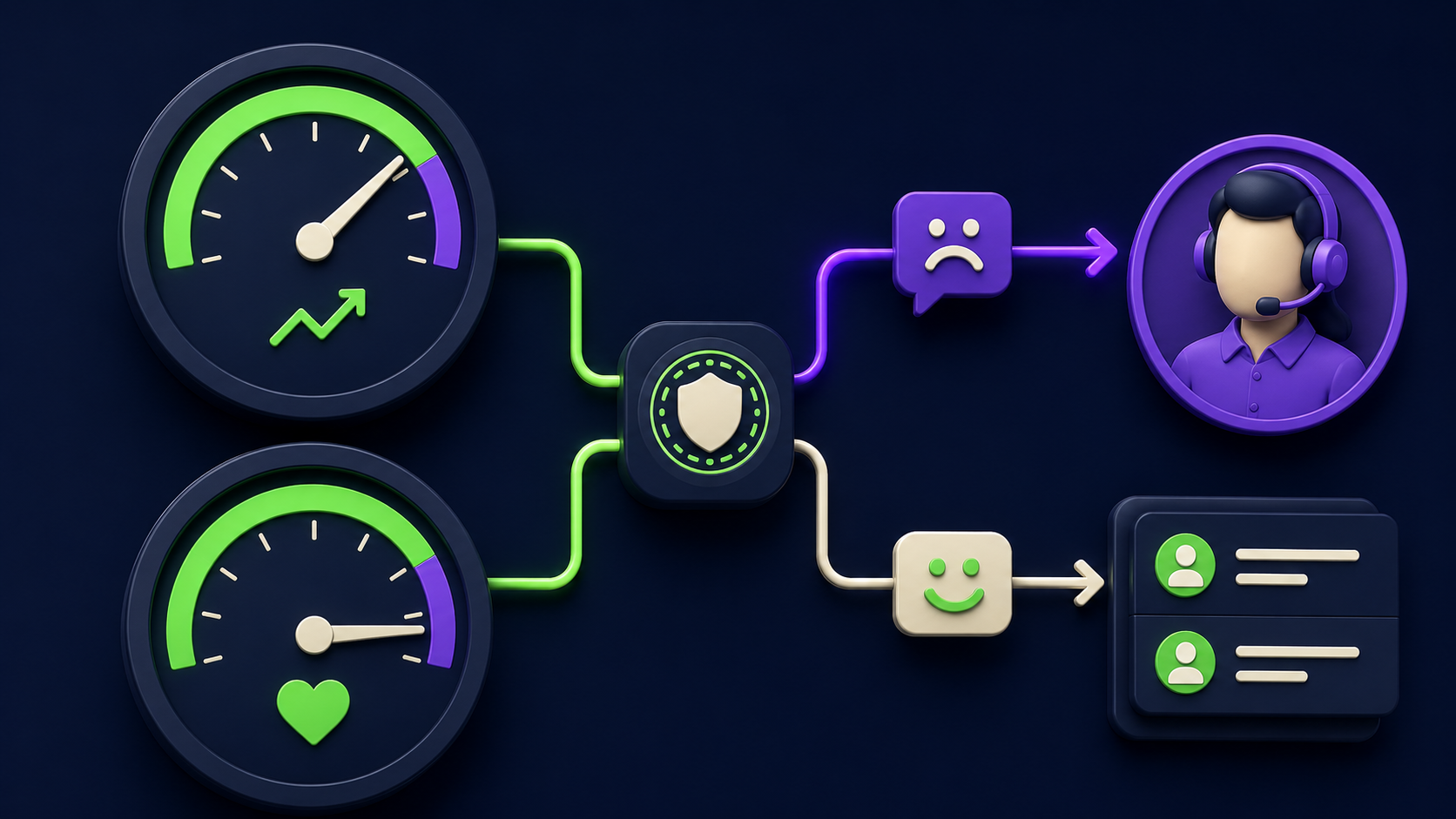
CSAT drops happen when one of four things goes wrong: the bot answers with incorrect information, the bot keeps the customer in a loop when they want a human, the handoff loses conversation context, or the agent queue wait time after escalation is too long. Fix all four, and CSAT typically rises alongside the deflection rate.
Zendesk's CX Trends 2025 data found that businesses running a structured hybrid model (bot for tier-1, agent for everything else) reported an 18% CSAT improvement within 90 days compared to their all-human baseline. The mechanism is straightforward: agents stop spending time on repetitive queries and can give fuller attention to escalated conversations, which are the ones where CSAT actually matters most.
Three rules that protect CSAT in practice:
Never trap the customer. Every bot conversation must have an accessible "talk to a human" path. If a customer asks directly, route them immediately, no conditions.
Warm handoff with context. The agent receives the full conversation history plus a one-paragraph summary generated by the bot. The customer never repeats themselves.
Measure post-escalation CSAT separately. If escalated conversations score 10-15% lower than auto-resolved ones, the handoff experience, not the bot itself, is the problem. Fix the context transfer before adjusting anything else.
This is the architecture Vantaige implements for clients building support automation. The full directory of customer support AI tools lists the software layer options at each step. For broader context on what these agent systems actually look like under the hood, see the guide to AI agent use cases across five industries.
What Does a Custom-Built RAG Support System Cost to Operate?
Cost structure depends heavily on whether you use a managed SaaS product or build on open-source components. For reference, here is how the two paths compare.
Managed SaaS (Intercom Fin, Zendesk AI): Pricing in 2026 is increasingly outcome-based. Zendesk charges $1.50 per automated resolution at committed volume, $2.00 pay-as-you-go. For a team resolving 2,000 tickets per month via AI, that is $3,000 per month before existing seat costs. Intercom Fin pricing varies by plan. Both include the retrieval infrastructure.
Custom build (n8n + Weaviate + LLM API): Infrastructure costs at 2,000 resolutions per month run $200-600 depending on LLM token volume and vector store tier. The upfront build cost depends on complexity. Maintenance requires a recurring QA hour investment but gives you full control over the routing logic, handoff behavior, and which data sources the bot can access. This path makes economic sense above roughly 3,000 tickets per month, or when business-specific routing rules would require heavy customization of a SaaS product. The 2026 AI automation rate card documents what operators charge to build this type of system.
Either path should be evaluated against a blended cost-per-resolution baseline (what one human-handled ticket costs including fully loaded agent salary and overhead). The break-even deflection rate at which AI becomes cheaper than human handling is typically 25-30% deflection for a 10-person support team. Beyond that, savings accrue linearly with volume.
For context on when to build vs. subscribe, see the analysis of replacing SaaS subscriptions with n8n AI agents and the patterns in AI agents for business automation.
What Are the Most Common Mistakes Teams Make When Deploying Support AI?
These failures show up across implementations regardless of which software platform is used.
Launching before the knowledge base is complete. A bot with 60% knowledge base coverage will hallucinate on the remaining 40% of question types. Customers do not distinguish between "the bot didn't know" and "the company gave me wrong information." Build the KB first.
No explicit "always human" routing rules. Billing disputes, cancellation intent, and complaints from customers contacting for the second time after a prior failure all require human handling. A bot that fields these questions directly will close them incorrectly and create silent churn.
Measuring deflection instead of resolution. A conversation the bot "deflects" (closes without escalation) but does not resolve creates a customer who contacts again, either by phone, email, or social. Track recontact rate alongside deflection. If recontact rises, the deflection number is misleading.
Skipping the handoff context transfer. Agents who receive a conversation with no summary ask the customer to repeat themselves. Every repetition drops CSAT. The context transfer is not optional engineering work; it is a direct CSAT variable.
No QA loop. Deflection rates plateau without feedback. Schedule a 60-minute monthly review of failed bot conversations. The compounding improvement over 6-12 months is the difference between a 40% and a 60% deflection rate.
Treating all ticket types the same. Churn conversations handled by a bot, without escalation, report higher account cancellation rates than the same conversations handled by a human. Routing policy is not a technical problem. It is a revenue protection decision.
FAQ
How long does it take to see 50% ticket deflection?
Most teams see 30-40% deflection within the first 30 days if the knowledge base covers the top 20 inbound question types before launch. Reaching 50-60% typically takes 60-90 days, driven by the QA loop filling knowledge base gaps identified from real conversations. Operators with a well-documented product and a clean existing help center tend to ramp faster.
Will an AI support bot hurt customer satisfaction?
A bot with correct answers, a working "talk to a human" path, and context-rich handoffs does not hurt CSAT. It often improves it, because agents spend less time on repetitive volume and give fuller attention to escalated conversations. The risk is a bot that answers incorrectly or traps customers. Both are implementation failures, not inherent properties of the technology.
What confidence threshold should trigger a human handoff?
Start at 65% confidence. Below that threshold, route to a human agent with the full conversation history attached. Tune the threshold up or down based on your first 30 days of CSAT data on bot-handled vs. escalated conversations. The right threshold differs by product complexity and ticket type. Billing and account questions typically need a higher threshold (70-75%) than product FAQ questions (55-60%).
What is RAG and do I need it for customer support?
RAG (retrieval-augmented generation) means the bot retrieves relevant content from your knowledge base before generating an answer, rather than relying on a model's training data alone. For customer support, RAG is the right architecture because your product details, policies, and pricing are not in any model's training set. Without RAG, the bot either hallucinates or can only answer generic questions. With RAG, the bot answers from your actual documentation.
Can I automate billing dispute resolution?
First-contact billing questions (checking a charge, explaining an invoice line) are good "assist" candidates: the bot pulls account data and drafts a response, but a human agent reviews and sends it. Full autonomous resolution of billing disputes is high-risk because errors create financial liability and escalate churn. Keep a human in the loop for anything that involves a credit, refund, or account adjustment until you have 90+ days of data proving bot accuracy on that category.
How do I measure whether the AI is actually saving money?
Calculate your fully loaded cost per human-handled ticket (agent salary plus benefits, divided by tickets per agent per month). Multiply that by the number of tickets the bot resolves each month. Subtract the AI infrastructure cost (API fees, platform subscription, or build cost amortized). The difference is the monthly saving. Track recontact rate to confirm deflected tickets are genuinely resolved, not just pushed to another channel.
What happens to agents when you deflect 50% of volume?
Agents handle fewer tickets but more complex ones. Most teams do not immediately reduce headcount. They redeploy agents from tier-1 triage to churn recovery, proactive success outreach, and quality review. The operations leaders who see the most value from support AI are the ones who explicitly redesign agent roles, not just reduce ticket queues. A smaller tier-1 queue with no new agent mandate typically produces better CSAT from the remaining human interactions.
Do I need a dedicated developer to build and maintain this?
For a custom RAG build (n8n + Weaviate), you need initial build capacity, either a developer or an automation specialist. Ongoing maintenance, primarily the monthly QA loop and knowledge base updates, is manageable by a non-technical support lead once the system is live. For managed products like Intercom Fin or Zendesk AI, a technical setup is minimal. The knowledge base work is the same regardless of platform. See the overview of AI agents for business for the full scope of what can be automated without a dev team.
Want your back office automated for you?
Vantaige audits your operations, finds the hours bleeding into manual work, and builds the AI workflows that reclaim them. Book a free process automation audit and we will show you the first three workflows worth building.
Related from Vantaige
References
BusinessWire: Survey Finds Agentic AI Helps CX Teams Handle 57% More Tickets (April 2025)
CreateWith: Intercom Fin 3 Reaches 67% Average Resolution Rate (2025)
DigitalApplied: AI Customer Support 2026 - 50+ Adoption and ROI Data Points
BuildMVPFast: Agent Handoff Patterns - AI to Human Escalation Confidence Threshold (2026)
Get the best new AI tools and guides, weekly
One short email a week. The tools worth trying, the guides worth reading, nothing else.
No spam. Unsubscribe anytime.
Aymen B
Contributing writer at Vantaige, covering the AI tools ecosystem.