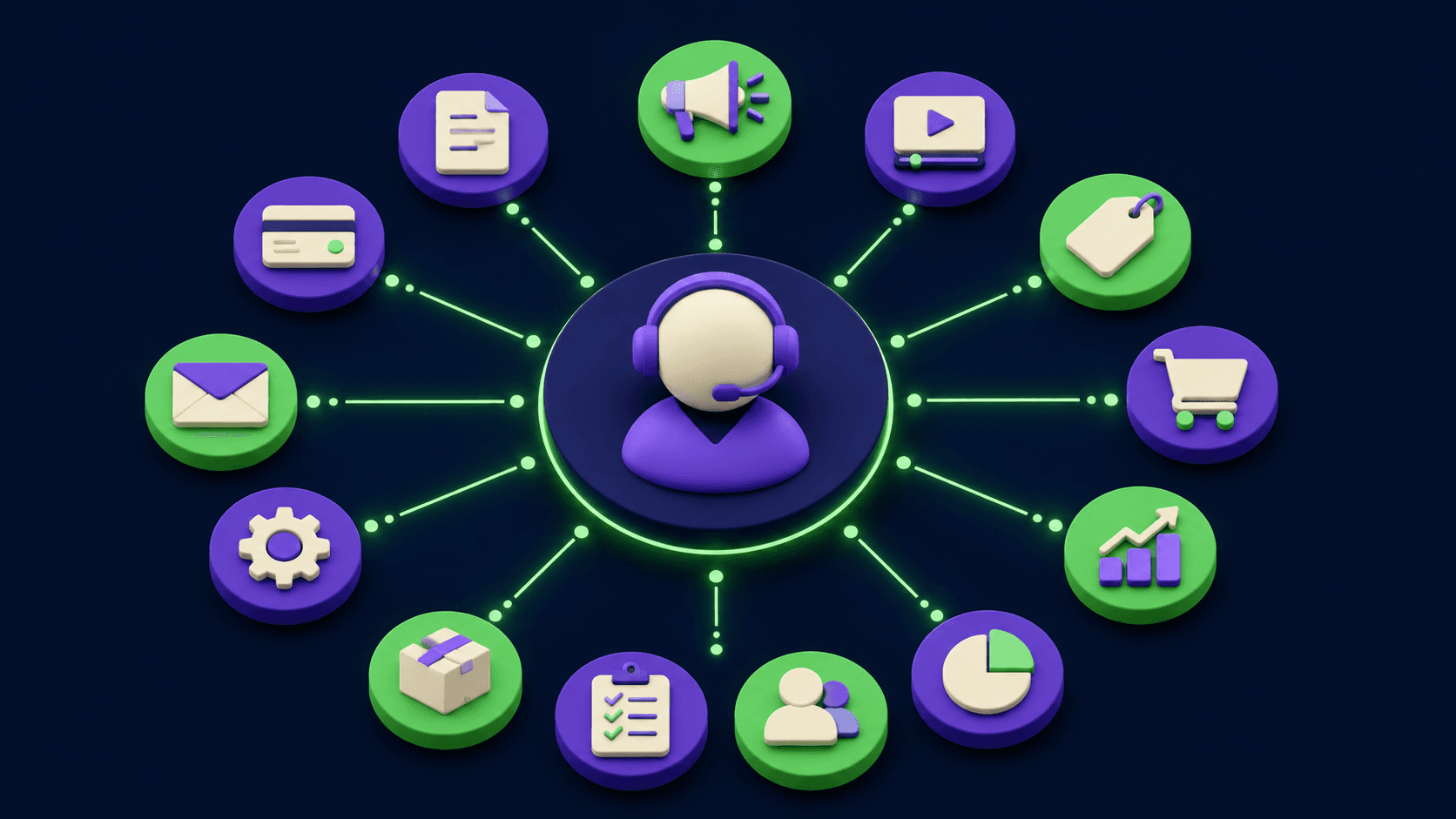
Chatbase turns your documentation, PDFs, and website content into a deployable AI customer support agent with no coding required. Built by solo founder Yasser Elsaid, it serves 10,000+ businesses and starts at $40/month.
Chatbase is a no-code AI chatbot builder that lets businesses train a custom support agent on their own content and deploy it across their website, WhatsApp, Slack, Instagram, and other channels. It was built and launched in February 2023 by Yasser Elsaid, a 24-year-old Egyptian-Canadian software engineer working through his final year of university. The company is 100% bootstrapped and has grown to over $8M in annual recurring revenue serving more than 10,000 businesses worldwide, including brands like Chuck E. Cheese, Bridgestone, and IHG. Under the hood, it uses retrieval-augmented generation (RAG) architecture on top of OpenAI and Anthropic models, pulling relevant content from your training sources to answer user questions accurately.
The core workflow is straightforward: upload PDFs, paste URLs, connect a Notion workspace, or drop in plain text, and Chatbase indexes that content into a searchable knowledge base. The resulting agent can be embedded as a website chat widget, connected to WhatsApp or Messenger, or reached via API. Beyond Q&A, the platform supports AI Actions that let agents take real steps, updating subscriptions, rescheduling appointments, pulling order status from integrations like Stripe and Zendesk, and escalating to a human help desk when needed. As of April 2026 the platform added voice calling (inbound phone handling) and integrated GPT-5.5 and Claude Opus 4.7 as model options alongside its existing lineup. The May 2026 changelog added Chatbase Widgets, which let agents respond with visual cards showing product details, order summaries, and flight information rather than plain text alone.
What Chatbase actually is in May 2026
The product started as "ChatGPT for your PDFs" in early 2023. That version was simple: upload a document, get a chatbot that could answer questions about it. Over two years of continuous development (founder Yasser Elsaid said in his two-year anniversary post that he had taken roughly 10 days off total), the platform has evolved into a customer-facing AI agent system with real workflow capabilities. The training pipeline handles text extraction from PDFs, web scraping from URLs, CSV parsing, and integrations with Notion and Google Drive. The knowledge base auto-retrains when source content changes, which removes the manual upkeep burden that similar tools require.
The agent configuration layer lets you set a persona, define the tone, control which topics the bot will and won't answer, and specify escalation rules in natural language. Deploying to a website takes an embed script; WhatsApp and Slack connections go through OAuth integrations. The help desk feature, added May 5, 2026, surfaces conversations that needed human involvement into a unified dashboard so support teams can manage escalations without switching between tools. The Widgets feature from May 11, 2026, is a meaningful upgrade for e-commerce use cases, where structured visual responses outperform plain text for product lookups and order confirmations.
Model choice matters for cost: advanced models like GPT-4-class options consume 20 message credits per response, while lighter models use just one. That 20x multiplier is something many users discover after their first billing cycle rather than before it.
"My tweet went viral. I didn't even have a pricing page yet." - Yasser Elsaid, founder, Indie Hackers interview, May 2023
Where Chatbase sits versus Botpress and Voiceflow
The chatbot builder space has three distinct product philosophies, and Chatbase, Botpress, and Voiceflow each represent one of them cleanly.
Chatbase is the RAG-first, no-code approach. The entire value proposition is: connect your knowledge sources, configure a persona, deploy. There is no visual flow builder, no conditional logic editor, no branching conversation designer. The AI handles intent and routing by itself, which works well when your content is comprehensive and your questions are within scope. When they are not, the bot either hallucinates or declines, depending on your escalation settings. You cannot build a checkout flow, an onboarding wizard, or a multi-step approval process inside Chatbase. That is a hard architectural limit, not a missing feature on a roadmap.
Botpress takes the opposite approach. It is open source (MIT license), self-hostable via Docker with PostgreSQL and Redis, and built around a node-based logic editor where developers define conversation steps, write JavaScript or TypeScript transitions, and inject LLM calls at specific points in the flow. Native human handoff, persistent conversation memory, and conditional branching are built in. The tradeoff is a steep onboarding curve: 68% of active Botpress users are developers or DevOps engineers, and setup typically takes two to eight hours for a basic deployment. For teams that need full control over conversation architecture and prompt engineering, Botpress delivers capabilities that Chatbase simply cannot match. For a non-technical founder who needs something live this afternoon, Botpress is the wrong tool.
Voiceflow sits between the two, using a visual conversation canvas designed for product and CX teams. It supports multi-channel flows including Alexa and telephone IVR through Twilio, which Chatbase did not have until April 2026 and Botpress only reaches via third-party integration. Voiceflow's Knowledge Base step embeds LLM Q&A within a larger designed flow, giving teams both the visual structure of a flow builder and the flexibility of RAG responses. The pricing model is its main friction point: per-editor seat pricing means a five-person team on the Business plan pays $750/month in seat costs before any usage credits. Voiceflow is genuinely the stronger choice for enterprise product teams building complex voice and chat experiences. It is not the right tool for a solo founder or small team that needs a working website chatbot by end of day.
For a mention of the fourth alternative that shapes this category, ManyChat is worth naming separately: it is not a knowledge-base chatbot builder at all. ManyChat is social-first automation for Instagram DMs, Facebook Messenger, and WhatsApp campaigns. It uses keyword triggers and pre-built flows rather than RAG training. If your goal is proactive broadcast messaging to a subscriber list, ManyChat is the correct tool and Chatbase is irrelevant. If your goal is inbound Q&A support on your website, ManyChat does not compete.
How AI actually works inside Chatbase
The architecture is retrieval-augmented generation running on OpenAI and Anthropic model backends. When a user sends a message, Chatbase embeds the query and performs a similarity search against your stored content chunks. The top-ranked chunks are injected into the system prompt alongside your persona instructions, and the selected model generates a response grounded in that context. This is why Chatbase works well for factual Q&A about documented topics and struggles with anything requiring reasoning across multiple sources, step-by-step logic, or real-time data it was not trained on.
AI Actions extend this by letting the agent call external APIs mid-conversation. When a user asks "What is the status of my order?", the agent can query a Stripe or Shopify integration, retrieve live order data, and incorporate it into the response. The Hobby plan allows five Actions per agent, Standard allows eight, and Pro allows twelve. These action limits, combined with message credit caps, are the main scaling constraint for growing businesses.
The model selection added in April 2026, including GPT-5.5 and Claude Opus 4.7, gives teams access to more capable reasoning for complex queries. The credit multiplier for premium models means this capability comes at a real per-conversation cost that compounds quickly at scale.
"The problem with 'hallucination' is quite apparent and the bot WILL generate a totally wrong answer." - Rik H., Capterra review, September 2023
The friction Chatbase users keep raising
Credit billing opacity is the most consistent complaint. Message credits are not a 1:1 mapping to user conversations. A GPT-4-class model consumes 20 credits per response; a lighter model consumes one. The practical result is that users on the Hobby plan's 500-credit allowance may be getting 25 substantive GPT-4-level responses per month, or 500 lightweight ones, with no easy way to predict which until the bill arrives. Auto-recharge at $40 per 1,000 additional credits adds an unpredictable variable to monthly costs.
The tier jump problem compounds this. The gap from Hobby ($40/month) to Standard ($150/month) is a 275% increase for businesses that outgrow 500 credits. The gap from Standard to Pro ($400-500/month) is a further 233% jump. There is no middle tier and no metered billing option. When traffic spikes, businesses hit a hard wall rather than paying incrementally.
Branding removal deserves its own mention. The "Powered by Chatbase" badge costs $99/month ($1,188/year) to remove, more than twice the Hobby plan price. Custom domains add another $59/month. For businesses that want a fully white-labeled experience, the add-on costs can add $1,500+ to the annual bill on top of the base plan. Users who discover this after signing up describe it as unexpectedly expensive for what should be a basic professionalism option.
Hallucination on out-of-scope questions is a persistent issue. Users on Capterra report bots fabricating URLs that include their company domain but lead nowhere, and generating confident wrong answers when the training content does not cover the query. The fix is to configure the agent to decline gracefully when outside its knowledge, but this requires deliberate persona configuration that not every user does upfront.
Tools like Dify and AnythingLLM serve as self-hosted alternatives when data residency or cost predictability is the primary concern; both support bring-your-own-model setups that Chatbase's SaaS model does not offer.
Who Chatbase is for
The strongest fit is a non-technical founder or small customer support team that needs a working FAQ bot in under an hour. If you have a help center, product documentation, or a PDF catalog, and your support queue is dominated by repetitive questions about documented topics, Chatbase can deflect a meaningful share of those tickets with minimal setup. The platform is purpose-built for this: it asks only what the content sources are and where to embed the widget, and handles everything else automatically.
E-commerce businesses get particular value from the AI Actions layer. Order status lookups, subscription modifications, and return policy Q&A are exactly the kinds of structured tasks that keep human agents busy, and Chatbase handles them well when connected to the right integrations.
Skip Chatbase when your support needs involve complex conversation flows: step-by-step onboarding, conditional routing based on user tier, multi-department handoffs, or process-guided interactions. Those scenarios require Botpress or Voiceflow. Skip it also if budget predictability is critical and traffic is variable: the credit model and tier jumps create real financial uncertainty at scale. And skip it if you need proactive outreach campaigns on social channels rather than inbound support handling.
The company's trajectory (bootstrapped to $8M ARR, continuous product updates, enterprise customer logos) suggests it is not going anywhere. The April and May 2026 changelog entries show a team still shipping meaningful features. For the right use case, it remains one of the fastest ways to get a knowledge-grounded chatbot in front of customers.
User Reviews
No reviews yet. Be the first to share your experience!
Sign in to write a review.
Related articles
Guides and articles related to Chatbase.
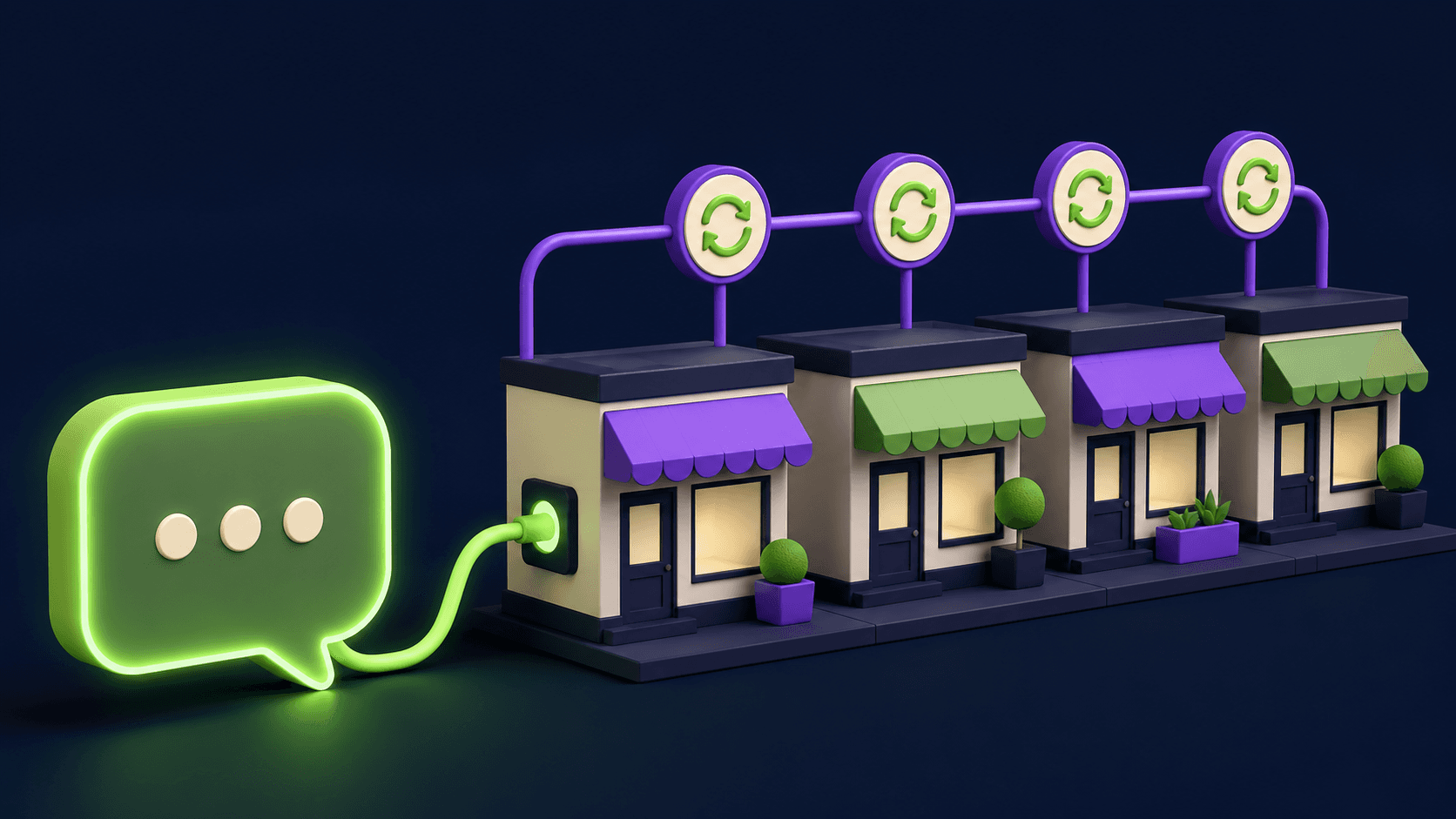
How to Sell AI Chatbots to Local Businesses ($1K-$5K Retainers, 2026)
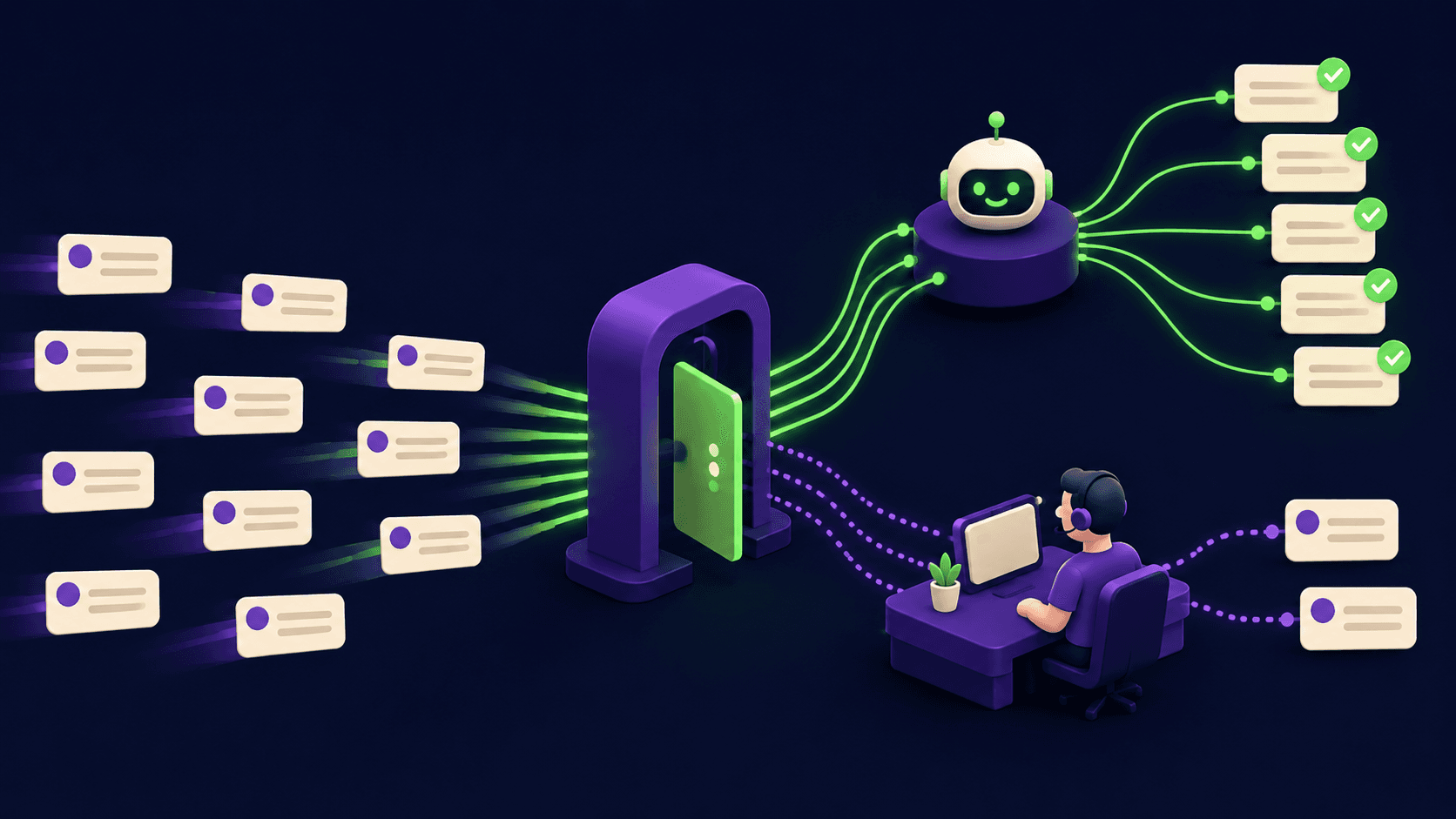
AI Customer Support Automation: Cut Ticket Volume 50% Without Hurting CX
Turn Any AI Agent Into a Superagent: The 12-Integration Stack (2026)
Build an Internal Knowledge Bot (RAG) for Your Company: A No-Nonsense Guide
Voice Agent for Missed Calls: Every Service Business Is Bleeding Leads After Hours (2026)